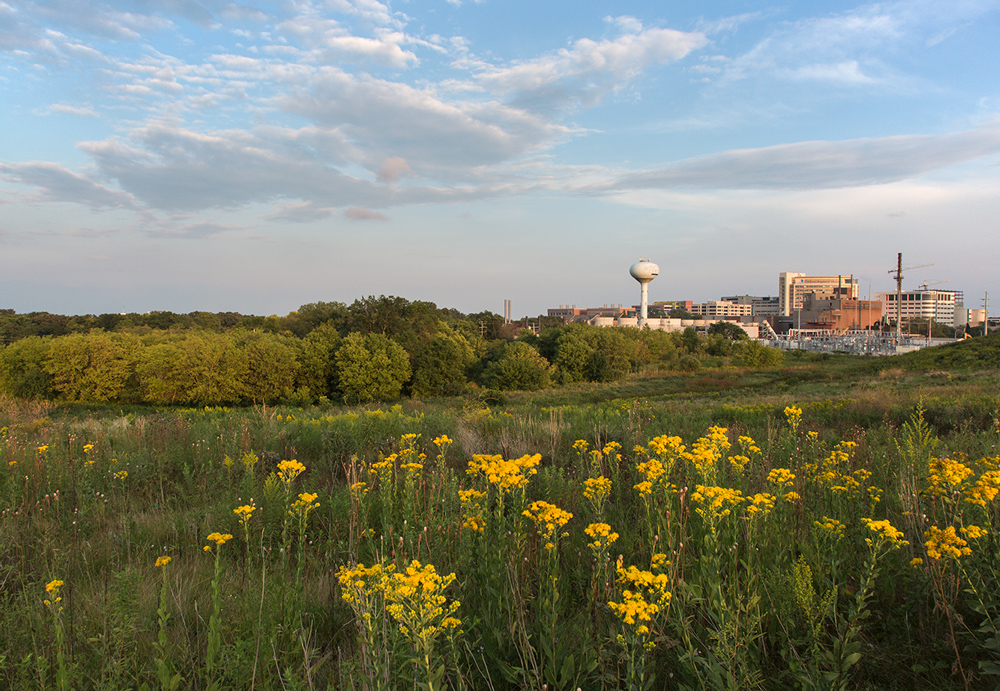
I've had the honor to be featured on The Cultural Landscape Foundation's
website.
I recently went to Houston to attend a TCLF conference called "Leading
with Landscape: The Transformation of Houston." In getting to know a few
of the TCLF members there I shared a little about my work and what's
going on in Milwaukee. They were interested enough to interview me for
their feature, "It Takes One." I'm reprinting it below. If you want to
read the original on their website,
click here.
I am a photographer and writer specializing in urban ecologies and
cultural landscapes. My practice is multidimensional. I tell stories
about particular places. I also examine how we perceive and construct
understandings of nature in the contexts of culture and the built
environment. I have long characterized my work with the paradoxical term
‘Urban Wilderness,’ which symbolizes the complexity of my subject
matter as well as its inherent tensions.
I have degrees in art
education with an emphasis on photography. After more than 30 years of
teaching art, photography, and architecture in secondary- and
higher-educational settings, for the past six years I have pursued my
current practice full time. I also have a long record of environmental
advocacy, having served on the boards of several local non-profit
organizations. I love all of the arts. Currently, I am collaborating
with two choreographers, who are incorporating my imagery into
environmental-themed dance programs. My interest in cultural landscapes
is less a conscious choice than a thoroughly ingrained personal
temperament.
 |
| Menomonee River reconstruction, Milwaukee, WI |
How do you define a cultural landscape?
A
cultural landscape is a place, whether natural, built, or otherwise
designed, that has felt the impact of the human imprint. These places
may be interpreted broadly or very particularly. Today, at the beginning
of what some are calling the Anthropocene Epoch—when human influence
has begun to affect ecology on a planetary scale—an argument can be made
that all landscapes have a cultural aspect. For the purposes of my
artistic practice, I generally choose to examine landscapes where the
human and natural elements are inextricably interconnected: Either there
has been a deliberate effort to modify a place or the features of a
place have motivated humans to adapt to it. To me, cultural landscapes
are places that live in the imagination as well as exist as earthy
terrain: They have stories worth telling.
What is the Urban Wilderness Project?
The
Urban Wilderness Project began as a voyage of discovery as well as a
means to advocate for conservation and restoration of natural habitats
within my local urban and suburban setting. It was also about how to
perceive a watershed while living in a city. I set out to explore and
document the existing conditions within the Menomonee River watershed,
which begins in an exurban area of farms and encroaching suburbs and
runs through the heart of industrial Milwaukee. I spent six years
exploring the physical features of the region and, in particular, its
rivers and riparian parks. The project dealt with issues of land use,
flood management, economic development, recreational opportunities,
pollution, wildlife diversity, and habitat restoration. The outcome was a
book entitled
Urban Wilderness: Exploring a Metropolitan Watershed, published by the Center for American Places at Columbia College Chicago.
Beyond
that specific project, I have used the term ‘Urban Wilderness’ more
generally to symbolize the complexity of my experiences as well as my
creative responses to the tensions and themes symbolized by this idea.
The term, which for me is rich with hope as well as contradiction, has
provided the conceptual underpinning for various bodies of work I have
undertaken in the past 20 years. Although these bodies of work are
loosely unified by the overarching ‘Urban Wilderness’ concept, they vary
in focus and style from documentary realism to abstract formalism.
Throughout, I try to emphasize an experience of the world that is
relational and conditional rather than singular and fixed.
 |
| St. Louis Art Museum, Forest Park, St. Louis |
How do you choose your projects?
In a world
that seems to have become an endless series of ecological catastrophes, I
have made a determined effort to choose projects that tell a more
hopeful story. I admire the efforts of others to raise awareness about a
wide variety of important and pressing environmental concerns; that is
essential. However, I seek places where I see positive transformation
either underway or being planned. In 2014, I served as the inaugural
artist-in-residence
in Milwaukee’s Menomonee Valley, a blighted post-industrial landscape
that is in the midst of economic and environmental revitalization. In
2015, I worked with the Milwaukee Metropolitan Sewerage District to
document its Kinnickinnic River Project, which will eventually remove
several miles of concrete channel and recreate a more naturalized river.
Is your work primarily documentary, or does it strive to do something else?
My
work can be difficult to categorize. Much of what I do is documentary.
My writing can be described as creative non-fiction. My photography
veers between straightforward documentary and the fine art formalism
that was the basis of my artistic education. I am unquestionably an
advocate for many things: the creation and enjoyment of urban parklands,
sustainable development, river revitalization, instilling a love of
nature in children, just and equitable access to nature, etc. My
artistic work often reflects this. Sometimes it is more abstract or
symbolic, like the long-running personal project I call
Synecdoche: the
fragment that represents the whole. Uncharacteristically, but
importantly, that project is not devoted to a specific place. Instead,
it suggests a more universal experience of nature as fragmentary and
that what remains must stand in for what has been lost.
I would
like to think that I observe the world with a childlike sense of wonder.
Occasionally I believe I achieve that valuable goal. But in truth,
there is nearly always a defining conceptual basis to the work I do,
whether symbolic, as in
Synecdoche, or pragmatic, as in the restoration
of a damaged river.
 |
| Curtain Wall, from Synecdoche: the fragment that represents the whole |
What are the advantages and disadvantages of the medium of photography in capturing the essence of a place?
Photography
has nearly universal appeal due to its accessibility and democratic
character. People generally believe what they see and photography can
lend credence to the subject it represents. That can be an asset for a
documentary project. It enables viewers to visualize a place and helps
drive a narrative. However, to turn the old saw on its head, a
photograph often requires a thousand words to put it into context.
Without contextual support, a single image can easily be misunderstood.
To remedy this potential pitfall, I rarely depend upon a single image
and I include written narratives to support my theses.
Alienation
from nature is a frequent theme in your work. Are parks and maintained
natural areas a true remedy to such alienation?
While I
am sensitive to the issue of alienation from nature, I don’t consider
that a starting point. It is my fundamental belief that the human/nature
divide is a false one. If I have a starting point for my practice it is
the idea of the interdependency of all life and the interconnection
between nature and the built environment symbolized by the theme of
'Urban Wilderness.' Having said that, in an increasingly urbanized world
we do have to deal with alienation from traditional experiences of
nature. I believe that urban parks and natural areas are indeed a vital
component in combatting what author Richard Louv refers to as “nature
deficit disorder.” In my experience, the well-documented health and
spiritual benefits of exposure to the natural world accrue to time spent
in urban natural areas as readily as elsewhere.
 |
| Urban Wilderness, from the Urban Wilderness Project |
What message would you like to give our readers that may inspire them to make a difference?
Like
most people who grew up in the 1950s and 1960s, a huge percentage of my
youth was spent outdoors and unsupervised. That kind of upbringing is
so rare today that children fortunate enough (from my perspective) to
have that experience are dubbed “free-range kids.” If children are not
provided with daily opportunities to run free in nature, the
consequences will not only affect their own development, potentially
leading to an increase in physical disabilities, decreased mental acuity
and spiritual poverty, it will also create a society that no longer
values nature enough to protect what remains.
As more and more of
the global population lives in urban settings, sensitively designed
public parks and natural areas become increasingly vital to everyone’s
future. We cannot reset the clock to 1955, but we can create a future
that enables people of all ages to see and touch nature within their own
communities.
 |
| Forest Park, St. Louis, MO |
Stay tuned for a blog post about Houston and my experiences there.