Showing posts with label park. Show all posts

Saturday, August 4, 2018

Phenology at Lakeshore State Park


“During every week from April to September there are, on the average, ten wild plants coming into first bloom. In June as many as a dozen species may burst their buds on a single day. No [one] can heed all of these anniversaries; no [one] can ignore all of them. … Tell me of what plant-birthday a man takes notice, and I shall tell you a good deal about his vocation, his hobbies, his hay fever, and the general level of his ecological education.”

~ Aldo Leopold


Phenology is the study of seasonal changes in the landscape, such as the emergence of plants and the migration of animals. Hearing the term reminds me of A Sand County Almanac, Aldo Leopold’s epic tribute to the natural world. The quote above is from a chapter entitled Prairie Birthday, which strikes me as appropriate for the landscape of Lakeshore State Park. This 22-acre treeless island in Milwaukee Harbor, which was wholly fabricated from debris excavated from Milwaukee’s deep tunnels, has been planted with flowers and grasses native to Wisconsin prairies.


It is a bold initiative, creating a park from scratch and in such an unlikely and precarious location between city and lake. Leopold also wrote this:

“I have read many definitions of what is a conservationist, … but I suspect that the best one is written not with a pen, but with an axe. It is a matter of what a man thinks about while chopping, or while deciding what to chop. A conservationist is one who is humbly aware that with each stroke he is writing his signature on the face of his land.”


I went to Lakeshore State Park for a phenology hike. It was a brilliant morning, not a cloud in the sky. The day promised to be hot, but the cooling effect of Lake Michigan had so far mitigated the relentless sun. A great time to explore the park. In the shade of a grove of river birches at the north entrance, I joined a small gathering, which had been organized by the Southeast Wisconsin Hiking Group of Meetup.com

This story was posted June 22 in The Natural Realm, a new blog on the new A Wealth of Nature website. Please click here to go to continue reading.


Monday, May 28, 2018

Welcome to summer: A lakefront photo essay

Bradford Beach


Milwaukee’s magnificent and unmatchable lakefront—where else do you go on Memorial Day weekend, the traditional start of summer? Especially if the inland temperatures rise above 90° as they did this weekend. Although I tend to avoid crowds, I decided to check it out this year. It was definitely crowded. Lincoln Memorial Drive was a slow crawl from end to end all afternoon. But it was in fact noticeably “cooler near the lake” and a perfect opportunity to observe how much we Milwaukeeans love our lakefront.

Bradford Beach
Bradford Beach, epicenter of the action, was pretty much wall-to-wall people. A surprising number even ventured into the frigid waters of the lake.

Beach volleyball on Bradford Beach
Defending the sand fort
Not wanting to be intrusive, I tend not to train my camera on individuals at the beach. But these young people saw my camera and invited me to take their picture.

Those who desired a less congested beach experience chose McKinley Beach, the semi-circular sandy inlet just north of McKinley Marina.

Kayakers setting off from McKinley Beach


The Veteran’s Park lagoon was hopping with activity, kayaks, paddleboats and paddleboards aplenty.


There was a kite festival going on at Veteran’s Park. I didn’t get out that far but it was easy to see the striking display of kite design and flying ability from Lincoln Memorial Drive. I did find a couple of boys having their own personal kite festival on the wide-open stretch between McKinley and Bradford Beaches.

The Oak Leaf Trail running between the lagoon and Lincoln Memorial Drive saw a steady stream of people walking, biking, rollerblading, and running.

I found this amazing and aromatic panorama of lilac bushes at the corner of E. Lafayette Hill Road, across from Colectivo. 


-->

Monday, April 30, 2018

Seeking wildflowers, finding…


Where is spring? I have been complaining about this elusive season ever since moving to Wisconsin (many years ago now.) But this year has been particularly egregious (see last week’s post of the blizzard!) On Saturday, a scheduled “Spring Wildflower Hike” at Havenwoods State Forest caught my eye and so, with minimal expectation, I went to see if the premise of the theme would be confirmed or not.

No, there were no flowers blooming, I was immediately informed when I arrived. The landscape was as sere and colorless as ever. Nevertheless, since I was there anyway I went for a walk and discovered that there were plenty of people out and about enjoying the park despite the delayed spring.

Nature can rejuvenate the spirit in any season. I have long believed that.

I didn’t wander aimlessly however. I was directed by park staff member Laura Spencer to where a group of Sierra Club members were working. They were digging up clumps of purple loosestrife, an invasive species. I learned that they were not digging them up in order to get rid of them but to take them back to the Nature Center and grow them. This came as a surprise until they explained further: The collected specimens would be grown in an enclosure so that beetles that are used to control the spread of the unwanted plants would reproduce and multiply.

Later the beetles will be released back into the wild in the areas that are infested with purple loosestrife where they will act as a natural biological control.


On my way home, I also stopped at McGovern Park, which is just across Silver Spring Drive from Havenwoods. Having been there in previous springs and delighted in a profusion of wildflowers I thought just maybe I would find a few early ones.


Most of the large woodlot there still looked quite barren, urban wilderness at its bleakest! I did see numerous shoots that I knew would bloom into lovely trout lily blossoms. But it would take another few days at least.

As at Havenwoods, however, the chilly temperature was not keeping everyone away.


Just when I was about ready to give up on wildflowers I found a few. I almost missed them. Spring beauties are tiny and these were not in the woodland where I expected them. They had sprouted up in a grassy spot next to the pond. Vindicated, I went home reassured that real spring would soon arrive. 

You can see last year's spectacle of trout lilies in McGovern Park in my column at Milwaukee Magazine on "Hidden Gems." 

-->

Sunday, April 29, 2018

Greenfield Park run for organ donation


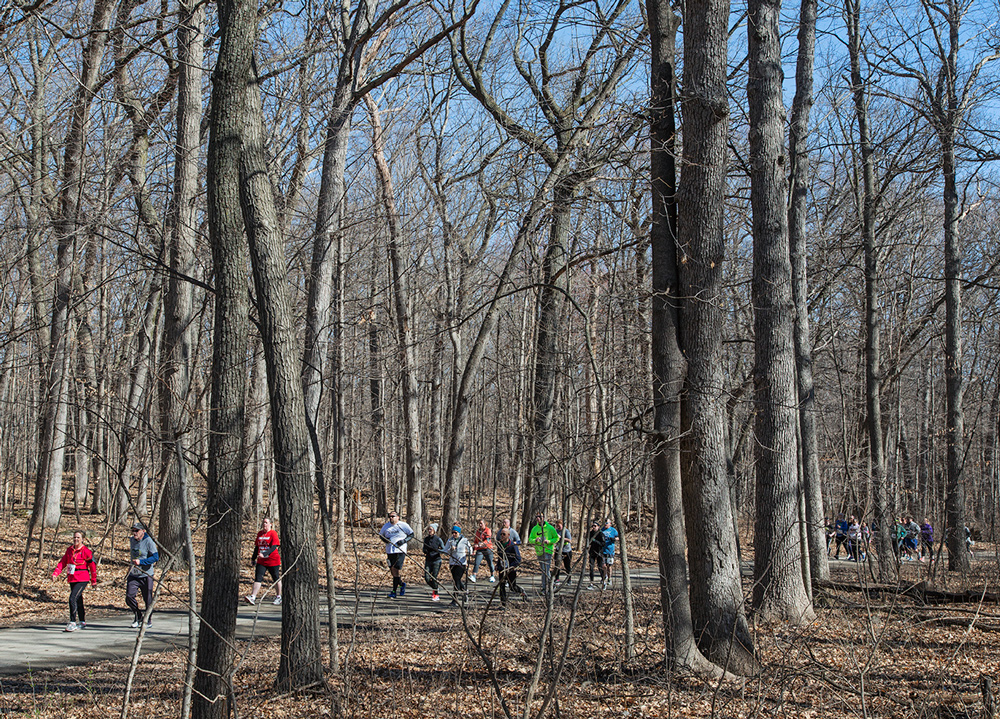
The temperature was still surprisingly chill for late April, but that didn't stop hundreds of people of all ages from turning out for the Cream City 5K, a run/walk to support organ donation. I caught a little of the action.


Wednesday, April 18, 2018

Nashotah Park: A lovely winter day in April!!

The snow was soft, heavy and surprisingly deep the third day after an unseasonable blizzard in April. But the wide trails over hills and through woodlands were well-trodden and tracked by skis by the time I got there. All the same I had the place nearly to myself on a lovely midweek morning. I say lovely because it was—if you forgot for a moment it being April. Sunny and warm for February.

Like every single person I’ve spoken to since it snowed, I felt betrayed by the weather. I didn’t go out to enjoy it for two days. My loss. I’m glad I broke the spell and ventured out to Waukesha County to explore a park new to me. The snow made an already beautiful place even more enchanting.

Nashotah Park is 444 acres nestled within a glacial terrain of rolling hills, woodlands, wetlands, and grasslands. There are two large natural lakes, an oak forest and an oak savanna. There are wide open fields, a cedar glade (I’m told—I didn’t find it), and broad expanses of marsh. 

I did see a solitary hiker on a portion of the 10-kilometer trail system, which has multiple loops. 


Later, around noon, towards the end of my walk, several skiers zipped by, proving the popularity of the park for cross-country skiing, even after an unexpected spring snowfall. Although they hadn’t been groomed this late in the season, the trails are groomed in winter for both classic and skate style cross-country skiing. There is even a separate trail for snowshoeing, according to the Wisconsin Trail Guide website

The Waukesha County Parks website states, “Due to the variety of landscapes, Nashotah Park has an outstanding array of songbirds.” And I saw some, including this pair of male Eastern bluebirds, looking rather cold in the circumstances. I was also surprised to see a couple of great blue herons fly by over the oak canopy—although I suppose it shouldbe warm enough for them by now! The redwing blackbirds were making a ruckus in the snow-dusted cattails, too.

Don’t let the snow get you down! I know we’re all hoping for balmier conditions and spring flowers to bloom. But, hey! It’s lovely out there in the parks.

This is one of an ongoing series of stories about parks that I have undertaken as part of a long-term project called A Wealth of Nature. Anyone familiar with my Urban Wilderness blog will find little to differentiate the new series, for it is entirely consistent with my previous work. However, in an effort to be more comprehensive I am deliberately exploring parks all around Southeast Wisconsin that are new to me.

A website for the project is underway. Meanwhile, I have just created a new Instagram account (@awealthofnature) and Facebook page, which I invite you to like and follow. A Wealth of Nature is a project of Preserve Our Parks, on the board of which I serve.


Saturday, April 14, 2018

Burning Washington Park


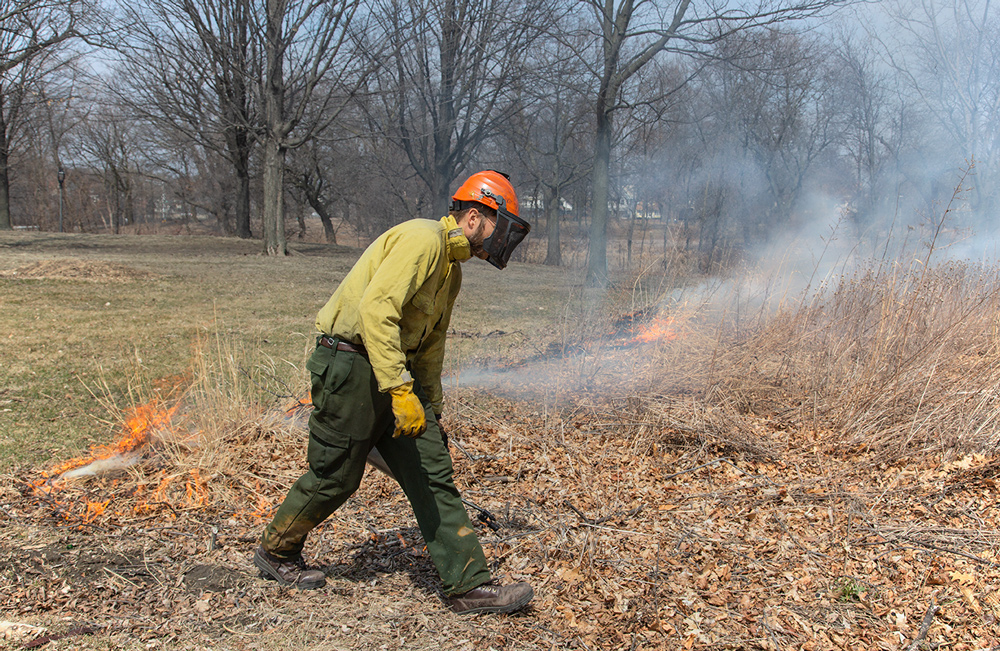
The other day I was delighted to be able to watch as parts of Washington Park went up in flames. No, I’m not a pyromaniac and the fires were carefully controlled by professionals. Although the benefits of using fire as a management tool have become relatively common knowledge it is still unusual to get the chance to see it in action—especially in an urban setting!

Fire was once a natural and common feature of many ecosystems native to the U.S., including woodlands, prairies and even wetlands. Many native plant communities adapted to fire. Some species even require burning to propagate. Prior to European settlement, the indigenous peoples used fire as a management tool in many parts of North America, including Wisconsin.

After over a century of fire suppression policies—think Smokey the Bear—we have come full circle. Once again, fire is being used for ecosystem management. The benefits of controlled or prescribed burning include reducing weeds and invasive species, removing the duff layer of last season’s leaves and other organic matter, returning nutrients to the soil, and invigorating fire adapted native species.

The burning of Washington Park was done by Dare Ecosystem Management under the supervision of the Urban Ecology Center, which has one of its three branches there. Five separate patches of prairie were burned. The ability of the crew to control the burn was quite impressive, especially considering conditions that involved gusty winds that shifted direction. 

Jason Dare of Dare Ecosystem Management uses a drip torch to ignite the perimeter of a patch of prairie. The drip torch, an essential tool for a prescribed burn, literally drips fuel (usually a mixture of gasoline and diesel).

The Washington Park Bandshell, never in danger, provides a backdrop for one of the prescribed burn sites.

Kim Forbeck, Manager of Land Stewardship at the Urban Ecology Center helping to control the blaze with a rake.

The actions of the crew, igniting and tending to the fires, brought to mind the "firemen" in Ray Bradbury's novel, Fahrenheit 451. In contrast to that dystopian tale, however, these actions are totally benign.

One of the burn sites was a narrow strip of prairie grass along the edge of the lagoon. A bystander watches from a park bench.

The burn contributes to the Milwaukee County Parks Department's Shoreline Habitat Restoration Project, which is intended to establish a riparian buffer zone between the land and the water. The native plants in the buffer zone help prevent erosion, provide food and shelter for wildlife, and protect water quality in the lagoon by capturing runoff. The Urban Ecology Center can be seen in the background.

Michaela Molter, Land Steward at the Washington Park branch of the Urban Ecology Center, supervising the burn. 


-->