Last Saturday was National Trails Day, so designated by the
American Hiking Society. The
River Revitalization Foundation (RRF) invited the public to celebrate the day with a hike along the Milwaukee River. Although I had to wonder why a specially designated day was needed, being highly self-motivated when it comes to hiking, the
Milwaukee River Greenway is one of my favorite places for it and I relished the idea of a hike guided by the knowledgeable staff of the RRF.
 |
| false Solomon's seal |
The worth of the designated event became apparent immediately as about 25 people assembled in Gordon Park. A few were seasoned hikers but most were not. Some confided that they’d never hiked along the Milwaukee River before.
We began with sight, across Locust St., of a modest house that belonged to Charles Whitnall, the mastermind of Milwaukee County’s magnificent park system. Vince Bushell, RRF’s Land Steward, provided some historical background about Gordon Park and the river below the bluff, which was invisible due to a screen of mature trees. When first developed, he said, the view was unobstructed. However, cuts to the parks budget have resulted in the elimination of tree trimming operations.
 |
| Anise blossoms |
We strolled down the recently developed, paved Beer Line Trail, so called because it follows the route of the former railroad line that once served Milwaukee’s breweries. Vince identified native flowers that were blooming in places that had been cleared of garlic mustard and other invasive species by RRF volunteers.
Next to one of the two massive UWM dorms that bracket the river at North Ave. we found a troop of boy scouts working on another RRF project: re-routing a mountain bike trail to reduce erosion. Bikers love the riparian trails – and multi-use is the name of the game in this high-profile urban wilderness.
I was delighted to see the creative re-use of buckthorn as a fencing material in the new Wheelhouse Gateway Park at the south end of the Greenway.
By the time we crossed the bridge at Caesar’s Pool and turned back north up the East Bank Trail attrition had reduced our party to seven diehards. Which was too bad, I thought, because the east side trail is unpaved, which I prefer, and because we discovered a number of fascinating projects in the works.
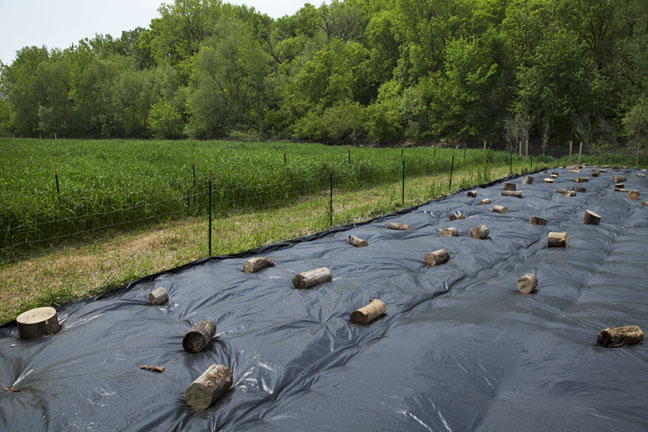
There were square depressions at regular intervals in the tall grass made by slabs of plywood laid down to provide shelter for endangered Butler’s garter snakes. A soccer-field size area had been battened down with black plastic, in an experimental effort by the
Urban Ecology Center to control invasive reed canary grass, which blankets much of the riverside.
The most exciting project has to be imagined from the devastation wrought upon one section of the bluff, which looks like a war zone. A new
40-acre arboretum is being created that will extend up and over the top of the bluff.
With an irony that is emblematic of the urban wilderness I love to write about, the first step in the development of the arboretum, apparently, is to clear-cut all the trees. The new, yet-to-be-planted trees will outlive me – and it fills my heart with joy to know that.
 |
| arboretum under construction |
We finished our loop in Riverside Park, which was originally designed in the 1890’s by
Frederick Law Olmsted and rescued a hundred years later from blight and neglect by the Urban Ecology Center. Much as I admire Olmsted’s classic landscape designs and anticipate the beauty of the new arboretum, I must admit I was heartened to see this magnificent old black willow (below) lying where it had recently toppled. It is a fitting symbol of a new sensitivity to ecological processes and biodiversity. One of the signature differences between a wilderness and most urban parks is what happens to fallen trees. Park managers traditionally have made lumber and carted it away. But where trees are left to decompose they provide habitat for wildlife and their nutrients eventually return to the earth, repeating the cycle of regeneration.

I enjoyed National Trails Day but I won’t be waiting for another official excuse to take my next hike in the urban wilderness. (You knew that!) I hope I see you out there on one of my hikes.
Click here to see more images from the National Trails Day hike and Milwaukee River Greenway.