Showing posts with label installation. Show all posts

Wednesday, April 27, 2016

Nothing Kills A River Like Concrete: Exhibit invitation

Concrete River: 
Memorial and Promise on the Kinnickinnic River

Photography by Eddee Daniel
Collaborative shrine and installation with Melanie Ariens

Alfons Gallery
1501 S. Layton Blvd., Milwaukee, WI

Opening reception: May 22, 1 - 3 pm. 
Artist's remarks: 2 pm.


I hope you'll join me and Melanie for this event. This will not be an ordinary photo exhibit. We plan an installation that will make the gallery feel like the concrete channel.

Exhibit runs through July 31

Gallery hours:
Wed, Thu, Fri, Sun 12 - 3 pm
and by appointment.

For more information: Alfons Gallery website.

Artist's Statement:

Nothing kills a river like concrete. How we treat rivers is suggestive of how we relate to the natural world in general.

Historically, rivers have been central to the growth of human civilization. This was as true at the founding of Milwaukee as it was in the Fertile Crescent between the Tigris and Euphrates. Somehow, though, in the late twentieth century, our modern society lost sight of this vital truth. Milwaukee’s three rivers suffered many abuses, including habitat loss, pollution and dams.

But there’s nothing like pouring concrete into it, essentially transforming it into a drainage ditch, to signal the destruction of a river. Sections of other rivers and creeks in the Milwaukee River watershed were subject to this debasement, but the Kinnickinnic River suffered the most.

In the 1960s the KK, as it is still affectionately known, was straightened and lined with concrete in order to mitigate flooding problems in the surrounding neighborhood. Although at the time this dramatic action did provide some relief from the risk of flooding, it also compromised the river in significant ways. The concrete channel destroyed aquatic and riparian habitats, degraded water quality, and increased the risk of drowning during high water flows. Ironically, today even the original intent of the channelization has become outdated and ineffective for flood control.

Fortunately, for the river and for the community, attitudes have once again shifted. Caring for and revitalizing rivers has captured the public imagination. On the KK the current solution is a project to remove the concrete channel and restore the river to a more natural condition. When I was invited by the Milwaukee Metropolitan Sewerage District to document the project area I jumped at the opportunity. It’s exactly the kind of subject to which I am drawn.
 
The KK River Project, officially known as the Kinnickinnic River Corridor Neighborhood Plan, is a joint endeavor by the MMSD and the Sixteenth Street Community Health Center. The project area is located between 6th Street and 27th Street. (An earlier phase of the project, completed in 2012, removed the concrete channel downstream from 6th St.) The 50-ft. wide concrete channel is to be removed and a 200 ft.-wide rock-lined river channel created. This has necessitated the acquisition and deconstruction of 83 homes in order to accommodate the wider river. Although most of those houses had already been removed, I witnessed and documented the deconstruction of several of the few remaining.

Because the project is in its early phases, most of the images in this exhibit depict the river’s current state as a concrete channel. Furthermore, the installation itself is intended to reinforce the claustrophobic and treacherous conditions that exist. In order to represent the more hopeful future of the KK, I have invited environmental artist Melanie Ariens to collaborate with me on a water shrine to signify the restored vitality that is envisioned in the KK River Project.

See more of my KK River photos in my Flickr album


Monday, August 4, 2014

Milwaukee celebrates water at Bradford Beach


Months in the making, We Are Water: Beachfront Celebration of Milwaukee's Water had its debut last night on Bradford Beach. The celebration took many forms, including recitations of poetry and spoken word, a dance performance, and a solemn spiritual ceremony led by members of a local Indian community.

As dusk grew deeper the beach was set aglow. The culminating activity was a participatory temporary art installation created and led by environmental artist Melanie Ariens. The audience was invited to take a clear plastic filled with water  illuminated with small LED lights and to place them on the beach in a prearranged pattern that represented the Great Lakes. In the gathering darkness the radiance of the lakes were joined by illuminated words provided by members of the Overpass Light Brigade.

The event was organized by Milwaukee Water Commons, a network of individuals and organizations intended "to foster connection, collaboration and broad community leadership on behalf of our waters" that was inspired by plans to make Milwaukee a “fresh water hub." (The Milwaukee Water Commons is the local chapter of a larger initiative called the Great Lakes Commons.)

There were a wide variety of participants of all ages. I didn't hear an official estimate but it looked to me like over a hundred people. When the ceremony ended with everyone gathered around the glowing Great Lakes in the darkness a local pastor gave a blessing and said, "Go in peace." No one moved; no one, it seemed, wanted the moment to end.

Here is my visual meditation on the event.


I was delighted to be in the company of many talented photographers. To see more images from the event go to the Milwaukee Water Commons Facebook page.

Thursday, December 13, 2012

Pedestrian bridge in the Menomonee Valley

I was sorry to have missed the installation yesterday of the first section of the new pedestrian bridge that will connect Mitchell Park (home of the domes) with the Menomonee Valley and the Hank Aaron State Trail. I won't try to repeat what others - who were on the scene yesterday - have written. There are two good stories about it in WUWM news and the Bike Federation's blog.

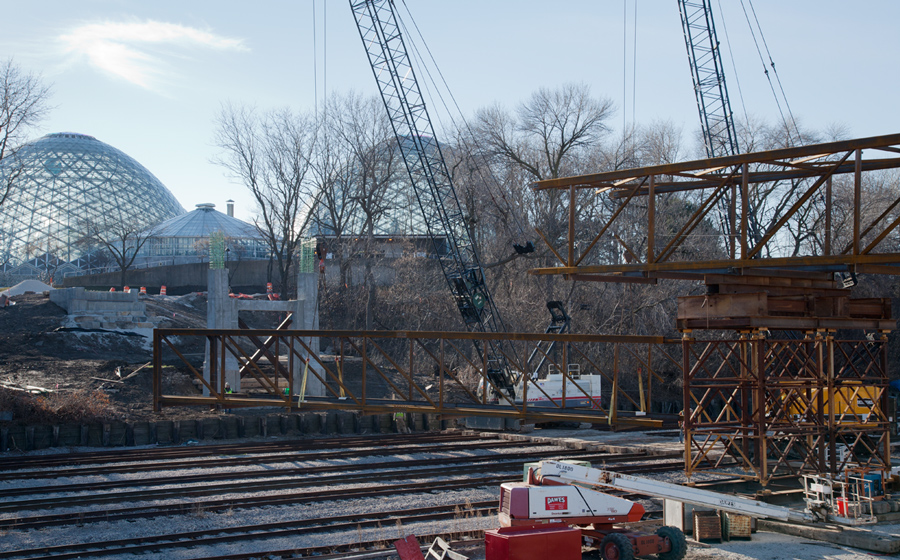
I tried to make up for not being there yesterday by going to see the second section of the three-part bridge installed. Here are a few pictures.


This is the section that was installed yesterday. I liked the idea of having the domes as a backdrop for the scene, so I hiked down to this site from the west end of the new airlines yard park. Initially that seemed like a good idea. Unfortunately, today's work took longer than yesterday's. As the sun rose the light changed and made the scene less dramatic. Still, the action was fascinating enough.


Utilizing two cranes, the crew is positioning the second section of the bridge over the railroad tracks.


Bringing the new section in line to make the connection with the existing section.


The two sections now erected are connected, making a single span over the tracks.


The view through the two joined sections towards Mitchell Park.


The third section, to be installed tomorrow, will complete the connection with Mitchell Park, to the right in this picture. Eventually, when it is fully operational, an extension of the Hank Aaron State Trail will run through the new park and cross over this bridge. From that vantage point will be a panoramic view of the Valley and downtown Milwaukee beyond.


(Full disclosure: I am a member of the Friends of the Hank Aaron State Trail board of directors.)