Showing posts with label channel. Show all posts

Monday, April 3, 2017

Underwood Creek in Wauwatosa is getting a makeover


Restoration is underway and the bulldozers and power shovels in the creek are a welcome sight.


For now you can still see some of the concrete that until recently has lined much of Underwood Creek like a straightjacket for over forty years. The channel, once so smooth and straight I’ve seen skateboarders on it in dry weather, is pocked with holes and severely cracked. Jackhammers have been working their way downstream towards the confluence with the Menomonee River near North Avenue.

View from Hansen Golf Course of the east end of the existing channel.
Upstream the work is further along. West of 102nd Street, where the creek is sandwiched between Fisher Parkway and a very active railroad line, all of the concrete has been removed and trucked away to be recycled. Bulldozers, excavators and earthmovers have reshaped the streambed, reintroducing meandering curves. Tons of rock have been laboriously deposited to stabilize the new channel and prevent erosion.

Work in progress on the newly restored and meandering creek bed.
Oddly enough the incongruous sight of huge power shovels squatting in the streambed is a welcome one—a long overdue remediation of the outdated and discredited policy of “channelizing” rivers and streams. The idea behind pouring concrete into waterways, popular in the Milwaukee region in the 1960s, was to move stormwater quickly through neighborhoods in an attempt to minimize flooding.

Houses along Fisher Parkway back onto the creek channel.
Unfortunately for everyone, the solution became increasingly obsolete as the problem of flooding was exacerbated by unrelenting new development upstream from the channels. Until recent implementation of more effective stormwater management techniques and policies, new development has led to increased stormwater entering—and more frequently breaching—the channels.

Pumps at the upstream end of the project divert creek water into pipes.
Of course, pouring concrete into rivers has always been devastating to the rivers themselves—along with the fish, reptiles, amphibians, birds, and other wildlife that depend on healthy waterways and riparian habitats for their survival. The suffering of plants and animals in degraded river systems is accompanied by a diminished quality of life for the human communities that surround them. And so it has come to this, that we need—and desire—bulldozers in the creek to correct our past mistakes.

View of Underwood Creek channel looking west from 115th Street.
This project, which began in November 2016, will remove 4,400 linear feet of concrete between Mayfair Road and North Avenue. The work is being overseen by the U.S. Army Corps of Engineers in partnership with Milwaukee Metropolitan Sewerage District (MMSD) and could be complete as early as this fall.

Previously restored section of Underwood Creek along Mayfair Road.
The current Underwood Creek project is part of a longer-term effort to address up-to-date stormwater issues, improve water quality, restore and naturalize the creek, increase fish passage and rehabilitate wildlife habitats. Another section of Underwood Creek just upstream from the new project was previously restored. There also are plans to undertake feasibility studies for channel removal on additional sections west and south of Mayfair Road.

MMSD has undertaken similar channel restoration projects on all three of Milwaukee’s major watersheds. These have included completed projects on Lincoln Creek and the Menomonee River as well as its huge on-going Kinnickinnic River Project.

View of the pipe from the underground passage at Hansen Golf Course.
One of the more fascinating aspects of this work, at least for me, is how the normal flow of water in the stream is handled during demolition and restoration. If you peek through the passage beneath the railroad at Hansen Golf Course you may be startled to see a large black pipe suspended in the air across your field of vision. Although rain and snowmelt still fill the channel on occasion, this pipe, which snakes all the way alongside the creek, carries the normal dry weather flow.

The pipe that holds creek flow running along the project site.
The best news I’ve heard yet about this project was from one of the construction workers at the site. “It’s already working,” he told me. “We’ve had to rescue half a dozen salmon that swam up and got stuck in here.”

A restored section of the creek within the project site.

A slightly edited version of this story was published by Milwaukee Magazine on March 27, 2017. 

Wednesday, April 27, 2016

Nothing Kills A River Like Concrete: Exhibit invitation

Concrete River: 
Memorial and Promise on the Kinnickinnic River

Photography by Eddee Daniel
Collaborative shrine and installation with Melanie Ariens

Alfons Gallery
1501 S. Layton Blvd., Milwaukee, WI
Opening reception: May 22, 1 - 3 pm. 
Artist's remarks: 2 pm.


I hope you'll join me and Melanie for this event. This will not be an ordinary photo exhibit. We plan an installation that will make the gallery feel like the concrete channel.

Exhibit runs through July 31

Gallery hours:
Wed, Thu, Fri, Sun 12 - 3 pm
and by appointment.

For more information: Alfons Gallery website.

Artist's Statement:

Nothing kills a river like concrete. How we treat rivers is suggestive of how we relate to the natural world in general.

Historically, rivers have been central to the growth of human civilization. This was as true at the founding of Milwaukee as it was in the Fertile Crescent between the Tigris and Euphrates. Somehow, though, in the late twentieth century, our modern society lost sight of this vital truth. Milwaukee’s three rivers suffered many abuses, including habitat loss, pollution and dams.

But there’s nothing like pouring concrete into it, essentially transforming it into a drainage ditch, to signal the destruction of a river. Sections of other rivers and creeks in the Milwaukee River watershed were subject to this debasement, but the Kinnickinnic River suffered the most.

In the 1960s the KK, as it is still affectionately known, was straightened and lined with concrete in order to mitigate flooding problems in the surrounding neighborhood. Although at the time this dramatic action did provide some relief from the risk of flooding, it also compromised the river in significant ways. The concrete channel destroyed aquatic and riparian habitats, degraded water quality, and increased the risk of drowning during high water flows. Ironically, today even the original intent of the channelization has become outdated and ineffective for flood control.

Fortunately, for the river and for the community, attitudes have once again shifted. Caring for and revitalizing rivers has captured the public imagination. On the KK the current solution is a project to remove the concrete channel and restore the river to a more natural condition. When I was invited by the Milwaukee Metropolitan Sewerage District to document the project area I jumped at the opportunity. It’s exactly the kind of subject to which I am drawn.
 
The KK River Project, officially known as the Kinnickinnic River Corridor Neighborhood Plan, is a joint endeavor by the MMSD and the Sixteenth Street Community Health Center. The project area is located between 6th Street and 27th Street. (An earlier phase of the project, completed in 2012, removed the concrete channel downstream from 6th St.) The 50-ft. wide concrete channel is to be removed and a 200 ft.-wide rock-lined river channel created. This has necessitated the acquisition and deconstruction of 83 homes in order to accommodate the wider river. Although most of those houses had already been removed, I witnessed and documented the deconstruction of several of the few remaining.

Because the project is in its early phases, most of the images in this exhibit depict the river’s current state as a concrete channel. Furthermore, the installation itself is intended to reinforce the claustrophobic and treacherous conditions that exist. In order to represent the more hopeful future of the KK, I have invited environmental artist Melanie Ariens to collaborate with me on a water shrine to signify the restored vitality that is envisioned in the KK River Project.

See more of my KK River photos in my Flickr album


Thursday, May 21, 2015

The Kinnickinnic River and community development: A makeover


--> -->
A south-side community fills a void created by flooding

The truck that was to deliver the flowers was late but no one seemed to mind. Neighbors chatted amiably in Spanish. Staffers from the Sixteenth Street Community Health Centers had set up two tents for an annual spring plant sale. The tents and the people milling around them seemed very small in the broad, vacant city block between the Kinnickinnic River and the row of houses fronting W. Harrison Ave .


Propelled by several impatient children, a few people went across the vestigial dead-end street to the adjacent city block, also largely vacant. Raised beds for community gardens had been built and fenced in a small corner of the block. Volunteers showed the kids how to pull weeds and rake the soil in preparation for planting. Incrementally, the community is reclaiming empty land that stretches four long city blocks alongside the river. 


Not long ago all of those blocks were filled with houses. The reason for their removal is as concrete as the river that bisects the neighborhood. The Kinnickinnic River has literally been lined with concrete since the 1960s. It looks more like a drainage ditch than a river. This was no accident. At the time it was believed that channelization would solve the problem of flooding.


Today the channeled river seems more like a catastrophe than a solution. While the drastic measure did reduce flooding for a time, it also degraded water quality, destroyed all semblance of wildlife habitat within and along the waterway and increased the threat of drowning. Now, ironically, even the original intent of the channel is no longer effective. The past 50 years has seen the floodplain rise dramatically. If nothing were done to alleviate the new circumstances, a major storm could inundate as many as 350 homes in the neighborhood.


Which is why the houses have been purchased and, one by one, dismantled. The removal of the houses is just part of a major flood management initiative led by the Milwaukee Metropolitan Sewerage District. Sixteenth Street Community Health Centers and partners have been implementing quality of life improvements from a companion plan called the Kinnickinnic River Corridor Neighborhood Plan. The most dramatic and eagerly awaited changes—the removal of the concrete channel and rehabilitation of a naturalized river—will come later. The most trying task is currently underway: asking families to move and tearing down houses.


Over 60 homes have already come down. Hence the vacant land. Last week I was able to observe the workers as they dismantled another. Although more expensive than traditional demolition, the MMSD has opted for a process called deconstruction. Forgoing the bulldozer for manual labor, everything salvageable or recyclable is painstakingly removed from the house. Usable appliances and fixtures are set aside. Plaster walls are pummeled until they reveal the lathe and studs beneath, which become recycled wood.


House demolition usually generates a huge amount of indiscriminately crushed debris that is hauled off to landfills. The more laborious deconstruction process enables materials to be separated for recycling and reduces what ends up in a landfill.


The process began here years ago. Numerous neighborhood meetings were conducted to explain the project and build community support. Initially, there was concern and hesitation about the acquisition and removal of homes. However, now that the work has progressed as far as it has the mood has shifted. According to Iris Gonzalez at the Sixteenth Street Community Health Centers, many people have become not just supportive but excited about the project. There is even some impatience at the pace of the work.


As more houses come down and more land stands vacant, people have begun to imagine its eventual transformation. They anticipate the planned new parkland and an actual river running through the neighborhood. The project is supposed to be completed in 2022.


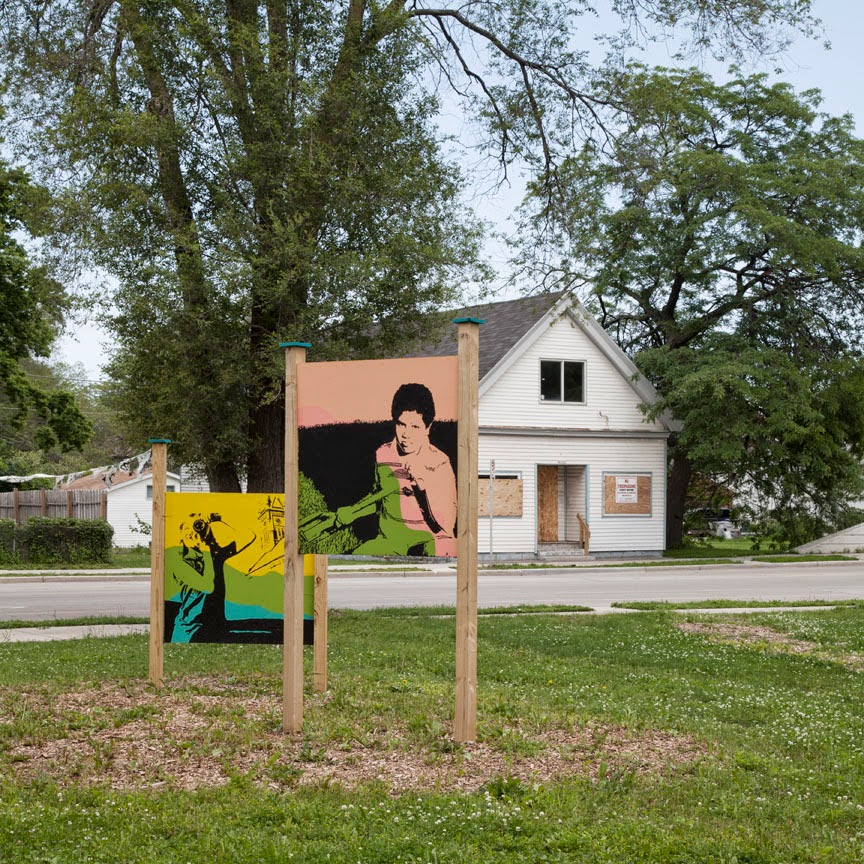
Meanwhile, the neighborhood has begun to fill the void. In addition to the community gardens some temporary public art has been erected on another corner of cleared land.


I wander back to the tents. The truck has arrived. A crowd gathers to help unload the plants and get them ready for sale. People are lined up to make their selections. The Sixteenth Street Community Health Centers staff is joined by young volunteers who help carry potted flowers back to cars and nearby homes. The annual event is called “Bloom and Groom.” It is subsidized by the collaborative efforts of Urban Anthropology and Sixteenth Street CHC along with grants from the Greater Milwaukee Foundation and the Neighborhood Improvement Development Corporation. The organizers hope that investing in flowers and improving the appearance of the neighborhood will be a visible demonstration of pride and commitment to the future.


The flowers are beautiful in the bright morning sun and the smiles on everyone’s faces, it seems to me, are a clear sign of that hope and pride.

To see more photos from the KK River and the neighborhood go to my flickr album.

If you missed my recent post about the Earth Day clean up of the KK River, click here.

Full disclosure: I am connected to the two lead organizations responsible for the KK River Flood Management Project and Neighborhood Plan. I am working with the MMSD to document the current phase of the KK River Project and until recently my daughter was employed by the Sixteenth Street Community Health Centers. But if you check out my flickr photos it will be clear that I've been interested in this work long before any of that!

Tuesday, April 21, 2015

Earth Day: A community cleans up the KK

-->
Which do you think is the more powerful metaphor?

A) While picking up trash along the concrete-lined Kinnickinnic River I found a framed print of exotic waterfowl discarded in riverside bushes.


B) Two hundred community members turned out last Saturday to pick up trash along a stretch of their river that has been little more than a drainage ditch for over 40 years.


The irony of the sentimental wildlife print discarded near the degraded river is good for a chuckle, but I choose B as the more important metaphor. The KK River Neighbors Association and the 16th St. Community Health Center turned people out in force to join in the annual Earth Day cleanup sponsored by Milwaukee Riverkeeper. The symbolism is clear: the community cares about its environment and is hopeful about the future of its maligned waterway.

The reason for that hope is as concrete as the river channel: The Milwaukee Metropolitan Sewerage District has begun a multi-year project to remove said concrete channel and restore a more natural flow to the Kinnickinnic River. Judging from the enthusiastic comments I heard repeatedly on Saturday, the community is thrilled at the prospect.


Acres of cleared land between Harrison Street (background) and the KK River (behind me) are evidence of progress on MMSD’s rehabilitation project. After houses in the flood-prone area are purchased and demolished the concrete channel will be removed and the river reconfigured within a landscaped park.

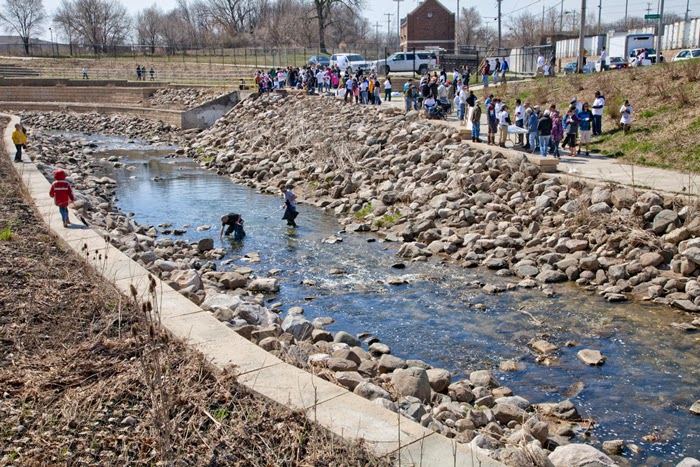
After two hours of picking up trash near the river and throughout the neighborhood on either side everyone gathered at another concrete symbol of the river’s revitalization. The concrete channel, which until recently extended east to the I-94 overpass, now ends just shy of the 6th St. Bridge. The first phase of the MMSD project was completed in 2011. In addition to removing the concrete channel a newly dedicated KK River Trail was created alongside the rehabilitated stream.


A huge crowd that included cleanup teams from several sites on the KK gathered along the 6th St segment of the KK River Trail for a “Trash Bash” organized by the event sponsors. Free pizza and burritos were available to all. There were family-friendly interactive displays related to water and the river. A team of scientists from UW—Madison were on hand to help folks learn more about their river.

The UW team provided hip waders for the public to borrow so that they could physically immerse themselves in the river. “Having kids and adults connect with the river in that way is huge,” said Iris Gonzalez, one of the organizers from the 16th St. Community Health Center. “Most of them were very hesitant to try but, after watching others (in some cases their own children), they were convinced. It is experiences like feeling the pressure of the water against your body, or the waders suck onto your legs when you step in and seeing fish and fish eggs up close that foment a spirit of stewardship.”


Local children spray water onto a watershed model that illustrates how water flows are affected by varying slopes, soils and vegetation conditions.

The success of the “Trash Bash” in bringing the community down to the river, to activate the new trail and to celebrate the transformation that is underway was a major achievement. Many in the neighborhood had not ventured there before, according to Gonzalez. However, she told me proudly, “I know they will be back!”

The event culminated in a spectacular demonstration of hydraulic flows and river dynamics. Peter Levi, the UW limnologist heading the team of scientists, poured red dye into the river just east of the 6th St. Bridge. At first the dye turned the water bright scarlet and then expanded to fill the width of the river. The dye gradually dissipated as it swirled downstream, around rocks and settled into pools. It was a crowd pleaser and a lovely end to the Earth Day river cleanup.


A brief series of photos from the day follows.


To see even more photos from this event go to my flickr album.

Full disclosure: I am substantially connected to many of the organizations responsible for the cleanup and KK River Project because the work they are doing is dear to my soul. As a former board member of Milwaukee Riverkeeper I have participated in most (if not all—I don’t quite recall) of their 20 annual river cleanups. I am working with the MMSD to document the current phase of the KK River Project. On top of that until recently my daughter, Chelsea, was employed by the 16th St. Community Health Center. And Chelsea brought my only (so far) granddaughter to help out with the cleanup. She’s only 3 years old, so she mostly played on the Cleveland Park playground and ate pizza at the Trash Bash. Hey, I said “full disclosure!” Oh, and Chelsea took my picture with this funny-looking fish.


More photos on flickr.

Friday, February 13, 2015

Last stretch of concrete to be removed from Menomonee River


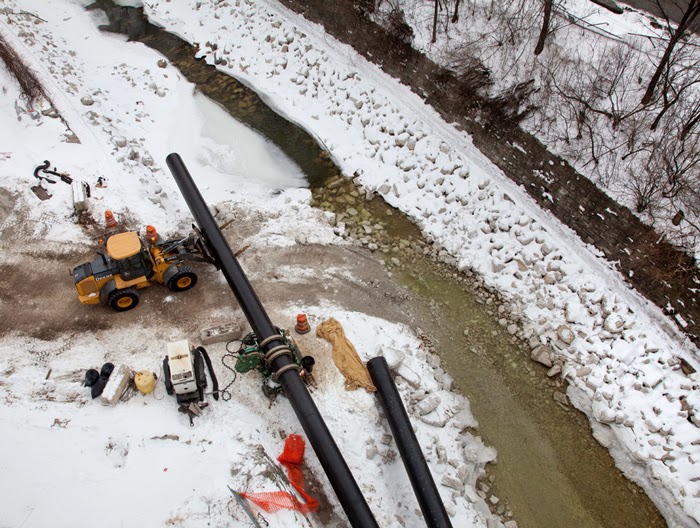
Preparation is underway for the removal of the last section of concrete channel from the Menomonee River. The project area runs from the Wisconsin Avenue viaduct through Piggsville to Miller Park. The current work being done is to install two diversion pipes along the sides of the existing channel. These pipes are intended to carry the flow of water during demolition and reconstruction.


New sections of pipe are attached at the upstream end of the line (above). After being welded together, the entire pipe must be dragged downstream by this tractor (below), which can pull the 200,000 lb. load.


At the downstream end of the line, just past the I-94 overpass, ice is being removed from the channel.


When completed the concrete channel will be replaced with rock, as was done with the previous stretch, which was done in 2013-2014 (below). To see a previous photo essay of that project, click here.


The purpose of the channel reconstruction is to remove the outdated, ineffective flood control channel, return the river to a more natural state and enable fish to migrate freely. To read more about this project, go to the MMSD website.