Showing posts with label urban forestry. Show all posts

Sunday, May 25, 2014

Photo Essay: Big Trees (and more) in Milwaukee County Parks

-->
In Memoriam: Richard Barloga, 1941-2014

Not long ago I traveled to California where I visited a couple of Redwood groves. They are deservedly popular (read my earlier post.) But did you know that we have very tall trees right here in Milwaukee County? You can see them without traveling thousands of miles; some of them are but a very short walk in the park.
Eastern cottonwood (Seminary Woods)
 Dan Buckler, Outings Chair of the local Sierra Club group (Great Waters Group), gave a tour Saturday of big trees in several Milwaukee County Parks. He made it clear to the group of about 20 of us that he doesn’t define “big” casually. The Wisconsin DNR keeps a database of exceptionally large trees all over the state. These include “Champion Trees,” which are the single largest example of any particular species that exists in the state, one of which we saw Saturday here in Milwaukee County.

Most of the trees we visited, while not officially Champions, are extremely large in one or more of the dimensions used as calibrations. These may be the diameter and/or circumference of the trunk, the height of the tree, or the width of the crown. In any case they are impressive.

Our tour took us to three County Parks and Seminary Woods, a privately owned but publicly accessible reserve.


We began our journey in Kern Park, along the Milwaukee River where we saw this enormous London planetree (Platanus x acerifolia). (Dan provided the identifications in English and Latin!)


Kern Park is home to several large, beautiful planetrees.


Among other species, some of them native to Wisconsin.


I wandered away from the group and discovered the path leading down to the riverside. I left it for another day, but it was well enough used by others.


Our second stop was South Shore Park, where this venerable European copper beech (Fagus sylvatica) stands right next to the parking lot. I would have been satisfied with its gnarly magnificence. But there was a larger one not far away.


Right on the edge of the park, as you can see. In fact, this one is so close to the road and--significantly--overhead power lines that, as Dan explained, the utility maintenance crews have to been especially careful when pruning, not to damage the tree.


This one is in fact a Champion Tree--the largest European copper beech in Wisconsin--and it has a plaque as proof.


It's coppery red leaves were just budding out.

Someone had the foresight--and curiosity--to look down as well as up. Fortunately. At our feet we found several baby copper beeches.


There were certainly other lovely species in this park too, resplendently decked out in with new foliage.


At Whitnall Park we found this burr oak (Quercus macrocarpa) right next to Whitnall Park drive and not far from the golf course. 


Dan explained that even these great trees must occasionally be pruned. Sometimes this is done to protect power lines, as at South Shore Park. Sometimes it is to protect the tree itself. 


Seminary Woods is more like a wild forest than an urban park. Unlike the other places on our tour, there was no lawn separating the trees. Instead what we discovered was a wealth of wildflowers. The trilliums were especially spectacular. 
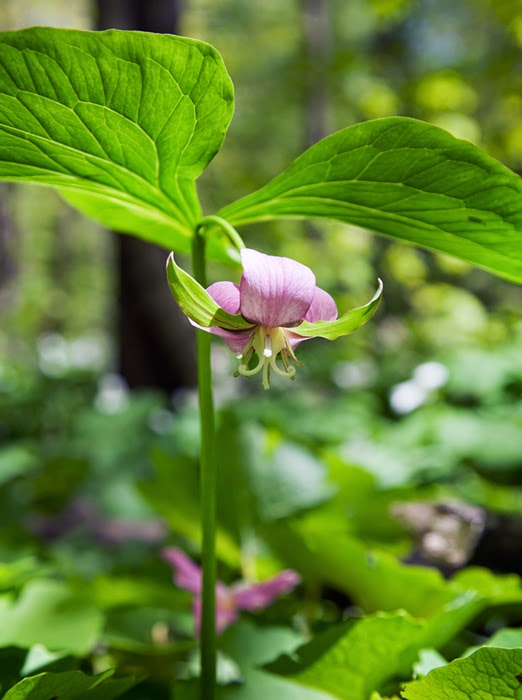

In fact I found a variety of trillium, called "nodding" for obvious reasons, that I'd never seen before.


We were here to see two especially tall trees. This American beech (Fagus grandifolia) was far too tall to see at one glance--or get in a single picture!


Dan most likely told the group how tall this was, but I had wandered off again and missed it.


That's how I happened upon this lovely patch of skunk cabbage in the hollow.

When I found my way back to the group again they were standing around the most gigantic Eastern cottonwood (Populus deltoids) I'd ever laid eyes on. Again I missed the actual height.


There is a well maintained cemetery in the middle of Seminary Woods. But that's another story.


I want to thank Dan Buckler, our intrepid tour leader. Dan is a forester who just moved to the Milwaukee area to work with the DNR in the Parks and Recreation Bureau.

In Dan’s own words, “I have been in love with the woods my entire life, and I have studied trees formally in school and informally in my spare time. Like many people I believe in the sentiment that "The groves were God's first temples" (that is, a forest can be a place of awe and reverence). That is what usually draws people into the woods in the first place. But then you start asking questions about how why a tree is shaped this way or that, how old can this tree become, what's the evolutionary advantage of this bark, and suddenly you discover the whole scientific world around you. All of these things make me want to keep going into the woods, learning more, and hopefully be able to share that knowledge with others.”


In closing, I want to dedicate this post to Richard Barloga, who was an indefatigable advocate for preservation in the Milwaukee region and beyond. I attended a memorial service for Richard after the tour. I was late getting there but I figured Richard would not only understand but applaud my appreciation for the places, the trees and the wildflowers I visited in his honor. In particular, I thought of Richard as I knelt before the Jack-in-the-Pulpit to photograph it. It seemed a fitting prayer.


I went back to Seminary Woods on Sunday because there hadn’t been time during our Saturday tour to check up on the owls I knew to be nesting there. I saw the mother owl perched high in a cottonwood overlooking the dead tree that held the nest. She flew off as I approached the dead tree, no doubt an attempt to draw me away from it.


I did have to back away from the tree to be able to see the two owlets peering intently at me from their perch inside the broken top of it, about 25-30 feet above the ground. New life in the forest. Richard would approve.

(To read Richard's obituary click here.)

Thursday, September 29, 2011

Exploring an Urban Forest


A new forestry center could add to the critical mass that has the potential to make the Milwaukee County Grounds one of Southeastern Wisconsin’s premier parklands.


High overhead branches toss wildly about, auguring another storm. The forest is still damp from yesterday’s deluge and dark from thickly overcast skies. But despite the moaning and twisting in the canopy, down here at ground level it is calm. The foliage rustles softly all around. The forest feels protective. 


I make my way through a particularly dense patch of undergrowth, most of which is invasive buckthorn. I understand the need for management.


Farther along the trail the forest opens up, clear of most undergrowth. Last year’s leaves carpet the earth. A few bright yellow and red maple leaves, which turn early, accent the brown and contrast with the still intensely green woodland. 


I reach the now dry depression that in spring was one of the few remaining vernal ponds, a vital habitat for many species. I understand the need for preservation.


Trails interlace the forest, winding among the giant hardwoods and brushy thickets. People come here to calm their minds, uplift their spirits, experience the mystery of nature. I step off the trail into wilder woodland and come upon a clearing where someone – some group by the size of it – has built a makeshift shelter. My mental tally of youthful shelters, tree houses, and forts now numbers four. I am reminded of my own childhood. How many more hideouts are hidden in the recesses of our local forest?


I understand the need for nearby nature that stimulates the imagination of people young and old.
Theodore Roosevelt, president and tireless advocate for nature, said, “A people without children would face a hopeless future; a country without trees is almost as helpless.” A new forestry education center, planned for this woodland on the Milwaukee County Grounds, would bring together children and trees. What a great concept!

The Forest Exploration Center’s plans for facilities and programming are ambitious. Eventually, a 60,000 sq. ft. indoor structure will be the heart of an educational complex that may include outdoor classrooms, a canopy walk/tower, and a working sawmill. 


The “science-based” programming will emphasize cultural and economic aspects of forest management, according to board member Tom Gaertner, who owns a tree farm in Door County.


I welcome sustainable forest management. Clearing the buckthorn and other invasive species, thinning the box elders and other weedy trees would not only improve the aesthetic experience of the woodland, but also would increase biodiversity. At the same time, the perennial explorer in me hopes that enough of its wildness remains that the alluring mystery isn’t lost.


As a long-time educator – and advocate for urban wilderness – the idea of bringing school groups as well as the general public into contact with our remarkable forest is very appealing. I never tire of applauding the Urban Ecology Center, which has created a nationally recognized model for environmental education and stewardship. The new center’s board rightly identifies the need for educational opportunities that connect children with nature. They would be well advised to develop a cooperative relationship with the Urban Ecology Center.


Cooperation also should be the watchword amongst the several entities with similar interests that fortuitously share the County Grounds. With effective and visionary planning and collaboration the new Forest Exploration Center, along with the new County Park, the Monarch Trail at Innovation Park, and MMSD’s flood detention basins together can fulfill the enormous potential to make the Milwaukee County Grounds unparalleled urban parkland.

After all, it’s important not to lose sight of the forest for the trees!


A hundred years after Teddy Roosevelt, another president, George Bush, said this:
“Trees can reduce the heat of a summer's day, quiet a highway's noise, feed the hungry, provide shelter from the wind and warmth in the winter. …Forests are the sanctuaries not only of wildlife, but also of the human spirit. And every tree is a compact between generations.”
Click here for an aerial view of the forest and surroundings. 


Click here for an aerial view of the forest and surroundings.
 

Thursday, March 3, 2011

Urban forestry vs. Urban Wilderness?

A pair of articles in Helium, an online compendium for publishers and writers, touts the benefits of urban forestry. Urban forestry is defined basically as planting, preserving, and maintaining trees in urban areas. The two authors' main point is that the presence of trees in urban environments improve the quality of life and city dwellers' mental health. Who would argue with that? Not I.

Claims also are made that well maintained trees in urban neighborhoods help to alleviate crime. Trees make neighborhoods more attractive, leading people to spend more time outdoors, which ought to deter criminal activity, according to this theory. That may be true; I wouldn't know.

Managed plantings provided by Rivercrest Condominiums
next to the Milwaukee River in Milwaukee, WI
However, I do have a concern about a reference to urban wilderness made in one of the articles. Sylvia Farley, who is from the United Kingdom, says "Urban wilderness is the incursion of unmanaged green areas into the city. Urban Forestry is carefully planned and integrated management of all publicly accessible trees within a given urban area." As anyone who has been following my blog and other writings will appreciate, I consider the phrase "urban wilderness" to be charged with many different, sometimes contradictory meanings. In itself, "urban wilderness" represents a paradox if not an oxymoron. That the term has gained currency throughout the US, if not the UK, in recent years is testimony to its conceptual power. (A google search of "urban wilderness" will turn up too many results to pursue.)

Urban wilderness is a largely symbolic idea that embodies the principle of harmony with nature for people who live in cities. However, I believe that there's a real, essentially physical component to urban wilderness that is as much about providing habitat for wildlife as it is about the recreational or psychological needs of people. An urban wilderness is a wildlife habitat in a city - or suburb. In other words, it's about more than trees: it's about urban ecology.

An urban wilderness in the Menomonee River Parkway in Wauwatosa, WI.
Due to budgetary restraints in Milwaukee County, it is largely unmanaged.
I'm not knocking urban forestry, as promoted in the Helium articles. I'm all for it. But let's not knock urban wilderness either. I chose the two images that accompany this post deliberately for their contrast. One shows managed plantings at a condo complex, no doubt intended as aesthetic improvements for the residents' quality of life. (Probably not what the authors had in mind as urban forestry, but where is the line drawn?) The other is from the Milwaukee County Park system, which includes 10,000 acres of natural areas. It is one of the places I like to go for my own peace of mind.