Showing posts with label milwaukee county parks. Show all posts

Monday, April 10, 2017

A beautiful, brief spring weekend in Wisconsin

Little Menomonee River Parkway

As I post this photo essay the weather has suddenly turned cold and nasty again. Yes, it's still that kind of spring. But you would be forgiven if over the past weekend you thought we'd skip that and go straight to being nice and warm, sun shining and flowers blooming. Because it was, if only briefly.

Little Menomonee River Parkway
My weekend began at dawn (top) in one of my favorite places along the Menomonee River Parkway, near where it ends at the county line. I went looking for migrating geese, which I've found there in abundance in the past. No luck with that this time. But the dawn itself was worth the time.

Little Menomonee River Parkway
Later, I explored the Donges Bay Gorge Natural Area, which was new to me. I never would have found it on my own, either. I came across it on the Ozaukee Washington Land Trust website and I stopped to check it out on my way to an event at the Lynden Sculpture Garden, which is nearby.

Donges Bay Gorge Natural Area

It's not only hard to find without a map or directions, but when I got there I discovered that they don't expect a crowd. The dirt parking lot has room for only three cars.

Donges Bay Gorge Natural Area
 It also isn't a very large natural area. The trail, called "Wendy's Trail" for reasons that are not revealed on the signage, runs along the rim of the "gorge," which is similar to many of the other ravines that can be found all along the shores of Lake Michigan. Wendy didn't like to hike down into the ravine, apparently, for the trail doesn't go there. After a short walk I reached the bluff overlooking the lake, where Wendy sits down on one of two benches provided for her.

Donges Bay Gorge Natural Area
It was lovely, though. The scent of pine and solitude, along with surprisingly warm sunshine, were reason enough to go there.

On Sunday, I returned to another of my favorite urban wilderness haunts, the Milwaukee River Greenway.

West Bank Trail, Milwaukee River Greenway
 The scenery is still largely devoid of leaves...

West Bank Trail, Milwaukee River Greenway


 ...but they're on the way.

Bank stabilization, Pleasant Valley Park, Milwaukee River Greenway

The Milwaukee River Greenway is a series of mostly named public parks, although some of the names are unfamiliar to all but the initiated. Take this one, Pleasant Valley Park, aka Blatz Park. Its "valley" is another one of those ravines, only this one leads to the river instead of the lake. When the river was in fact a lake, backed up behind the North Avenue dam, this park was an exotic resort. Steam boats pulled up at a dock here and crowds of passengers poured out to partake of its beer garden. You would never imagine this if you go there now. (Read all about "the forgotten Milwaukee River park" in Milwaukee Notebook.)

Causeway to nowhere, Pleasant Valley Park, Milwaukee River Greenway

Until recently, when the steep slope of one side of the "valley" was denuded of trees in order to save it, the most notable and quirkiest thing about this ravine was the pedestrian causeway that crosses it for no discernible reason. Now, the view from the causeway of the bank stabilization effort draws one's attention, as would a person who had shaved one half of his head and left the other in a tangled mat of unkempt hair. "But it will grow back" is probably the polite thing to say.

West Bank Trail, Milwaukee River Greenway
What I can't figure out here is whether or not the beaver was in on the joke or if the joke was on the beaver. I'm trying to imagine the moment when the beaver had just gotten far enough through the trunk that the remaining fibers started to tear apart. How far, I wonder, does a beaver back off at that point? It couldn't possibly have guessed that, instead of crashing straight down over the edge of the river, as it normally would, the whole tree would suddenly catch in the crook of another tree and spring up like a mouse trap. I had to ask myself, did the beaver lose a tooth? Or its head!

West Bank Trail, Milwaukee River Greenway
I hope you enjoyed your weekend as much as I did. And may spring return soon!

To see more photos of the Milwaukee River Greenway, go to my Flickr album.


Monday, April 3, 2017

Underwood Creek in Wauwatosa is getting a makeover


Restoration is underway and the bulldozers and power shovels in the creek are a welcome sight.


For now you can still see some of the concrete that until recently has lined much of Underwood Creek like a straightjacket for over forty years. The channel, once so smooth and straight I’ve seen skateboarders on it in dry weather, is pocked with holes and severely cracked. Jackhammers have been working their way downstream towards the confluence with the Menomonee River near North Avenue.

View from Hansen Golf Course of the east end of the existing channel.
Upstream the work is further along. West of 102nd Street, where the creek is sandwiched between Fisher Parkway and a very active railroad line, all of the concrete has been removed and trucked away to be recycled. Bulldozers, excavators and earthmovers have reshaped the streambed, reintroducing meandering curves. Tons of rock have been laboriously deposited to stabilize the new channel and prevent erosion.

Work in progress on the newly restored and meandering creek bed.
Oddly enough the incongruous sight of huge power shovels squatting in the streambed is a welcome one—a long overdue remediation of the outdated and discredited policy of “channelizing” rivers and streams. The idea behind pouring concrete into waterways, popular in the Milwaukee region in the 1960s, was to move stormwater quickly through neighborhoods in an attempt to minimize flooding.

Houses along Fisher Parkway back onto the creek channel.
Unfortunately for everyone, the solution became increasingly obsolete as the problem of flooding was exacerbated by unrelenting new development upstream from the channels. Until recent implementation of more effective stormwater management techniques and policies, new development has led to increased stormwater entering—and more frequently breaching—the channels.

Pumps at the upstream end of the project divert creek water into pipes.
Of course, pouring concrete into rivers has always been devastating to the rivers themselves—along with the fish, reptiles, amphibians, birds, and other wildlife that depend on healthy waterways and riparian habitats for their survival. The suffering of plants and animals in degraded river systems is accompanied by a diminished quality of life for the human communities that surround them. And so it has come to this, that we need—and desire—bulldozers in the creek to correct our past mistakes.

View of Underwood Creek channel looking west from 115th Street.
This project, which began in November 2016, will remove 4,400 linear feet of concrete between Mayfair Road and North Avenue. The work is being overseen by the U.S. Army Corps of Engineers in partnership with Milwaukee Metropolitan Sewerage District (MMSD) and could be complete as early as this fall.

Previously restored section of Underwood Creek along Mayfair Road.
The current Underwood Creek project is part of a longer-term effort to address up-to-date stormwater issues, improve water quality, restore and naturalize the creek, increase fish passage and rehabilitate wildlife habitats. Another section of Underwood Creek just upstream from the new project was previously restored. There also are plans to undertake feasibility studies for channel removal on additional sections west and south of Mayfair Road.

MMSD has undertaken similar channel restoration projects on all three of Milwaukee’s major watersheds. These have included completed projects on Lincoln Creek and the Menomonee River as well as its huge on-going Kinnickinnic River Project.

View of the pipe from the underground passage at Hansen Golf Course.
One of the more fascinating aspects of this work, at least for me, is how the normal flow of water in the stream is handled during demolition and restoration. If you peek through the passage beneath the railroad at Hansen Golf Course you may be startled to see a large black pipe suspended in the air across your field of vision. Although rain and snowmelt still fill the channel on occasion, this pipe, which snakes all the way alongside the creek, carries the normal dry weather flow.

The pipe that holds creek flow running along the project site.
The best news I’ve heard yet about this project was from one of the construction workers at the site. “It’s already working,” he told me. “We’ve had to rescue half a dozen salmon that swam up and got stuck in here.”

A restored section of the creek within the project site.

A slightly edited version of this story was published by Milwaukee Magazine on March 27, 2017. 

Tuesday, November 8, 2016

Humans & animals: Lake Park and Schlitz Audubon


Part 1: Lake Park

I was walking slowly along the bluff top path in Lake Park the other day, carrying my camera and tripod, trying to catch the colors of autumn as I had been doing in parks all over the region. A young man sidled up to me so that I would pay him attention. When I did he asked me softly, Do you mind if I give you my philosophy about cameras? *

Inwardly, I had to smile. After all, I had taught photography to young men like him for 30 years and not once did any of them confront me with such a bold, straightforward request. His earnest expression piqued my curiosity. Please do, I said.

He told me, The landscape isn’t the best subject for photographs. Because it is always there. Noting my quizzical expression he quickly added, People are the better subject. They are always different, moment to moment. Intrigued, I accepted his statement as a challenge, although it was clear he didn’t mean it that way. For when I said, Alright, how would you like to be my subject? he was startled.

He recovered quickly though. Where do you want me? he asked. I put the question back to him and, turning towards the woods, said, Not near the lake. That’s too powerful a force. I admired his perception: Don’t want to compete with Lake Michigan, I guess. He agreed.

I introduced myself and he told me his name: Raekwon. As he was now my subject, I sized up his gold hoodie and eagerly steered him towards a ravine where I had spied some maple trees with the exact same shade of leaves. Usually I have to settle for whoever comes by and often wait in vain for someone to enter a composition wearing the right clothing to match or contrast with the surroundings. And here was Raekwon, not only wearing the perfect color but ready to pose for me. In fact, by posing the question he had precipitated the photo session.


As we walked towards the ravine I asked how often he came to Lake Park. This is my first time, he said. I was thunderstruck. Well you picked a great day for it, I offered. It was one in the string of unseasonably warm days we’ve had this month. Isn’t it beautiful? I added. Maybe it was my imagination, but he seemed to look around as if seeing the trees and the leaves and the blue sky for the first time. Yes, it is. I think I’ll come back again.


So, what brought you here today? I asked. Just killing time before I have to go to work, he told me. Well you picked a good place for it. Lake Park is one of my favorites. As I framed up the portrait , his head haloed by the autumn leaves, I felt blessed by his presence, as if by divine intervention. After I shot a few frames of him, we parted. Later, when I wanted someone to be in a shot of the ravine bridge, I took a cue from Raekwon’s philosophy of cameras. Instead of waiting for it to happen I asked someone passing by to pause for me. “Look over the railing, just about there, please,” I said to him when he politely agreed to do so.

Because you can always count on the landscape and people are ephemeral.


*I was not taking notes and my memory for quotations is unreliable so I am paraphrasing the gist of what I heard. My apologies to Raekwon if I haven’t captured his eloquence accurately. And my thanks for his inspiration.


Part 2: Schlitz Audubon Nature Center


Saturday was “Extreme Raptor” day at Schlitz Audubon, one of the most popular events of the year. On top of the excitement that seeing raptors up close engenders, we had yet another warm and sunny day. I knew it was going to be mobbed. It was so crowded, in fact, that all parking was diverted to a nearby middle school and the multitudes queued up for shuttle buses that came every 5-10 minutes.

While the animals were the draw, the focus clearly was on the visiting public. In other words, the Nature Center is all about people. People experiencing nature, that is. I shot mostly birds, like everyone else—whether they had a cell phone or a DSLR and telephoto lens. But I remembered Raekwon’s philosophy as I wandered through the carefully designed and thoroughly educational landscape.


Mostly I let the birds stand in for the people in my portraits. They each had names, expressive faces and individual personalities that led them to react to the inquisitive humans in their own unique ways. Although I generally prefer my nature less populated, I felt privileged to be able to enjoy the center, the expertise of the staff and volunteers, and of course the raptors—as well as the sunshine, warmth and autumn splendor.

On such a day in November—in Wisconsin!—it wouldn’t have mattered to me where I went as long as I could feel the earth underfoot and see the sky overhead. Eagles, falcons and owls were an extraordinary bonus.


Here is a selection of what I saw.

Brown screech owl

Peregrine falcon

Karl with injured gray screech owl


Snapping turtle lurks in pond vegetation
Snowy owl
The celebrities of the show were the two bald eagles, which truly are impressive birds. They each had their own scheduled times for viewing. This one is named Valkyrie (below).


Like all celebrities the eagle was surrounded by admirers at all times. Some of them wore face paint to emulate the raptors.


This is the seventh in a series of posts about autumn 2016 in Milwaukee (with one more to come!)

Here are links to the others:

You can also see more photos of Milwaukee's magnificent parks and natural areas in other seasons on my Flickr album.


Saturday, November 5, 2016

Autumn in the Parks: Cudahy Nature Preserve & Falk Park


Falk Park

I had wanted to explore Barloga Woods, a part of Falk Park, for quite a while. It was reputed to be one of the more pristine forested areas in the Milwaukee County Parks system. I drove to the dead end of 20th Street looking for a way to enter the woods. Houses and private front yards faced the street the whole way, or so it seemed. I consulted the parks system map again. It showed the two sections of Barloga Woods divided cleanly by the private land except for two tiny strips of green that connected to the street somewhere near the middle. I must have missed them.

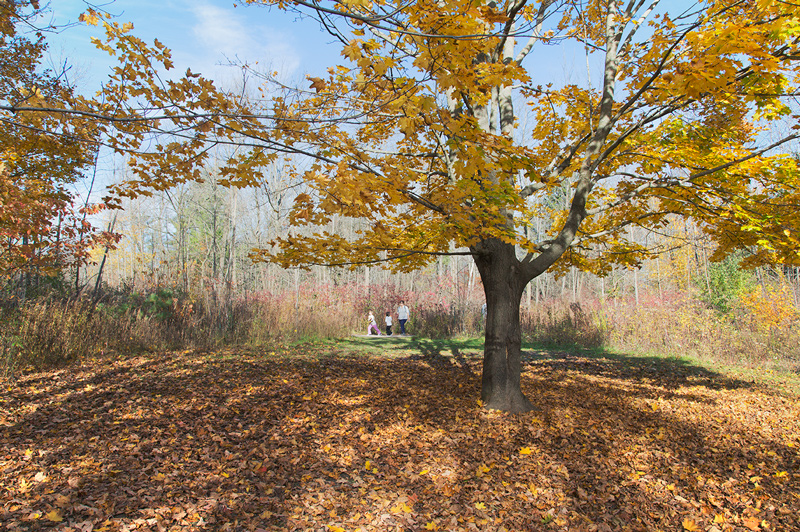
I drove slowly back and sure enough there was a short space without a yard fronting the street. No sign identified the park and no obvious trail led into it on either side. I parked on the shoulder and chose the more inviting side to the west. Although I never found a trail the ground was remarkably clear of undergrowth. And the canopy was spectacular, like an autumn-hued stained glass ceiling in the cathedral of nature (above and below.)


How fitting, I thought, that this lovely place was so hard to find. Richard Barloga, for whom it was named, had been characteristically reserved and a little hard to penetrate. Unless, that is, you got him started about the native plants of Milwaukee’s natural areas, which were his passion. He knew all the best places and the names of all the species you could find in them. And he devoted his life to protecting them until he died in 2014.


I spent only a short time in the woods. I knew I would have to return for a more thorough exploration. I had already spent hours that morning walking the entire loop trail in the main, easily accessible section of Falk Park. There I had been disappointed in the foliage. I found a few splashes of orange and yellow, but much of the forest was either still green or already gone brown. Knowing where and when to go to see the best autumn colors has been tricky this year.


As I drove away from Barloga Woods I stopped again briefly on 27th Street. I could see the forest in the distance across a drab landscape of fallow fields (below.) 


Even the canopy at which I had marveled just moments ago was muted. The distant view gave little hint of the natural wonders that could be found on the inside. But what was immediately clear was the pressure of development. A sprawling condominium complex ironically called “Colonial Woods” had already colonized any actual woods that might have been in its place. The fallow field between Barloga Woods and me most likely will follow before too long.


Cudahy Nature Preserve


I “discovered” this magnificent park last spring thanks to Milwaukee County Parks Dept. Natural Areas Coordinator Brian Russart. When I first wrote about it then it was the luxuriant spring flowers that blew me away. So I’ve been waiting with enthusiastic anticipation to see what it would be like in the fall. I went there on Oct. 22 only to find that the forest remained largely green.


I persevered and when I reached the southern edge of the preserve I stepped across the threshold to see what it would look like from the outside. As you can see, the “edge effect” was striking. The south-facing trees were much further along than those inside the forest. (Just as striking, of course, was how abrupt was the transition from forest to lawn.)


A week later I returned and was rewarded with what has so far been the most magnificent display of intense autumn color I’ve seen in Milwaukee this season. The photographs can barely suggest the splendor of being immersed in such a sea of color, which ranged from quickly yellowing shades of green, through gold and on into orange and rusty red.


Cudahy Nature Preserve is located next to one of the flight paths of Mitchell Airport. When the wind is right the planes take off and land almost directly overhead. Periodically one is subjected to the tremendous roar of ascent. But they are mostly invisible from the depths of the forest.


Access to Cudahy Nature Preserve is from College Avenue. This is a view of the preserve from Rawson Avenue, which is to the south. The canopy of the woods is just visible in the background, beyond the truck distribution facility, another reminder that this is an urban wilderness.

This is the sixth in a series of posts about autumn in Milwaukee (with more to come!)

Here are links to the others:

You can also see more photos of Milwaukee's magnificent parks and natural areas in other seasons on my Flickr album.