Showing posts with label concrete. Show all posts

Monday, April 3, 2017

Underwood Creek in Wauwatosa is getting a makeover


Restoration is underway and the bulldozers and power shovels in the creek are a welcome sight.


For now you can still see some of the concrete that until recently has lined much of Underwood Creek like a straightjacket for over forty years. The channel, once so smooth and straight I’ve seen skateboarders on it in dry weather, is pocked with holes and severely cracked. Jackhammers have been working their way downstream towards the confluence with the Menomonee River near North Avenue.

View from Hansen Golf Course of the east end of the existing channel.
Upstream the work is further along. West of 102nd Street, where the creek is sandwiched between Fisher Parkway and a very active railroad line, all of the concrete has been removed and trucked away to be recycled. Bulldozers, excavators and earthmovers have reshaped the streambed, reintroducing meandering curves. Tons of rock have been laboriously deposited to stabilize the new channel and prevent erosion.

Work in progress on the newly restored and meandering creek bed.
Oddly enough the incongruous sight of huge power shovels squatting in the streambed is a welcome one—a long overdue remediation of the outdated and discredited policy of “channelizing” rivers and streams. The idea behind pouring concrete into waterways, popular in the Milwaukee region in the 1960s, was to move stormwater quickly through neighborhoods in an attempt to minimize flooding.

Houses along Fisher Parkway back onto the creek channel.
Unfortunately for everyone, the solution became increasingly obsolete as the problem of flooding was exacerbated by unrelenting new development upstream from the channels. Until recent implementation of more effective stormwater management techniques and policies, new development has led to increased stormwater entering—and more frequently breaching—the channels.

Pumps at the upstream end of the project divert creek water into pipes.
Of course, pouring concrete into rivers has always been devastating to the rivers themselves—along with the fish, reptiles, amphibians, birds, and other wildlife that depend on healthy waterways and riparian habitats for their survival. The suffering of plants and animals in degraded river systems is accompanied by a diminished quality of life for the human communities that surround them. And so it has come to this, that we need—and desire—bulldozers in the creek to correct our past mistakes.

View of Underwood Creek channel looking west from 115th Street.
This project, which began in November 2016, will remove 4,400 linear feet of concrete between Mayfair Road and North Avenue. The work is being overseen by the U.S. Army Corps of Engineers in partnership with Milwaukee Metropolitan Sewerage District (MMSD) and could be complete as early as this fall.

Previously restored section of Underwood Creek along Mayfair Road.
The current Underwood Creek project is part of a longer-term effort to address up-to-date stormwater issues, improve water quality, restore and naturalize the creek, increase fish passage and rehabilitate wildlife habitats. Another section of Underwood Creek just upstream from the new project was previously restored. There also are plans to undertake feasibility studies for channel removal on additional sections west and south of Mayfair Road.

MMSD has undertaken similar channel restoration projects on all three of Milwaukee’s major watersheds. These have included completed projects on Lincoln Creek and the Menomonee River as well as its huge on-going Kinnickinnic River Project.

View of the pipe from the underground passage at Hansen Golf Course.
One of the more fascinating aspects of this work, at least for me, is how the normal flow of water in the stream is handled during demolition and restoration. If you peek through the passage beneath the railroad at Hansen Golf Course you may be startled to see a large black pipe suspended in the air across your field of vision. Although rain and snowmelt still fill the channel on occasion, this pipe, which snakes all the way alongside the creek, carries the normal dry weather flow.

The pipe that holds creek flow running along the project site.
The best news I’ve heard yet about this project was from one of the construction workers at the site. “It’s already working,” he told me. “We’ve had to rescue half a dozen salmon that swam up and got stuck in here.”

A restored section of the creek within the project site.

A slightly edited version of this story was published by Milwaukee Magazine on March 27, 2017. 

Sunday, July 10, 2016

Menomonee River reconstruction nears completion


The limestone rip rap gleams in the hard mid-day sun, a beautiful sight to see. And, yes, I think it will look even better after a few years, when vegetation grows through and over it, softening its hard edges and obscuring the gleam of the white stone. But this corrective measure has been years in the making and it's good to see it nearing completion.
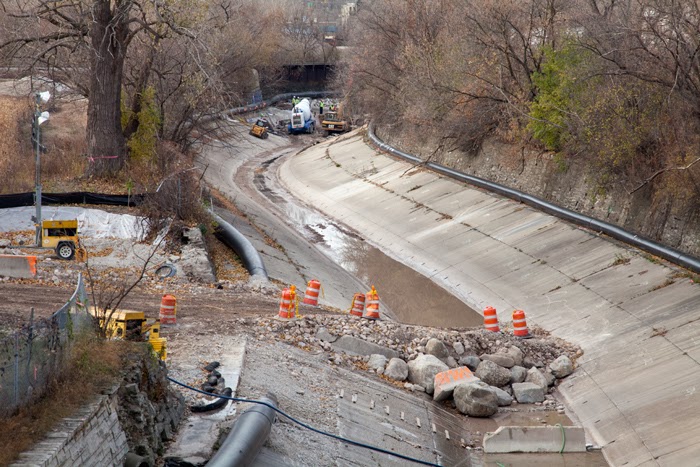

This one short section, right next to the Wisconsin Avenue viaduct, is all that remains of the concrete channel that was installed in the Menomonee River between the stadium and Miller Brewing in the 1060s as an ill-conceived and ultimately ineffective flood mitigation strategy. To read more about the project go to the MMSD website. To see my previous post, a photo essay showing the beginnings of this phase of the project in 2015, click here.


Meanwhile, the Kinnickinnic River project, which will remove even more concrete from that much more maligned waterway, is underway and projected to be completed in 2022. If you haven't seen it yet, my exhibit, Concrete River: Memorial and promise on the Kinnickinnic, is still on display at the Alfons Gallery through July 31. For more information, click here.


Monday, April 13, 2015

The Milwaukee County Grounds: A visual meditation

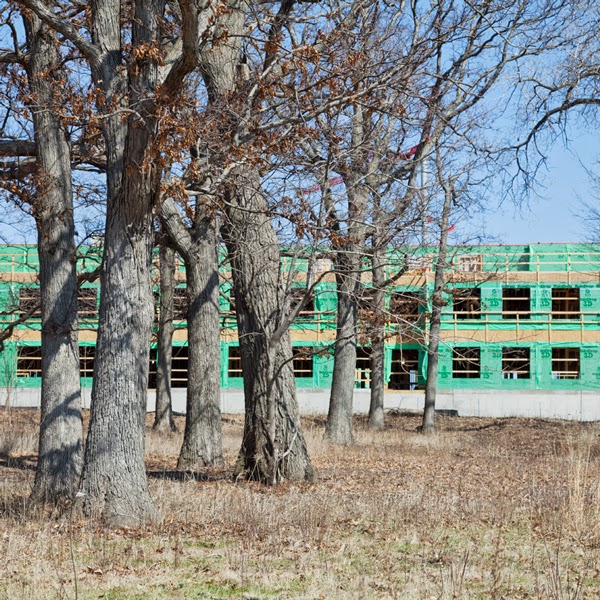
Two brief photo meditations, actually. The first is an update on construction progress for the Eschelon Apartments project at Innovation Park. Following that, signs of spring in Wil-O-Way Woods include early wildflowers and a concrete recycling operation on the future site of the Forestry Exploration Center.

Eschelon Apartments rising at Innovation Park


The Monarch Trail

Wil-O-Way Woods


Friday, February 13, 2015

Last stretch of concrete to be removed from Menomonee River


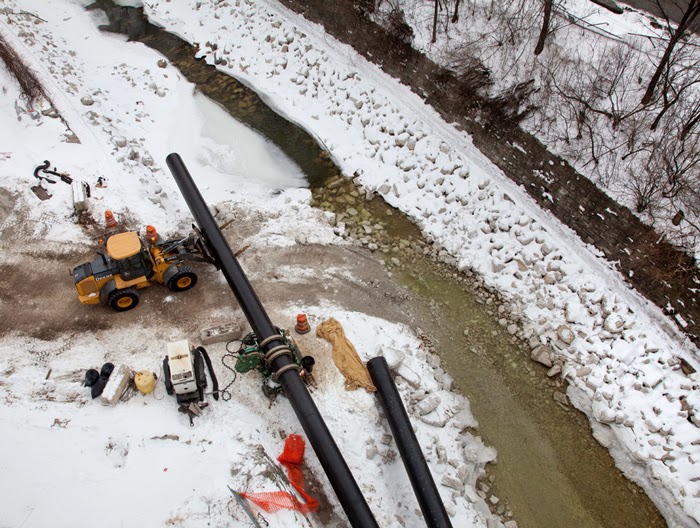
Preparation is underway for the removal of the last section of concrete channel from the Menomonee River. The project area runs from the Wisconsin Avenue viaduct through Piggsville to Miller Park. The current work being done is to install two diversion pipes along the sides of the existing channel. These pipes are intended to carry the flow of water during demolition and reconstruction.


New sections of pipe are attached at the upstream end of the line (above). After being welded together, the entire pipe must be dragged downstream by this tractor (below), which can pull the 200,000 lb. load.


At the downstream end of the line, just past the I-94 overpass, ice is being removed from the channel.


When completed the concrete channel will be replaced with rock, as was done with the previous stretch, which was done in 2013-2014 (below). To see a previous photo essay of that project, click here.


The purpose of the channel reconstruction is to remove the outdated, ineffective flood control channel, return the river to a more natural state and enable fish to migrate freely. To read more about this project, go to the MMSD website.

Monday, April 21, 2014

Butterflies return to County Grounds - etched in concrete


If you live anywhere near the intersection of I-94 and I-894/Hwy 45 you probably received the latest edition of the Zoo Interchange Newsletter, as did I. It is full of maps and handy information about the progress of this massive--and massively disruptive--construction project. In addition the practical information about which ramps and roads are currently closed or under construction, you can learn about carpooling options and how much recycling the WisDOT is doing.

Did you know, for example, that the DOT "anticipates recycling the equivalent of 4,000 dump trucks full of concrete" in 2015? (What you won't learn from the newsletter is the good news that, as of yet at least, the concrete crushing that precedes all this recycling is not being done in the middle of the County Grounds.)

But what caught my eye right away was the small photograph in the lower right corner of the front page of the newsletter. It depicts "the butterfly wall" that recently has been completed under the Swan Boulevard bridge crossing Hwy 45. The concrete wall has been deeply etched with flowers and butterflies. It will be visible to motorists on Hwy 45 as they flash by. And also to anyone who uses the yet-to-be-completed underpass trail that will connect the new trail system in Innovation Park with the existing one in Wil-O-Way Woods on the north side of Swan.

The caption under the photo reads, "The 2013 Swan Boulevard project includes the construction of 'the butterfly wall' along US 45. The wall celebrates the migratory path of monarch butterflies."

Other recently rebuilt bridges sport similar designs. The airport spur has airplanes etched into the bridge abutments. The most interesting one, I think, is the I-43 bridge over Fon du Lac Avenue. In raised relief it commemorates the underground railroad and the struggle for civil rights.

I think it's great that the DOT is decorating the highways. They could go further, it seems to me. There are all those sound barriers being erected along the freeways to protect adjacent neighborhoods from the incessant noise. Why not liven them up with graphic designs?

But instead of cheering me up the butterfly wall saddens me. Last fall the migration that the wall celebrates was disappointing. It may have been temporary. It certainly was part of a larger problem that extended throughout the historic monarch migration routes and was most noticeable in the wintering grounds of Michoacan, Mexico.

Loss of habitat is the most often cited reason for the decline, as is the case with so many other animal species. At the County Grounds an 11-acre segment of the Innovation Park campus has been set aside as protected monarch habitat. With proper and persistent care and maintenance, perhaps it will enable the butterflies to return in future years. That is the hope.

For now we have concrete freeway walls etched with commemorative butterflies. I had to go see them for myself. With construction suspended for Easter Sunday I was able to do so. Here is what I saw.


The small sign in the center, erected by the Friends of the Monarch Trail, reads, "Butterfly habitat restoration project."


There is a second "butterfly wall" under construction along the unfinished cloverleaf ramp for the new Watertown Plank Road interchange.


A small wetland habitat next to the Eschweiler complex is staked with protective flags.


The boarded engineering building, part of the Eschweiler complex, awaits its fate: restoration if all goes well; demolition if not.


ABB is the first business to be located in the Innovation Park campus. The building is expected to open sometime this spring.


Saturday, November 30, 2013

Menomonee River concrete channel removal underway: a photo essay

Work began in September to remove 1,100 feet of concrete channel in the Menomonee River near Miller Brewing and the Wisconsin Avenue viaduct. The purpose is to return the river to a somewhat more natural state and enable fish to more easily migrate upriver. A final section of concrete channel south of the viaduct is slated for removal later in 2014. That will complete the channel removal that began upstream at 45th Street when a small dam was removed approximately 15 years ago. Those who are familiar with my book, Urban Wilderness: Exploring a Metropolitan Watershed (published in 2008) may remember that I wrote about the promise of channel restoration at that time. Thankfully, that promise finally is being fulfilled. Here is a photo essay of the current conditions. (For a more detailed account of the project go to jsonline.)

Water intake pipes
View towards Wis. Ave. viaduct
Graffiti on railroad bridge


View from viaduct with Miller lot in background
View downwards from viaduct
View from Bluemound Rd. bridge upstream
Outflow pipes
A section of the restored channel