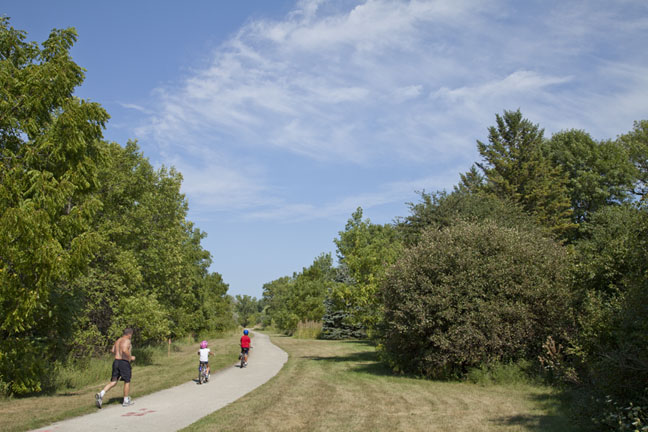
Showing posts with label oak leaf trail. Show all posts

Friday, April 24, 2015

Milwaukee County parkland threatened by gun club’s plan for shooting range


This story was first published (edited and with fewer photos) as a column for Milwaukee Magazine with the title, A Bullseye View: A Milwaukee County park on Lake Michigan may be threatened by a Cudahy gun club’s new shooting range.

A persistent, hollow rat-a-tat-tat echoed from somewhere unseen, deepening the woods. Clearly a woodpecker; seemingly a large one. Then, close by, a lighter tapping drew my eye upwards. Short bursts, like stitching, repeated at irregular intervals. A small black and white downy woodpecker flitted along the tree line next to the trail. Suddenly it was directly overhead, tapping a dead branch. In a moment it was gone. Wildlife enthusiasts live for such ephemeral moments.


I had come to Warnimont Park in early April with my friend Karen Johnson, a birder who—unlike me—can tell a downy woodpecker from a red-bellied one just by the sound it makes. We continued along the bike path, listening, looking for movement amongst the trees, bright with morning sun but still gray and leafless in the lingering Wisconsin winter. The light, lively chatter, Karen said, was mostly chickadees that have been around all winter. Their bright chirps vary from a high-pitched, serene “sweet-tee” to the occasional, more urgent “chick-a-dee-dee-dee” for which they are named.


Although it is early in the season we were hoping to hear and see a few of the migrating birds that congregate in Warnimont on their annual trek north from distant wintering areas. We have two reasons for coming to this particular park. The relative wildness of the middle section of the park along with a diversity of habitats make it one of the premier locations in Milwaukee County for birders. For my part, I wanted to see what might be lost if a controversial plan to create a shooting range in the middle of it is approved.


At its north end, next to Warnimont Golf Course, the park currently has a shooting range that is slated to close. Operated by the 83-year old Cudahy Sportsmen’s Club (CSC), the range has been used for decades by gun-owners and, occasionally, by local law-enforcement. It also has been a magnet for controversy. Its bluff-top location causes lead shot to be deposited into Lake Michigan, a serious hazard to aquatic wildlife as well as a violation of both the federal Clean Water Act and Resource Conservation Recovery Act. As a result, the Milwaukee County Parks Department finally terminated the CSC’s lease in November, 2014.


When it faced identical circumstances, the Milwaukee Gun Club, once located on the lakeshore at the north end of Lincoln Memorial Drive, was compelled to close in 1992. At Warnimont, the Parks Dept. granted the club a one-year extension, allowing operations to continue with the stipulation that steel be used instead of lead shot. But a new controversy looms over the club’s plan to relocate.


Karen and I continued to walk along the winding Oak Leaf Trail. She abruptly raised her binoculars to identify a small, yellowish shape that shot across our path. A golden-crowned kinglet, she tells me with relish, an early migrant. The woodland thins and opens into a broad meadow dotted with low shrubs. Joggers and cyclists swerve around us on the trail.


We head off into the meadow on a dirt path, following a stuttering call that Karen identifies as a song sparrow. Before long we are doubly rewarded. We spot the song sparrow among brambles and then farther along a dark-eyed junco perched atop a leafless bush.
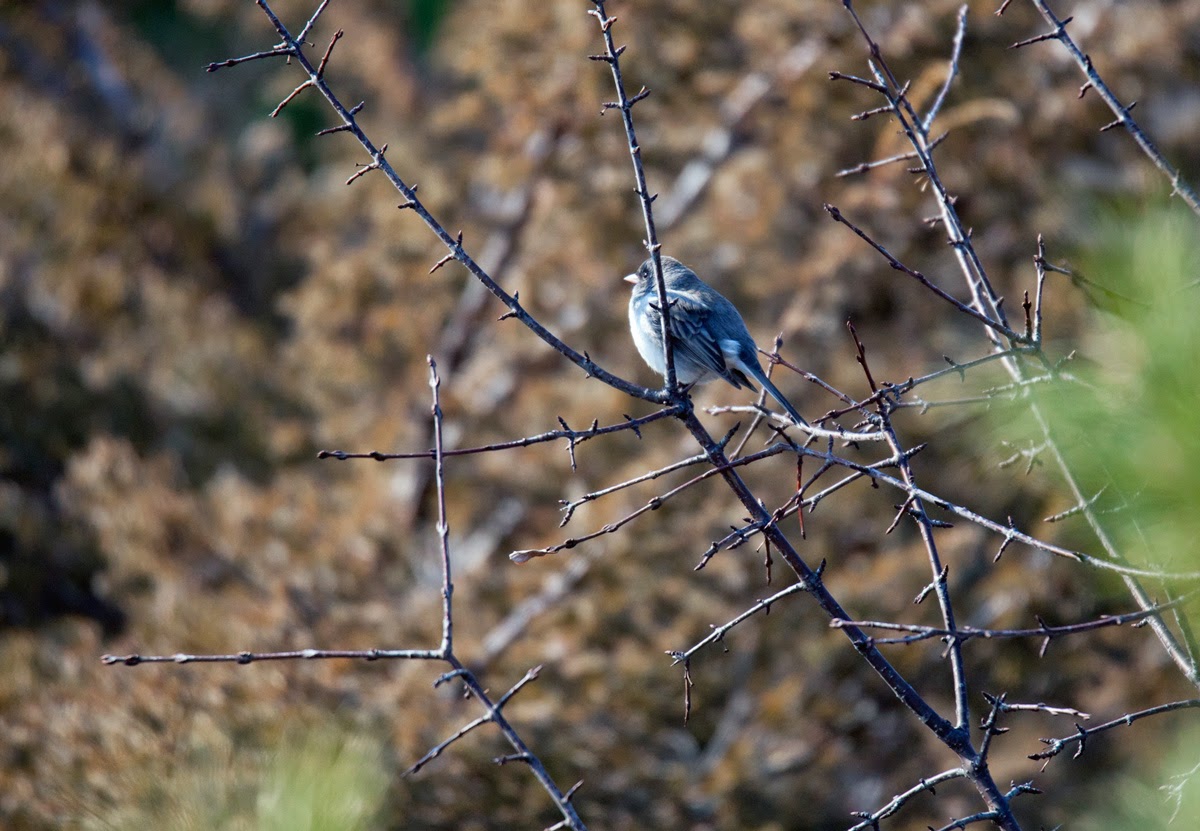

Individually, the woodland and the meadow provide excellent cover and distinct habitats for a wide variety of local and migrating birds. Together, however, they create a remarkably diverse ecosystem, one that’s hard to match in Milwaukee County. The convergence of two habitats, such as the woods and the meadow, creates what naturalists call an ecotone or a point of transition. The mingling of species that occurs in an ecotone makes for a particularly rich environment for wildlife. This is what draws so many birders to Warnimont.


The Cudahy Sportsmen’s Club would like to create its new shooting range smack in the center of this county park’s exquisite and irreplaceable natural area. According to CSC president Tom Ahmad, the design of the range would include six trap and skeet machines, a tall shot curtain and an earth berm between the range and the bluff. Also, unlike the current range, a chain-link fence would surround the new one. The curtain and berm are necessary to protect off-road cyclists, hikers and dog-walkers who frequent the bluff-top path. They also would facilitate clean up of plastic shot wads and broken clay targets, which has been another point of contention at the current site. Bright, often toxic fragments of targets litter the steep, deeply eroded escarpment and plastic wads drift onto popular beaches below.


To the untrained or utilitarian eye, a meadow in a park might seem like the ideal place to develop—unruly grass in an already open space. That’s one of the reasons upland meadows and prairies are among the most endangered habitats in the country. But many bird species require precisely those conditions. Its proximity to the Lake Michigan flyway makes Warnimont Park especially attractive to seasonal migrants. The prospect of bulldozing this exceptional landscape—a jewel in Milwaukee County’s park system—has ignited passionate opposition.


Members of the local chapter of the Audubon Society are incensed. The chapter has posted a petition online opposing the proposed location of the shooting range, addressed to County Supervisor Jursik, whose jurisdiction includes Cudahy. The petition has over 500 signatures. And birders are not the only vocal opponents.

Jursik says that she has received calls from people opposed to the proposal “for all kinds of reasons.” Park neighbors are alarmed that the already disturbing noise of shooting would be moved closer to homes near S. Lake Dr. Aurora St. Luke’s South Shore Hospital on S. Lake Dr. is “very concerned” about it, Jursik says.


The gun club proposal, which has not yet been formally submitted, would clear cut a very sensitive ecological area of mixed conifers, hardwoods, and meadow—and one of the highest points on the western shore of Lake Michigan. It also would move the heavily used Oak Leaf Trail away from the rugged scenery along the bluff to a new route adjacent to S. Lake Dr. thus diminishing the recreational experience. The vast majority of those users have not heard of the proposal and therefore have not weighed in on the controversy.


Gun club members have framed their position as a gun rights issue. “This is totally false,” says Jursik. “It has nothing to do with second amendment rights.” The issue is appropriate land use in a beautiful public park.

When the plan was first announced the club mounted a highly visible public relations campaign to muster support, enlisting the aid of talk radio. After an initial flurry of calls from club supporters, says Jursik, “in the last 2-3 months, all of my calls have been in opposition.”

Milwaukee County is under no obligation to provide a place for the gun club, according to Guy Smith, chief of operations for Milwaukee County Parks. The club has other options on private land. Jursik says the Winchester Gun Club in Racine is willing to accommodate them.

Parks Director John Dargle expects a decision to be made by June, 2016, once a detailed proposal is submitted and after engineering and environmental impact studies and public hearings are completed.


Although I’ve cycled through Warnimont on the Oak Leaf Trail many times, I had never stopped to explore it until I learned of this issue. In the past month I’ve returned several times. I’ve seen the snow melt away and the first blush of spring buds begin to green the woodlands. Thanks to several members of the Audubon Society I’ve seen a wider variety of birds than I knew existed—and heard many more that went unseen. I’m looking forward to May when the buds will have opened, grasses will have greened, and a full array of migratory birds will arrive. 


For more photos (along with captions) from Warnimont Park, click here.

Tuesday, July 1, 2014

ATC begins tree cutting in Underwood Parkway

Those who have been following the Underwood Creek Parkway controversy about placing power lines through there to provide power to the proposed We Energies substation on the County Grounds know that permission was granted by the WI Public Service Commission months ago. (Read my original post describing the issues by clicking here.)


The work began in earnest recently. Wauwatosa, an officially designated "Tree City USA," is losing more of them. The power lines will run along the north side of the railroad tracks from the existing powerlines near 119th St. to 115th St. (above) They will then cross the tracks, the road, and Underwood Creek to follow the Oak Leaf Trail east of 115th St. (below)


I don't know what is being done in the park between the Parkway road and the creek west of 115th, but something is. Construction fences surround many of the existing trees and cyclone fences surround at least two sections where work is being done. Here's what it looked like over the weekend.


Sunday, November 24, 2013

Help redesign the Menomonee River Parkway

Two years ago I wrote a post about the potholes on the Menomonee River Parkway. Since then condition of the parkway has only worsened. However, there is finally a plan--and, more important, money in the budget--not only for repaving but also for redesigning the parkway. About time!


All aspects of parkway design are to be considered, including "pedestrian access, bike and pedestrian safety, traffic flow, traffic calming, and aesthetics of the parkway" as well as runoff water quality. 

You can help! Please do. (Read on, or click here to go directly to the County Parks Menomonee River Renewal site.) 

The parks department held a public open house last week at Mount Mary University that was very well attended--by the public as well as a variety of officials.


Those who attended were able to fill out a survey and leave comments and suggestions. If you missed the open house, you have until December 6 to go to the County Parks Menomonee River Renewal website and fill out their survey. Be sure to include comments.

My suggestions were these:

The Parkway ought to be considered a park and not a highway. Therefore, bicycle and pedestrian access and safety should be considered more important than the speed or convenience of vehicular traffic. (I live right next to the parkway and I drive on it daily. I'm happy to slow down for bikes and pedestrians.)

Off-road bike paths should be included along the entire length of the parkway, as already exists in Hoyt Park.

Street design should encourage drivers to slow down. (Check out the maps provided on the website and share in the horror when you learn how many accidents there have been all along the parkway.)

Except for invasive species, existing trees should be preserved. Let's not clearcut the parkway and then plant new seedlings (as we've seen done elsewhere in Wauwatosa!)

The wild sections of the parkway along the river are among my favorite places to walk. These should be preserved and not cleared or paved. They are the urban wildernesses that our children and grandchildren need be able to explore.


Go to Menomonee River Renewal today and make your voice heard. Let's get this right, shall we?


Parkway between Burleigh and Hwy 100

Friday, January 20, 2012

County Board to consider resolution regarding power lines in parks


The Parks and Parkways need your support!

The Milwaukee County Parks, Energy and Environment Committee is meeting at 9:00 a.m. on Tuesday, Jan. 24.  Supervisor Schmitt plans to introduce a resolution that would prohibit power lines in Milwaukee County Parks, Parkways, the Oak Leaf Trail, or wetlands and natural areas. This is an excellent step! He can use all the support we can give. Details below.

If you cannot make the meeting please look for the contact information below and send a note of support for this resolution.

The impetus for this resolution is the proposal by the American Transmission Company (ATC) to route a power line through Underwood Parkway. This proposal not only would compromise the integrity of Underwood Parkway, a stretch of the Oak Leaf Trail, and the common good, it would set a terrible precedent for all Milwaukee County Parks and Parkways. The ATC proposal provides alternative routes, but they have indicated that the parkway route is a preferred one. 

Proposed power line route: Oak Leaf Trail in Underwood Parkway
To learn more about this issue read my previous posts.

Here are the key points of the proposed resolution:
  • The county and city support the effort to supply additional electricity.
  • The county and city oppose Route B, which runs through Underwood Parkway.
  • The county and the city oppose any other current or future plans involving placement of high voltage electric transmission lines along Milwaukee County Parkways, the oak Leaf Trail, or wetlands and natural areas.
  • The county and city request that ATC trench the transmission lines that will traverse the County grounds.

Supervisor Schmitt has said that his resolution will be first on the agenda on Tuesday. The committee meeting begins at 9 a.m. and will be in either Room 201B or 203R of the County Courthouse. If you can attend, please allow time to go through the security checkpoint at the entrance. I hope you'll join me there.

If you cannot attend, contact:


Chairman Lee Holloway
Milwaukee County Board lee.holloway@milwcnty.com

Supervisor James "Luigi" Schmitt
James.Schmitt@milwcnty.com
 
A complete list of county supervisors is available here.

A similar resolution is being introduced at an upcoming Wauwatosa Common Council meeting. Please send a copy of your message to Common Council Chair and Acting Mayor, Eric Meaux: emeaux@wauwatosa.net

Let's keep our parkways and bike trails free of power lines.


Friday, September 9, 2011

Power lines may ruin what remains of parkway


Who will speak for nature? Who will speak for Underwood Parkway?

“I wish to speak a word for Nature, for absolute freedom and wildness….” – Henry David Thoreau      
       Like Thoreau, I would like to speak a word for nature. Although the “freedom and wildness” that our parks provide us in Milwaukee County can hardly be called “absolute,” that doesn’t make them less valuable or less deserving of protection. So, let me speak a word for relative freedom and wildness.
      Once upon a time Underwood Creek was as free and wild as any other stream in Wisconsin. Then houses were built near it and the Menomonee River, into which it flows. Eventually, flooding occurred. What followed, for long portions of Underwood Creek, was called channelization. Riparian woodlands were chopped down, the meandering stream was bulldozed straight, and its channel was lined with concrete. This “solution” was not only temporary; ultimately it led to increased flooding.
            Current plans for Underwood Creek include the removal of concrete and the restoration of a more naturally meandering stream. This already has been done for the short stretch that runs next to Hwy 100 as well as for stretches of other waterways in the county.
      Despite the degradations to which it has been subjected, Underwood Creek is valued enough to be part of the award-winning Milwaukee County Parkway system. A popular segment of the Oak Leaf Trail runs through it. Furthermore, a short stretch of the original, un-channeled creek lies in a densely wooded, swampy area. This is a place that is just about as free and wild as nature gets around here, a place where even Thoreau might have found what he termed the healing “tonic of wildness.”
Sadly, unless there is concerted public effort to preserve it, this small bit of urban wilderness may soon be destroyed.
      As reported recently in Wauwatosa Patch, WeEnergies is planning to build a new substation on the Milwaukee County Grounds. Electrical power will be brought to the substation via two new transmission lines to be constructed by the AmericanTransmission Co. (ATC). Four routes are being considered, from which two will be selected by the Public Service Commission (PSC).
Map of four proposed alternatives
      One of the proposed alternatives would run 60- to 100-foot-tall high-voltage overhead power lines through Underwood Parkway. If this route is chosen, an 80-foot right-of-way would be cleared, effectively destroying one of the few natural areas left in Wauwatosa. What is potentially more distressing to the many people who use it, utility poles and overhead cables also would run along the off-road portion of the Oak Leaf bike trail between 115th St. and Watertown Plank Rd.
      This doesn’t have to happen. There are three viable alternatives. Unfortunately for the parkway and the people who enjoy it, other alternatives run along residential streets. The prospect of having your yard and street dug up for a buried power line, even temporarily, is a powerful incentive to become a vocal opponent of that alternative. This is to be expected and it is how a solution that benefits the few may win out over a solution that benefits the many.
      The parkway and Oak Leaf Trail need vocal opponents of the Underwood Creek alternative. Only if many people are willing to speak a word for nature will we save it.   
      Please attend the open house on Sept. 12 from 4 p.m. to 7 p.m. at the Wauwatosa Civic Center, 7725 W. North Ave. ATC experts will be able to answer questions about the project and explain how to provide input to the PSC. (You can email comments to info@atcllc.com if you cannot attend the meeting.)  
      The PSC will rule on the final two routes based on input received from all interested parties, including ordinary citizens as well as residents of affected neighborhoods and major stakeholders such as the Milwaukee Regional Medical Complex and UWM.
      No one wants overhead power lines obstructing their own views. Cables will be buried in sensitive locations, like the Medical Complex, UWM’s Innovation Park, and residential neighborhoods. But this is expensive. From a purely economic standpoint, the parkway seems an attractive alternative because the overhead power lines would save money. From a political standpoint, the parkway lacks residents who complain. From an ecological and recreational standpoint, however, overhead power lines and an 80-foot wide swath of clear-cut are anything but attractive.
      It is ironic that just three months ago Wauwatosa announced a new branding campaign for which the theme of the city will be Innovation Parkway. If the city is going to promote the value of its parkways – as it should – sacrificing one of them in this fashion would be antithetical to the effort. Officials in Wauwatosa who support the Innovation Parkway theme, as well as all Milwaukee County users of the Oak Leaf Trail should be pounding home the point – power lines do not belong anywhere near our parkways.
For the benefit of all, let us speak a word for nature…!
      Here is an Underwood Parkway photo essay with explanatory captions. Click to enlarge each photo.
This view west from 115th St. is the channelized Underwood Creek most people see.
This is a view of the original creek that still exists in a little-known natural area immediately north of the previous view.
This set of tracks bisects the parkway and separates the two channels pictured above.
Underwood Parkway drive and Oak Leaf Trail immediately south, adjacent to the channelized creek pictured at top.
This existing power line, at 119th St., is where the proposed new transmission line would begin. An 80-foot-wide right-of-way would be cut through the woodland to the right.
This wetland would be in the power line right-of-way. Wetlands, which slow and absorb stormwater run off, are important for flood management and groundwater recharge.
The off-road segment of the Oak Leaf Trail east of 115th St. If the Underwood Creek Parkway alternative is chosen, this scene would include overhead power lines 60-100 feet tall.
Alternative routes that run through residential neighborhoods, like this Walnut St. route, would use buried cables.

Tuesday, June 21, 2011

Hank Aaron State Trail goes west!


I know I should have done it before now. I’ve been meaning to ride the west extension of the Hank Aaron State Trail (HAST) since the new Valley Passage and Menomonee River bridge opened way back in November! (See previous post.) With apologies to friends at the Friends of the Hank Aaron State Trail for my tardiness, I’ve finally biked the section of the trail that runs from Miller Park out to 123rd St.


It was clear from the start that plenty of other people had discovered it. As I rode up the incline from the Valley Passage, I passed a steady stream of bikers coasting down. I thought I knew what to expect: The trail was established on an old railroad line, which is common enough to have its own Rails to Trails national program. This railroad line ran due west from the Menomonee Valley, through urban neighborhoods of Milwaukee and West Allis. I expected to see a lot of houses, businesses, and industrial buildings.


Well, Okay, I did see a lot of those things, but I also saw a lot more than I expected, including some interesting bits of nature. I didn’t expect to see any wildlife, the corridor being so narrow, but I soon caught out my own bias in this regard. Richard Louv observes in his new book, The Nature Principle, that many people think only of animals when they think of wildlife. There is even a term for it: “plant blindness.” I guess I’ve been guilty of this on occasion.


Some of the bikers on the trail speed along without glancing around, focused on fitness perhaps, or trying to reach a destination. Some ride in pairs or groups, making the trail a social experience. I saw at least one girl riding along with one hand gripping the handlebar and holding a cell phone up to her ear with the other. I hope there were a few who enjoyed discovering the flowers and other plants as much as I did.
 
Among my favorites was the wild rose, which I saw frequently. Many of the blossoms had already started to wilt, but enough were fresh to brighten up the lush green foliage with their delicate pink accents.

 At Wood National Cemetery I passed a hillside full of daisies.


I found a tall stand of newly planted wild rye grass near Miller Park to be surprisingly dazzling in the bright afternoon light.


Unfortunately, many of the plants, even attractive flowers like this multiflora rose bush, are non-native. This is a common problem throughout the urban wilderness, of course. Not all non-native plants are invasive and many have been planted deliberately, but they do tend to compete with the native species and limit biodiversity.


The trail passes through the State Fairgrounds where I found some decidedly unnatural curiosities.


The pavement ends at 94th Place but a gravel trail continues quite a bit farther. Eventually, it will be paved all the way to where it will intersect with the Oak Leaf Trail near the Milwaukee County line. But it passes under the Zoo Interchange where I-94 meets I-894 and Highway 45. The whole interchange is due to be rebuilt in a few years. Paving the HAST will follow that huge enterprise.


After riding for several miles in relatively narrow confines, the west end of the trail begins to seem pretty wild by comparison. There is no illusion of wilderness, what with the freeways and power lines, but the character of the trail changes and more open.

 Cattails grow in puddles alongside the trail.


The trail itself becomes a dirt track crowded with weeds. This lovely crop of yellow flowers is, sadly, invasive. When I sent the picture to a plant-knowledgeable friend to confirm its identity as bird’s foot trefoil, she added “ick.”

Currently the HAST doesn’t quite reach its intended destination. The abandoned rail line continues on but old railroad ties remain in place, making it impossible to ride that way. I had to make a short detour on the road to finish up and return home via the Oak Leaf Trail.