
I could have waited for the hand of autumn to paint the land
with glorious color. I could have cleared a day on my calendar. But then, in
all likelihood, something urgent would have come up to preempt my trip. Besides,
I’ve already waited far to long to visit Aldo Leopold’s farm.
I picked up my first copy of Leopold’s classic “A Sand
County Almanac” sometime in my idealistic youth, when Wisconsin was just one of
many unexplored states west of my home in New York. That slender volume with
its cover illustration of wild geese calling, now yellowing and worn with age,
has survived many a move. The most important brought me permanently to
Wisconsin. Coincidence.
Since then, over more decades than I care to enumerate, I often
thought about visiting “the shack” where Leopold lived, wrote, and experimented
with the ecological ideas that made him justifiably famous. Though fame and
influence have a way of crossing over into mythos, Leopold’s writing, both
eloquent and accessible, rooted him firmly in the real world. I’ve never tired
of rereading the “Almanac” but my latent aspiration went unconsummated.
Until today.

The trip wasn’t planned; you won’t find it on my calendar. On
impulse, “with such dignity as I can muster of a July morning,” as Leopold wrote
in his almanac entry for this month of deepest summer, I set out from the city to
satisfy finally my long-dormant desire. Two hours later I leave the freeway and
head west through cornfields on a rural road that skirts the Baraboo hills,
which are distressingly brown due to drought. A turn north takes me towards the
Wisconsin River. The roads get progressively narrower and trees close in
overhead.
When Leopold bought his 80 acres along the Wisconsin River
in 1935, it was little more than sand, having been cleared, over-farmed, and
abandoned. I salute the dense forest that greets me on the final leg of my
pilgrimage, knowing it to be the result of careful restoration efforts by
Leopold and his family in the 1930’s and 40’s.

The Leopold Center parking lot is full and its courtyard rings
with a lively clamor. But down the road a piece there is only one car pulled
off to the side where a humble log fence barely keeps the forest at bay.
Fittingly, no signs mark the place. Leopold savored his solitude. The conundrum
for this particular kind of historical site is how best to honor the founder’s
intentions while welcoming a multitude of tourists eager to share in the
experience. A passage from the Almanac is especially poignant: “There are
degrees and kinds of solitude,” he wrote, as he described with relish being
stranded by spring floods.
I set off through the thick stand of aromatic pines. An
unlocked bicycle is propped against a trunk. A low post bears an elegantly
designed numeral for the self-guided brochure I picked up at the Center. I read
that 3,000 pines were planted every year despite the “dust-bowl conditions”
that decimated the plantings with “95-99% mortality.” I ponder perseverance as
the forest broods in deep shade under the midday sun.

“The Prairie” opens suddenly before me. Bursts of white wild
indigo with vibrant gray-green leaves stand out against prematurely yellowing
sedges and prairie grass. Tall rhizomes reach skyward; the white flowers that
give this species its name already have become strings of seedpods, many well
on their way to mature black. Leopold was forward thinking in so many ways.
This patch of sun and deep-rooted flora was a pioneer restoration project at a
time when prairie landscapes were still underappreciated.

Then, surprisingly close to the road, I recognize the asymmetrical roofline
snuggled up against the woodland and the weathered gray wood siding and white
door of “the shack.” It is not the farm’s most important feature, certainly not
in the ecological sense. But the weight of his presence makes it Leopold’s most
distinctive “signature on the face of the land.” The shack is modest and
utilitarian. What, I wonder, would Leopold make of the sturdy padlock required
to prevent admirers from walking off with his teakettle for a keepsake? Or one
of the turtle shells he placed on a shelf along with his axes, shovel and saws?

A few paces away, notched in a pine and cedar grove, is the outhouse.
This decidedly more modest and
utilitarian edifice, built by Leopold’s son, was engagingly dubbed “the
Parthenon.” We value most the things that we make with our own hands.
Compelling as they are as part of a portrait of the man,
these material artifacts are not what I have come to see. Leopold himself
concludes the foreword to his Almanac with the words, “Nothing could be more
salutary … than a little healthy contempt for a plethora of material blessings.”
No, I have come to walk the land that he so cherished, to listen for the birdcalls
that he so lovingly describes, to steep myself in this very personal and yet universal
biotic community.

I find the sand farther on, near the river. It’s a wonder
anything can grow here! But the evidence of nature’s resilience is incontrovertible.
Oak saplings spring from the sand like biological explosions. Sauk is the actual
name of this county. Leopold titled his almanac to express the ubiquity of sand
and the hardships involved in farming on – or restoring it.
In fact much of the underbelly of the entire state of
Wisconsin is sand. Ironically, we are blessed with such nice sand – a very pure form of silica dioxide bearing a high
compressive strength – that it is in great demand as a hydrofracking proppant. The
sand is mixed with water and chemicals and then the resultant toxic slurry is
injected at high pressures into fissures deep below the earth’s surface. The
purpose of this violent and controversial process is to shake up shale and
other rock sufficiently to release oil and natural gas. Thus we feed our fossil
fuel addiction.
I kick up a spray of sand, musing on one of Leopold’s most
important and oft-quoted passages: “We abuse land because we see it as a
commodity belonging to us. When we see land as a community to which we belong,
we may begin to use it with love and respect.” How would the author of “A Sand
County Almanac” feel, I wonder, if he knew that the sand, bane of agriculture
and forest restoration alike, was being extracted “in excess of 12 million tons
per year?”1 Large swaths of Wisconsin countryside, both farms and
forests, are being ignominiously scraped away and transported to distant states
with lucrative oil shale formations.

“Like winds and sunsets, wild things
were taken for granted until progress began to do away with them. Now we face
the question whether a still higher ‘standard of living’ is worth its cost in
things natural, wild, and free.” He wrote that in 1949! “For us in the
minority,” he continued, “the opportunity to see geese is more important than
television, and the chance to find a pasque-flower is a right as inalienable as
free speech.” Minority indeed; as I look out over the wide Wisconsin River I am
enjoying a hefty measure of the solitude Leopold sought in this very place. Though
delightfully peaceful it confirms my membership in “the minority.”

The river is uncommonly low. It too
seems to consist more of sand than water. Except for some dead logs, the
surface remains unbroken under the hot July sun. No insects stir the air; no
fish rise to seek them. A pair of gulls squabbles half-heartedly on the far
shore. Scorched grasses and shriveled wildflowers line the riverbanks.
The drought I’d observed earlier
plagues huge swaths of the state.

Is the drought an anomaly or a symptom of global warming?
The governor – who disputes the possibility of global warming on ideological
rather than scientific grounds – recently declared 23 counties disaster areas. It
is, indisputably, the worst drought in 24 years and counting, with no relief in
sight. As I stroll through brown, desiccated grass I come upon a brake of
scrawny and twisted berry canes, blackened as if by fire. A hard, tiny nub of a
berry adorns the tip of each cane, so completely shrunken and disfigured that I
can’t tell if they are wild raspberries, blackberries, or some other kind.
Drained of all succulence, neither bird nor passing pilgrim will dine on these drought-charred
berries.
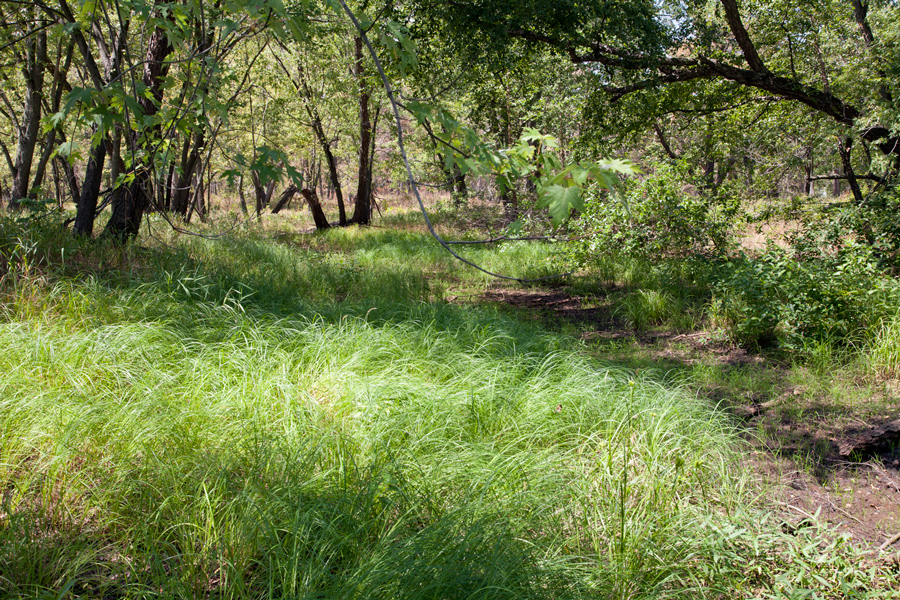
Even in the shade of a boggy dell where ground cover remains
green, I find deer tracks like future fossils embedded deeply in mud so dry that
the weight of my step doesn’t squeeze out even a teardrop of moisture.

The self-guided trail is a short loop that could be
circumnavigated in less than half an hour, even stopping to read the brochure
at every marker. My pace is leisurely. Each new unfolding moment I hold like a
Rosary bead, feeling blessed. In the midday heat there are few signs of
wildlife. I disturb a sunbathing turtle, which abandons its post on the end of
a log with a peremptory plop. A disheveled knot of unidentifiable downy white
feathers in the grass hints at the daily struggle of life in the wild. Farther
on two empty halves of a shell leave no doubt that someone made a lunch of river
clam.
In his July chapter Leopold informs us, “During every week
from April to September there are, on the average, ten wild plants coming into
first bloom.” But on this late July day the woods seem bereft of flowers.
Perhaps it’s the drought, or just the low point of deepest summer when the law
of averages balances out profligate spring. “In June as many as a dozen species
may burst their buds on a single day.” Not now.

I am not complaining. There is no wrong time to for a walk
outdoors. Leopold tells us “It is, by common consent, a good thing for people
to get back to nature.” But what kind of nature do we find when we “get back
to” it? Leopold’s farm, in many ways, was and still is a laboratory for nature,
for ecological restoration.
Everywhere I walk I notice small, unnaturally bright orange flags
festooning the groundcover, seemingly at random. I knew better than to expect a
wilderness. Leopold himself identifies an inherent conflict: “All
conservation of wildness is self-defeating, for to cherish we must see and
fondle, and when enough have seen and fondled, there is no wilderness left to
cherish.” The flags, I learn, mark patches of invasive garlic mustard so
that the foundation staff can locate new sprouts early in spring before they
have a chance to propagate. In lieu of wilderness we have, wisely it seems to
me, opted for nature that is “husbanded” – managed for healthy and sustainable
biodiversity.
I don’t know when I first began to hear the sound of
traffic. The increase in volume has been gradual as I walk a ridgeline,
following the self-guided trail through the pines. But as I near the last marker
on the trail, without any obvious crescendo, I am suddenly aware of the loud,
persistent hum of rubber on concrete. Startled in equal measure by its
familiarity and incongruity, I am struck with the uncomfortable realization
that I might well be back in Milwaukee, walking as I so often do along the
Menomonee River Parkway trying to ignore the same noisome intrusion.
It is not visible from here, but a steady stream of
travelers on the interstate freeway passes by within earshot. The phenomenon is
not unlike that of the railroads in Leopold’s time, which “began to carry
city-dwellers, en masse, to the countryside.” The effect, he lamented, was that
“the greater the exodus, the smaller the per-capita ration of peace, solitude,
wildlife, and scenery, and the longer the migration to reach them.”

This very freeway, of course, brought me here for my own
personal ration of the same natural amenities. “The automobile has spread this
once mild and local predicament to the outermost limits of good roads—it has
made scarce in the hinterlands something once abundant on the back forty.”
Ironically, I have made my pilgrimage only to find the truth that I’ve known well
all along: what I sought is indeed available to me in the “back forty” of my
beloved urban wilderness areas of Milwaukee. After nearly three hours, feeling
fully steeped in Leopold’s oeuvre, I’ve “come home” in more ways than I’d
imagined possible when I set out this morning.
Two centuries ago when the Industrial Revolution began,
there’s been a steadily accelerating assault on the natural systems that our
planet needs to survive. The wilderness has been driven back on every front.
But we may finally be approaching full circle when “getting back to nature” is
unremarkable, when our culture sufficiently values nearby nature to ensure that
it is available to “city-dwellers.” Cities are where most of us live today.
Urban parks are the equivalent of Leopold’s “back forty.” This has to be more
than a metaphor. We have to get out of our cars and go to them to find “refuge
from too much modernity.”
1Silica Sand Mining in Wisconsin, Wisconsin Department
of Natural Resources, January 2012.


