Showing posts with label ecology. Show all posts
Wednesday, June 3, 2015
Warnimont Park gun club update: public hearing today!
Should the Cudahy skeet-shooters remain in Warnimont Park? Should they be allowed to destroy one of the best sites for birding in Milwaukee County?
Speak up at a public hearing Wed. June 3, 2015, at Cudahy Family Library.
The Cudahy Sportsmen’s Club, a skeet-shooting club, have met in Warnimont Park on Lake Michigan for many years, but neighbors increasingly object to the shooting noise and the debris left in the lark and in the lake. The club is requesting a new location in the park, but opponents say the new site is too close to private houses and a hospital. The Audubon Society has voiced strong opposition because of the sensitive ecology of the proposed new site.
Read much more (and see more photos) in my earlier column in Milwaukee Magazine.
WHAT: Public hearing to discuss whether Cudahy Sportsmen’s Club may remain in Warnimont Park
WHEN: Wednesday, June 3, from 6:30-8:30 p.m. Public comments will begin at 7:15
WHERE: Cudahy Family Library, 3500 Library Drive, Cudahy
DIRECTIONS: Take East Layton Avenue to Sweet Applewood Lane. Turn south on Sweet Applewood. Turn east on Barnard Drive and cross RR tracks. The green library building on Library Drive will be visible on your right. Park on Barnard Drive or behind library. (Directions allow for construction in area.)
Wednesday, January 14, 2015
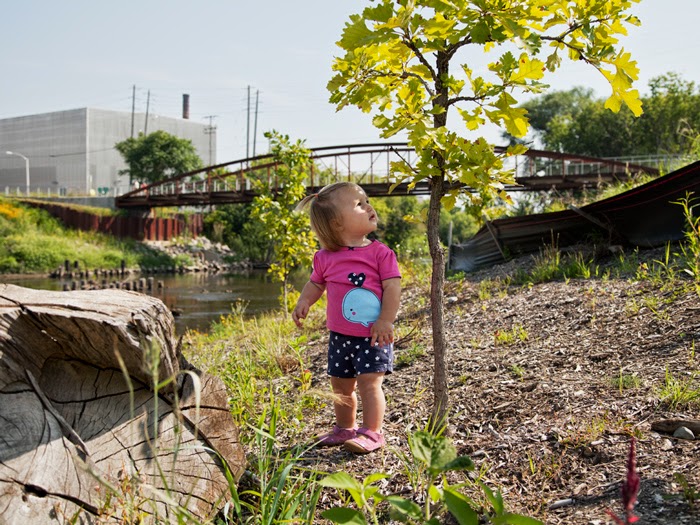
Ruby and the Tree: Growing with 3 Bridges Park
-->
In the year since that first photo was taken Ruby already
has grown significantly, of course. She now toddles around the tree, the nearby
log, and the rocks along the path. The park too has begun to bloom. The earthen
slope, still predominantly covered in protective burlap, sprouts spindly
saplings, thin patches of rye grass and the occasional wildflower. Dan
concludes, “It’s nice to see all of this happening all at once right here where
we live in the center of Milwaukee.”
It is at once perfectly ordinary and miraculous each time a
baby is born into a loving family as it was for Dan and Nora not long ago. By
contrast, the creation of an urban park isn’t an ordinary event and although in
retrospect it may seem like a miracle, it is not. The establishment of 3
Bridges Park in Milwaukee’s Menomonee Valley was the result of a long planning
process, hard work, and no small financial commitment. 3 Bridges Park arrived the
same year as Dan and Nora’s daughter, Ruby.
The coincidence of these seemingly unrelated events has
become intertwined for the young couple who saw in them new beginnings not only
for their family but also for the community at large. Moved by the symbolism of
new life and growth, they began what they intend to be an annual ritual. They
agreed to let me accompany them and to share their story.
On a warm, sunny afternoon in August I met the three of them
at their home in the Merrill Park neighborhood on the north edge of the
Menomonee Valley. After bundling Ruby into her stroller, we headed past the 35th
Street viaduct towards the freeway underpass where 32nd Street
connects with Canal Street. Dan, who works for Layton Boulevard West Neighbors,
explained that he takes the viaduct back and forth every day to his job near 27th
and Greenfield. For casual walks in the Valley and to reach the park they
prefer the Canal Street route. Although less direct, it’s quieter and they
generally see other people using the Hank Aaron State Trail, which parallels
the roadway.
We wound our way through the Menomonee Valley Industrial
Center, past Palermo’s Pizza, J.F. Ahern Co. and Falk Corporation, to where 33rd
Ct. ends at the middle of the three bridges leading into the park. We paused on
the bridge to look out over the river and the park. Dan pointed to the place
they had gone the year before to pick out a tree. “We thought it would be
meaningful,” he said “to document Ruby growing up as the park grows up.”
After we had circled around and descended the boat ramp
nearly to the water Dan gestured towards a small oak, its tender leaves
resplendent in the mid-day sun. He continued his story. “We found the tree in
this picturesque spot. You can see the river and the middle bridge in the
background.” They sat infant Ruby next to the tree and snapped the shot.
“The idea,” Nora told me, “is that every year around the
same time we will come back and take a picture so that as she grows and the
tree grows and the park grows up around it, we’ll get a record of that kind of
growth—the park, the community, our daughter.”
I looked up from the tableau of this family and their
symbolic tree and surveyed the surrounding landscape. Suddenly, from this
vantage it seemed as though the city itself was growing up around the newly
created park. Perhaps it is, in a sense. Perhaps that’s the real lesson of 3
Bridges Park and of the Menomonee Valley redevelopment process. Like Ruby, we
all have an opportunity to grow together with a new and sustainable urban
landscape. After all, building a park out of an abandoned brownfield is a
hopeful act.
Ruby and the tree are a perfect symbol for the desire to
improve our world. The motivation for planting trees is to some degree the same
as for having children: they embody our dreams for a brighter future.
This post is one in a series that
relates to my Menomonee Valley Artist in Residency. For more information about
the residency and links to previous posts and photographs, go to MV AiR.
Labels:
3 bridges park,
city,
ecology,
environment,
growth,
menomonee,
milwaukee,
nature,
park,
people,
river,
three bridges park,
urban,
valley,
wisconsin
Wednesday, June 11, 2014
Reverie: Riverside Park, Springfield, IL
Roughly patched macadam leads past vacant ball fields, broad
and Illinois prairie flat. A tree line hides the river until I reach where the
pavement ends and a sliver of concrete tilts, continues down into the brown
water. The Sangamon River flows languidly. Rays of rising sun burst into the
canyon between its tree-lined banks, illuminating exuberant spring greens in
the overhanging crown of the forest.
I walk the length of the pocked dirt road, skirting puddles,
river on my right. From the shadows ahead a squad car slowly approaches. The
officer and I exchange waves through window glass as he rolls by. Soft
crunching of gravel diminishes, leaving behind stillness, then birdsong. The
only other sound is the distant rumble of early morning traffic, muffled by the
trees. I walk between twin silences, river and forest.
A piercing mechanical roar disturbs the peace, tapers to a
hiss, ceases. Where the road ends a railroad cuts through the forest, crosses
the river on a trestle bridge. The source of the roar isn’t revealed. I head
away from the still silent river into the deeper, darker silence of the forest.
Black earth leads me, a trail cut precisely through luxuriant undergrowth. The
soles of my shoes gather mud until I am an inch or two taller and ungainly. I
stop to scrape on a log. This process is repeated again and again, though I’m
careful to accumulate only mud and not any of the horse manure that
occasionally blots the trail.
After a while the silence, punctuated with the cheerful warbling
of unseen birds, suddenly gives way to an enormity of fervent amphibian
utterances. The sound grows nearly deafening as I approach a woodland pond.
Sunlight pours into the opening in the forest, glares off the murky surface of the
pool as if to cast a spotlight on the cacophony. The pond is unapproachable,
the frogs imperturbable, the din unwavering in its intensity. In my mind hear
my wife’s voice penetrating the solitude: “That’s the sound of sound of sex,” she
invariably comments with an impish grin, hoping to get a rise out of me.
I am not lost. One could not get lost on this wide path. But
where it is taking me has become a mystery and a concern. I have passed
numerous forks and alternative routes, always choosing one that leads towards
the ever higher sun, which I’ve assumed would take me back to the road. Now, as
my deferred breakfast beckons and the mosquitoes thicken, I wonder. At the next
fork I cut north. A white tail deer plunges off the trail ahead. Before the
rumbling in my stomach grows uncomfortable I see the bright line of the open
field through the trees.
I’ve overstayed the early morning tranquility. Three mowing
machines crisscross the fields, buzzing distantly like mechanical mosquitoes. The
corral near the entrance, empty when I drove in, now holds a whole herd of
horses. The sun blazes down on the wide-open playing fields, flat as the
Illinois prairie.
Labels:
ecology,
environment,
forest,
hiking,
illinois,
nature,
park,
parks and recreation,
river,
Riverside,
sangamon,
springfield,
urban nature,
woods
Monday, May 12, 2014
A spring morning at the Urban Ecology Center
Randy Powers is the proprietor of Prairie Future Seed Company, which specializes in the propagation, proliferation, and care for native species. Saturday morning he was out in front of the Urban Ecology Center selling flowers.
![]() |
| Potted Queen of the Prairie seedlings |
Jeff Veglahn, the Urban Ecology Center's Land Steward, helps out with the sale.
![]() |
| Wild Iris |
A group of girls representing three scout troops from Whitefish Bay and Mukwonago went on a birding expedition along the Menomonee River, led by UEC staff.
![]() |
| Observation Deck |
Pausing on the eroded riverbank to view a family of Canada geese swimming to the opposite shore.
![]() |
| Adaptable species, the Canada goose. |
![]() |
| View from the Hank Aaron State Trail |
Oaks are late bloomers. Sandbar willows form a bright green backdrop for this oak, yet to bud out. If you turn 180 degrees from this point overlooking the river and look across Canal Street you see this:
Life in the urban wilderness.
This post is one in a series that relates to my Menomonee Valley Artist in Residency. For more information about the residency and links to previous posts and photographs, go to MV AiR.
Thursday, May 8, 2014
Nature and Community: Reviving the Spirit
-->
This
post is one in a series that relates to my Menomonee Valley Artist in
Residency. For more information about the residency and links to
previous posts and photographs, go to MV AiR.
On a trip through the high Sierras John Muir came upon a
particularly lovely glen with a river running through it. He climbed a large
boulder in the river, which he likened to an altar. After musing upon the power
of spring floods to move boulders he rhapsodized about moss, the clear pool,
blossoming lilies and light coming through overarching leaves. “The place
seemed Holy,” he concluded, “where one might hope to see God.”1
Muir was hardly the first to equate nature with holiness. His
descriptions of wilderness experiences often bordered on spiritual ecstasy and yet
they were paired with keen phenomenological observations and precise taxonomic
identification of plants and animals he encountered. Muir clearly was
comfortable blending empirical science with personal theology. His rigorously
analytical mind was open to mysticism.
I recently picked up a volume of Muir’s writing, thinking it
was time for me to revisit his perspective on nature. I’d been asked to talk
about the spiritual component of my urban wilderness escapades. It was not the
first such request I’d received and, like Muir, I recognize and welcome the spiritual
dimension of my own examinations of nature, urban and otherwise.
When I first began to explore the Menomonee River for my
book, Urban Wilderness, my impulse
was analytical and documentary. My episodic travels would take me nowhere that
hadn’t been thoroughly mapped as well as completely altered by hundreds of
years of human activity. Nevertheless, in a very real sense it was a journey of
discovery. Among the many surprises of that endeavor was the spiritual presence
I felt in undeniably compromised remnants of nature.
No matter where I went in the watershed I could find pockets
of blessed tranquility, whether a grove of stately trees, a marshy oxbow in the
river, or a sunny meadow enlivened with a chorus of birdsong.
Unlike Muir’s, my wilderness has been interwoven inextricably
with an urban fabric. My spiritual experiences may not have been quite as
ecstatic as his, but they are no less real. I discovered that I didn’t have to
travel to the high Sierras to encounter the sublime or to consider nature
sacred. As I wandered along the rivers I did occasionally have to ignore the
sounds of traffic from a freeway somewhere out of sight. However, this was not
only possible but became an essential element of my spiritual practice. Muir,
undisturbed by the mosquitoes in his wilderness, said, “Imagination gives us
the sweet music of tiniest insect wings….”2
Now, however, the request to speak of the spirit inherent in
my artistic practice made me pause. Fifteen years ago, when I “discovered” the
Menomonee Valley it truly was an urban wilderness. It’s wild state and my
imagination enabled me to savor the sublime. Today, I find those same places
transformed and “civilized.” In my role as resident artist in the Menomonee
Valley, I suddenly realized, I had relinquished the very wildness that had
first attracted me there.
The original Valley environment, a broad marsh of wild rice,
had been first trampled, then tamed and, finally, abandoned by human industry. Wildlife
had gradually re-inhabited the vacated landscape. In the shadows of viaducts a
forest grew up around crumbling buildings. Coyotes prowled through meadows of
wildflowers. A peregrine falcon perched atop a disused chimney, terrifying
songbirds in the bushes below. Ironically, of all the places I visited in the
watershed, the unlikeliest, the industrial valley, was among the wildest. That
wildness was both muse and spiritual touchstone. This was my Sierra!
Fifteen years after my first explorations of it the Valley
is in the midst of yet another transformation. The forest has been trimmed to a
riparian fringe. A conventionally landscaped industrial park has replaced the
meadows. The newly created parklands and the rehabilitated river are lovely, of
course. They also are vital and inspiring. But only with an exceedingly generous
imagination can they be called wild. Reluctantly, when describing the Menomonee
Valley I now resist the term, “urban wilderness” that so motivated my earlier
artistic practice.
But, in the absence of wildness, what has become of the
spiritual dimension of my practice? In the current issue of Orion magazine Paul
Kingsnorth wrestles with the same question: “On wild hilltops…I have pulled at
the edges of some great force that seems way beyond me, a force that seems
embedded in the world itself; the wild world of beauty and complexity and dark
magic that my kind are busy destroying and replacing with a culture of
future-worship and straight lines. If anything is sacred…surely it is this
thing we call ‘nature.’”3
Of all places in Milwaukee the Menomonee Valley arguably has
suffered the most from this tendency to replace a wild and fertile nature with
the straight lines of mechanized “civilization.” Clearly, the chance to
experience a sublime version of wild nature, in the tradition of Muir, is now
more remote. And yet, I am not discouraged. Far from it!
The Valley no longer is a wild rice marsh, but neither is it
the unrelieved industrial zone that replaced that marsh. More importantly, I
believe, we citizens of Milwaukee no longer are the people who tore down the
limestone bluffs to crush the marsh. We are beginning to envision a city where
industry and nature can coexist. Not only here in Milwaukee, but across the
globe, we are part of a nascent but burgeoning movement, a shift in thinking
away from the binary either/or of wilderness vs. civilization. We see a “third
way” of integrating the two.
In the aftermath of Hurricane Sandy New York City has been
forced to grapple with the need for an integrated approach to rebuilding. In
the same issue of Orion Meera Subramanian asserts, “It seems increasingly clear
that there may be a third way: an approach that blends a trace of conciliation
with an abundance of creativity, using hints from the ecological past to design
the coastlines of the future.”4
You don’t need a hurricane-ravaged coast to appreciate the
wisdom of this new approach. Hints from our ecological past and, yes, an
abundance of creativity have informed the redevelopment of the Menomonee Valley.
What has made this new transformation possible is as old as the origins of
human culture: a concern for community.
In modern Western culture the human community, beginning
with its so-called “Enlightenment,” has been led away from natural communities.
The separation of humankind and “nature” was always artificial. No, the
ecologies of cities and of forests are not comparable, but at its core ecology
teaches the importance of interconnections. Although Western cultural tradition
led us unilaterally to disassociate ourselves from nature—with tragic and
global consequences for both sides of the equation—we can never really sever the
human from the natural. Global climate change is teaching us that human
communities are not sustainable without reintegration with the ecological
community.
Have I digressed from my theme of finding something
spiritual in my work? Not at all. Like a voyage of discovery, a spiritual quest
veers in directions dictated by winds of contingency and circumstance, rather
than a predetermined plan. Just as my earlier exploration of the Menomonee
River watershed led to unforeseen spiritual insights, so too has this new
endeavor. I too am “pulled at the edges of some great force that seems way
beyond me.” But the windswept hilltops where I feel this power are not wild but
bulldozed into shape, engineered by imagination and human agency.
That great force is embedded in the faces of the people;
people who care deeply about this place. Some of them are visionaries boldly determined
to create a future worth worshiping. Others are newcomers to the Valley, welcomed
into it by the latest transformation. In their eyes I see the marvel of
discovery: that the straight lines of civilization can intersect with the
lyrical curves of nature.
And so my spiritual quest turns full circle; my faith in the
human community complements and deepens my enchantment with the earth. The
sacredness of nature isn’t diminished when we recognize our own worth. If
anything is sacred, surely it is this thing we call ‘human.’
Science and industry have granted us the power to shape the
world in ways previous generations couldn’t imagine. But in order to wield that
power for the benefit of the community it takes a human heart and human spirit.
As with the coastal modifications being done along the Long Island shore, the
transformation underway in the Menomonee Valley integrates the human community
with a restored natural environment. Urban, economic redevelopment is
complemented with sensitivity to ecological systems.
Dr. Martin Luther King, Jr. envisioned a Beloved Community “in
which all people can share in the wealth of the earth.”5 People
yearn for that inclusive and joyful community, consciously or not. In the
Menomonee Valley there is a conscious attempt to create it. That community is
not only visionary, it is sacred.
Notes:
1. Muir: Nature Writings, 1997.
2. The Wilderness World of John Muir, 2001
3. Kingsnorth, Orion Mar/Apr 2014
4. ibid.
5. TheKingCenter.org
The two photos at the top are from Urban Wilderness: Exploring a Metropolitan Watershed, Center for American Places, 2008. The other three are Adam, Laura and Omar: 2014.
Labels:
ecology,
environment,
holy,
menomonee river,
menomonee valley,
muir,
nature,
redevelopment,
restoration,
sacred,
spirit,
spiritual,
urban nature,
wild,
wilderness,
wildness,
wisconsin
Subscribe to:
Posts (Atom)