Showing posts with label wildness. Show all posts

Thursday, May 8, 2014

Nature and Community: Reviving the Spirit

-->
On a trip through the high Sierras John Muir came upon a particularly lovely glen with a river running through it. He climbed a large boulder in the river, which he likened to an altar. After musing upon the power of spring floods to move boulders he rhapsodized about moss, the clear pool, blossoming lilies and light coming through overarching leaves. “The place seemed Holy,” he concluded, “where one might hope to see God.”1

Muir was hardly the first to equate nature with holiness. His descriptions of wilderness experiences often bordered on spiritual ecstasy and yet they were paired with keen phenomenological observations and precise taxonomic identification of plants and animals he encountered. Muir clearly was comfortable blending empirical science with personal theology. His rigorously analytical mind was open to mysticism.

I recently picked up a volume of Muir’s writing, thinking it was time for me to revisit his perspective on nature. I’d been asked to talk about the spiritual component of my urban wilderness escapades. It was not the first such request I’d received and, like Muir, I recognize and welcome the spiritual dimension of my own examinations of nature, urban and otherwise.

When I first began to explore the Menomonee River for my book, Urban Wilderness, my impulse was analytical and documentary. My episodic travels would take me nowhere that hadn’t been thoroughly mapped as well as completely altered by hundreds of years of human activity. Nevertheless, in a very real sense it was a journey of discovery. Among the many surprises of that endeavor was the spiritual presence I felt in undeniably compromised remnants of nature.

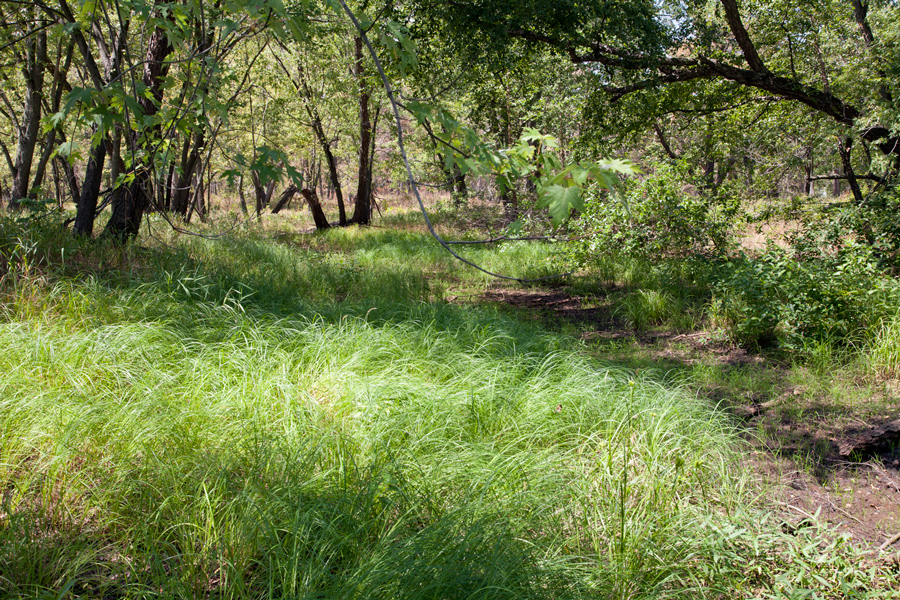
No matter where I went in the watershed I could find pockets of blessed tranquility, whether a grove of stately trees, a marshy oxbow in the river, or a sunny meadow enlivened with a chorus of birdsong.

Unlike Muir’s, my wilderness has been interwoven inextricably with an urban fabric. My spiritual experiences may not have been quite as ecstatic as his, but they are no less real. I discovered that I didn’t have to travel to the high Sierras to encounter the sublime or to consider nature sacred. As I wandered along the rivers I did occasionally have to ignore the sounds of traffic from a freeway somewhere out of sight. However, this was not only possible but became an essential element of my spiritual practice. Muir, undisturbed by the mosquitoes in his wilderness, said, “Imagination gives us the sweet music of tiniest insect wings….”2

Now, however, the request to speak of the spirit inherent in my artistic practice made me pause. Fifteen years ago, when I “discovered” the Menomonee Valley it truly was an urban wilderness. It’s wild state and my imagination enabled me to savor the sublime. Today, I find those same places transformed and “civilized.” In my role as resident artist in the Menomonee Valley, I suddenly realized, I had relinquished the very wildness that had first attracted me there.

The original Valley environment, a broad marsh of wild rice, had been first trampled, then tamed and, finally, abandoned by human industry. Wildlife had gradually re-inhabited the vacated landscape. In the shadows of viaducts a forest grew up around crumbling buildings. Coyotes prowled through meadows of wildflowers. A peregrine falcon perched atop a disused chimney, terrifying songbirds in the bushes below. Ironically, of all the places I visited in the watershed, the unlikeliest, the industrial valley, was among the wildest. That wildness was both muse and spiritual touchstone. This was my Sierra!


Fifteen years after my first explorations of it the Valley is in the midst of yet another transformation. The forest has been trimmed to a riparian fringe. A conventionally landscaped industrial park has replaced the meadows. The newly created parklands and the rehabilitated river are lovely, of course. They also are vital and inspiring. But only with an exceedingly generous imagination can they be called wild. Reluctantly, when describing the Menomonee Valley I now resist the term, “urban wilderness” that so motivated my earlier artistic practice.

But, in the absence of wildness, what has become of the spiritual dimension of my practice? In the current issue of Orion magazine Paul Kingsnorth wrestles with the same question: “On wild hilltops…I have pulled at the edges of some great force that seems way beyond me, a force that seems embedded in the world itself; the wild world of beauty and complexity and dark magic that my kind are busy destroying and replacing with a culture of future-worship and straight lines. If anything is sacred…surely it is this thing we call ‘nature.’”3

Of all places in Milwaukee the Menomonee Valley arguably has suffered the most from this tendency to replace a wild and fertile nature with the straight lines of mechanized “civilization.” Clearly, the chance to experience a sublime version of wild nature, in the tradition of Muir, is now more remote. And yet, I am not discouraged. Far from it!

The Valley no longer is a wild rice marsh, but neither is it the unrelieved industrial zone that replaced that marsh. More importantly, I believe, we citizens of Milwaukee no longer are the people who tore down the limestone bluffs to crush the marsh. We are beginning to envision a city where industry and nature can coexist. Not only here in Milwaukee, but across the globe, we are part of a nascent but burgeoning movement, a shift in thinking away from the binary either/or of wilderness vs. civilization. We see a “third way” of integrating the two.

In the aftermath of Hurricane Sandy New York City has been forced to grapple with the need for an integrated approach to rebuilding. In the same issue of Orion Meera Subramanian asserts, “It seems increasingly clear that there may be a third way: an approach that blends a trace of conciliation with an abundance of creativity, using hints from the ecological past to design the coastlines of the future.”4

You don’t need a hurricane-ravaged coast to appreciate the wisdom of this new approach. Hints from our ecological past and, yes, an abundance of creativity have informed the redevelopment of the Menomonee Valley. What has made this new transformation possible is as old as the origins of human culture: a concern for community.

In modern Western culture the human community, beginning with its so-called “Enlightenment,” has been led away from natural communities. The separation of humankind and “nature” was always artificial. No, the ecologies of cities and of forests are not comparable, but at its core ecology teaches the importance of interconnections. Although Western cultural tradition led us unilaterally to disassociate ourselves from nature—with tragic and global consequences for both sides of the equation—we can never really sever the human from the natural. Global climate change is teaching us that human communities are not sustainable without reintegration with the ecological community.

Have I digressed from my theme of finding something spiritual in my work? Not at all. Like a voyage of discovery, a spiritual quest veers in directions dictated by winds of contingency and circumstance, rather than a predetermined plan. Just as my earlier exploration of the Menomonee River watershed led to unforeseen spiritual insights, so too has this new endeavor. I too am “pulled at the edges of some great force that seems way beyond me.” But the windswept hilltops where I feel this power are not wild but bulldozed into shape, engineered by imagination and human agency.

That great force is embedded in the faces of the people; people who care deeply about this place. Some of them are visionaries boldly determined to create a future worth worshiping. Others are newcomers to the Valley, welcomed into it by the latest transformation. In their eyes I see the marvel of discovery: that the straight lines of civilization can intersect with the lyrical curves of nature.

And so my spiritual quest turns full circle; my faith in the human community complements and deepens my enchantment with the earth. The sacredness of nature isn’t diminished when we recognize our own worth. If anything is sacred, surely it is this thing we call ‘human.’

Science and industry have granted us the power to shape the world in ways previous generations couldn’t imagine. But in order to wield that power for the benefit of the community it takes a human heart and human spirit. As with the coastal modifications being done along the Long Island shore, the transformation underway in the Menomonee Valley integrates the human community with a restored natural environment. Urban, economic redevelopment is complemented with sensitivity to ecological systems.

Dr. Martin Luther King, Jr. envisioned a Beloved Community “in which all people can share in the wealth of the earth.”5 People yearn for that inclusive and joyful community, consciously or not. In the Menomonee Valley there is a conscious attempt to create it. That community is not only visionary, it is sacred.


This post is one in a series that relates to my Menomonee Valley Artist in Residency. For more information about the residency and links to previous posts and photographs, go to MV AiR.

Notes:
1. Muir: Nature Writings, 1997.
2. The Wilderness World of John Muir, 2001
3. Kingsnorth, Orion Mar/Apr 2014
4. ibid.
5. TheKingCenter.org

The two photos at the top are from Urban Wilderness: Exploring a Metropolitan Watershed, Center for American Places, 2008. The other three are Adam, Laura and Omar: 2014.

Friday, August 23, 2013

Postcards from Walden Pond

-->
“We need the tonic of wildness...At the same time that we are earnest to explore and learn all things, we require that all things be mysterious and unexplorable, that land and sea be indefinitely wild, unsurveyed and unfathomed by us because unfathomable. We can never have enough of nature.” ~ H. D. Thoreau.


“I went to the woods because I wished to live deliberately, to front only the essential facts of life, and see if I could not learn what it had to teach, and not, when I came to die, discover that I had not lived.” That, of course, is one of the more popular quotations from the man who made Walden Pond famous. The quote is popular enough to be carved into a wooden sign that stands next to the site of Thoreau’s even more famous cabin in the woods. That site is marked with granite pillars and iron chains.


Lots of people still “go to the woods,” that is, to Walden Pond, but few, it seems go to “live deliberately.” Fewer still go to find the solitude that Thoreau famously craved.  “I have never found a companion that was so companionable as solitude,” he said. (So he claimed, though society was never far off. He also said, “I had three chairs in my house; one for solitude, two for friendship, three for society.”


Mostly the multitudes come to swim in the pond, which is a fair sized lake (and quite warm, especially compared with the ocean. I can attest to that!)

They come in droves. Some find their way to the replica of Thoreau’s cabin that has been placed conveniently between large parking lots, across the road from the actual pond and quite a distance from the site of Thoreau’s actual cabin on the far side of the pond. That is to say, about a leisurely 15-minute walk, or 10 minutes at a brisk pace.


The replica of the cabin, along with interpretive signage and a curiously small bronze statue of Thoreau contemplating…what exactly? It appears to be his own hand.


Inside the replica of the cabin are replicas of the three chairs, a replica writing table, replica stove, replica bed with a replica moth-eaten woolen blanket neatly tucked in around it. Also, there were actual tourists. Here a boy holds up his illustrated copy of Walden for his mother who is wielding her cell phone camera. Others came through while I lingered, commenting on the size of the space, or its Spartan furnishings, or the smell. 

"It smells like ham," a group of four unaccompanied young girls all agreed. As they left, the tallest - presumably the eldest - told the others with authority, "This is his real cabin." One of the other girls asked plaintively, "Isn't this like a replica?" The first reasserted, "This is the real one." 

"Did he die here?" I heard one of them ask as they all strode off towards the pond. They were out of earshot before I could catch the answer. Just as well, I suppose.


I made the walk to the actual cabin site, of course. It took me longer than 15 minutes because I stopped frequently to observe, and photograph, the wildlife. All of it was of the human kind, although the sign on this unkempt pile of wood reads, "Turtle nesting site; please do not disturb."


The narrow path is lined with barbed wire. Thoreau wrote, “Say what you have to say, not what you ought. Any truth is better than make-believe.” I personally have no problem with a little make-believe now and then, but I'm with Thoreau on this one. This is Walden Pond, the straight facts.


At intervals were hung signs that read “Please stay on the trails…. Violators are subject to fines.” Neither the signs nor the barbed wire, it seems, are enough to thwart some people determined to enjoy the blessings of nature. Thoreau again: “All change is a miracle to contemplate, but it is a miracle which is taking place every instant.” Much has changed here at Walden; miracles, however, seem to be in short supply.


“A lake is a landscape's most beautiful and expressive feature. It is Earth's eye; looking into which the beholder measures the depth of his own nature.”  ~ H. D. Thoreau.
 
With apologies to Thoreau, I went to the woods deliberately because I wished to pay homage, to front the essential facts of life as it unfolds at Walden Pond in 2013, and see if I could not learn what it had to teach. I learned something. After all, "Only that day dawns to which we are awake. There is more day to dawn." 

I paid my respects. I also paid the State of Massachusetts to park and for the honor of owning a T-shirt inscribed with that most famous quote: “In wildness is the preservation of the world.” (Which, of course, was not among his writings from Walden, but the essay, “Walking.”)

In the end I went back to my car, which I had parked at the farthest corner of the lot, and I got out the picnic lunch that I’d brought along. I went a short distance along a trail that led away from the pond and the people. Warm sunlight dappled the scene before me. A low, marshy spot was visible through the trees. I sat on a boulder while I ate. No one passed. The solitude of the woods was a refreshing tonic.


“If the day and the night are such that you greet them with joy, and life emits a fragrance like flowers and sweet-scented herbs, is more elastic, more starry, more immortal- that is your success. All nature is your congratulation, and you have cause momentarily to bless yourself. The greatest gains and values are farthest from being appreciated. We easily come to doubt if they exist. We soon forget them. They are the highest reality. Perhaps the facts most astounding and most real are never communicated by man to man. The true harvest of my daily life is somewhat as intangible and indescribable as the tints of morning or evening. It is a little star-dust caught, a segment of the rainbow which I have clutched.” ~ H. D. Thoreau

Unlike the one on my new T-shirt, all of the other quotes in this post are from Walden, Thoreau's reflection on his two-year stay in this woods, near the pond. Before leaving I pause to reflect, to greet the day with joy, to understand that there is cause to feel momentarily blessed. I have taken my pictures, made my notes and learned a little of what this place has teach, but the true harvest is intangible.

Sunday, September 9, 2012

Urban Ecology Center opens in the Menomonee Valley

-->
The Urban Ecology Center opened in 1991. No, wait – it just opened today.* Yes; and the fact that both statements are true is a tribute to the entire community and provides hope for the future of Milwaukee – and the world. Hyperbole? One of Thoreau’s most famous quotes is often taken out of context: “In Wildness is the preservation of the world,” he wrote; and then he went on: “Every tree sends its fibres forth in search of the Wild. The cities import it at any price.” If Thoreau only knew how desperate is the need in most cities today, over one hundred and fifty years after he penned those words!

But we in Milwaukee are more fortunate than most. Not only do we have a wealth of “wildness” in the form of natural areas in our parks, but also we have one of the most remarkable and effective educational resources in the country heralding its importance.

The Urban Ecology Center first began bringing Milwaukee’s inner city school children to nature back in 1991. What opened today was the newest of three branches of the Urban Ecology Center, at 3700 W. Pierce St. in the Menomonee Valley. 

Ken Leinbach, Executive Director of the Urban Ecology Center with Kate Morgan of 1000 Friends of Wisconsin on the rooftop deck, which overlooks the Menomonee River in the background.

If you’re a follower of Urban Wilderness you know I love the Urban Ecology Center. I think it’s one of the very best things Milwaukee has going for it. One of the things I love the most is hearing the stories about the Center and the experiences children have as a direct result of the Center’s programs. 

From the podium at the opening ceremonies, Ken Leinbach, and Beth Heller, Branch Coordinator, mused about the day in 1991 when they first formulated the idea. “This was before we even had the trailer in Riverside Park,” Leinbach said. “We knew even then that we wanted a branch in Washington Park. We knew we wanted to serve the South Side. And now, here we are next to a park that’s being built from scratch!”

Ask Leinbach about the Valley Passage, which is a short tunnel under a single railroad track that provides the new Center – and the nearby Silver City community – access to the Menomonee River, the Hank AaronState Trail, and the unfinished park. He will tell you about the intense negotiations – with the City, the County, the railroad and the companies it serves, among others – that were necessary to make that passage possible. …And the remarkable single night of construction that it took to build the passage under a working rail line that couldn’t be interrupted even for one day.

Beth Heller introduced Glenna Holstein, whose personal story exemplifies the mission of the Center better than any other. As a teen Glenna experienced some of the earliest programing offered by the Center in its infamous double-wide trailer in Riverside Park (before the construction of their current multimillion dollar, award-winning, 20,000 sq. ft. “green”building.) Glenna now has come full circle. Her new job, as branch manager of the Menomonee Valley Branch of the Urban Ecology Center has just begun.

Glenna Holstein helps Aniyah plant a seedling along the Hank Aaron State Trail in the still unfinished park.

The most moving story in a long series of moving stories came from Laura Bray, Executive Director of the Menomonee Valley Partners, a non-profit that shares much of the glory in the celebrations of this opening ceremony. She recalled growing up near the Milwaukee River in the 1980s. But she was not allowed to go there because it was unsafe. When it was her turn to raise children, she said, she deliberately moved to the Riverwest neighborhood so that she could encourage her children to go to the Milwaukee River and break the cycle of disengagement with nature. The tears in her eyes brought tears to my own. Children need nature. In Wildness is the preservation of the world – and our physical and mental health. We all need safe parks and rivers.

The fact that the Milwaukee River, and now the Menomonee River, have safe parks for us to take our children to today is due in no small part to the Urban Ecology Center.

Celebrants of all ages were serenaded by a mariachi band and other musicians.

 A beautiful mosaic mural hangs in the new Center. It was made by neighborhood children, teens and adults under the direction of mosaic artist Leann Wooten, who was on hand to explain some of the symbolism. References to rivers, flowers and trees are clear enough, but the three moons represent the three branches of the Urban Ecology Center itself. Most important, she said, it is the spirit of collaboration that went into its creation. This symbolizes a world in which we are all connected not only to each other but also to the natural world all around us. In Wildness is the preservation….

Urban Ecology Center educator Dan Graves leads a diverse and enthusiastic crowd as they head out to plant native wildflowers in the new park.

Everett plants a seedling.

Beekeeping is in the planning stage at this new Center, but several beehive frames ready to be harvested were imported for the day. Below, family members Seamus, Anna, and their mother, Beth, help scrap the wax cap from a frame of cells.

On this first day the Center is already doing what it does best: allowing children, of all ages, to get their hands dirty – and sticky!


Sandwiched between the Menomonee River and the still active railroad line, Milwaukee’s newest park, as yet unnamed, is taking shape. Not only is it being “built from scratch,” but it reintroduces nature into the most industrialized and long abused valley in the region, if not the state. Thoreau, were he alive to reflect on it, might amend his famous prescription: In urban wildness is the preservation of the world. If our children can’t experience nature where they live, in cities, then the future will be bleak. Here in Milwaukee, at the Urban Ecology Center and in the Menomonee Valley, there is a vision for a brighter future.


*I wrote this on Saturday, September 8, 2012.

Thursday, August 9, 2012

A visit to “Sand County”


I could have waited for the hand of autumn to paint the land with glorious color. I could have cleared a day on my calendar. But then, in all likelihood, something urgent would have come up to preempt my trip. Besides, I’ve already waited far to long to visit Aldo Leopold’s farm.

I picked up my first copy of Leopold’s classic “A Sand County Almanac” sometime in my idealistic youth, when Wisconsin was just one of many unexplored states west of my home in New York. That slender volume with its cover illustration of wild geese calling, now yellowing and worn with age, has survived many a move. The most important brought me permanently to Wisconsin. Coincidence.

Since then, over more decades than I care to enumerate, I often thought about visiting “the shack” where Leopold lived, wrote, and experimented with the ecological ideas that made him justifiably famous. Though fame and influence have a way of crossing over into mythos, Leopold’s writing, both eloquent and accessible, rooted him firmly in the real world. I’ve never tired of rereading the “Almanac” but my latent aspiration went unconsummated.

Until today.

The trip wasn’t planned; you won’t find it on my calendar. On impulse, “with such dignity as I can muster of a July morning,” as Leopold wrote in his almanac entry for this month of deepest summer, I set out from the city to satisfy finally my long-dormant desire. Two hours later I leave the freeway and head west through cornfields on a rural road that skirts the Baraboo hills, which are distressingly brown due to drought. A turn north takes me towards the Wisconsin River. The roads get progressively narrower and trees close in overhead. 

When Leopold bought his 80 acres along the Wisconsin River in 1935, it was little more than sand, having been cleared, over-farmed, and abandoned. I salute the dense forest that greets me on the final leg of my pilgrimage, knowing it to be the result of careful restoration efforts by Leopold and his family in the 1930’s and 40’s.

The Leopold Center parking lot is full and its courtyard rings with a lively clamor. But down the road a piece there is only one car pulled off to the side where a humble log fence barely keeps the forest at bay. Fittingly, no signs mark the place. Leopold savored his solitude. The conundrum for this particular kind of historical site is how best to honor the founder’s intentions while welcoming a multitude of tourists eager to share in the experience. A passage from the Almanac is especially poignant: “There are degrees and kinds of solitude,” he wrote, as he described with relish being stranded by spring floods.

I set off through the thick stand of aromatic pines. An unlocked bicycle is propped against a trunk. A low post bears an elegantly designed numeral for the self-guided brochure I picked up at the Center. I read that 3,000 pines were planted every year despite the “dust-bowl conditions” that decimated the plantings with “95-99% mortality.” I ponder perseverance as the forest broods in deep shade under the midday sun.

“The Prairie” opens suddenly before me. Bursts of white wild indigo with vibrant gray-green leaves stand out against prematurely yellowing sedges and prairie grass. Tall rhizomes reach skyward; the white flowers that give this species its name already have become strings of seedpods, many well on their way to mature black. Leopold was forward thinking in so many ways. This patch of sun and deep-rooted flora was a pioneer restoration project at a time when prairie landscapes were still underappreciated.

Then, surprisingly close to the road, I recognize the asymmetrical roofline snuggled up against the woodland and the weathered gray wood siding and white door of “the shack.” It is not the farm’s most important feature, certainly not in the ecological sense. But the weight of his presence makes it Leopold’s most distinctive “signature on the face of the land.” The shack is modest and utilitarian. What, I wonder, would Leopold make of the sturdy padlock required to prevent admirers from walking off with his teakettle for a keepsake? Or one of the turtle shells he placed on a shelf along with his axes, shovel and saws?

A few paces away, notched in a pine and cedar grove, is the outhouse. This decidedly more modest and utilitarian edifice, built by Leopold’s son, was engagingly dubbed “the Parthenon.” We value most the things that we make with our own hands.

Compelling as they are as part of a portrait of the man, these material artifacts are not what I have come to see. Leopold himself concludes the foreword to his Almanac with the words, “Nothing could be more salutary … than a little healthy contempt for a plethora of material blessings.” No, I have come to walk the land that he so cherished, to listen for the birdcalls that he so lovingly describes, to steep myself in this very personal and yet universal biotic community.

I find the sand farther on, near the river. It’s a wonder anything can grow here! But the evidence of nature’s resilience is incontrovertible. Oak saplings spring from the sand like biological explosions. Sauk is the actual name of this county. Leopold titled his almanac to express the ubiquity of sand and the hardships involved in farming on – or restoring it.

In fact much of the underbelly of the entire state of Wisconsin is sand. Ironically, we are blessed with such nice sand – a very pure form of silica dioxide bearing a high compressive strength – that it is in great demand as a hydrofracking proppant. The sand is mixed with water and chemicals and then the resultant toxic slurry is injected at high pressures into fissures deep below the earth’s surface. The purpose of this violent and controversial process is to shake up shale and other rock sufficiently to release oil and natural gas. Thus we feed our fossil fuel addiction.

I kick up a spray of sand, musing on one of Leopold’s most important and oft-quoted passages: “We abuse land because we see it as a commodity belonging to us. When we see land as a community to which we belong, we may begin to use it with love and respect.” How would the author of “A Sand County Almanac” feel, I wonder, if he knew that the sand, bane of agriculture and forest restoration alike, was being extracted “in excess of 12 million tons per year?”1 Large swaths of Wisconsin countryside, both farms and forests, are being ignominiously scraped away and transported to distant states with lucrative oil shale formations.

“Like winds and sunsets, wild things were taken for granted until progress began to do away with them. Now we face the question whether a still higher ‘standard of living’ is worth its cost in things natural, wild, and free.” He wrote that in 1949! “For us in the minority,” he continued, “the opportunity to see geese is more important than television, and the chance to find a pasque-flower is a right as inalienable as free speech.” Minority indeed; as I look out over the wide Wisconsin River I am enjoying a hefty measure of the solitude Leopold sought in this very place. Though delightfully peaceful it confirms my membership in “the minority.”

The river is uncommonly low. It too seems to consist more of sand than water. Except for some dead logs, the surface remains unbroken under the hot July sun. No insects stir the air; no fish rise to seek them. A pair of gulls squabbles half-heartedly on the far shore. Scorched grasses and shriveled wildflowers line the riverbanks.

The drought I’d observed earlier plagues huge swaths of the state.

Is the drought an anomaly or a symptom of global warming? The governor – who disputes the possibility of global warming on ideological rather than scientific grounds – recently declared 23 counties disaster areas. It is, indisputably, the worst drought in 24 years and counting, with no relief in sight. As I stroll through brown, desiccated grass I come upon a brake of scrawny and twisted berry canes, blackened as if by fire. A hard, tiny nub of a berry adorns the tip of each cane, so completely shrunken and disfigured that I can’t tell if they are wild raspberries, blackberries, or some other kind. Drained of all succulence, neither bird nor passing pilgrim will dine on these drought-charred berries.

Even in the shade of a boggy dell where ground cover remains green, I find deer tracks like future fossils embedded deeply in mud so dry that the weight of my step doesn’t squeeze out even a teardrop of moisture.

The self-guided trail is a short loop that could be circumnavigated in less than half an hour, even stopping to read the brochure at every marker. My pace is leisurely. Each new unfolding moment I hold like a Rosary bead, feeling blessed. In the midday heat there are few signs of wildlife. I disturb a sunbathing turtle, which abandons its post on the end of a log with a peremptory plop. A disheveled knot of unidentifiable downy white feathers in the grass hints at the daily struggle of life in the wild. Farther on two empty halves of a shell leave no doubt that someone made a lunch of river clam.

In his July chapter Leopold informs us, “During every week from April to September there are, on the average, ten wild plants coming into first bloom.” But on this late July day the woods seem bereft of flowers. Perhaps it’s the drought, or just the low point of deepest summer when the law of averages balances out profligate spring. “In June as many as a dozen species may burst their buds on a single day.” Not now.

I am not complaining. There is no wrong time to for a walk outdoors. Leopold tells us “It is, by common consent, a good thing for people to get back to nature.” But what kind of nature do we find when we “get back to” it? Leopold’s farm, in many ways, was and still is a laboratory for nature, for ecological restoration.

Everywhere I walk I notice small, unnaturally bright orange flags festooning the groundcover, seemingly at random. I knew better than to expect a wilderness. Leopold himself identifies an inherent conflict: “All conservation of wildness is self-defeating, for to cherish we must see and fondle, and when enough have seen and fondled, there is no wilderness left to cherish.” The flags, I learn, mark patches of invasive garlic mustard so that the foundation staff can locate new sprouts early in spring before they have a chance to propagate. In lieu of wilderness we have, wisely it seems to me, opted for nature that is “husbanded” – managed for healthy and sustainable biodiversity.

I don’t know when I first began to hear the sound of traffic. The increase in volume has been gradual as I walk a ridgeline, following the self-guided trail through the pines. But as I near the last marker on the trail, without any obvious crescendo, I am suddenly aware of the loud, persistent hum of rubber on concrete. Startled in equal measure by its familiarity and incongruity, I am struck with the uncomfortable realization that I might well be back in Milwaukee, walking as I so often do along the Menomonee River Parkway trying to ignore the same noisome intrusion.

It is not visible from here, but a steady stream of travelers on the interstate freeway passes by within earshot. The phenomenon is not unlike that of the railroads in Leopold’s time, which “began to carry city-dwellers, en masse, to the countryside.” The effect, he lamented, was that “the greater the exodus, the smaller the per-capita ration of peace, solitude, wildlife, and scenery, and the longer the migration to reach them.”

This very freeway, of course, brought me here for my own personal ration of the same natural amenities. “The automobile has spread this once mild and local predicament to the outermost limits of good roads—it has made scarce in the hinterlands something once abundant on the back forty.” Ironically, I have made my pilgrimage only to find the truth that I’ve known well all along: what I sought is indeed available to me in the “back forty” of my beloved urban wilderness areas of Milwaukee. After nearly three hours, feeling fully steeped in Leopold’s oeuvre, I’ve “come home” in more ways than I’d imagined possible when I set out this morning.

Two centuries ago when the Industrial Revolution began, there’s been a steadily accelerating assault on the natural systems that our planet needs to survive. The wilderness has been driven back on every front. But we may finally be approaching full circle when “getting back to nature” is unremarkable, when our culture sufficiently values nearby nature to ensure that it is available to “city-dwellers.” Cities are where most of us live today. Urban parks are the equivalent of Leopold’s “back forty.” This has to be more than a metaphor. We have to get out of our cars and go to them to find “refuge from too much modernity.”


1Silica Sand Mining in Wisconsin, Wisconsin Department of Natural Resources, January 2012.