Wednesday, January 30, 2013

What a difference a day makes!


Yesterday’s high of 61° melted what little ice remained on the river. That on top of the rainfall made the Menomonee River bulge. The ground thawed as well. As evening fell, a thick ground fog rose over muddy soccer fields here at Hoyt Park as well as over the river. I became confused when I first stepped outside. My body, like muscle memory, reacted with relief and joy at the spring-like warmth. Even so, it felt wrong mentally, for I knew it couldn't be spring. Groundhog Day is still three days away!


Today, of course, we had snow. Twenty-four hours later it is 26° and still falling towards a projected low of 11°. The river is even higher; the soccer fields a featureless sheet of white.


High water, erratic temperatures and extreme weather events have become the new normal in this time of climate change. Just ask those who are still rebuilding after Hurricane Sandy. And those of us who believed in global warming all along feel no satisfaction in saying, “I told you so” to all those who didn’t. (At least I don’t.)


We thought we had dominion over nature. We fought--and, sadly, continue to fight--the wilderness into submission, making casualties of innumerable species, but we cannot conquer the wild. It returns with a vengeance.

What a difference a day makes. The trees that were mown down in one day in order to pave the way for progress at Innovation Park (see previous post) will not grow back in a day, or a year, or in our lifetimes. The climate will not go back to normal in our lifetimes either. We can bulldoze the landscape but when we strip nature we leave ourselves naked.


Try as we do, we cannot fence out the wild. The more we suppress it the greater its fury.

We must learn to live again with nature, to feel one with nature. Plant new trees, yes. But we must be very cautious about the ones that remain. They are more than symbolic of our willingness to compromise our earthly nest; they embody our spirit.

So—while there still is snow—go for a run in it with your mouth wide open.


Thursday, January 24, 2013

County Grounds tree cutting update


“Everyone likes trees. Some like them vertical; some like them horizontal.” ~ Anonymous

Delivered with droll humor over the phone, that was one of the multitude of responses I have received since I posted my previous story about the tree removal on the County Grounds. Many of the replies have been far more strident. What is most clear from the outpouring of grief and anger over this incident is that a great many people, both near and far, care very deeply about the fate of the County Grounds.

Here is a more typical response, from Gail, a Wauwatosa resident: “I am so heart broken – as I know so many other people are too. Please keep all of us, who have fought long and hard for this plot of land, in your thoughts as we go through the long painful process of mourning during the construction process….  To some of us this is where we go for spiritual uplifts….”

I am grateful, not only for the attention that this issue has received, but especially for the concern expressed by so many. I think that it is important to note that the concern goes beyond tree-hugging to encompass larger issues of land use, appropriate development for this unique site, and transparency as development proceeds.

As County Supervisor James “Luigi” Schmitt put it, “After it’s done, it’s done.” If there is a silver lining in this for those of us who reacted with shock and dismay it is that, while many trees have come down, the development of Innovation Park is far from done. This is the beginning. Still on the agenda is the upcoming and highly controversial decision about preserving vs. demolishing the Eschweiler buildings.

Accounts in the media also have evolved as concern has widened. Several of you sent me the link to the Fox 6 News spot (about the cold that the contractors had to endure to cut down those trees) that was posted on Monday, adding comments like “unbelievable.” You will be happy to learn that I was interviewed last night by a news team from CBS 58. The far more reflective piece they produced, which aired at 10 pm last night, is posted online.

Its president, David Gilbert, represented the position of the UWM Real Estate Foundation, which is responsible for the development. No one who has followed this issue closely will be surprised by the rationale he expressed. Yes, the DOT forced some of the choices. Yes, there has been a commitment to preserve an 11-acre habitat for wildlife. And yes, I definitely favor planting native tree species to replace those that were, as a story in WauwatosaNOW put it, “mown down.” 

A few of those trees were diseased; some of them were considered “weed trees.” But, while new trees can and should be planted, the hundred-year-old ones of any species (some were venerable and hardy) will not be “replaced” in our lifetimes.

One more significant clarification should be made: while the Friends of the Monarch Trail, among others, are grateful for the commitments made to preserve the 11-acre habitat zone, those 11 acres were not identified in isolation. The agreement by Milwaukee County at the time of the sale of the land to the Real Estate Foundation and adopted by the City of Wauwatosa included a Habitat Restoration Landscape Plan for the Northeast Quadrant. This plan contains guidelines for the entire Northeast Quadrant of the County Grounds, including Innovation Park. Among its goals is to provide a consistent character throughout the Northeast Quadrant and to utilize existing topography and natural resource features. (Emphasis mine.)

As County Supervisor Deanna Alexander put it to me in an email, “It was my understanding that some land would be cleared for development, but that most of the aesthetics of the area would be preserved….”

Notwithstanding my own photographs, this issue isn’t primarily about trees. It is about how we envision our community and whether or not we choose to integrate what we build with the natural environment. The County Grounds has been called the “most valuable real estate in Milwaukee County.” Why? Not because of its potential for development, but because of the location and its existing natural features, including magnificent views. The past few days have proved that many in our community envision something truly innovative on the County Grounds: development that is valued because it respects the natural features and the interests of the public.

The plan that made the UWM Real Estate Foundation, with its relationship to the university itself, the steward of the development zone was a compromise. I am among those who saw this as preferable to IKEA and a swath of condominiums, which were options being considered. I won’t say that the Real Estate Foundation has broken its promises, but it is obvious that skepticism has been generated.

The responses to what happened over the weekend have ranged from anguish to incredulity and raised many questions. I can’t answer them all. Here is one that I can answer: Jim Toth, in a comment on the blog, asked, “What will become of the "harvested" wood? There is probably hundreds of feet of furniture-grade lumber in those old trunks. Is it all destined for the chipper?”

Again, thank you to all for your concern, and in particular to several of the County Supervisors who took the time to reply. I encourage you once again to contact the following and to let them know about your concern. Venting is healthy; communication is healing.

The Wauwatosa Common Council 
The Milwaukee County Board of Supervisors
The UWM Real Estate Foundation, President David H. Gilbert:
The City of Wauwatosa:
Mayor Kathleen Ehley:  mayor@wauwatosa.net 
Paulette Enders, Development Director:  
William C. Porter, Director of Public Works:
wporter@wauwatosa.net

Monday, January 21, 2013

Slaughter on the Milwaukee County Grounds: Innovation What?

"The care of the Earth is our most ancient and most worthy, and after all our most pleasing responsibility. To cherish what remains of it and to foster its renewal is our only hope." ~ Wendell Berry

It is a cold day on the Milwaukee County Grounds. An icy front pushed through last night. My fingers are numb only minutes after leaving the car. But the tingling in the tips of my fingers, toes and ears is bearable compared to the numbness that afflicts my mind and soul as I behold the chilling operation that is underway.


I thought I was prepared for this. I’ve known something like this was coming for a long time now. There are some things – skydiving, the birth of a first child, going into battle – for which no amount of preparation can account. Is the cutting of a few old trees comparable? No, but the shock of seeing a stately and beloved grove of trees, some over a hundred years old, unceremoniously slaughtered is real. No, I am not prepared.


I take refuge behind my camera. Peering through its viewfinder distances me enough to record the event. My mind reverts to acquired routines: scout for points of view, frame compositions, wait for the action, … shoot. Shoot again. And again.


The action proceeds non-stop, so efficiently that it takes only two workers to level the entire grove before noon. The mechanical efficiency of the operation contributes to my shock. One worker operates the tree cutting machine and the other watches. He watches me. If they didn’t need someone to keep curious spectators away from danger, one worker could do the job.


They needn’t fear for my safety; I don’t want to be close to this.

The hydraulic arm of the tree-cutting machine is tipped with an entirely utilitarian and perfectly hideous combination of claws and spinning blade. The tractor clanks towards the next target. I expect it to jerk like a cinematic robot, but the arm rises smoothly, eases towards the trunk. There is a momentary hesitation; then it pushes straight into the gray bark. With a bright spray of chips the claws clamp onto the suddenly severed trunk and lift the entire tree, still upright, through the air. Like raising a toast!


The tree is released a good fifteen feet off the ground. It tilts slowly and falls. With a great crunch of breaking limbs and a splattering of branches, it collapses onto the earth. Then the machine pivots, moves on and does it again.


I am equal parts appalled and riveted.

The machine approaches a maple tree too large to topple in one swipe. It progresses methodically from limb to limb, lopping and tossing them aside as easily as my infant granddaughter tosses a toy in order to reach for another one.


The next tree, as the blade bites into it, explodes. Branches fly off in every direction and, though I have kept my distance, I am showered with a barrage of wood chips. I turn aside, protecting my eyes and lens from the cloud of dust that follows. When I turn back a flurry of dark, burnt umber oak leaves wafts in the updraft. Through the dissipating dust the machine’s operator sees me, then smiles and waves.

Burning questions bubble up, insistently. “Why?” doesn’t begin to express the inquisition the situation requires. In simple terms, I know the answer: The land has been purchased for its potential as real estate. It is intended to become a campus, a research facility, a business incubator, a privileged residential address. It will mean jobs, taxes, economic development. In the narrowly constrained rationalization that accepts the myth of progress a grove of trees cannot compete with all that.

But the real reason is even simpler: trees, along with uneven, natural contours, increase development costs. The cheapest way to maximize the utility of the land is to clear it and flatten it. This is supposed to be called Innovation Park. Where is the promise implied in the name?


The rotating steel blade catches the sun, gleaming. It spins relentlessly. As it snaps off another hundred-year-old trunk I can’t help feeling that conventional thinking bested innovation on this round.

Why, it must be asked, all of the trees? It is a failure of imagination to suggest that any of the intended uses of the property are inconsistent with the retention of strategically situated, mature, beautiful trees. That the people who one day will work and live in this place would not have benefitted by their healing presence.

Why is the bottom line always so bereft of what is truly valuable?

When will we begin to learn that value accrues to the ineluctable, spiritual qualities of nature as much as to material, economic considerations? When will we understand that by stripping the land of nature we leave ourselves naked?


I look away from my camera, tearing my eyes from the terrible and compelling activity I’ve been shooting with such intensity. I am confronted with a ravaged landscape. A rabbit scurries out of a woodpile, away from the uproar, disappears into another. The Milwaukee County Parks Administration building sits beyond, newly exposed in the bright, wintry light. Atop its pole the flag snaps in the wind. Land of the free….


When there is only one tree left, the spotter walks over to me and tells me he is leaving, perfunctorily warns me not to get too close. He understands that I will not. Then he, like the rabbit, vanishes.

The last oak stands, its lacy tangle of branches stark and black against the sky.

Then there is only sky.


Note: If, like me, you are saddened and disappointed by this and want to know what you can do, please contact the following with your questions and comments:
The Wauwatosa Common Council 
The Milwaukee County Board of Supervisors
The UWM Real Estate Foundation, President David H. Gilbert: -->
The City of Wauwatosa:
Mayor Kathleen Ehley:  mayor@wauwatosa.net 
Paulette Enders, Development Director:  
William C. Porter, Director of Public Works:
wporter@wauwatosa.net

To read another perspective on this topic, click on WauwatosaNOW.

Sunday, December 30, 2012

Marks and remarks from the Urban Wilderness

As I went out this morning light snow drifted slowly out of a clear blue sky. It was beautiful and mysterious, perhaps a portent on the cusp of a new year. Though if I believed in omens I might choose instead the coyote I spotted in the Menomonee Valley a few days ago. Instead of being sunny, a deep overcast was spitting sleet in spurts. The coyote's fur was sodden and dripping as it loped across the pavement in front of my car. It splashed in the icy roadside ditch, slipped through a chain link fence and on into the narrow field between the vast stadium parking lot and the railroad. The bent grasses amongst which it paused looked as bedraggled as it did. Above, I could see a steady stream of cars speeding by on the freeway. The coyote looked around briefly, then turned and slipped out of sight.

Some indigenous peoples of North America revere the coyote as the Creator. More commonly known as a Trickster, though, coyote may appear the fool or the clever impersonator. As I watched this lone, scrubby coyote disappear into perfect camouflage of its wintry surroundings, one thing is unambiguous - here is the wild incarnate. And, against what odds I can only guess, it lives in the heart of Milwaukee. The coyote may not in itself be the creator of the wild, but wherever it goes it does far more than impersonate what is wild. Coyote embodies the wild. To my way of thinking, that it can do this in the city is a good omen indeed.

In addition to my glimpse of the coyote, I caught many a photograph this year, as you may have come to expect if you are a regular to my blog. Three that I shot just yesterday near the Milwaukee River in Gordon Park accompany this post.


2012 was a year for the record books. Much of the reason was bad news. But as December draws to a close, I am mindful of a more hopeful report I heard this week that claimed this was a watershed year for at least one important reason. Due to several extreme climatic events, including Superstorm Sandy and the worst drought conditions since the Dust Bowl, the general public and the media finally caught up with scientists regarding the real and inarguable effects of global warming.

Here at Urban Wilderness I like to recall high points of the passing year, as do many of us. I feel fortunate to have been able to explore both near and far, to revisit familiar places and to discover new ones. There were a number of surprises along the way, which I recorded in posts throughout the year. Listed below, with brief annotations, is what I consider my best of 2012.

The most significant event of the year was the most personal, the loss of my mother at 87. In August I wrote about her influence on me and my love of nature: In memoriam

Other than that, my favorite moments, in chronological order:

The year began softly, in a January blizzard. My meditation on the day is called A snowy silence

In February I covered one of my most regular beats, the Milwaukee County Grounds with Ronald McDonald House plans expansion. Although the specific request by Ronald McDonald House was settled by the County Board of Supervisors in July (see my update), questions remain about the ultimate fate of one final corner of unprotected land.

Also in February, Historic Milwaukee held a forum called "Remarkable Milwaukee." I weighed in with What's remarkable about Milwaukee?

An illuminating trip to Houston, Texas inspired a trilogy of posts. The first installment is called Waking to a new world. (Links to subsequent installments follow each.)

In March I explored a new (to me) park in the Milwaukee County system : A warm gray day in Grobschmidt Park.

In April I was invited by the Great Waters Group of the Sierra Club to give a keynote address for their annual Earth Day celebration. Here is what I told them: Reflections on Earth Day

A new trail in the Cambridge Woods portion of the Milwaukee River Greenway generated controversy in May: Urban wilderness and accessibility

In June I visited the Chicago Wilderness along the Des Plaines River: The scent of summer

And a trip to Phoenix resulted in a two-part post: It's a desert out there! (A link to part 2 follows this post.)

In July I finally made a long-awaited pilgrimage to visit Aldo Leopold's shack on the Wisconsin River north of Madison: A visit to Sand County

There was wonderful news to report in September: A new branch of the Urban Ecology Center opens in the Menomonee Valley

In October, another two-part post, this time from New York City: The High Line: Good and Bad. (A link to part 2 follows this post.)

In November a short excursion led to a surprising discovery - Starved Rock State Park - two hours southwest of Chicago: Off Season

This was also the year when I finally got around to putting the finishing touches on a book too long in the works: The Milwaukee County Grounds: Island of Hope

Happy New Year from the Urban Wilderness!


Friday, December 21, 2012

Happy New “Cycle”

-->

Well, this morning dawned like any other, which came as no surprise to me. The apocalyptic predictions fizzled like so many previous ones have.

I did hear from one person who woke up this morning to the sound of unusual silence and a power outage. That proved to be the result of yesterday’s storm, however and not attributable to ancient – or modern – superstitions.

If you are still blissfully ignorant of the purported “end of the world” that some had predicted would happen yesterday, based on the Mayan Calendar, then good for you for living above or beyond the media chatter! Yesterday was considered to be the end of the 5125-year-long cycle that the ancient Mayan peoples used in what’s called the long count calendar. Presumably, then, the new cycle begins today.

Happy New Cycle!

May the next 5125 years be better than the last. At least by then whoever is around will know how this global warming business turned out.

I was delighted to open my New York Times last Sunday to find that their editors had turned to poetry to commemorate the event (or non-event).

Here’s one short poem from the collection they published that I found particularly trenchant:

AT FIRST I THOUGHT

The blue jay
Was the last leaf
To fall
When it rocked
From side to side And slowly tumbled
To land on the snow
Weightless
As a piece of sky
Broken off
The cold blue place
Where winter keeps
The number zero.
— TOM HENNEN

Of course today is also the winter solstice. So, if the whole Mayan calendar thing is meaningless, we still have that traditional reason to celebrate a new beginning today. I for one always welcome the return of the sun, gradual though it is. And what a beautiful day it turned out to be! Though the cold was punishing it was quite lovely while I could stand it. I went out to the County Grounds to look around at the new fallen snow and I make this offering to both the new Cycle and the solstice.


I will close with another poetic meditation, this one by Mary Oliver:

In the Storm

Some black ducks
were shrugged up
on the shore.
It was snowing

hard, from the east,
and the sea
was in disorder.
Then some sanderlings,

five inches long
with beaks like wire,
flew in,
snowflakes on their backs,

and settled
in a row
behind the ducks --
whose backs were also

covered with snow --
so close
they were all but touching,
they were all but under

the roof of the duck's tails,
so the wind, pretty much,
blew over them.
They stayed that way, motionless,

for maybe an hour,
then the sanderlings,
each a handful of feathers,
shifted, and were blown away

out over the water
which was still raging.
But, somehow,
they came back

and again the ducks,
like a feathered hedge,
let them
crouch there, and live.

If someone you didn't know
told you this,
as I am telling you this,
would you believe it?

Belief isn't always easy.
But this much I have learned --
if not enough else --
to live with my eyes open.

I know what everyone wants
is a miracle.
This wasn't a miracle.
Unless, of course, kindness --

as now and again
some rare person has suggested --
is a miracle.
As surely it is.

~ Mary Oliver ~


Wednesday, December 19, 2012

First snow


To commemorate the season’s first snow, late as it is, I have a short photo essay shot yesterday, mostly while it was coming down around me. Lovely.

Not feeling particularly insightful today, I humbly offer a selection of haiku that I’ve written over the years on the themes of snow and winter. To me haiku is less about writing and more akin to a spiritual practice. There was a time when I wrote one a day, but I’ve lapsed lately.

Enjoy the snow!

Honey Creek Parkway, West Allis

leaving the road
my footprints
in unbroken snow

Honey Creek Parkway, West Allis

stopping in snowy woods
the stranger suddenly smiles
her dog licks my hand

Menomonee River at Hart Park, Wawatosa

morning mist
off the river
my breath rising

Hoyt Park, Wauwatosa

pulling off snowy boots
near the fire
my tingling toes

Menomonee River at Hart Park, Wauwatosa

on the verge of sleep
snowplow scraping, beeping
scraping, beeping

Honey Creek Parkway, West Allis

in the midst of blowing snow
a purple balloon
                           bouncing

Honey Creek Parkway, West Allis


Thursday, December 13, 2012

Pedestrian bridge in the Menomonee Valley

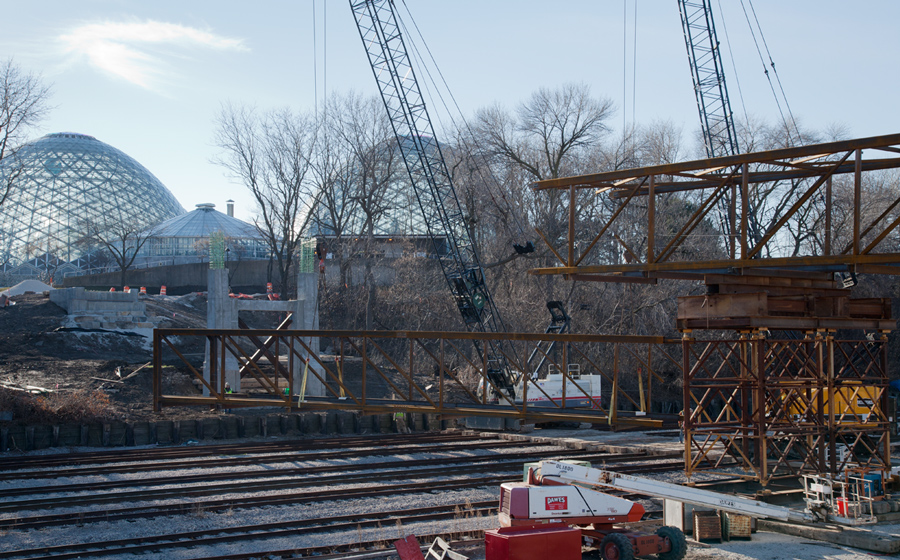
I was sorry to have missed the installation yesterday of the first section of the new pedestrian bridge that will connect Mitchell Park (home of the domes) with the Menomonee Valley and the Hank Aaron State Trail. I won't try to repeat what others - who were on the scene yesterday - have written. There are two good stories about it in WUWM news and the Bike Federation's blog.

I tried to make up for not being there yesterday by going to see the second section of the three-part bridge installed. Here are a few pictures.


This is the section that was installed yesterday. I liked the idea of having the domes as a backdrop for the scene, so I hiked down to this site from the west end of the new airlines yard park. Initially that seemed like a good idea. Unfortunately, today's work took longer than yesterday's. As the sun rose the light changed and made the scene less dramatic. Still, the action was fascinating enough.


Utilizing two cranes, the crew is positioning the second section of the bridge over the railroad tracks.


Bringing the new section in line to make the connection with the existing section.


The two sections now erected are connected, making a single span over the tracks.


The view through the two joined sections towards Mitchell Park.


The third section, to be installed tomorrow, will complete the connection with Mitchell Park, to the right in this picture. Eventually, when it is fully operational, an extension of the Hank Aaron State Trail will run through the new park and cross over this bridge. From that vantage point will be a panoramic view of the Valley and downtown Milwaukee beyond.


(Full disclosure: I am a member of the Friends of the Hank Aaron State Trail board of directors.)