Sunday, June 15, 2014

A study in contrast: Joliet Arsenal and the Tallgrass Prairie


Midewin National Tallgrass Prairie was established in 1996 on 19,000 acres of the Joliet Arsenal, which once manufactured munitions for the army. It was the first national tallgrass prairie in the U.S. It is also the southwestern-most corner of Chicago’s Millennium Reserve, which is being developed as the nation’s largest network of urban parklands and natural areas.

Restoration of the native prairie landscape is a long-term project. On a recent visit in early spring I found evidence of this effort as well as obvious remains of its former life as a military installation. Here is my photo essay.


To see a previous photo essay on the Millennium Reserve click here.


Wednesday, June 11, 2014

Reverie: Riverside Park, Springfield, IL


Roughly patched macadam leads past vacant ball fields, broad and Illinois prairie flat. A tree line hides the river until I reach where the pavement ends and a sliver of concrete tilts, continues down into the brown water. The Sangamon River flows languidly. Rays of rising sun burst into the canyon between its tree-lined banks, illuminating exuberant spring greens in the overhanging crown of the forest.


I walk the length of the pocked dirt road, skirting puddles, river on my right. From the shadows ahead a squad car slowly approaches. The officer and I exchange waves through window glass as he rolls by. Soft crunching of gravel diminishes, leaving behind stillness, then birdsong. The only other sound is the distant rumble of early morning traffic, muffled by the trees. I walk between twin silences, river and forest.


A piercing mechanical roar disturbs the peace, tapers to a hiss, ceases. Where the road ends a railroad cuts through the forest, crosses the river on a trestle bridge. The source of the roar isn’t revealed. I head away from the still silent river into the deeper, darker silence of the forest. Black earth leads me, a trail cut precisely through luxuriant undergrowth. The soles of my shoes gather mud until I am an inch or two taller and ungainly. I stop to scrape on a log. This process is repeated again and again, though I’m careful to accumulate only mud and not any of the horse manure that occasionally blots the trail.


After a while the silence, punctuated with the cheerful warbling of unseen birds, suddenly gives way to an enormity of fervent amphibian utterances. The sound grows nearly deafening as I approach a woodland pond. Sunlight pours into the opening in the forest, glares off the murky surface of the pool as if to cast a spotlight on the cacophony. The pond is unapproachable, the frogs imperturbable, the din unwavering in its intensity. In my mind hear my wife’s voice penetrating the solitude: “That’s the sound of sound of sex,” she invariably comments with an impish grin, hoping to get a rise out of me.


I am not lost. One could not get lost on this wide path. But where it is taking me has become a mystery and a concern. I have passed numerous forks and alternative routes, always choosing one that leads towards the ever higher sun, which I’ve assumed would take me back to the road. Now, as my deferred breakfast beckons and the mosquitoes thicken, I wonder. At the next fork I cut north. A white tail deer plunges off the trail ahead. Before the rumbling in my stomach grows uncomfortable I see the bright line of the open field through the trees.


I’ve overstayed the early morning tranquility. Three mowing machines crisscross the fields, buzzing distantly like mechanical mosquitoes. The corral near the entrance, empty when I drove in, now holds a whole herd of horses. The sun blazes down on the wide-open playing fields, flat as the Illinois prairie. 


Monday, June 9, 2014

Planting Day at 3 Bridges Park: A photo essay

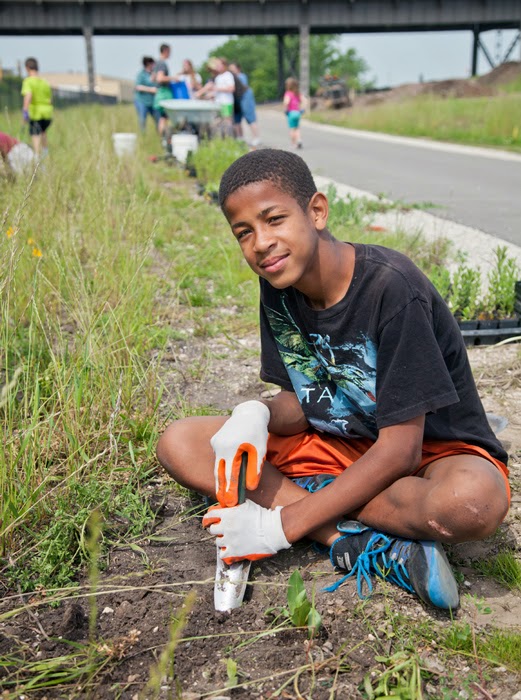
The Urban Ecology Center hosted a planting day on Saturday as a part of its efforts to flesh out the still largely bare 24-acre landscape of 3 Bridges Park. A crew of volunteers including a number of young girl scouts eagerly pulled invasive weeds as well as planting new seedlings. Here is a photo essay of the activities and participants.


Preparations underway for the community gardens (above and below)


Volunteers arriving at the park
A group effort
Michael, a UEC staffer, helps Henry with a potted seedling.

Invasive thistle
Katie & Kaylin


Willie
Terry
Patrick, a UEC staffer, helps Jacob with the shovel.

Photo op


Pete with Chayton
Melissa, Hank Aaron State Trail manager
Jeff, UEC land steward, carries a flat of seedlings past a railroad maintenance crew at work.

A 3 Bridges Park halleluia!

This post is one in a series that relates to my Menomonee Valley Artist in Residency. For more information about the residency and links to previous posts and photographs, go to MV AiR.


Sunday, June 8, 2014

Beautiful day on the County Grounds draws supporters to the Monarch Trail

Cool and breezy, not a cloud in the sky: a great time to visit the Monarch Trail on the County Grounds in Wauwatosa. A steady stream of people did just that. Many had come to take advantage of the lovely weather to walk the trail. Others stopped by to purchase plants being sold to support the Friends of the Monarch Trail and their efforts to preserve and maintain butterfly habitat.

I stopped by to chat and take a few photos to share.


Friends of the Monarch Trail supporters gathered along Eschweiler Drive.


Walking the Monarch Trail near the Eschweiler complex.


Monarch Trail leader Barb Agnew showed me where to find this warbler nest in the tall grass of the Eschweiler complex quadrangle. It was completely invisible to the untrained eye (and therefore easy to miss and step on!) Good reason to stay on the marked trails and to keep dogs on a leash. Moreover, it demonstrates the importance of maintaining unmowed sections of grassland.

I can think of few things that better symbolize the fragility of life and the importance of habitat preservation than ground nesting birds.


The ABB building is now open for business. Beyond, construction continues on the new Watertown Plank Road interchange.


Three seedlings have been planted here on the ABB parcel of Innovation Park, across the road from the Monarch Trail.


The brisk wind drew at least one kite flyer to the hilltop next to Discovery Parkway.


The Milwaukee County Grounds, as I have long advocated, can be a place for small adventures as well as for health and well-being. The healing potential of nature nearby has come to be more widely recognized as our lives have become more urbanized. Dr. Marc Gorelick of Children's Hospital has written a blog post about this recently: Hitting the Wellness Trail.

Sunday, June 1, 2014

Herons roost in Menomonee Valley

-->

I discovered the heron rookery by accident a couple weeks ago. I was investigating an out-of-the-way corner of the Menomonee Valley.

Does it sound strange that there can be an out-of-the-way place in the Valley? It’s true: A place so unlikely to be visited by people that herons are willing to roost there. It’s one of the greatest miracles of urban wilderness, to be able to experience wildlife in the midst of industrial development.

I fairly literally stumbled upon the rookery, making my way across broken concrete, when I heard a commotion in the crown of the trees overhead. Two or three large birds squawked loudly and took flight as the branches dipped and swayed from their weight. I caught only a glimpse at first.

Picking my way through the underbrush I scared off several more of what seemed likely to be herons. I also noticed what appeared to be nests—bundles of sticks in crooks of high branches. Finally I spotted a bird that remained stationary long enough for me to train my lens on it.


This bird, if not all of them, turned out to be a black-crowned night-heron. According to the Cornell Lab of Ornithology website, this is the most widespread heron species in the world. It also says, “They live in fresh, salt and brackish wetlands.” I don’t think the Menomonee Valley canal quite lives up to any of those descriptions. Is there a term like “brackish” that refers to a mixture of fresh and polluted? Still, I’m encouraged to know that the water is clean enough to attract herons.


There were more surprises in store when I revisited the spot this weekend. I had to cross a railroad to get to get to the rookery. No sooner did I step on to the rail bed than I saw five or six herons, along with sundry mallards and herring gulls, lounging on the tracks farther down. By the time I got close enough to grab this shot with my telephoto the others had all flapped away.

Then when I reached the meager woodland, lo and behold, the expected handful of birds turned out to be several dozen or more! With every step more birds started up with their raucous complaints. Everywhere I looked up I saw more nests. The leaves of the ground cover—mostly creeping Charlie and bishop’s weed—were completely speckled with droppings.


Suddenly it was my turn to be startled as a train just barely visible through the trees began to move. There was an enormous crashing of metal on metal. Each car clanked loudly in rapid succession as the couplings were wrenched into motion. The herons took no notice of this unnatural racket. It was me with my camera that they found threatening.

Upon further reflection, the presence of herons here in the Valley is no more miraculous than the presence of railroads. In the twenty-first century, here in this place, who is to judge which is more natural? We have inherited a landscape that has been utterly transformed in pursuit of utilitarian ends. If an unused corner of it can appeal to herons, consider how much more wildlife we might attract into our urban lives by deciding it is an end worth pursuing?

The good news of the Menomonee Valley is that we have made that decision. We are bringing nature and wildlife back along with new industries. I look forward to the day when more discriminating species than black-crowned night-herons, mallards and herring gulls will flourish in the Valley.


This post is one in a series that relates to my Menomonee Valley Artist in Residency. For more information about the residency and links to previous posts and photographs, go to MV AiR.