Showing posts with label cliff. Show all posts

Monday, December 5, 2016

Quarry Lake ramble: Photographs and poetry


--> On the first day of December--before the snow started falling--I went to Quarry Lake Park in Racine. Actually, I went to the Wustum Museum of Art in Racine to pick up work that had been in their exhibit, Wisconsin Photography 2016. I've been to the Wustum many times over the years and since it is located next to Quarry Lake Park I have driven past said park just as often--twice as often if you count to and fro! Nearly every time I've wondered about the park and thought that one day I ought to stop. This time I did. 
I shot a series of photos, all with my iPhone. (I had brought my camera along but left it in the car, erroneously anticipating few opportunities to use it, the day being gloomy and with a light drizzle that continually threatened to turn heavier.) I enjoyed the walk far more than expected. 

Adjacent to a golf course, the 40-acre park boasts a “spring-fed lake” in the former quarry, along with a beach, pavilion/bathhouse, dog park, picnic tables, and a fishing pier. The Racine County Parks website doesn’t mention the Root River, which also runs through the park and which was of more interest to me when I decided to stop to explore. 

A narrow, wall-like ridge of un-quarried stone separates the lake and the river. The authorities had erected a chain link fence to prevent people from walking up the ridge, which is essentially a two-sided cliff. This was primarily to discourage cliff jumping into the lake, an illicit activity that had unfortunate consequences last June. However, the appeal seems insatiable. The fence has been violated, making it easy to step through.

After I finished exploring and photographing the park I found in the experience further inspiration. Although I hadn't written any haiku for over a year I ended up with a series of them. The poems are not meant to be read as captions for the photos. They are a complimentary expression of my encounter with Quarry Lake Park.

heavy overcast
the surface of the water
the color of stone


in three rows

twelve vacant tables
cemented in place


visible

through chain link fence

a well-trodden path


reeling

the fisherman draws a line 
in the scum


separating

quarry lake from river 
two-sided cliff


an icy gust

on the cliff top 
bare footprints


standing on uncut rock

surrounded 
by the crowns of trees


I plod along

snarl of thorny underbrush
roar of ascending airplane 

 
on the opposite bank

through leafless trees
house lights


at the water’s edge

a young couple 
posing for selfies


quarry lake

a million grains of sand 
trucked in for the beach


December afternoon

the darkening sky
drizzles  


Tuesday, November 13, 2012

Off Season


Snapshots and random thoughts from Starved Rock State Park, Illinois


The first surprise is the rugged terrain. Cliffs high enough to dwarf human visitors surround canyons deep enough to confound my expectations, extinguish all sense of being in the Midwest. Most of Illinois is as flat as a state can get. I’ve seen flat: Kansas, the Texas panhandle…. Illinois is pulled as tight as a military bed sheet.

The Illinois River has cut through this sheet, carved deeply into the underlying bedrock, a layer of sedimentary sandstone that dates back 425 million years. The sheer bluffs and dramatically eroded canyons would be pretty spectacular anywhere between the Rocky Mountains and the Appalachians. In Illinois they are simply stunning.

As we drive in, nothing moves. The parking lot is vast and completely vacant. Brown and yellow leaves lie scattered on the pavement. The place seems deserted. Perfect!

Far out over the wide river, seemingly out of the open sky, a sycamore leaf wafts gently downward.

Pelicans huddle on the water like bundles of white laundry, deceptively small with distance. Another surprise: American White Pelicans, I learn, rival the California condor for longest wingspan in North America. With a flurry of black-tipped wings they leap-frog downstream.

In the Visitor’s Center I reach for one of the stack of trail maps. The uniformed woman behind the reception counter says, “you can take one of those but you won’t need it.” Pointing to the mural sized, highly detailed map on the wall nearby, she explains: “we have trail maps like this at trail crossings, so you’ll always know where you are.”

One of the things I seek in nature is an aura of mystery and the chance to explore. I keep it to myself.

Though her matter-of-fact tone fell short of boastful, she was not exaggerating. Two by four foot iterations of the green and blue map are securely framed and mounted at every trail intersection without fail, sometimes within sight of one another, even in the remotest parts of the park. An hour and a half from Chicago remote is a nuanced concept.

According to legend, in the 1760’s a band of Ottawa and Potawatomi laid siege to the butte that gives the park its name. A band of Illiniwek had sought refuge there. Instead of protection the rock brought starvation. So the story goes.


Today the tall chimney of rock is a maze of boardwalks and wooden railings reminiscent of the French colonial stockade reproduced in a diorama in the Visitor’s Center. Despite expansive views of the river and lake far below, I feel hemmed in. 


Mountaineer and author Jack Turner: “We treat the natural world according to our experience of it. Without aura, wildness, magic, spirit, holiness, the sacred, and soul, we treat flora, fauna, art, and landscape as resources and amusement.”

Starved Rock, like most parks, exists for the spectacle it provides, for its entertainment value. There may be wild places here, but innumerable signs make clear they are strictly off limits. It is equally evident that the public does not universally respect the posted rules.

Is a visit to the park the beginning of an appreciation for nature or a diversion?

Gratefully we walk in solitude. It is the off-season. Last year over 2.4 million people visited Starved Rock State Park, starved for something, whether a taste of nature or a diversion.

The afternoon is so warm we leave our jackets behind. We are surrounded by autumnal shades of brown and tan, as if this place were caught in amber, marvelously preserved.  A stand of pines relieves the monochrome. In contrast to the popular Starved Rock trail, which is paved with concrete, we stroll along the bluff trail on sandy soil and pungent pine needles.

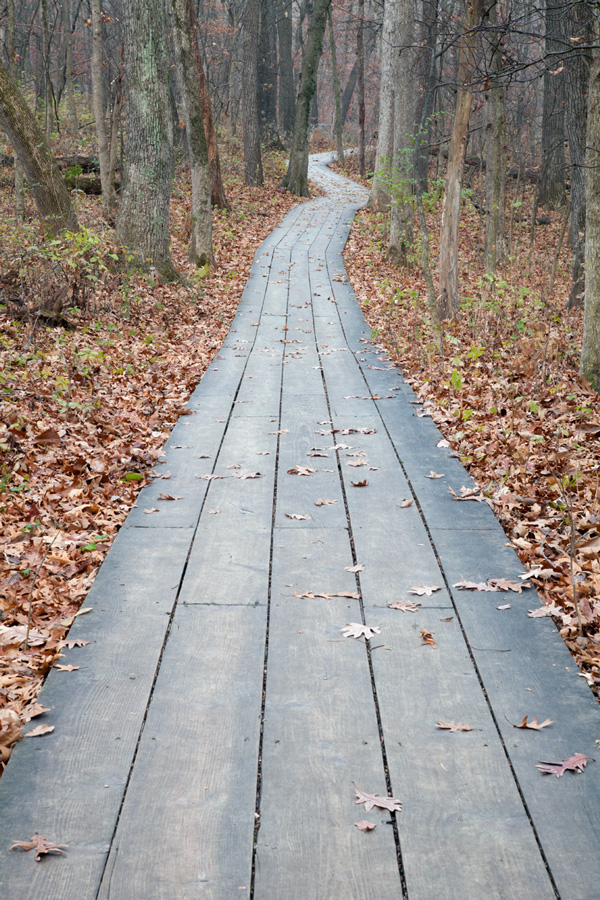
Mysteriously, a boardwalk appears. The bluff is high. We are neither in a wetland nor crossing one of the many ravines. Reaching its end, a staircase dispels the notion of accessibility.

When nature became a place other than and distinct from where people lived, we no longer felt part of it. The false dichotomy that resulted has led to all kinds of environmental mischief. Roderick Frazier Nash says, “The dawn of civilization created powerful biases. We had settled down, developed an ecological superiority complex, and bet our evolutionary future on the idea of controlling nature.”

I step off onto the earth again.

Canyons are the creation of water. At certain times of the year the park is blessed with many waterfalls, one of its primary attractions. We have come off-season. The only waterfalls we see grace the postcards in the gift shop.  No matter. Just as I prefer the feel of the earth beneath my feet, so too do I prefer a dry solitude.

The silence in a box canyon lends poignancy and power to a single birdcall.


To see more photos from Starved Rock, go to my flickr page