Sunday, March 11, 2012

A warm gray day in Grobschmidt Park


Wednesday, March 7.

It is beyond unseasonably warm. Stepping outside elicits the peculiar feeling of dislocation that happens when I travel to some completely other – tropically warm – place during Wisconsin’s usually interminable winters. I love stepping off the plane and taking that first deep breath. Immediately I know I’m not home any more.

Today I feel it without going anywhere! Just outdoors.

Grobschmidt Park
I can’t go back inside! I decide to explore a county park that is new to me. From the Parks Department map I pick Grobschmidt, a neat green rectangle just off College Ave. on the northern edge of Franklin.

I know I am getting close when subdivision signs begin to read “Homes on the Park,” “Parkwood Village” and “Parkwater Apartments.” The urge to name what we’ve built after the things we’ve destroyed seems irresistible. We set aside remnants so that residents of the ‘homes on the park’ can look out picture windows and imagine what they don’t even realize is lost.

A line from T. S. Eliot’s poem, The Waste Land, drifts up from my subconscious: “These fragments I have shored against my ruins.”

Grobschmidt has no lot. I pull up and park along S. 35th St., which provides public access.

The view from the road is of a fairly large lake populated with a boisterous crowd of floating waterfowl. The lake is surrounded by what seems like level land and a featureless gray tree line. But you can’t experience wilderness – or nature in general – from a road. And I’ve learned to suspect first impressions as shallow, despite their potential for lasting influence.

Besides, if anything it has gotten even warmer. I leave my jacket in the car.

trail through buckthorn
The heavily overcast sky threatens rain but I am not deterred. A muddy trail parallels the lakeside. A clamor of ducks and geese punctuates the gray land, gray water, gray sky. Before long I veer off into the woods on an even muddier, narrower – and grayer – track. Soon it becomes a tunnel through a particularly dense thicket of buckthorn.

hawthorn
The world is gray, wood and sky alike, but my mood is buoyant, elevated by the balmy temperature. I ponder the essence of grayness and relish its endless permutations. The hawthorn is dark, twisted and spiky. The loose bark of the mighty hickory is chalky with a hint of cyan. A brace of nearly white brambles dances before a rigid backdrop of charcoal trees.

A close observer of nature is never threatened with tedium. Even so, the occasional colorful spray of red osier dogwood is reason for exultation.

hickory
The earth, so recently blanketed, is everywhere soggy from sudden snowmelt. Muddy deer tracks bearing fresh hoof prints crisscross the trail. They are so numerous I have to wonder why I don’t see a single deer. (A veritable herd of them sauntered across my patio just yesterday! I guess they’ve all decamped for Wauwatosa to see if my tulips have sprouted yet.)

In seventh grade I was made to read The Waste Land by a no doubt well-meaning and ambitious English teacher. Wasted on me then (pun intended), decades passed before I could return to it with appreciation. In its famous opening lines Eliot says, “April is the cruelest month, breeding  / Lilacs out of the dead land, mixing / Memory and desire, stirring / Dull roots with spring rain.”

Eliot didn’t live in Wisconsin. If April is the cruelest month here it is because winter has not yet loosed its grip and the lilacs are waiting for the certainty of May. But I’ve long considered March to be the crueler month. Its mercurial moods dash confidence in the coming of spring. The land remains dead.

The “forgetful snow” is gone. The marsh is broken, matted with bent reeds. “The nymphs are departed.” And – normally in March – it is still too damn cold.

But not today, a miraculously mild day in Grobschmidt Park!

Warm wind passes through the gray trees, rattles dead leaves still clinging to trees. Barren branches clatter like dry bones. (As I write these words, a day later, it is indeed cold again. There is even a dusting of new snow. March!)

My first impression of barren flatness is long forgotten by the time I reach the far end of the park and glimpse a roof over the crest of a distant hilltop. I slip down into lowland forest, skirt open marsh, cross a dormant, still icy, sedge meadow, and head uphill again to upland forest. Brian Russart, the Milwaukee County Park system’s natural areas coordinator, considers Grobschmidt a microcosm, exemplary of habitat diversity. Even now, all hued in gray, I can see why.

My circuit of the park nearly complete, I reach a section that does look like a wasteland. A wide swath has been slashed. The few spindly trees that were spared emphasize the apparent devastation all around. One scraggly hawthorn holds up a tiny, dried out nest as if in supplication. Memory and desire, stirring.

“What are the roots that 
clutch, what branches grow
Out of this stony rubbish?”
But, no, this is not The Waste Land. I am not alarmed. The county has a habitat improvement plan that includes a three-year cycle of mowing to maintain the prairie-like grassland. Hell, I’d like to see it burn! That would be even healthier for biodiversity.

I’d also like to see the Parks Department budget grow enough to control the buckthorn in the woodlands. Fragments, yes, but our parks must be shored up against our ruins.

Saturday, March 10, 2012

Celebrating Leopold Weekend in Riverside Park


I did celebrate Aldo Leopold Weekend by taking a hike in Riverside Park. I managed a few photos to commemorate the day.

 
The Urban Ecology Center, a most appropriate place to pay homage to Leopold.


A view of Gordon Park from Riverside Park.


The Milwaukee River and the urban wilderness through which it runs.


For more photos, check out my Milwaukee River Greenway set on flickr.

Tuesday, February 28, 2012

Are you ready for Aldo Leopold Weekend?


“There are some who can live without wild things, and some who cannot. These essays are the delights and dilemmas of one who cannot.

Like winds and sunsets, wild things were taken for granted until progress began to do away with them. Now we face the question whether a still higher 'standard of living' is worth its cost in things natural, wild, and free. For us of the minority, the opportunity to see geese is more important than television, and the chance to find a pasque-flower is a right as inalienable as free speech.”

The world has changed since Aldo Leopold wrote these opening lines to “A Sand County Almanac,” which was first published in 1949. Leopold would likely be saddened to see how many more of the wild places he so cherished have been diminished or have disappeared altogether. On the other hand, one can hope that he would be heartened by the tremendous increase in public awareness about the importance of ecology and concern for the natural world, and by ever more urgent efforts to preserve remaining wild lands all over the world.

Aldo Leopold himself, of course, was instrumental in sparking this increase in awareness and concern. For this reason the first weekend in March was officially designated in 2004 as “Aldo Leopold Weekend” here in his home state of Wisconsin.

Leopold spent most of his career in Wisconsin as a writer, forester, scientist and professor at the University of Wisconsin in Madison. In 1935, he bought a farm along the Wisconsin River near Baraboo. The farmland had been exhausted. He and his family set about restoring the land to a more native state, planting thousands of pine trees and reestablishing prairies.

That personal experience with ecological restoration and his meticulous documentation of consequent changes in the flora and fauna on the farm both inspired and informed his writings.

I recently pulled from my shelf a well-worn paperback copy of “A Sand County Almanac,” with its split binding, yellowed pages, and numerous underlined passages. The slim volume didn’t take long to reread. The familiarity of the stories didn’t diminish my delight in the quality of the prose and his ideas are if anything more important today than ever.

“There are two spiritual dangers in not owning a farm. One is the danger of supposing that breakfast comes from the grocery, and the other that heat comes from the furnace.”

The implications of that simple observation are as topical as the controversy over routing power lines through Milwaukee County Parkways or the dramatic increase in gas prices over the past two weeks.

Leopold’s most important contribution, arguably, is the idea that we need a “land ethic.” His brief “Almanac” is followed by a series of essays. It is in the concluding essay that Leopold makes his boldest statement and issues his most stirring call to action.

In general terms, ethics refers here to the unwritten rules and mores by which people live in community with one another. Leopold’s inspired notion is to expand our idea of community to include not just people but the natural world: plants, animals, the soil, water. Collectively, he called this “the land." Scientifically it is the biotic community.

The land ethic can be summed up, in Leopold’s words, as follows: “A thing is right when it tends to preserve the integrity, stability, and beauty of the biotic community. It is wrong when it tends otherwise.”

Even in places less well endowed with parks and rivers as Milwaukee County people need to be mindful of nature, of not dirtying the environment that sustains us. If that sounds obvious, perhaps it’s a good reason to celebrate Aldo Leopold Weekend – in remembrance of his influence on our culture.

You might ask, “How can I celebrate Aldo Leopold Weekend?” Well, I’m glad you asked. Here are a few suggestions:

1. You know what I like to do: go outside and enjoy the urban wilderness! Find a local park with natural areas and explore.

2. Visit the library, borrow a copy of “A Sand County Almanac” and read it with pleasure – or buy one that you can read over and over, as I have.

3. Go to the North Shore Library in Glendale at 1:30 pm on Saturday, March 3 to see “Green Fire.” A feature-length documentary about Aldo Leopold, “Green Fire” highlights his extraordinary career and his influence on the modern environmental movement.

4. Don’t forget to check out the Aldo Leopold Foundation website, which has a wealth of information about Leopold and the special weekend ahead. There’s even a Facebook photo contest.

If you’re more ambitious you can plan a trip to visit Leopold’s farm, which is managed by the foundation.

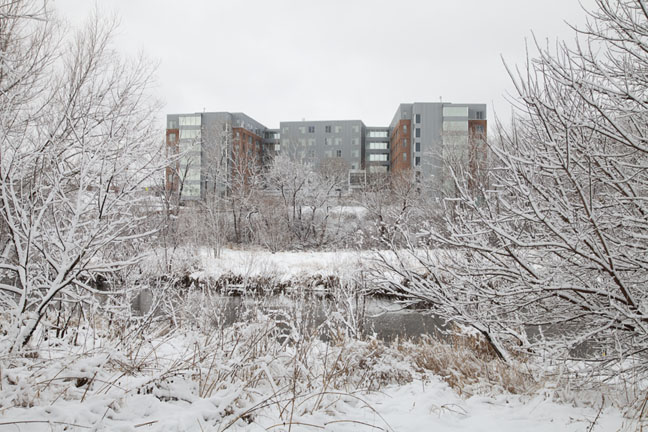
A note on the images that accompany this post: I shot them all last Friday morning right after the big, heavy snowfall. It may not be immediately clear how they represent Leopold’s vision of a healthy biotic community for I’ve deliberately chosen to find the ambiguity, if not the paradox, of urban nature.

But we need even these fragments to connect us to the larger land community. In his essay on the land ethic Leopold himself observed, "The weeds in a city lot convey the same lessons as the redwoods."

For a more typical selection of urban wilderness photos, also from Friday morning, scroll down to my previous post. I am, after all, one of those who cannot live without wild things.


Saturday, February 25, 2012

Milwaukee River Greenway in White!

Wasn't it beautiful on Friday! Thick snow like frosting on everything. I managed to get out in it and take a few pictures along the Milwaukee River between Caesar's Pool and the Locust Street Bridge. Here is a selection.


View of the icy river from the pedestrian bridge at Caesar's Pool.


Approaching the North Avenue Bridge along the east bank.


A makeshift shelter next to the North Avenue Bridge.


The downtown skyline obscured by the Urban Wilderness. View from the North Avenue Bridge.


Wisconsin Paperboard stack rises above the East Bank Trail.


View of an even more distant downtown from the Locust Street Bridge. It was a good day in the Urban Wilderness!

Additional photos can be seen on my flickr page.

Thursday, February 16, 2012

Ronald McDonald House plans expansion


Are we still talking about more development on the County Grounds – and consequent loss of potential parkland? Where will the line be drawn?

If you haven’t been to Ronald McDonald House it’s probably because you haven’t needed its services. Officially called Ronald McDonald House Charities of Eastern Wisconsin, Inc., the organization provides a place to stay as well as outreach programs for families of children who are patients in Children’s Hospital. Perched on a lovely hilltop across Watertown Plank Road from the hospital and surrounded by acres of meadow and woodlands, it is ideally situated for its mission.

Now, due to the success of its worthy cause, the organization wants to nearly triple the size of its facility and is ready to pursue that plan.

The bucolic setting is hardly a coincidence and provides much more than proximity to the hospital. Natural surroundings are often preferred by hospitals, hospices, and convalescent homes because they promote healing and provide a welcome respite to patients and visitors alike.

In fact, if you walk through the woods and down into the ravine behind Ronald McDonald House you will find the remains of stone stairways, overgrown sidewalks, and a crumbling foundation or two. Some of the county’s most needy patients once strolled these pathways behind the County Asylum. The entire Medical Complex owes its very existence to the exurban terrain that Milwaukee County began purchasing for it in 1852.

Ronald McDonald House is truly privileged to be surrounded by such beauty on the County Grounds. What a perfect match between such undeniably important humanitarian services and nature!

What will happen to this symbiotic relationship when—once again—the County Grounds are faced with further development pressures?

As I write this, still ringing in my ears are the words of the Wauwatosa mayoral candidates who spoke Monday evening at a forum sponsored by Patch. All three insisted that no more of the County Grounds should be developed. Alderman Donegan said, “I don’t think the people of Wauwatosa will tolerate further development of the County Grounds.” John Pokrandt was even more categorical. “The remainder of the land absolutely must be protected,” he said.

I understand his passion. I share it.

Monday afternoon, the same day as the forum, representatives of Ronald McDonald House met with members of the County Board and County Executive’s office to present their request for an expansion. Their existing facility rests on four acres and they are requesting an additional seven acres stretching out towards the meadow and the wood.

They can do this because throughout the more than 10 years of controversy about saving open green space approximately 30 acres on the southeast corner of the County Grounds has never been part of the discussion. It is still zoned by the City of Wauwatosa for economic development.

The staff and the board of Ronald McDonald House are sensitive to their situation. Last week I met with Linda Kohler, President of RMH, Bob Monday, Chair of the Board, and Ann Phillips, Head Gardener. Because they understand the value that the citizens of Milwaukee County place on this land they also care about how the community will react to their request.

They plan to meet with environmental organizations and other concerned citizens to discuss how best to satisfy everyone’s concerns.

County Executive Abele’s office is expected to introduce to the County Board a resolution to proceed with negotiations soon. The public will have an opportunity to testify at a meeting of the Economic and Community Development Committee on March 5, 2012. The meeting will be in room 201B, County Courthouse, at 9 am (this is subject to change.)

Open space advocates—and mayoral candidates—may reasonably shudder at the prospect of yet another compromise and loss of open land on the County Grounds. But County Supervisor Lynn DeBruin says, “It seems like a win-win can be reached.”

I agree. If the expansion plans are shifted to concentrate development only along Watertown Plank Road and if—this is the crucial point—the northern portion of the site is truly protected from further development with conservancy zoning, then it will be a win-win-win, as I see it.

Ronald McDonald House will be able to expand to meet its needs. The general public, including the literally hundreds of dog-walkers who regularly enjoy this site, will retain one of the jewels of the County Grounds in perpetuity.

The third win? Children’s Hospital, along with the entire Medical Complex, will benefit not only from the expansion of services at Ronald McDonald House, but also from that symbiotic relationship with nature that is so restorative.

It could seem as though the cards are stacked against conservation, since the current zoning envisioned development for medical use. However, a lot has occurred on the County Grounds since that parcel was zoned. The Medical Complex has continued to grow, choosing increased density instead of sprawl that would encroach on the valuable amenity across the way.

The public has spoken out repeatedly on the need for preservation—and along the way has learned to love the land by getting out and walking on it.

Wauwatosa has debated the types and scope of development on the Innovation Park site and the city already has rezoned parts of the grounds, including what is now Milwaukee County’s newest park.

The mayoral candidates are only the latest in a series of civic leaders who have come to recognize the importance of our parks and open space to sustainability and the quality of life in our community.

The time is right for rezoning this last piece of the County Grounds puzzle. What we have here really is akin to New York City’s Central Park. It’s value as parkland far exceeds any other use to which it may be put. And this 20-acre corner truly is one of the most significant natural gems on the entire grounds. 

I recommend that you visit Ronald McDonald House and ask for a tour. Its magnificent great room is the hub of a network of excellent programs. The need for more space will quickly become apparent. When you finish that tour, take a walk out back. Stroll beneath the grand old oaks and maples. Listen for the owls; watch for the hawks. Discover for yourself the reminders of its storied past.

What a perfect match! Let’s pursue the win-win-win solution and complete the puzzle that will make the County Grounds a matchless asset to the region – as parkland.

Monday, February 13, 2012

Owl vs. Falcon

Photos by Rick Remington


A story about a snowy owl attacked by a peregrine falcon in Chicago was posted in North American Birding by Greg Neise. This is a great read and a wonderful set of pictures. Check it out.

Although I haven't seen it myself, Milwaukee Riverkeeper's Cheryl Nenn tells me that we have a snowy owl on our own lakefront in Milwaukee.

Among the many great shots by Remington, my favorite is this one of the owl doing a backflip to defend itself from the falcon.

Wednesday, February 8, 2012

Why we love zoos

"Why we love zoos" appeared as an opinion piece in last Sunday's NY Times. Read it here.

Personally, I nearly always feel conflicted when I visit the zoo. I often do enjoy going to a good zoo, like ours here in Milwaukee County, but I never escape without feeling some guilt at the conditions under which zoos keep "wild" animals. Worse, I've been to a number of really bad zoos at one time or another.