Showing posts with label gordon park. Show all posts

Sunday, December 30, 2012

Marks and remarks from the Urban Wilderness

As I went out this morning light snow drifted slowly out of a clear blue sky. It was beautiful and mysterious, perhaps a portent on the cusp of a new year. Though if I believed in omens I might choose instead the coyote I spotted in the Menomonee Valley a few days ago. Instead of being sunny, a deep overcast was spitting sleet in spurts. The coyote's fur was sodden and dripping as it loped across the pavement in front of my car. It splashed in the icy roadside ditch, slipped through a chain link fence and on into the narrow field between the vast stadium parking lot and the railroad. The bent grasses amongst which it paused looked as bedraggled as it did. Above, I could see a steady stream of cars speeding by on the freeway. The coyote looked around briefly, then turned and slipped out of sight.

Some indigenous peoples of North America revere the coyote as the Creator. More commonly known as a Trickster, though, coyote may appear the fool or the clever impersonator. As I watched this lone, scrubby coyote disappear into perfect camouflage of its wintry surroundings, one thing is unambiguous - here is the wild incarnate. And, against what odds I can only guess, it lives in the heart of Milwaukee. The coyote may not in itself be the creator of the wild, but wherever it goes it does far more than impersonate what is wild. Coyote embodies the wild. To my way of thinking, that it can do this in the city is a good omen indeed.

In addition to my glimpse of the coyote, I caught many a photograph this year, as you may have come to expect if you are a regular to my blog. Three that I shot just yesterday near the Milwaukee River in Gordon Park accompany this post.


2012 was a year for the record books. Much of the reason was bad news. But as December draws to a close, I am mindful of a more hopeful report I heard this week that claimed this was a watershed year for at least one important reason. Due to several extreme climatic events, including Superstorm Sandy and the worst drought conditions since the Dust Bowl, the general public and the media finally caught up with scientists regarding the real and inarguable effects of global warming.

Here at Urban Wilderness I like to recall high points of the passing year, as do many of us. I feel fortunate to have been able to explore both near and far, to revisit familiar places and to discover new ones. There were a number of surprises along the way, which I recorded in posts throughout the year. Listed below, with brief annotations, is what I consider my best of 2012.

The most significant event of the year was the most personal, the loss of my mother at 87. In August I wrote about her influence on me and my love of nature: In memoriam

Other than that, my favorite moments, in chronological order:

The year began softly, in a January blizzard. My meditation on the day is called A snowy silence

In February I covered one of my most regular beats, the Milwaukee County Grounds with Ronald McDonald House plans expansion. Although the specific request by Ronald McDonald House was settled by the County Board of Supervisors in July (see my update), questions remain about the ultimate fate of one final corner of unprotected land.

Also in February, Historic Milwaukee held a forum called "Remarkable Milwaukee." I weighed in with What's remarkable about Milwaukee?

An illuminating trip to Houston, Texas inspired a trilogy of posts. The first installment is called Waking to a new world. (Links to subsequent installments follow each.)

In March I explored a new (to me) park in the Milwaukee County system : A warm gray day in Grobschmidt Park.

In April I was invited by the Great Waters Group of the Sierra Club to give a keynote address for their annual Earth Day celebration. Here is what I told them: Reflections on Earth Day

A new trail in the Cambridge Woods portion of the Milwaukee River Greenway generated controversy in May: Urban wilderness and accessibility

In June I visited the Chicago Wilderness along the Des Plaines River: The scent of summer

And a trip to Phoenix resulted in a two-part post: It's a desert out there! (A link to part 2 follows this post.)

In July I finally made a long-awaited pilgrimage to visit Aldo Leopold's shack on the Wisconsin River north of Madison: A visit to Sand County

There was wonderful news to report in September: A new branch of the Urban Ecology Center opens in the Menomonee Valley

In October, another two-part post, this time from New York City: The High Line: Good and Bad. (A link to part 2 follows this post.)

In November a short excursion led to a surprising discovery - Starved Rock State Park - two hours southwest of Chicago: Off Season

This was also the year when I finally got around to putting the finishing touches on a book too long in the works: The Milwaukee County Grounds: Island of Hope

Happy New Year from the Urban Wilderness!


Saturday, March 10, 2012

Celebrating Leopold Weekend in Riverside Park


I did celebrate Aldo Leopold Weekend by taking a hike in Riverside Park. I managed a few photos to commemorate the day.

 
The Urban Ecology Center, a most appropriate place to pay homage to Leopold.


A view of Gordon Park from Riverside Park.


The Milwaukee River and the urban wilderness through which it runs.


For more photos, check out my Milwaukee River Greenway set on flickr.

Saturday, February 25, 2012

Milwaukee River Greenway in White!

Wasn't it beautiful on Friday! Thick snow like frosting on everything. I managed to get out in it and take a few pictures along the Milwaukee River between Caesar's Pool and the Locust Street Bridge. Here is a selection.


View of the icy river from the pedestrian bridge at Caesar's Pool.


Approaching the North Avenue Bridge along the east bank.


A makeshift shelter next to the North Avenue Bridge.


The downtown skyline obscured by the Urban Wilderness. View from the North Avenue Bridge.


Wisconsin Paperboard stack rises above the East Bank Trail.


View of an even more distant downtown from the Locust Street Bridge. It was a good day in the Urban Wilderness!

Additional photos can be seen on my flickr page.

Wednesday, June 8, 2011

River Revitalization Foundation takes a hike on National Trails Day


Last Saturday was National Trails Day, so designated by the American Hiking Society. The River Revitalization Foundation (RRF) invited the public to celebrate the day with a hike along the Milwaukee River. Although I had to wonder why a specially designated day was needed, being highly self-motivated when it comes to hiking, the Milwaukee River Greenway is one of my favorite places for it and I relished the idea of a hike guided by the knowledgeable staff of the RRF. 
false Solomon's seal
The worth of the designated event became apparent immediately as about 25 people assembled in Gordon Park. A few were seasoned hikers but most were not. Some confided that they’d never hiked along the Milwaukee River before.

We began with sight, across Locust St., of a modest house that belonged to Charles Whitnall, the mastermind of Milwaukee County’s magnificent park system. Vince Bushell, RRF’s Land Steward, provided some historical background about Gordon Park and the river below the bluff, which was invisible due to a screen of mature trees. When first developed, he said, the view was unobstructed. However, cuts to the parks budget have resulted in the elimination of tree trimming operations.

Anise blossoms
 We strolled down the recently developed, paved Beer Line Trail, so called because it follows the route of the former railroad line that once served Milwaukee’s breweries. Vince identified native flowers that were blooming in places that had been cleared of garlic mustard and other invasive species by RRF volunteers. 


Next to one of the two massive UWM dorms that bracket the river at North Ave. we found a troop of boy scouts working on another RRF project: re-routing a mountain bike trail to reduce erosion. Bikers love the riparian trails – and multi-use is the name of the game in this high-profile urban wilderness.


I was delighted to see the creative re-use of buckthorn as a fencing material in the new Wheelhouse Gateway Park at the south end of the Greenway.

By the time we crossed the bridge at Caesar’s Pool and turned back north up the East Bank Trail attrition had reduced our party to seven diehards. Which was too bad, I thought, because the east side trail is unpaved, which I prefer, and because we discovered a number of fascinating projects in the works.


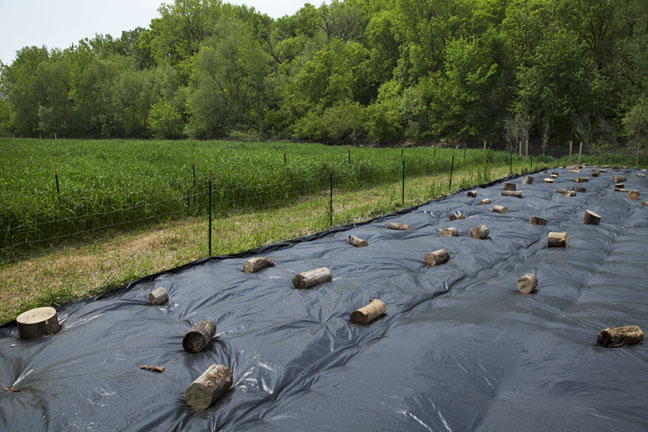
 There were square depressions at regular intervals in the tall grass made by slabs of plywood laid down to provide shelter for endangered Butler’s garter snakes. A soccer-field size area had been battened down with black plastic, in an experimental effort by the Urban Ecology Center to control invasive reed canary grass, which blankets much of the riverside.


The most exciting project has to be imagined from the devastation wrought upon one section of the bluff, which looks like a war zone. A new 40-acre arboretum is being created that will extend up and over the top of the bluff.  With an irony that is emblematic of the urban wilderness I love to write about, the first step in the development of the arboretum, apparently, is to clear-cut all the trees. The new, yet-to-be-planted trees will outlive me – and it fills my heart with joy to know that. 

arboretum under construction
We finished our loop in Riverside Park, which was originally designed in the 1890’s by Frederick Law Olmsted and rescued a hundred years later from blight and neglect by the Urban Ecology Center. Much as I admire Olmsted’s classic landscape designs and anticipate the beauty of the new arboretum, I must admit I was heartened to see this magnificent old black willow (below) lying where it had recently toppled. It is a fitting symbol of a new sensitivity to ecological processes and biodiversity. One of the signature differences between a wilderness and most urban parks is what happens to fallen trees. Park managers traditionally have made lumber and carted it away. But where trees are left to decompose they provide habitat for wildlife and their nutrients eventually return to the earth, repeating the cycle of regeneration. 


I enjoyed National Trails Day but I won’t be waiting for another official excuse to take my next hike in the urban wilderness. (You knew that!) I hope I see you out there on one of my hikes.

Click here to see more images from the National Trails Day hike and Milwaukee River Greenway.