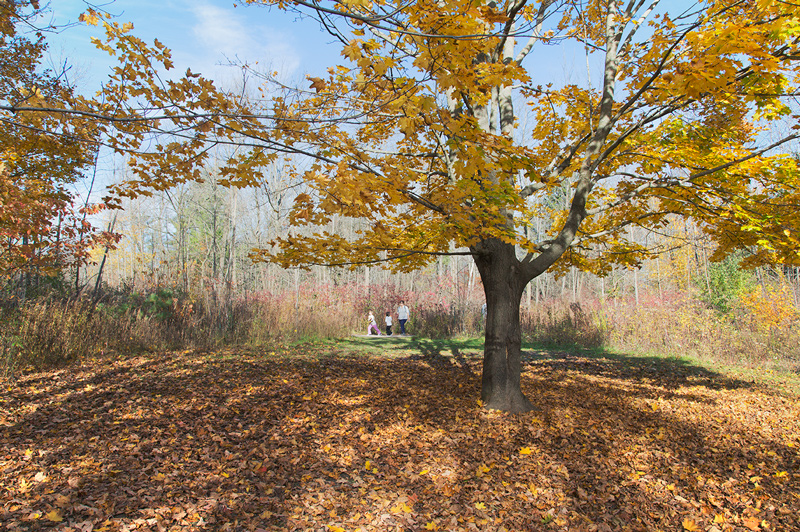
Part 1: Lake Park
I was walking slowly along the bluff top path in Lake Park
the other day, carrying my camera and tripod, trying to catch the colors of
autumn as I had been doing in parks all over the region. A young man sidled up
to me so that I would pay him attention. When I did he asked me softly, Do you mind if I give you my philosophy
about cameras? *
Inwardly, I had to smile. After all, I had taught
photography to young men like him for 30 years and not once did any of them
confront me with such a bold, straightforward request. His earnest expression piqued
my curiosity. Please do, I said.
He told me, The
landscape isn’t the best subject for photographs. Because it is always there.
Noting my quizzical expression he quickly added, People are the better subject. They are always different, moment to
moment. Intrigued, I accepted his statement as a challenge, although it was
clear he didn’t mean it that way. For when I said, Alright, how would you like to be my subject? he was startled.
He recovered quickly though. Where do you want me? he asked. I put the question back to him and,
turning towards the woods, said, Not near
the lake. That’s too powerful a
force. I admired his perception: Don’t
want to compete with Lake Michigan, I guess. He agreed.
I introduced myself and he told me his name: Raekwon. As he was now my subject, I sized up his gold hoodie and eagerly steered him towards a ravine where I had spied some maple trees with
the exact same shade of leaves. Usually I have to settle for whoever
comes by and often wait in vain for someone to enter a composition wearing the
right clothing to match or contrast with the surroundings. And here was
Raekwon, not only wearing the perfect color but
ready to pose for me. In fact, by posing the question he had precipitated the
photo session.
As we walked towards the ravine I asked how often he came to
Lake Park. This is my first time, he
said. I was thunderstruck. Well you
picked a great day for it, I offered. It was one in the string of
unseasonably warm days we’ve had this month. Isn’t it beautiful? I added. Maybe it was my imagination, but he
seemed to look around as if seeing the trees and the leaves and the blue sky
for the first time. Yes, it is. I think
I’ll come back again.

So, what brought you
here today? I asked. Just killing
time before I have to go to work, he told me. Well you picked a good place for it. Lake Park is one of my favorites.
As I framed up the portrait , his head haloed by the autumn leaves, I felt
blessed by his presence, as if by divine intervention. After I shot a few
frames of him, we parted. Later, when I wanted someone to be in a shot of the
ravine bridge, I took a cue from Raekwon’s philosophy of cameras. Instead of
waiting for it to happen I asked someone passing by to pause for me. “Look over the railing, just about there,
please,” I said to him when he politely agreed to do so.
Because you can always count on the landscape and people are
ephemeral.
*I was not taking notes
and my memory for quotations is unreliable so I am paraphrasing the gist of
what I heard. My apologies to Raekwon if I haven’t captured his eloquence
accurately. And my thanks for his inspiration.
Part 2: Schlitz Audubon Nature Center
Saturday was “Extreme Raptor” day at Schlitz Audubon, one of
the most popular events of the year. On top of the excitement that seeing
raptors up close engenders, we had yet another warm and sunny day. I knew it
was going to be mobbed. It was so crowded, in fact, that all parking was
diverted to a nearby middle school and the multitudes queued up for shuttle
buses that came every 5-10 minutes.
While the animals were the draw, the focus clearly was on
the visiting public. In other words, the Nature Center is all about people. People
experiencing nature, that is. I shot mostly birds, like everyone else—whether
they had a cell phone or a DSLR and telephoto lens. But I remembered Raekwon’s
philosophy as I wandered through the carefully designed and thoroughly
educational landscape.
Mostly I let the birds stand in for the people in my
portraits. They each had names, expressive faces and individual personalities
that led them to react to the inquisitive humans in their own unique ways. Although
I generally prefer my nature less populated, I felt privileged to be able to
enjoy the center, the expertise of the staff and volunteers, and of course the
raptors—as well as the sunshine, warmth and autumn splendor.
On such a day in November—in Wisconsin!—it wouldn’t have mattered to me where I went as long
as I could feel the earth underfoot and see the sky overhead. Eagles, falcons
and owls were an extraordinary bonus.
Here is a selection of what I saw.
 |
| Brown screech owl |
 |
| Peregrine falcon |
 |
| Karl with injured gray screech owl |
 |
| Snapping turtle lurks in pond vegetation |
 |
| Snowy owl |
The celebrities of the show were the two bald eagles, which truly are impressive birds. They each had their own scheduled times for viewing. This one is named Valkyrie (below).
Like all celebrities the eagle was surrounded by admirers at all times. Some of them wore face paint to emulate the raptors.
This is the seventh in a series of posts about autumn 2016 in Milwaukee (with one more to come!)
Here are links to the others:
You can also see more photos of Milwaukee's magnificent parks and natural areas in other seasons on my Flickr album.