Showing posts with label menomonee valley partners. Show all posts

Monday, February 5, 2018

Photo Essay: Urban Candlelight Hike 2018


Excitement had been building for weeks for the second annual Urban Candlelight, which was held last Saturday, Feb. 3. After last year’s surprisingly successful inaugural event drew an estimated 2,500 people on an especially frigid night, expectations were high among the organizers. And those expectations were exceeded.

People began appearing on the Hank Aaron State Trail in Three Bridges Park before dark and the official start time of 5:30 pm. Light snow during the day had frosted the trail with a fresh white sheen. Before long the few early birds were joined by dozens and then hundreds. And they kept coming all evening. I don’t think I’ve seen the trail as crowded at any time of the year.

Almost as if planned, snow began to fall again as the event got underway. The falling snow coated hats, softened the landscape and made everything feel magical. The overcast sky glowed from city lights surrounding the park. It never got truly dark!

The event attracted people of all stripes. There were many families pushing strollers, as well as a few wheelchairs. I even saw a few bicycles in the snow.  Lots of dogs on leashes. Children ran up the hills and slid down the steep slopes on their snow pants. Marshmallows were roasted over bonfires. Selfies were taken everywhere along the trails.

Many of the hikers were visiting Three Bridges Park for the first time. They learned, among other things, that the park stretches from the Mitchell Park Domes on the east to the Menomonee Valley branch of the Urban Ecology Center on the west. 


I haven’t yet heard an official estimate but those I spoke to were certain, as I was, that it would prove higher and likely substantially higher than last year. We do know that 1,100 adults pre-registered online even though registration was not required. And that number did not include all the children--or dogs!

Thanks to the sponsoring organizations, Friends of the Hank Aaron State Trail, Menomonee Valley Partners and the Urban Ecology Center, for the effort involved in making this event so successful.

The conditions made photographing the event challenging, especially the blowing snow and so many of my images may seem a bit more impressionistic than usual. The lighting was particularly strange and not only because it was dark. The color of the overcast sky kept changing with whatever lights were nearby.

The crowds were so thick, as well as the falling snow, that I had no hope of running into anyone I knew. But I did. Several times. It was great to see y'all there!
 
This year's hike became a family affair when my wife, Lynn, brought our granddaughter, also named Lynn. 


Full disclosure: I am on the board of the Friends of the Hank Aaron State Trail.


Tuesday, December 22, 2015

New Menomonee Valley book now available


A Year in the Valley:
Witnessing Menomonee Valley Revitalization

As followers of this blog know, I served as the 2014 Menomonee Valley Artist in Residence. During that time I created two small books. One, entitled Gestures, is a photo essay that explores the visual vocabulary of the Valley in intimate detail. It is a slim, meditative volume.


The second, also slim, serves as a portfolio of images from the year. Titled simply 2014 Menomonee Valley Artist in Residence, it’s basically a sampling of highlights from a year of photographing in the Valley.


However, my newest book, entitled A Year in the Valley: Witnessing Menomonee Valley Revitalization, is a comprehensive compilation of the work done during the residency period (January through December, 2014). In addition to an expansive selection of images, this book includes the text of most of the essays, stories and profiles that I wrote during the year. These were originally published on my blogs.

A Year in the Valley also represents in book form what I’ve posted on the website created specifically for the Menomonee Valley project. 


Project goals included documenting physical transformation in the Menomonee Valley, promoting public awareness of this nationally renowned redevelopment model, fostering connections amongst the diverse communities who work and recreate in the Valley, and highlighting the importance of art and culture in carrying out future developments as well as developing a sense of place.

The history of the Menomonee Valley is one of continual transformation. The original environment, a fertile wild rice marsh, was completely filled as the Valley became Milwaukee’s industrial powerhouse. By the late twentieth century most of the industries had moved out, leaving a legacy of blight and pollution. The last 15 years have seen a concerted effort by the city, business interests and environmental advocates to revitalize the Valley. Visionary plans are underway that combine economic and community development with environmental restoration. Businesses have returned, the river has been rehabilitated and new parks have been created, along with new opportunities for arts, culture and recreation.

This project and this book captures a 12-month slice of the ongoing story of the transformation of the Menomonee Valley.

The 2014 Artist in Residency was sponsored my Menomonee Valley Partners and Zimmerman Architectural Studios.

To go to the Menomonee Valley AiR website, click here.


Wednesday, January 8, 2014

Why have an Artist in Residence in the Menomonee Valley?

I read a news article recently about a guy named Jesse Welter who has started a tourist business in Detroit. He guides clients through abandoned buildings because, apparently, there is a great demand to see the devastation and decay of a once great city. (Welter works surreptitiously because what he’s doing is both illegal and risky.) Detroit also has become a mecca for photographers attracted to the opportunities it provides for producing images of ruin and social upheaval. There is a book by two French photographers called, “The Ruins of Detroit.”

Using ruins as an artistic motif has historical roots tracing back at least to the Italian Renaissance, of course, when ancient civilizations were unearthed and used as a springboard for modern transformations of a medieval society. But what is being done in Detroit has been dubbed “ruin porn” by residents who see it as exploiting the decay without offering any solutions to the problems facing their community.

When I first began photographing the Menomonee Valley about 15 years ago, Milwaukee was often compared to Detroit and many thought our city to be on the verge of slipping into a similar abyss. The Menomonee Valley, the geographical center of the city, was also the epicenter of urban decay. We had ruins, too, particularly at the west end of the Valley where the Milwaukee Road once was the city’s largest employer. For a while, until they became unstable and had to be torn down, the chimneys that were the last vestiges of those ruins acquired value as monuments.

Chimneys, 2009

Although Milwaukee still has work to do, we have not suffered Detroit’s fate. The story of Milwaukee diverged from that of Detroit and one of the most important chapters in that story is the one about the Menomonee Valley. Ever since white settlers drove out the indigenous inhabitants, the history of the Valley has been one of repeated transformations.

The verdant wild rice marsh became the locus of urban expansion as the surrounding bluffs were torn down to fill it in. The Valley became Milwaukee’s industrial core—“machine shop to the world.” By the late Twentieth Century industry had moved on. The Valley had been abandoned, blighted with pollution, and hollowed out, much like Detroit.

The Valley is now seeing its fourth major period of transformation. This new transformation has been led, in no small measure, by Menomonee Valley Partners (MVP), a non-profit organization created for the purpose. While the revitalization of Milwaukee is part of a global trend of urbanization, the story of the Menomonee Valley diverges, again, in important ways. As in most cities, jobs and economic development are appropriately a primary concern. But from its inception MVP has had a larger vision.  

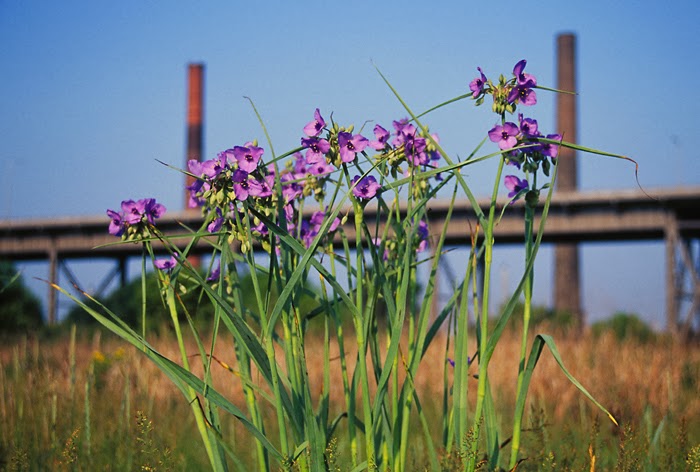
What first attracted me to the Valley weren’t the ruins. It was the resurgent wildness that had grown up around them. Neglect, contamination and blight had driven out the people and, ironically, made the valley once again attractive to wildlife. In contrast to the first transformation of the Valley, which filled the marshes, channeled the river and drove out wildlife, the new vision for redevelopment has included restoration of the river and natural areas along with business development.

Spiderwort, ca. 2001
Instead of destroying natural habitats in the name of progress, there is a new understanding that a sustainable future involves the integration of the natural environment with human activity. The vision for the Valley layers on a third component to economic development and ecological rehabilitation: cultural revitalization. After all, what distinguish great cities from merely dense population centers are their cultural assets. They are places made vibrant by their histories, their recreational opportunities and by the arts.

If Detroit is to be saved it won’t be because Jesse Welter saw in it a business opportunity. It won’t be due to a flock of photographers who descend on the city for a day or a week and leave with images, however poignant and metaphorical. It will be the result of community efforts, including the many artists who have taken up residence there and whose work is about transformation and hope rather than decay and despair.

The latest chapter in the on-going story of the Menomonee Valley is one of transformation and hope. It is a story worth telling. Stay tuned.

Wednesday, August 14, 2013

Photos available from 3 Bridges Park opening

If you missed the opening of Milwaukee's newest park -- 3 Bridges Park in the Menomonee Valley -- it's not too late to go see it. In fact, it will only get better and better! If you want to see photographs from the day of the event, there are many posted on the Menomonee Valley Partners' flickr site, including some of mine.

I was asked by MVP to take portraits of people who attended the opening. There is an official set of those portraits. Click here to view them. One of the purposes of the portraiture was to document the event itself and to see who was in attendance. There is also another purpose. Our goal is to revisit the site in coming years and document how the park changes over time. I am delighted to be involved in that process.

This is just one of the portraits I made that day. Not a random one, though. Meet Laura Bray, director of Menomonee Valley Partners.

Sunday, July 21, 2013

Grand opening of Menomonee Valley's new 3 Bridges Park: a photo essay

3 Bridges Park opened yesterday on an auspiciously bright morning. Hundreds of people joined three processions that led from the eponymous bridges towards a platform next to the Menomonee River. There they heard Mayor Barrett, the directors of the two sponsoring organizations, Menomonee River Partners and the Urban Ecology Center, and other dignitaries and community activists talk about their excitement about the new park. Following the speaches and a ribbon cutting there was music and festivities throughout the 24-acre park.

You can read much more thorough stories about the day's event at JSOnline and The Active Pursuit. Here are a few of the photographs I took of the festivities. (I also was there to shoot portraits of people attending the event. Check back to see those. It'll take me a few days to process and upload them all.)


A trio of musicians leads one of the three processions from the bridge at 33rd Ct. in the center of the park.


The processions marched along newly paved multi-use paths that are an extension of the Hank Aaron State Trail.


Drummers leading a second procession from the bridge at the east end of the park, which connects to the Mitchell Park Domes.


The procession that came from the bridge at the east end of the park merges with the group from the 33rd Ct. bridge.


Mayor Barrett headlines the list of distinguished speakers who extolled the significance of the park for the neighborhood, the Menomonee Valley, the City of Milwaukee and the larger community.


Alderman Murphy (in red shirt), a long-time advocate for the park and the Valley, joins the throng of spectators crowding the narrow paths between newly seeded slopes of park land.


Several children join in the ribbon cutting along with the mayor, the alderman, and the directors of MVP and UEC, Laura Bray and Ken Leinbach, respectively.


The dignitaries toss handfulls of seed to symbolize the potential of the park.


De la Buena, a local band, provided entertainment with a Latin flavor.


UEC staff led popular kayaking demonstrations throughout the day from the newly created ramp that slopes down to the river.


Younger members of the crowd could elect to have their faces painted with floral and animal designs.


There were plenty of cyclists pedaling throughout the park all day. This is the Valley Passage bridge at the west end of the park.


There was also one prominent unicyclist, UEC director Ken Leinbach, who traveled the length of the park in his inimitable, unique style.

Postscript: I've been asked by a number of people how to get to the park.
Here is a link to a map.

Thursday, February 21, 2013

Name the new Menomonee Valley Park!

Can you come up with creative name for the fabulous new park in the Menomonee Valley? The message below is excerpted from a press release issued by Menomonee Valley Partners. 

credit: Wenk and Associates
 Community invited to submit ideas for name of new park
in the Menomonee Valley

24-acre park along Menomonee River to open July 20
Just east of Miller Park, beneath the 35th and 27th Street Viaducts, a former railroad yard is being transformed into a 24-acre park. The effort is part of a partnership among the State of Wisconsin, City of Milwaukee, Menomonee Valley Partners, and the Urban Ecology Center.

The park has a little bit of everything. Serving as the new "outdoor classroom" for the Urban Ecology Center's new Menomonee Valley Branch, the public park will include 24 acres of native vegetation, re-created glacial topography offering great vistas of the city, wildlife habitat, access to the Menomonee River for canoeing and fishing, a mile extension of the Hank Aaron State Trail (connecting the Valley to Mitchell Park and the Domes), community gardens, and public art.

The only thing missing is a name. So the partners are asking the community to submit their suggestions. "This is a once-in-a-lifetime opportunity," said John Gurda, Milwaukee historian and a selection committee member. "Lots of people name their babies, but who gets to name an entire park?"  People should submit their suggestions at RenewTheValley.org through Friday, March 22.

credit: Milwaukee Dept. of City Development
For thousands of years, this area of the Menomonee Valley was part of a wild rice marsh, where the Potawatomi gathered with other Native Americans during the harvest. In the late 1700s, the first permanent trading post in Wisconsin was established here for commerce between the French fur traders and the native people. In the 1900s, when Milwaukee was known as the “Machine Shop of the World,” this site became a rail yard of the Milwaukee Road Shops, an enormous complex that made rail cars and locomotives and was one of the largest employers in Milwaukee.

After a decade of planning and redevelopment, the site will open July 20 as a new public park. “The park will be a community effort for years to come,” said Laura Bray, Executive Director of Menomonee Valley Partners. “Getting people engaged in naming the land is the first step. In the next several years there will be many opportunities for people to help with plantings as the park continues to grow and develop.” The land is owned by the Redevelopment Authority of the City of Milwaukee, managed by the Wisconsin Department of Natural Resources (WDNR) as part of the Hank Aaron State Trail, and will be the outdoor science classroom of the Urban Ecology Center, which will run programs there throughout the year.
 
The names submitted will be vetted by a selection committee that includes representatives from several nearby neighborhoods, the City, WDNR, Menomonee Valley Partners, Urban Ecology Center, Potawatomi Community Foundation, and others. The committee will select a name that relates to the land’s history, its future, or something uniquely Milwaukee and put forth a recommendation for approval by the Wisconsin Department of Natural Resources and the
Redevelopment Authority of the City of Milwaukee. A name will be announced prior to the July opening. More information at Renew the Valley.

Sunday, September 9, 2012

Urban Ecology Center opens in the Menomonee Valley

-->
The Urban Ecology Center opened in 1991. No, wait – it just opened today.* Yes; and the fact that both statements are true is a tribute to the entire community and provides hope for the future of Milwaukee – and the world. Hyperbole? One of Thoreau’s most famous quotes is often taken out of context: “In Wildness is the preservation of the world,” he wrote; and then he went on: “Every tree sends its fibres forth in search of the Wild. The cities import it at any price.” If Thoreau only knew how desperate is the need in most cities today, over one hundred and fifty years after he penned those words!

But we in Milwaukee are more fortunate than most. Not only do we have a wealth of “wildness” in the form of natural areas in our parks, but also we have one of the most remarkable and effective educational resources in the country heralding its importance.

The Urban Ecology Center first began bringing Milwaukee’s inner city school children to nature back in 1991. What opened today was the newest of three branches of the Urban Ecology Center, at 3700 W. Pierce St. in the Menomonee Valley. 

Ken Leinbach, Executive Director of the Urban Ecology Center with Kate Morgan of 1000 Friends of Wisconsin on the rooftop deck, which overlooks the Menomonee River in the background.

If you’re a follower of Urban Wilderness you know I love the Urban Ecology Center. I think it’s one of the very best things Milwaukee has going for it. One of the things I love the most is hearing the stories about the Center and the experiences children have as a direct result of the Center’s programs. 

From the podium at the opening ceremonies, Ken Leinbach, and Beth Heller, Branch Coordinator, mused about the day in 1991 when they first formulated the idea. “This was before we even had the trailer in Riverside Park,” Leinbach said. “We knew even then that we wanted a branch in Washington Park. We knew we wanted to serve the South Side. And now, here we are next to a park that’s being built from scratch!”

Ask Leinbach about the Valley Passage, which is a short tunnel under a single railroad track that provides the new Center – and the nearby Silver City community – access to the Menomonee River, the Hank AaronState Trail, and the unfinished park. He will tell you about the intense negotiations – with the City, the County, the railroad and the companies it serves, among others – that were necessary to make that passage possible. …And the remarkable single night of construction that it took to build the passage under a working rail line that couldn’t be interrupted even for one day.

Beth Heller introduced Glenna Holstein, whose personal story exemplifies the mission of the Center better than any other. As a teen Glenna experienced some of the earliest programing offered by the Center in its infamous double-wide trailer in Riverside Park (before the construction of their current multimillion dollar, award-winning, 20,000 sq. ft. “green”building.) Glenna now has come full circle. Her new job, as branch manager of the Menomonee Valley Branch of the Urban Ecology Center has just begun.

Glenna Holstein helps Aniyah plant a seedling along the Hank Aaron State Trail in the still unfinished park.

The most moving story in a long series of moving stories came from Laura Bray, Executive Director of the Menomonee Valley Partners, a non-profit that shares much of the glory in the celebrations of this opening ceremony. She recalled growing up near the Milwaukee River in the 1980s. But she was not allowed to go there because it was unsafe. When it was her turn to raise children, she said, she deliberately moved to the Riverwest neighborhood so that she could encourage her children to go to the Milwaukee River and break the cycle of disengagement with nature. The tears in her eyes brought tears to my own. Children need nature. In Wildness is the preservation of the world – and our physical and mental health. We all need safe parks and rivers.

The fact that the Milwaukee River, and now the Menomonee River, have safe parks for us to take our children to today is due in no small part to the Urban Ecology Center.

Celebrants of all ages were serenaded by a mariachi band and other musicians.

 A beautiful mosaic mural hangs in the new Center. It was made by neighborhood children, teens and adults under the direction of mosaic artist Leann Wooten, who was on hand to explain some of the symbolism. References to rivers, flowers and trees are clear enough, but the three moons represent the three branches of the Urban Ecology Center itself. Most important, she said, it is the spirit of collaboration that went into its creation. This symbolizes a world in which we are all connected not only to each other but also to the natural world all around us. In Wildness is the preservation….

Urban Ecology Center educator Dan Graves leads a diverse and enthusiastic crowd as they head out to plant native wildflowers in the new park.

Everett plants a seedling.

Beekeeping is in the planning stage at this new Center, but several beehive frames ready to be harvested were imported for the day. Below, family members Seamus, Anna, and their mother, Beth, help scrap the wax cap from a frame of cells.

On this first day the Center is already doing what it does best: allowing children, of all ages, to get their hands dirty – and sticky!


Sandwiched between the Menomonee River and the still active railroad line, Milwaukee’s newest park, as yet unnamed, is taking shape. Not only is it being “built from scratch,” but it reintroduces nature into the most industrialized and long abused valley in the region, if not the state. Thoreau, were he alive to reflect on it, might amend his famous prescription: In urban wildness is the preservation of the world. If our children can’t experience nature where they live, in cities, then the future will be bleak. Here in Milwaukee, at the Urban Ecology Center and in the Menomonee Valley, there is a vision for a brighter future.


*I wrote this on Saturday, September 8, 2012.

Monday, November 8, 2010

Hank Aaron State Trail ribbon cutting today

The sun was bright and the weather balmy today as eager supporters of the Hank Aaron State Trail (HAST) assembled on Pierce Street at 37th to celebrate the opening of the new Valley Passage, a new bridge over the Menomonee River, and a new length of the HAST. I’d call it a three run homer for Hank! Mayor Barrett headlined an all-star cast of dignitaries and celebrities who universally extolled the virtues of a Trail that is now within a fifteen minute bike ride of over 400,000 people in the Milwaukee area.

 People stream down the elegant S-curve of the Valley Passage towards the river.

The Valley Passage and bridge reopens a route from the near south side Silver City neighborhood into the Menomonee Valley, thus providing access to the Valley with its still expanding industries and recreational opportunities. Simultaneously, a new leg of the HAST now reaches from the Valley out to 94th Street along a former rail line. Plans to continue it out to join the Oak Leaf Trail near the county line will make it possible to ride a bicycle from Lake Michigan to the Mississippi River.


 Officials and celebrities join in the ribbon cutting at the new bridge.

But wait, there’s more! Another runner rounds third and hits the bag for a fourth run: Ken Leinbach, director of the Urban Ecology Center (UEC) was on hand to officially announce the center’s partnership with the State Trail. The UEC’s third satellite center will be housed in a former bar building right next to the Valley Passage and bring children from south side schools into newly restored riverside parklands. Have I mentioned lately how important the work of the UEC is to Milwaukee’s urban wilderness? I cannot speak more highly of their programs. I hope someday there are satellite centers within a fifteen minute bike ride from everywhere in Milwaukee County.


This doesn’t look like much more than piles of dirt today, but this was once a rail yard and will soon be beautifully restored parkland that evokes Wisconsin’s glacial heritage. The HAST will provide access and the UEC will bring schoolchildren to explore the river and native wildlife there.

Many people were thanked at the ceremony today, including State DNR and Milwaukee officials, politicians, and businesses, among others, who contributed time, energy, materials, and funds to make all of this possible. However, the most important thanks go to trail manager Melissa Cook, the staff of Menomonee Valley Partners, and the Friends of the Hank Aaron State Trail, many of whom are gathered here for their first ride across the new bridge.


Oh, and stay tuned. Here's artist Chad Brady putting final touches on the first section of a new mural that will cover the entire concrete retaining walls of the Valley Passage. The other sections will be finished next spring.