Showing posts with label photography. Show all posts

Sunday, November 12, 2017

Chasing autumn in Milwaukee area parks


Noyes Park, Milwaukee
For many people, myself included, this is the best time of the year. But let’s face it. Autumn 2017 in Milwaukee has been disappointing. Blame climate change or natural variability but it was unusually mild early in the season. While that’s hard to complain about as the prospect of another Wisconsin winter nears, it seems to have dulled the colors. Many tree species, oaks in particular, seem to have gone directly from green to brown. Others have remained green far longer than normal. Some, like the maples, were finally turning as the calendar went from October to November.

Vernon Wildlife Area, Waukesha County

I finally found a few brilliant sparks amid the embers of the season but it was more challenging than last year. Here is a selection of five area parks that I visited recently. Two of them—Holy Hill and Greenfield Park—are old favorites, worth revisiting often. The other three were new to me: Glacier Hills in Washington County, Vernon Wildlife Area in Waukesha County, and Noyes in Milwaukee. If you act quickly, you too may still be able to capture a little of the fading glory of autumn.

This story was published in my column at Milwaukee Magazine. Click here to read further.

Here is just one of the photos from each of the five parks included in the story:

Glacier Hills County Park


Ice Age Trail at Holy Hill


Vernon Wildlife Area 


Greenfield Park


Noyes Park


 To see the rest, click here.


Sunday, September 11, 2016

Water communion


I am blessed. Last night, after a week of occasionally heavy downpours, I walked from my house to the Milwaukee County Grounds where I was treated to one of the more spectacular sunsets I have had the pleasure to witness. Brilliantly lit by the setting sun, a thunderhead moved off to the north, still visibly drenching the earth below it. The sun on the horizon in the west lit up the underside of the thunderstorm and created an intense perpendicular rainbow, like a scene from Close Encounters. (The image, shot with my iPhone, doesn't do it justice!)

Caught up in the spectacle, I didn't stop at the time to think further about the thunderstorm or the role that rain plays in the water cycle. But the theme of the service at church this morning brought that image into sharper focus, metaphorically speaking. I am a member of Unitarian Universalist Church West (UUCW) and it was our annual "Water Communion" service, which signals the start of the church year.

Smallmouth bass, Riveredge Nature Center, Mke River, 5/16
The Water Communion is a ritual that symbolizes not only the importance of water to all of life but also the spiritual community of the congregation. Congregants are encouraged to bring water to church that comes from a place we have visited over the summer or that represents a meaningful event that happened. During the ritual people pour their offering into a common bowl, mingling the waters.

The litany that accompanied the ritual included this: "We bring water water of sunrise and new beginnings..., water of harvest and sunset; the sweat of a job well done; the tears of endings..., water of quiet and peace...." We paused in meditation, to reflect on our water, its source and its meanings in our personal lives. As I reflected on this I was struck, not for the first time, by how much my life is blessed. I have been privileged with experiences relating to waters both near and far. 

Kayaking the Menomonee River, 5/16
Here I offer a selection of images and brief reflections. (The links embedded in the text will take you to previous blog posts.) I fulfilled a long-time goal in May of kayaking the Menomonee River. In the process I found it to be surprisingly wild even given my already high expectations. The smallmouth bass (above) was caught by naturalists at Riveredge Nature Center as part of World Fish Migration Day.


It's true that I saw many scenes involving Lake Michigan that were quite similar to this one. But in June I had the great fortune to spend the solstice in Finland. This sunset occurred at approx. 11:45 pm. over the Gulf of Finland. I was on a cruise-ship-size ferry on my way from Helsinki to...


St. Petersburg, Russia. The highlight of my two days there was the Hermitage, seen here from across the Neva River.

The UUCW house band played Joni Mitchell's The Circle Game for the Water Communion. I hadn't heard it in years:

And the seasons they go round and round
And the painted ponies go up and down
We're captive on the carousel of time
We can't return we can only look
Behind from where we came
And go round and round and round
In the circle game


"A community is a network of relationships and the places where those relationships interact."

Water and more specifically the Kinnickinnic River was the theme of my most important art exhibit of the year. Concrete River: Memorial and Promise on the Kinnickinnic, a collaboration with Melanie Ariens, opened at the Alfons Gallery in May and ran through July. Collaboration continued when the dance duo of Andrea and Daniel Burkholder, pictured here, performed a site-specific dance created especially to harmonize with the exhibit.


And while the Concrete River exhibit showcased the planned rehabilitation of the KK River, it was gratifying to see the last stretch of concrete channel finally disappear from the Menomonee River this summer (near the stadium, visible in the distance).


The limestone ledges and cliffs of the Niagara escarpment along Green Bay framed a week at The Clearing, a self-styled "Folk School" where I attended a writer's workshop in July. Along with few (well, more than a few) photos, I returned with a water-related haiku:

sitting on stone
scent of cedar
clear horizon


August was a busy month and water was a constant theme. On August 7 the Milwaukee Water Commons staged its annual We Are Water celebration on Bradford Beach.

"People want more community these days because contemporary life in mainstream America can be pretty discouraging. We're bombarded every day by messages that promote individualistic behavior--and the more disconnected we feel the more...we consume." To me these words from the Water Communion service extend beyond the human community to include all life.


Because we are an activist denomination, the Water Communion included a call to action. One of this summer's actions was the second annual "Convergence at the Confluence" rally to promote oil train safety. It took place at the confluence of the Menomonee and Milwaukee Rivers on August 14.

"In community we lend our strength and support to one another--in community we can do things we could never do alone!"


August 25 marked the centennial anniversary of the founding of the National Park Service. I marked the occasion by visiting the closest National Park to Milwaukee, Indiana Dunes National Lakeshore. There, along with some of those Lake Michigan horizons, I discovered a wealth of other habitats, including this wetland called the Great Marsh (although the discerning eye will note that it is in fact a swamp!) (It's the trees.)


September got off to a watery start when I decided to explore the Root River sections of the Oak Leaf Trail for the first time. Here you see it in high water, a condition that will be far more common when the Waukesha water diversion project is implemented and that community's wastewater will be dumped into the Root River.

Another quote from the Water Communion: "The water we have gathered comes from the world's far corners and our own kitchen sinks. It is as salty as tears, as cool as a deep spring, as turbulent as a rushing river, as calm as a deep blue lake."


My most recent water-related adventure was just yesterday, when I led a stalwart group of Sierra Club members on a guided hike along the Menomonee River. In the rain. I was concerned that no one would show up. It being the Sierra Club, however, they knew what to wear and we all enjoyed the wet. An Englishman named Alfred Wainwright is credited with a saying I am fond of recalling in these situations: "There is no such thing as bad weather, just unsuitable clothing."


One of the hymns we sang for the Water Communion included this line: "When our heart is in a holy place we are blessed with love and amazing grace." I saved what I consider my most amazing photo for last. It is an undoctored image of the sun rising out of Lake Michigan.

I am blessed. The best week of the summer was not my voyage to the foreign shores of Finland but, as I said, right here on our own Great Lake. I spent a very relaxing week staring at that horizon. I saw the sun rise each day. Each day it was different and new. It looked like this only once. My heart was in a holy place that day. (And my camera was on a tripod!)

But one last water story. My favorite.

Until she started school for the first time last week I took care of my granddaughter once a week, as I've done for the past 4 years. The best day of my week was when Lynncita came to play with me. On hot days in the summer we liked to walk to Hoyt Park Pool. Even in cold weather when all we have is the sink, she enjoys playing with water. This summer she invented a new game. I would fill the watering can with water from the hose and then she would pour the water into pails. Then she lifted the pails and dropped them to watch the water splash. There is nothing like a 4-year-old to make you feel young again!

One warm day she was doing her pail splashing thing over and over, continually asking me for more water. Then suddenly, with no warning or hint of her intentions, instead of dropping the lifted pail she turned it upside down over her head. I watched as she sputtered and wiped her eyes, wondering what would come after. She erupted with the most gleeful chortling laugh.

And then she did it again. And again...

I did not get a still photo of it. But you can see it on YouTube.

I promise it will make you smile.

I do feel blessed.


Wednesday, April 27, 2016

Nothing Kills A River Like Concrete: Exhibit invitation

Concrete River: 
Memorial and Promise on the Kinnickinnic River

Photography by Eddee Daniel
Collaborative shrine and installation with Melanie Ariens

Alfons Gallery
1501 S. Layton Blvd., Milwaukee, WI

Opening reception: May 22, 1 - 3 pm. 
Artist's remarks: 2 pm.


I hope you'll join me and Melanie for this event. This will not be an ordinary photo exhibit. We plan an installation that will make the gallery feel like the concrete channel.

Exhibit runs through July 31

Gallery hours:
Wed, Thu, Fri, Sun 12 - 3 pm
and by appointment.

For more information: Alfons Gallery website.

Artist's Statement:

Nothing kills a river like concrete. How we treat rivers is suggestive of how we relate to the natural world in general.

Historically, rivers have been central to the growth of human civilization. This was as true at the founding of Milwaukee as it was in the Fertile Crescent between the Tigris and Euphrates. Somehow, though, in the late twentieth century, our modern society lost sight of this vital truth. Milwaukee’s three rivers suffered many abuses, including habitat loss, pollution and dams.

But there’s nothing like pouring concrete into it, essentially transforming it into a drainage ditch, to signal the destruction of a river. Sections of other rivers and creeks in the Milwaukee River watershed were subject to this debasement, but the Kinnickinnic River suffered the most.

In the 1960s the KK, as it is still affectionately known, was straightened and lined with concrete in order to mitigate flooding problems in the surrounding neighborhood. Although at the time this dramatic action did provide some relief from the risk of flooding, it also compromised the river in significant ways. The concrete channel destroyed aquatic and riparian habitats, degraded water quality, and increased the risk of drowning during high water flows. Ironically, today even the original intent of the channelization has become outdated and ineffective for flood control.

Fortunately, for the river and for the community, attitudes have once again shifted. Caring for and revitalizing rivers has captured the public imagination. On the KK the current solution is a project to remove the concrete channel and restore the river to a more natural condition. When I was invited by the Milwaukee Metropolitan Sewerage District to document the project area I jumped at the opportunity. It’s exactly the kind of subject to which I am drawn.
 
The KK River Project, officially known as the Kinnickinnic River Corridor Neighborhood Plan, is a joint endeavor by the MMSD and the Sixteenth Street Community Health Center. The project area is located between 6th Street and 27th Street. (An earlier phase of the project, completed in 2012, removed the concrete channel downstream from 6th St.) The 50-ft. wide concrete channel is to be removed and a 200 ft.-wide rock-lined river channel created. This has necessitated the acquisition and deconstruction of 83 homes in order to accommodate the wider river. Although most of those houses had already been removed, I witnessed and documented the deconstruction of several of the few remaining.

Because the project is in its early phases, most of the images in this exhibit depict the river’s current state as a concrete channel. Furthermore, the installation itself is intended to reinforce the claustrophobic and treacherous conditions that exist. In order to represent the more hopeful future of the KK, I have invited environmental artist Melanie Ariens to collaborate with me on a water shrine to signify the restored vitality that is envisioned in the KK River Project.

See more of my KK River photos in my Flickr album. 


Sunday, March 27, 2016

It Takes One: A feature by The Cultural Landscape Foundation

I've had the honor to be featured on The Cultural Landscape Foundation's website. I recently went to Houston to attend a TCLF conference called "Leading with Landscape: The Transformation of Houston." In getting to know a few of the TCLF members there I shared a little about my work and what's going on in Milwaukee. They were interested enough to interview me for their feature, "It Takes One." I'm reprinting it below. If you want to read the original on their website, click here.

It Takes One: Eddee Daniel

I am a photographer and writer specializing in urban ecologies and cultural landscapes. My practice is multidimensional. I tell stories about particular places. I also examine how we perceive and construct understandings of nature in the contexts of culture and the built environment. I have long characterized my work with the paradoxical term ‘Urban Wilderness,’ which symbolizes the complexity of my subject matter as well as its inherent tensions.

I have degrees in art education with an emphasis on photography. After more than 30 years of teaching art, photography, and architecture in secondary- and higher-educational settings, for the past six years I have pursued my current practice full time. I also have a long record of environmental advocacy, having served on the boards of several local non-profit organizations. I love all of the arts. Currently, I am collaborating with two choreographers, who are incorporating my imagery into environmental-themed dance programs. My interest in cultural landscapes is less a conscious choice than a thoroughly ingrained personal temperament.

Menomonee River reconstruction, Milwaukee, WI
How do you define a cultural landscape?
A cultural landscape is a place, whether natural, built, or otherwise designed, that has felt the impact of the human imprint. These places may be interpreted broadly or very particularly. Today, at the beginning of what some are calling the Anthropocene Epoch—when human influence has begun to affect ecology on a planetary scale—an argument can be made that all landscapes have a cultural aspect. For the purposes of my artistic practice, I generally choose to examine landscapes where the human and natural elements are inextricably interconnected: Either there has been a deliberate effort to modify a place or the features of a place have motivated humans to adapt to it. To me, cultural landscapes are places that live in the imagination as well as exist as earthy terrain: They have stories worth telling.

What is the Urban Wilderness Project?
The Urban Wilderness Project began as a voyage of discovery as well as a means to advocate for conservation and restoration of natural habitats within my local urban and suburban setting. It was also about how to perceive a watershed while living in a city. I set out to explore and document the existing conditions within the Menomonee River watershed, which begins in an exurban area of farms and encroaching suburbs and runs through the heart of industrial Milwaukee. I spent six years exploring the physical features of the region and, in particular, its rivers and riparian parks. The project dealt with issues of land use, flood management, economic development, recreational opportunities, pollution, wildlife diversity, and habitat restoration. The outcome was a book entitled Urban Wilderness: Exploring a Metropolitan Watershed, published by the Center for American Places at Columbia College Chicago.

Beyond that specific project, I have used the term ‘Urban Wilderness’ more generally to symbolize the complexity of my experiences as well as my creative responses to the tensions and themes symbolized by this idea. The term, which for me is rich with hope as well as contradiction, has provided the conceptual underpinning for various bodies of work I have undertaken in the past 20 years. Although these bodies of work are loosely unified by the overarching ‘Urban Wilderness’ concept, they vary in focus and style from documentary realism to abstract formalism. Throughout, I try to emphasize an experience of the world that is relational and conditional rather than singular and fixed.

St. Louis Art Museum, Forest Park, St. Louis
How do you choose your projects?
In a world that seems to have become an endless series of ecological catastrophes, I have made a determined effort to choose projects that tell a more hopeful story. I admire the efforts of others to raise awareness about a wide variety of important and pressing environmental concerns; that is essential. However, I seek places where I see positive transformation either underway or being planned. In 2014, I served as the inaugural artist-in-residence in Milwaukee’s Menomonee Valley, a blighted post-industrial landscape that is in the midst of economic and environmental revitalization. In 2015, I worked with the Milwaukee Metropolitan Sewerage District to document its Kinnickinnic River Project, which will eventually remove several miles of concrete channel and recreate a more naturalized river.

Is your work primarily documentary, or does it strive to do something else?
My work can be difficult to categorize. Much of what I do is documentary. My writing can be described as creative non-fiction. My photography veers between straightforward documentary and the fine art formalism that was the basis of my artistic education. I am unquestionably an advocate for many things: the creation and enjoyment of urban parklands, sustainable development, river revitalization, instilling a love of nature in children, just and equitable access to nature, etc. My artistic work often reflects this. Sometimes it is more abstract or symbolic, like the long-running personal project I call Synecdoche: the fragment that represents the whole. Uncharacteristically, but importantly, that project is not devoted to a specific place. Instead, it suggests a more universal experience of nature as fragmentary and that what remains must stand in for what has been lost.

I would like to think that I observe the world with a childlike sense of wonder. Occasionally I believe I achieve that valuable goal. But in truth, there is nearly always a defining conceptual basis to the work I do, whether symbolic, as in Synecdoche, or pragmatic, as in the restoration of a damaged river.

Curtain Wall, from Synecdoche: the fragment that represents the whole
What are the advantages and disadvantages of the medium of photography in capturing the essence of a place?
Photography has nearly universal appeal due to its accessibility and democratic character. People generally believe what they see and photography can lend credence to the subject it represents. That can be an asset for a documentary project. It enables viewers to visualize a place and helps drive a narrative. However, to turn the old saw on its head, a photograph often requires a thousand words to put it into context. Without contextual support, a single image can easily be misunderstood. To remedy this potential pitfall, I rarely depend upon a single image and I include written narratives to support my theses.

Alienation from nature is a frequent theme in your work. Are parks and maintained natural areas a true remedy to such alienation?
While I am sensitive to the issue of alienation from nature, I don’t consider that a starting point. It is my fundamental belief that the human/nature divide is a false one. If I have a starting point for my practice it is the idea of the interdependency of all life and the interconnection between nature and the built environment symbolized by the theme of 'Urban Wilderness.' Having said that, in an increasingly urbanized world we do have to deal with alienation from traditional experiences of nature. I believe that urban parks and natural areas are indeed a vital component in combatting what author Richard Louv refers to as “nature deficit disorder.” In my experience, the well-documented health and spiritual benefits of exposure to the natural world accrue to time spent in urban natural areas as readily as elsewhere.

Urban Wilderness, from the Urban Wilderness Project
What message would you like to give our readers that may inspire them to make a difference?
Like most people who grew up in the 1950s and 1960s, a huge percentage of my youth was spent outdoors and unsupervised. That kind of upbringing is so rare today that children fortunate enough (from my perspective) to have that experience are dubbed “free-range kids.” If children are not provided with daily opportunities to run free in nature, the consequences will not only affect their own development, potentially leading to an increase in physical disabilities, decreased mental acuity and spiritual poverty, it will also create a society that no longer values nature enough to protect what remains.

As more and more of the global population lives in urban settings, sensitively designed public parks and natural areas become increasingly vital to everyone’s future. We cannot reset the clock to 1955, but we can create a future that enables people of all ages to see and touch nature within their own communities.

Forest Park, St. Louis, MO
Stay tuned for a blog post about Houston and my experiences there.

Tuesday, June 16, 2015

WPCA hosts panel on Menomonee Valley

I hope you'll join me for a discussion panel and special reception in conjunction with my current exhibition at Walker's Point Center for the Arts.

Thursday, June 18, 6-8 pm.


A distinguished panel of community leaders will be on hand to ensure a lively and informative discussion focusing on the various projects that are making the Valley a healthy and vibrant place to work and play.

PANELISTS
- Ben Gramling - Director of Environmental Health, 16th Street Community Health Center
- Corey Zetts - Executive Director, Menomonee Valley Partners
- Glenna Kate Holstein - Menomonee Valley Branch Manager, Urban Ecology Center
- Daniel Adams - Director of Planning; Harbor District, Inc.

- Eddee Daniel - Writer, Photographer, 2014 Menomonee Valley Partners Artist in Residence

The exhibition runs through July 11.

Walker's Point Center for the Arts is located at 839 S. 5th St., one block south of National Ave.

Gallery hours: Tue-Sat, 12-5 pm.  


Wednesday, May 20, 2015

A Year in the Menomonee Valley on exhibit at WPCA

You're invited!

Please join me for

Eddee Daniel: A Year in the Valley
Witnessing Menomonee Valley Revitalization

May 29 - July 11

Opening reception: Friday, May 29, 5-9 pm.

Walker's Point Center for the Arts
839 South 5th Street
Milwaukee, WI

The exhibition will feature photography and stories from my 2014 tenure as the Menomonee Valley Partners' inaugural Artist in Residence.

The Menomonee Valley, once blighted and shunned, is in the midst of a dramatic and well-orchestrated transformation and has become a nationally renowned model for sustainable urban redevelopment. It was an honor and a joy to have had the opportunity to observe and document part of that transformation. I hope you'll come to see the results.

In addition to the opening reception, there will be a panel discussion on Thursday, June 18, 6–9 pm. Representatives from Menomonee Valley Partners, Milwaukee Riverkeeper, Urban Ecology
Center, Sixteenth Street Community Health Center and the Harbor District will join me to discuss Menomonee Valley revitalization – its history, ongoing development and future plans.

For more information about the exhibit go to WPCA.

For a lot more information about my year in the Menomonee Valley, including photographs, essays, and stories, go to the website that I created for the purpose.


Saturday, May 2, 2015

Horicon Marsh: A poetic and photographic odyssey

-->
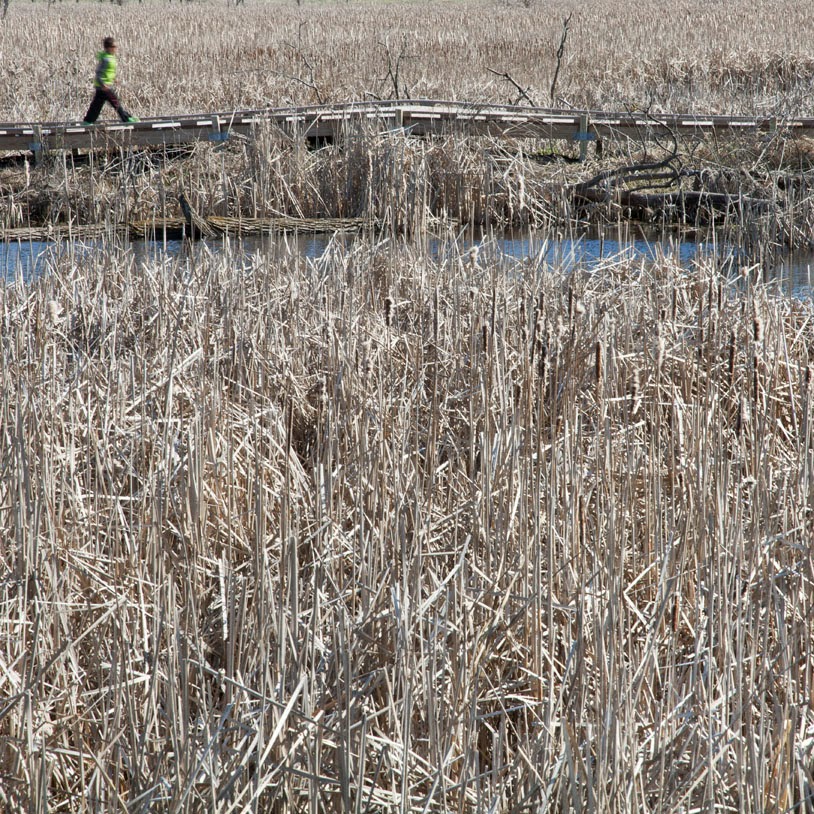
The marsh was burning. I’ve known for some time about changing forest management practices. I knew that controlled burning is now widely accepted as a method to control invasive species as well as to prevent uncontrolled, destructive wildfires. But it hadn’t occurred to me that a wetland would burn.


I was in Horicon Marsh National Wildlife Refuge with my friend Charlie. We happened upon a crew in the midst of a controlled burn authorized by the U.S. Fish and Wildlife Service. Traveling around the marsh we noted many areas that had been visibly burned, some quite recently, others during the past year. Evidence of burning became one of my photographic themes during our odyssey.


Charlie is a poet. We share similar values, including a reverence for nature, and we like to get away together now and then to soak up some of it. We usually choose a place within a couple of hours drive that is near a park or natural area. Horicon Marsh, the largest freshwater cattail marsh in the U.S. and less than an hour from Milwaukee, easily fits the bill. 


We dawdled for two days, walking trails in several parts of the marsh. As will become clear when you read Charlie’s poetic contribution below, I did more walking than he did. We stopped at both the federal and state visitor’s centers. Yes, there are two contiguous sanctuaries, the State Wildlife Area as well as the National Wildlife Refuge. Not that you can tell by looking at the topography (although we humans couldn’t leave well enough alone—a dike roughly coincides with the boundary.)


By the second day we had circumnavigated the entire marsh, both state-owned and federal. We even discovered Nitschke Mounds County Park filled with dozens of ancient, but un-photogenic, Indian mounds (above). Unlike the wildlife refuges, which were popular, we had the mounds to ourselves—and the thousand-year-old spirits of Late Woodland Culture effigy mound builders.


People often visit Horicon to see the birds and we certainly saw plenty, although migration was far from peak. We saw mostly the ubiquitous Canada geese and a variety of ducks. I also tallied a flock of Sandhill Cranes (above), a couple flocks of swans, a deuce each of prairie chickens and wild turkeys, bluebirds and some kind of swift. Plus numerous unidentifiable (by me) other birds.


And 16 turtles. You won’t see many birds in the photos. Gotta admit I’ve never been patient enough to be a wildlife photographer. Turtles are sitting ducks, so to speak, so I caught a few of them. Mostly I focused on my customary and oppositional themes: revealing the enchantment of nature near my urban haunts and finding traces of humanity’s presence in natural landscapes. The burns were an enthralling bonus.


Charlie wrote the following poem. I took photos. More selections below.

ON A HILLSIDE OVERLOOKING HORICON MARSH
WHILE MY FRIEND EDDEE WANDERS OFF
DOWN THE TRAIL TO TAKE PICTURES

Goose honk and bird chirp,
the blue-brown landscape
of marsh grass and water,
a few dead trees scratch the sky.
This is a place for birding,
but I’m here for loafing.
I’m good at it, lying here
with my head on a rock.
The afternoon sun, warm
on my face and jeans,
blue bird atop the blue bird house,
turkey vulture overhead.
Times like this I realize
if you stay still and wait long enough,
nature comes to you.

Charlie Rossiter, April, 2015


To see more photos go to my flickr album.