Saturday, December 21, 2013

Winter Solstice: a true story

-->
This is one of the stories from Urban Wilderness: Exploring a Metropolitan Watershed, which was published in 2008 by the Center for American Places at Columbia College Chicago. I offer it again on the shortest day of 2013. The story, written ten years ago, describes a County Grounds that has undergone profound changes since then. And yet, the grove of trees at the heart of the story remains intact, for the time being. May it ever be so.

Late afternoon sun glows weakly through a thin skein of clouds.  On this darkest of days, it has never been far from the horizon. We leave behind a house and neighborhood as yet unlit, from which all color has been drained.  
So begins my family's annual pilgrimage, a private solstice tradition connected to 4,000 years of ritual observances rife with the symbolism of renewal. At the winter solstice (literally "to stand still," referring to the celestial moment when the sun stops receding from the equator) ancient peoples often referred to the "unconquered sun" because its descent into darkness is arrested. Ritual helped explain this event and drive off the "monsters of Chaos" that might prevent the sun's return, with catastrophic consequences. Prior to the construction of elaborate structures for the marking of the solstices, such as Stonehenge in England, these rituals often took place at sacred natural sites, on hilltops or in groves of trees.
Traffic on the Menomonee River Parkway is thin; its fittingly subdued sounds fade as we pass through the empty park. Across the railroad tracks, in the County Grounds, urban slowly yields to wilderness. Turned but snow-free fields still bear meager, dryly rattling cornstalks, hollowed skins of squash, and carefully bundled staking sticks. Our footsteps fall on progressively softer earth; the concrete street gives way to asphalt sidewalk, then tire-tracked dirt road to earthen trail; then finally to grass as we step off the path entirely.  No paths can take us from where we live to where we want to be today. 
Formerly waist-high grasses lie in arrhythmic whorls. Rigid stalks of sturdier plants—goldenrod, teasel, and milkweed—stand like punctuation marks in an undecipherable text. Ahead stands the grove we seek, in its already shadowed hollow, as the sun burns softly on the horizon.  Across the open meadow the wind is biting, but dies when we reach the dell. Pushing cattails gently aside, I test the ice atop the tiny rill. There is an open rift where water runs, black and silent, but the ice holds and we step across into the heart of the grove. A galaxy of animal prints—rabbits, raccoons, and many birds—swirls around its center of gravity.
 Among the smaller maples and ash is a tremendous, old black willow, with so many trunks that they go uncounted. They radiate from its open center like ancient standing stones. Several have fallen and resprouted. One scarred limb lies horizontally across the middle, its bark completely abraded off by countless climbing shoes. It assumes the roles of megalith and altar.

Out of the wind, it is suddenly warm, despite the icy ground. To dispel the gathering gloom, we light candles along the broken limb. Overhead the crown of the tree glows brightly. It is the moment of solstice—the standing-still sun. Our vigil combines solemnity with celebration; it also recognizes continuity between ancient archetypes and contemporary concerns. We honor the spirit of this place, the animals that share its shelter, the larger landscape all around, and the life-sustaining Earth; we uphold the unity of Creator and Creation; and we do all of this with a particular awe: we are here, minutes from home, in the center of metropolitan Milwaukee, and yet in quiet solitude, in the urban wilderness. 
When we emerge again to the open field, the golden horizon has cooled to magenta and a fierce winter wind flies in our faces. But the "monsters of Chaos" have been contained again; the darkest night will soon be gone; the land will persist and—beyond superstition—the belief is rekindled, that we as a people will learn to live in harmony with nature. The unconquered sun will be brighter tomorrow. 
This is one of a pair of posts in honor of the Winter Solstice. Click here for "Winter solstice ceremony on Milwaukee’s lakefront."

Sunday, December 15, 2013

Christmas trees and geese at Harley Davidson Museum


I was out in the Menomonee Valley again when it snowed yesterday. Did you know that you can buy your Christmas tree at the Harley Davidson Museum? I didn't know that. The big black cubic building was what drew my attention. It was quite striking in the snowy landscape. It's blackness was softened by the snow, as you can see in the photo above.


It wasn't until I drove in to park near the building that I noticed the orange fencing, which at first I took as part of the Harley Davidson color scheme. That seems to be a coincidence, though.


Out in front of the small, fenced tree lot the open field had attracted a huge flock of geese.


Now and then more geese landed singly or in small wedges. Most of them stayed hunkered down into the snow until I disturbed them by approaching too close.


I did catch a few flying over the museum from across the canal. I wrote a haiku to capture the contrast:

wintry stillness
a wedge of silent geese
a full-throttled roar


Wednesday, December 11, 2013

Common Ground sponsors tour of MMSD

-->
 
 The photos are mine, but the text that follows was written by Pete Overholt, who organized the tour we took on behalf of Common Ground.
 “Did you know the deep tunnel has close to 30 miles of water storage capacity?  Did you know leaky laterals – the pipes that connect our homes to the sewage treatment system - are a significant problem during large rain events?  Did you know you may be eligible for a mini-grant to help pay for installation of a rain garden on your property?  Did you know one of the major tools for water treatment is microbes … that “gobble up” contaminants?  Did you know that Milorganite is short for “Milwaukee Organic Nitrogen”? 
A bus-load of Unitarian Universalists learned all this and a lot more during a tour of the Milwaukee Metropolitan Sewerage District (MMSD) Jones Island wastewater treatment plant on Saturday, 12/7.  Clouds of vapor rising from settling ponds set against crisp blue sky provided a dramatic backdrop for the event, and our guides did a great job of fielding a steady stream of questions. Our group followed the process from trash filtering to settling, through the microbial buffet and chemical cleansing, to final discharge of clean water to Lake Michigan.
The operation was impressive, but there is always room for improvement.  While sewer overflows are a much smaller problem than they were in the past (thanks to deep tunnel storage capacity), they still occur, and urbanization continues to add impervious surface, increasing the volume of water that must be handled.  Individually, we can all have an impact; if it’s raining hard, shorten your shower, and save laundry for another day!  Collectively, MMSD gave us a picture of sanitation and storm water handling in our community.”
Common Ground is a nonpartisan organization in Southeastern Wisconsin dedicated to identifying pressing social problems facing our community and bringing about creative solutions. To learn more about Common Ground, go to their website.
The interior shots are all of the drying facility that makes Milorganite, which is used as fertilizer.
The Jones Island stack is 300 feet tall, which is also how deep the deep tunnels are.

Full disclosure: I attended the tour as a member of Unitarian Universalist Church West.

Tuesday, December 10, 2013

Snowscapes in the Menomonee Valley


A flock of geese descending towards a small patch of open water on the Menomonee River at the Valley Passage Bridge crossing. I went out during the snowfall on Sunday and caught this. It was beautiful and haunting.

And the Industrial Park across Canal Street from the river was also haunting in its own way. It will come as no surprise to followers of this blog that one of the things I love about the Menomonee Valley is this juxtaposition of urban and wilderness!


Sunday, December 8, 2013

Mysterious Menomonee River stalagmite formations in Hoyt Park

Friends of mine were out walking along the Menomonee River in Hoyt Park yesterday when they discovered a mysteriously tall ice formation. Knowing that I would be interested, they stopped by to alert me of the phenomenon. It did sound intriguing but I was unprepared by their description of it for just what a curiosity I'd find. Along the downstream edge where the water flows over a weir numerous formations resembling stalagmites have formed. The tallest, as the photo below shows, is about as tall as I am. Water could be seen bubbling up from the center of several of the smaller formations, which explains how they grew. I am quite baffled as to how one could have gotten so tall.


While I was out I was delighted to see that there were quite a few hardy souls braving the unseasonably frigid temperatures to enjoy the wild side of Hoyt Park. Hikers, joggers and even a few bikers were out on the trail on the south side of the river.

I may go out again today to see what the snow fall has done to the ice. It is certain to draw out a few skiers.

The weir in the photo, by the way is one of several still left in the Menomonee River. I hope that someday before too long it can go the way of the concrete channel that is currently being removed downstream near Miller Brewing. See my last post for more on that.

Saturday, November 30, 2013

Menomonee River concrete channel removal underway: a photo essay

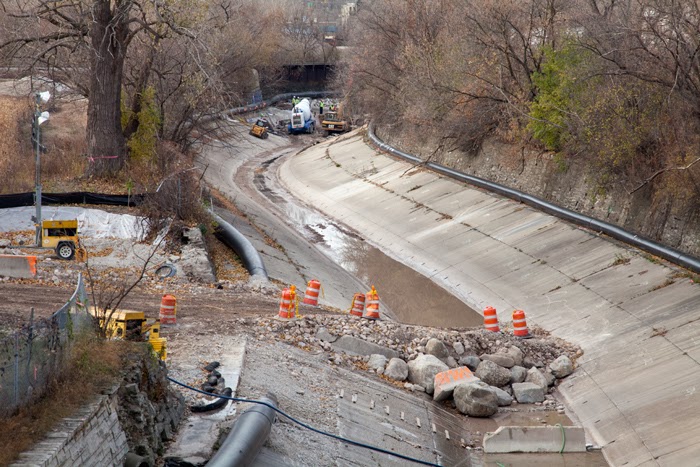
Work began in September to remove 1,100 feet of concrete channel in the Menomonee River near Miller Brewing and the Wisconsin Avenue viaduct. The purpose is to return the river to a somewhat more natural state and enable fish to more easily migrate upriver. A final section of concrete channel south of the viaduct is slated for removal later in 2014. That will complete the channel removal that began upstream at 45th Street when a small dam was removed approximately 15 years ago. Those who are familiar with my book, Urban Wilderness: Exploring a Metropolitan Watershed (published in 2008) may remember that I wrote about the promise of channel restoration at that time. Thankfully, that promise finally is being fulfilled. Here is a photo essay of the current conditions. (For a more detailed account of the project go to jsonline.)

Water intake pipes
View towards Wis. Ave. viaduct
Graffiti on railroad bridge


View from viaduct with Miller lot in background
View downwards from viaduct
View from Bluemound Rd. bridge upstream
Outflow pipes
A section of the restored channel