I watch for clouds. When I notice them tumbling overhead, I seek out open spaces where I can see the drama unfold. Today a brisk westerly wind whips them up. I’ve been eager for an excuse to revisit the troubled Kinnickinnic River. On my way there I crane my neck to see through the car windows. Cumulus, billowing and wrestling, converge on torn patches of blue sky.
By the time I reach the KK Parkway gray clouds have overcome the blue. It is completely overcast; gloomy. Disappointed but unfazed, I head down the concrete slope into the KK channel, where gloomy seems an appropriate mood.
Last week I kayaked down the Milwaukee River. (Read my
previous post.) The KK River repels as romantic nonsense any notion of setting a boat into it. This river repels even the notion of “river.” It appears more like an empty freeway with a watery median.
What kind of society paves its rivers?
To slightly alter one of my favorite lines from an old song by Paul Simon, “I’d rather be a river than a street….” So, now and then, I step off the concrete “pavement” into the channel. The chorus concludes, “I’d rather sail away, like a Swan that’s here and gone….” But I am determined. I continue down the much-abused river.
Within fifteen minutes the clouds have dissipated. Shredded remnants are a theatrical backdrop for the river of concrete. The resurgent sun lightens my mood as well as the surroundings.
I rarely go out without my camera, which is probably my loss. Mostly I acquire a lot of pictures that fill up an enormous amount of space on my hard drives. What I risk losing is the freedom to experience my surroundings aimlessly, purely.
Thoreau wrote, “Our moments of inspiration are not lost though we have no particular poem to show for them; for those experiences have left an indelible impression….” (Substitute “photo” for “poem.”) The Kinnickinnic River, with its relentless concrete, leaves an indelible impression.
I am glad for my camera today. The abased river is rich with imagery and metaphor.
I come to a wall built during the Civilian Conservation Corps era. The meticulous craftsmanship of its construction is still evident despite the depredations of time and erosion. Vines dangle over it and in places trees burst through the carefully laid stones, as if mocking our puny efforts to control natural forces, raging rivers, erosion. Even a walk along a concrete river can provide a lesson in humility. Who are we to wall in a river?
Adding insult to injury, the steel ramparts of a railroad bridge are defiled with layers of graffiti. One particular tag is compellingly ironic: boldly, the word JOKE vanquishes previous tags, for now. The question goes begging: on who is the joke? Trailing vines swing in the breeze, emphasizing how inert the JOKE really is.
A variegated shaft of sunlight slashes across the warring layers of graffiti underneath the bridge. There is no victor here. But! Farther on….
Grass ruptures concrete. The leaves of emergent bushes burst through, spill out like an organic solvent for human arrogance. Trees rise from the paved river. An ovation of clouds rises to applaud the transfiguration.
The Kinnickinnic, identified as one of the “most endangered” rivers in the country, is nothing to celebrate. The penetration of concrete by blades of grass, while marvelous, does not constitute redemption. And yet…!
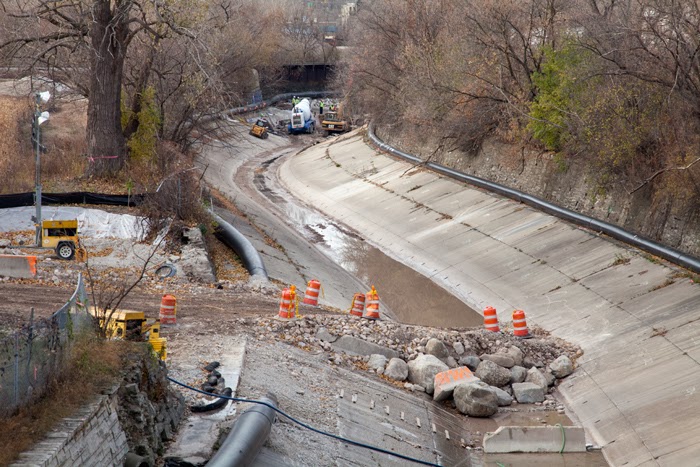
I arrived in gloom; but the clouds have lifted and so have my spirits. There is hope. The ruptured concrete may be a symbol of a new awareness. Not far downstream machinery is poised to remove the concrete channel from a section of the KK and reconfigure a more natural river. The concrete channel is not ordained. Let us be like the humble grass.
We can be a society that unpaves its rivers. But it is in ourselves that change must happen.
I leave the concrete river, satisfied that I have managed to arrest the flow of time and the river with a few photographs, but challenged by Thoreau once again:
“It is something to be able to paint a particular picture, or to carve a statue, and so to make a few objects beautiful, but it is more glorious to carve and paint the very atmosphere and medium through which we look, which morally we can do. To affect the quality of the day, that is the highest of arts. We are tasked to make our lives, even in their details, worthy of the contemplation of our most elevated and critical hour.”