Monday, April 23, 2018

Menomonee River Parkway: Close encounters in an April snowstorm

You may think last week's snowstorms were an unseasonable fluke or a sign of the changing climate. You may have felt cheated of spring on the cusp of Earth Day. You may have grumbled about having to shovel out so late in the year. I know I did. However...


It was beautiful! (Look closely at the center of the photo to see the two deer.)

I'm not sorry it's melting away now. All I'm saying is when the climate gives you lemons, make lemonade. In this case, go out and enjoy the snow. I know I did.

One lovely, snowy evening I went to one of my favorite haunts along the Menomonee River Parkway just north of North Avenue. I didn't expect to see the deer, but I saw them, in spades. Both sides of the river. A few of them, as you can see, got up close and personal. (I was not using a telephoto lens.)

They seemed surprisingly tame, curious...and hungry. When I didn't offer them anything to eat they returned to rooting in the snow.

The deer were not the only wildlife blindsided by the blizzard. Numerous ducks swam about on the river, ducking for cover.


Most of the snow had melted by the weekend. On Saturday I joined the hundreds of volunteers for the annual river clean up sponsored by Milwaukee Riverkeeper. While I didn't actually do any cleaning up, I did take a bunch of photos, which you can see on Flickr.


Wednesday, April 18, 2018

Nashotah Park: A lovely winter day in April!!

The snow was soft, heavy and surprisingly deep the third day after an unseasonable blizzard in April. But the wide trails over hills and through woodlands were well-trodden and tracked by skis by the time I got there. All the same I had the place nearly to myself on a lovely midweek morning. I say lovely because it was—if you forgot for a moment it being April. Sunny and warm for February.

Like every single person I’ve spoken to since it snowed, I felt betrayed by the weather. I didn’t go out to enjoy it for two days. My loss. I’m glad I broke the spell and ventured out to Waukesha County to explore a park new to me. The snow made an already beautiful place even more enchanting.

Nashotah Park is 444 acres nestled within a glacial terrain of rolling hills, woodlands, wetlands, and grasslands. There are two large natural lakes, an oak forest and an oak savanna. There are wide open fields, a cedar glade (I’m told—I didn’t find it), and broad expanses of marsh. 

I did see a solitary hiker on a portion of the 10-kilometer trail system, which has multiple loops. 


Later, around noon, towards the end of my walk, several skiers zipped by, proving the popularity of the park for cross-country skiing, even after an unexpected spring snowfall. Although they hadn’t been groomed this late in the season, the trails are groomed in winter for both classic and skate style cross-country skiing. There is even a separate trail for snowshoeing, according to the Wisconsin Trail Guide website. 

The Waukesha County Parks website states, “Due to the variety of landscapes, Nashotah Park has an outstanding array of songbirds.” And I saw some, including this pair of male Eastern bluebirds, looking rather cold in the circumstances. I was also surprised to see a couple of great blue herons fly by over the oak canopy—although I suppose it shouldbe warm enough for them by now! The redwing blackbirds were making a ruckus in the snow-dusted cattails, too.

Don’t let the snow get you down! I know we’re all hoping for balmier conditions and spring flowers to bloom. But, hey! It’s lovely out there in the parks.

This is one of an ongoing series of stories about parks that I have undertaken as part of a long-term project called A Wealth of Nature. Anyone familiar with my Urban Wilderness blog will find little to differentiate the new series, for it is entirely consistent with my previous work. However, in an effort to be more comprehensive I am deliberately exploring parks all around Southeast Wisconsin that are new to me.

A website for the project is underway. Meanwhile, I have just created a new Instagram account (@awealthofnature) and Facebook page, which I invite you to like and follow. A Wealth of Nature is a project of Preserve Our Parks, on the board of which I serve.


Saturday, April 14, 2018

Burning Washington Park


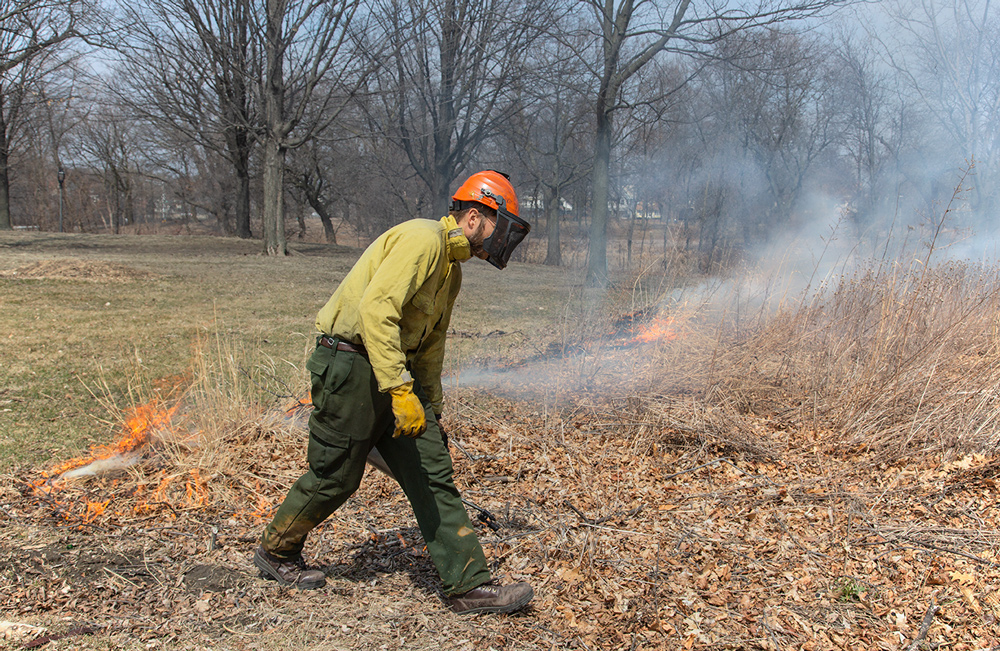
The other day I was delighted to be able to watch as parts of Washington Park went up in flames. No, I’m not a pyromaniac and the fires were carefully controlled by professionals. Although the benefits of using fire as a management tool have become relatively common knowledge it is still unusual to get the chance to see it in action—especially in an urban setting!

Fire was once a natural and common feature of many ecosystems native to the U.S., including woodlands, prairies and even wetlands. Many native plant communities adapted to fire. Some species even require burning to propagate. Prior to European settlement, the indigenous peoples used fire as a management tool in many parts of North America, including Wisconsin.

After over a century of fire suppression policies—think Smokey the Bear—we have come full circle. Once again, fire is being used for ecosystem management. The benefits of controlled or prescribed burning include reducing weeds and invasive species, removing the duff layer of last season’s leaves and other organic matter, returning nutrients to the soil, and invigorating fire adapted native species.

The burning of Washington Park was done by Dare Ecosystem Management under the supervision of the Urban Ecology Center, which has one of its three branches there. Five separate patches of prairie were burned. The ability of the crew to control the burn was quite impressive, especially considering conditions that involved gusty winds that shifted direction. 

Jason Dare of Dare Ecosystem Management uses a drip torch to ignite the perimeter of a patch of prairie. The drip torch, an essential tool for a prescribed burn, literally drips fuel (usually a mixture of gasoline and diesel).

The Washington Park Bandshell, never in danger, provides a backdrop for one of the prescribed burn sites.

Kim Forbeck, Manager of Land Stewardship at the Urban Ecology Center helping to control the blaze with a rake.

The actions of the crew, igniting and tending to the fires, brought to mind the "firemen" in Ray Bradbury's novel, Fahrenheit 451. In contrast to that dystopian tale, however, these actions are totally benign.

One of the burn sites was a narrow strip of prairie grass along the edge of the lagoon. A bystander watches from a park bench.

The burn contributes to the Milwaukee County Parks Department's Shoreline Habitat Restoration Project, which is intended to establish a riparian buffer zone between the land and the water. The native plants in the buffer zone help prevent erosion, provide food and shelter for wildlife, and protect water quality in the lagoon by capturing runoff. The Urban Ecology Center can be seen in the background.

Michaela Molter, Land Steward at the Washington Park branch of the Urban Ecology Center, supervising the burn. 


-->

Saturday, April 7, 2018

Photo Essay: South Shore Marathon


Sheridan Park


Although the sun was bright the temps were more reminiscent of January than April. But that didn't stop hundreds of runners from participating in today's South Shore Half Marathon. The race began at South Shore Park and went along the Oak Leaf Trail to Grant Park and then back for a total of 13.1 miles. Along the way the runners went through Bay View Park, Sheridan Park and Warnimont Park, one of the nicest stretches of parkland you'll find in any city anywhere, if you ask me.

Here are a selection of photos:

Bay View Park


Bay View Park


Warnimont Park


Bay View Park


Warnimont Park


Warnimont Park


Warnimont Park


Warnimont Park


Bay View Park


Bay View Park


Warnimont Park

Sunday, April 1, 2018

Searching for Spring: Parks can help ease late winter blues


Case Eagle Park, Burlington, Racine Co.
It’s that time again—the dregs of the year. The snows of winter have melted. The leaves and the wildflowers have yet to bud or bloom. The earth everywhere is brown and gray. Still cold. Groundhog lied again. The first of April arrives and the joke is on everyone who expects it to feel like spring.

Brown Deer Park, Brown Deer, Milwaukee Co.
In a song about the seasons John Denver included an instrumental bridge for a fifth season, late winter, early spring, to which he added parenthetically “when everyone goes to Mexico.” Spoken out of privilege, of course. Maybe everyone wishes they could go to Mexico. I know I do. But, since that isn’t an option, I’ve gone to a few local parks to see nature stripped bare. Here are a selection of images and the parks where I found them.


Brown Deer Park


This 363-acre park in the Village of Brown Deer is part of the Milwaukee County Park System. The northern half consists of several woodlots separated by grassy fields, along with a 5-acre lake. The southern half is a golf course, which is groomed in winter for skate style cross-country skiing. A second trail, maintained for classic-style skiing, winds around and through the woodlands. In warmer weather a disc golf course runs through some sections. The pond is stocked with panfish, trout and largemouth bass.

The Oak Leaf Trail runs along the north end of the park on the park road between Range Line Rd. on the east and Bradley Rd. on the west. The park has numerous amenities, including a boat house, athletic fields, playground, and restrooms.


Brown Deer Park location: 7835 N Green Bay Road, Brown Deer, WI 53209
For a Milwaukee County Parks map, click here.


Case Eagle Park

This 239-acre park features nature trails and a canoe launch on the Fox River, which runs through the park. The Seven Waters Trail, a Racine County bike trail also runs through the park. The 17-mile long, wheelchair accessible trail runs from Burlington to Muskego Lake and encourages the following activities: biking, cross-country skiing, inline skating and walking. It connects with the White River State Trail in Burlington.

Part of the Racine County Park System, the entrance is located off S. Rochester Street, which is also County Highway J. Access is also possible from N. Brown’s Lake Dr., which is also County Highway W. Amenities include baseball diamonds and a fenced dog park.

Sumac bobs
Case Eagle Park location: 310 S. Rochester St., Rochester, WI 53105


Honey Creek Wildlife Area

This 1,495-acre Wildlife Area is made up of four separate parcels in western Racine County and eastern Walworth County. Habitats include oak woodland, lowland woodland, shallow and deep marsh, and grassland. Waterways include Long Lake, Honey Creek, and Sugar Creek. Wildlife includes deer, turkey, waterfowl, pheasants and other small game.
The easternmost parcel includes the 83-acre Cherry Lake Sedge Meadow State Natural Area, which contains southern sedge meadow, fen, and northern wet forest communities. Of special interest are round-leaved sundew, shrubby cinquefoil, yellow twayblade, marsh St. Johns-wort, marsh fern, and sphagnum moss.

Honey Creek is featured in the Lake Michigan Region of the Great Wisconsin Birding and Nature Trail as a property with a mix of habitats that provides opportunities to see flycatchers, terns, great blue herons, American bitterns and Sandhill cranes.

According to the DNR website, additional recreational opportunities include canoeing, cross-country skiing, hiking, trapping, wild edibles/gathering and wildlife viewing. However, there are no designated trails.

For more information, go to Honey Creek Wildlife Area.
Three of the four parcels have parking areas. For locations and WDNR map, click
here.


-->