Showing posts with label parks. Show all posts

Sunday, May 13, 2018

Photo essay: A spring bouquet for Mother's Day!

Happy Mother's Day to my mother (in remembrance), to the mother of my children, to the mother of my grandchildren, and all the other mothers out there. After a disappointing April that included a blizzard, May finally has given us spring flowers. Here is a bouquet of wildflowers (except for those at Boerner Botanical Gardens) to brighten up your Mother's Day.

Crown imperial (fritillaria) nestled among bluebells at Boerner Botanical Gardens, Hales Corners.
Hepatica
Hepatica, Genesee Oak Opening and Fen State Natural Area, Genesee.
Marsh marigold patch, Greenfield Park, West Allis Forsythia and South Ravine Bridge, Lake Park, Milwaukee
Skunk cabbage, Zinn Preserve, Town of Erin, Washington Co. Hawthorn budding, Zinn Preserve, Town of Erin, Washington Co. White trout lilies, Niagara Escarpment, Town of Leroy, Dodge Co. Trout lily patch, Niagara Escarpment, Town of Leroy, Dodge Co. Yellow trout lilies, Sanctuary Woods, Milwaukee County Grounds, Wauwatosa White trilliums, Jacobus Park, Wauwatosa Tulips, Boerner Botanical Gardens, Hales Corners. Redbud, Boerner Botanical Gardens, Hales Corners Bloodroot, Retzer Nature Center, Waukesha Co.
Flowering fruit tree, Underwood Parkwy, Milwaukee County Grounds, Wauwatosa

Saturday, April 14, 2018

Burning Washington Park


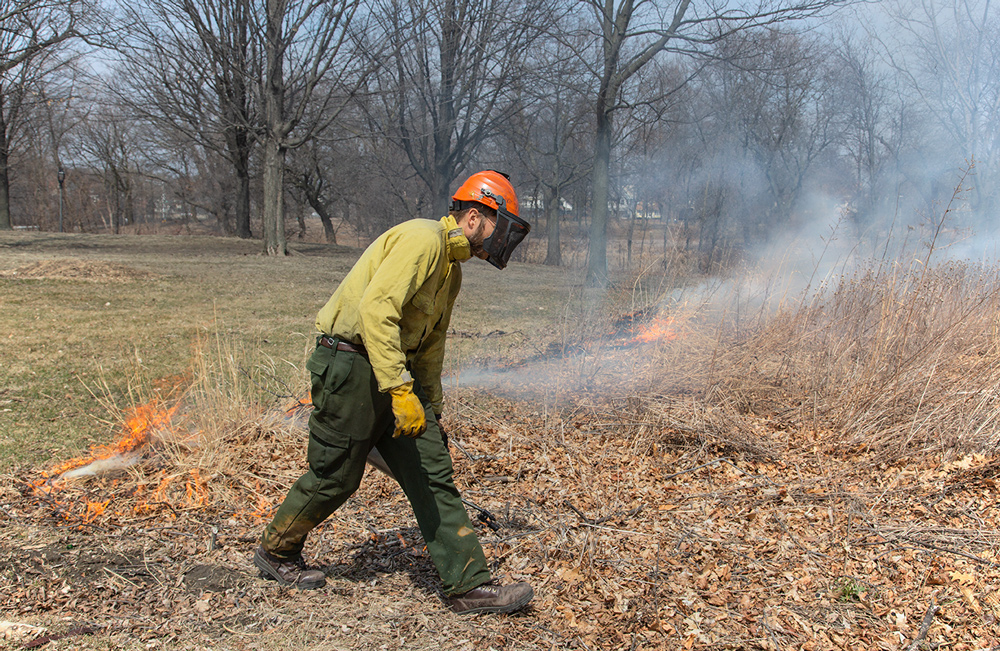
The other day I was delighted to be able to watch as parts of Washington Park went up in flames. No, I’m not a pyromaniac and the fires were carefully controlled by professionals. Although the benefits of using fire as a management tool have become relatively common knowledge it is still unusual to get the chance to see it in action—especially in an urban setting!

Fire was once a natural and common feature of many ecosystems native to the U.S., including woodlands, prairies and even wetlands. Many native plant communities adapted to fire. Some species even require burning to propagate. Prior to European settlement, the indigenous peoples used fire as a management tool in many parts of North America, including Wisconsin.

After over a century of fire suppression policies—think Smokey the Bear—we have come full circle. Once again, fire is being used for ecosystem management. The benefits of controlled or prescribed burning include reducing weeds and invasive species, removing the duff layer of last season’s leaves and other organic matter, returning nutrients to the soil, and invigorating fire adapted native species.

The burning of Washington Park was done by Dare Ecosystem Management under the supervision of the Urban Ecology Center, which has one of its three branches there. Five separate patches of prairie were burned. The ability of the crew to control the burn was quite impressive, especially considering conditions that involved gusty winds that shifted direction. 

Jason Dare of Dare Ecosystem Management uses a drip torch to ignite the perimeter of a patch of prairie. The drip torch, an essential tool for a prescribed burn, literally drips fuel (usually a mixture of gasoline and diesel).

The Washington Park Bandshell, never in danger, provides a backdrop for one of the prescribed burn sites.

Kim Forbeck, Manager of Land Stewardship at the Urban Ecology Center helping to control the blaze with a rake.

The actions of the crew, igniting and tending to the fires, brought to mind the "firemen" in Ray Bradbury's novel, Fahrenheit 451. In contrast to that dystopian tale, however, these actions are totally benign.

One of the burn sites was a narrow strip of prairie grass along the edge of the lagoon. A bystander watches from a park bench.

The burn contributes to the Milwaukee County Parks Department's Shoreline Habitat Restoration Project, which is intended to establish a riparian buffer zone between the land and the water. The native plants in the buffer zone help prevent erosion, provide food and shelter for wildlife, and protect water quality in the lagoon by capturing runoff. The Urban Ecology Center can be seen in the background.

Michaela Molter, Land Steward at the Washington Park branch of the Urban Ecology Center, supervising the burn. 


-->

Tuesday, February 13, 2018

Photo essay: Winter fun in area parks!

Minooka County Park, Waukesha

Did you get out to enjoy the snow over the weekend? Lots of folks did. Everywhere I went I found people out sledding, cross-country skiing, snowshoeing, jogging, walking dogs and even cycling in the snow. After our repeated freeze-thaw cycles of January it seemed as though there was finally enough snow to enjoy winter for a change. Here are some photos.

Hundreds of people of all ages were snowboarding and sledding on the long slope down to the lake behind the  Whitnall Park clubhouse. 

Hoyt Park, Wauwatosa
Family snowshoeing at Retzer Nature Center, Waukesha
Hiking the Pike River trail at Petrifying Springs Park, Kenosha
Hoyt Park, Wauwatosa
Fox River Parkway, Waukesha
Groomed cross-country trail at Whitnall Park, Franklin
Skiers looking for a trail, Retzer Nature Center
Hoyt Park, Wauwatosa
Minooka Park, Waukesha
Hoyt Park, Wauwatosa
Retzer Nature Center, Waukesha


Monday, January 22, 2018

Please oppose Pay-to-park plan for County Parks

County plan would charge $3.50 per hour to park in 76 parks and parkways.

Whitnall Park
The following op ed by Preserve Our Parks president, Jim Goulee was posted in Urban Milwaukee and is reprinted here with permission:

Imagine having to pay to park your car each time you go to a dog park, play golf, take your children swimming, play a game of tennis, soccer or baseball, take your kids to a tot lot, attend a picnic, enjoy a beer garden, or simply sit and observe nature.  These are only some of the occasions when you would be required to pay a fee to park your vehicle in one of Milwaukee County’s beautiful parks.
The 2018 adopted budget for Milwaukee County Parks System includes $1.7 million to be derived from new parking fees that would be incorporated in numerous parks and parkways. The County Board will soon be considering the proposed installation of metering and payment devices in as many as 76 parks and parkways for up to $3.50 per hour.

When this unfortunate idea was presented by County Executive Chris Abele in his version of the 2018 budget, many thought there was no way the County Board would go along with it. Sadly, they did.  To make matters worse, the budget did not include any working capital to accomplish this task. A small Pay-to-Park Workgroup was commissioned through the budget to study the paid-parking issue and make recommendations to the County Board. An informational report by that entity will be presented at the Parks, Energy and Environment Committee meeting on January 23rd. This group includes predominantly County employees, with very little representation by citizens.

Based on meeting notes acquired through the Budget Division of the Milwaukee County Department of Administrative Services, the Pay-to-Park Workgroup will recommend that the County award a contract to an outside parking vendor willing to invest in the necessary infrastructure and provide ongoing management, collection, and enforcement. It will also recommend that the contractor pay a base fee and a percentage of parking revenue to the Parks Department.

The City of Chicago did something similar a number of years ago for their city-wide parking. Chicago now receives only 10 percent of all revenue derived from parking. The other 90 percent stays with the contractor. There have been countless reports about how much both citizens and government officials loathe this onerous privatized contract.

It is interesting to note that during their deliberations, the workgroup has identified as many as 2,500 potential parking spaces that could gross as much as $3.1 million dollars at $3.50 per hour. It was not apparent from the workgroup notes how they calculated the gross revenue figure. Did they factor in any firm number regarding parking-space occupancy rates? Did they consider that many park goers would find alternative free parking in neighborhoods adjacent to parks and parkways? Have they determined the effects this might have on other revenue-producing entities such as beer gardens, the Domes and Boerner Botanical Gardens; athletics such as soccer and Little League; or the impacts on the health and well-being of many who will find themselves priced out of visiting parks they have long loved? Did they factor in the inevitable parking problems and bad will within adjacent neighborhoods when streets become inundated with cars of park users? These are questions that must be answered before the County Board can make a decision whether to allow the Parks Department to actively seek bids from parking contractors.

Let’s assume that the nebulous $3.1 million in gross revenue from parking fees in parks is attainable. A contract similar to Chicago’s would net the County a 10 percent return which would be $310,000. Even if the County could negotiate a contract that doubles Chicago’s return, or 20 percent, the revenue would still be over a million dollars short of the budgeted $1.7 million dollars needed for the Parks to attain their revenue target.

To date, this bad idea has been discussed and planned behind closed doors without much in the way of public input. Preserve Our Parks, a local parks advocacy group, feels that it is time for all citizens to have their say in this paradigm change in the way our parks are managed and funded. The public will have two opportunities to speak on this issue. The Parks Energy and Environment Committee of the County Board will hear comments at their meeting on January 23rd at 9 a.m. in Room 210 at the County Courthouse. There will also be a meeting for the public on the issue at the Domes Annex on February 6th at 6 p.m.

Since the founding of our once-envied park system, citizens have enjoyed unfettered access to our parks whether by foot, bicycle, or motorized vehicle. Now the politicians who represent us are attempting to reverse that course. They need to consider very carefully that how they proceed on this poorly conceived issue will resonate loudly with their constituency.

Jim Goulee, President of Preserve Our Parks

Full disclosure: I am on the board of Preserve Our Parks.


Sunday, November 12, 2017

Chasing autumn in Milwaukee area parks


Noyes Park, Milwaukee
For many people, myself included, this is the best time of the year. But let’s face it. Autumn 2017 in Milwaukee has been disappointing. Blame climate change or natural variability but it was unusually mild early in the season. While that’s hard to complain about as the prospect of another Wisconsin winter nears, it seems to have dulled the colors. Many tree species, oaks in particular, seem to have gone directly from green to brown. Others have remained green far longer than normal. Some, like the maples, were finally turning as the calendar went from October to November.

Vernon Wildlife Area, Waukesha County

I finally found a few brilliant sparks amid the embers of the season but it was more challenging than last year. Here is a selection of five area parks that I visited recently. Two of them—Holy Hill and Greenfield Park—are old favorites, worth revisiting often. The other three were new to me: Glacier Hills in Washington County, Vernon Wildlife Area in Waukesha County, and Noyes in Milwaukee. If you act quickly, you too may still be able to capture a little of the fading glory of autumn.

This story was published in my column at Milwaukee Magazine. Click here to read further.

Here is just one of the photos from each of the five parks included in the story:

Glacier Hills County Park


Ice Age Trail at Holy Hill


Vernon Wildlife Area 


Greenfield Park


Noyes Park


 To see the rest, click here.


Saturday, September 9, 2017

Summer bouquet: area parks alive with flowers

Black-eyed Susans, Hoyt Park, Wauwatosa
Is it my imagination or are there more flowers this year? When a friend asked me that recently I agreed it seemed to be true. The couple of experts I asked for corroboration differed in their judgments. The point remains mysterious. And yet, I’ve come to believe it. Now and then over the course of the summer I have been startled and amazed at the abundance.

Comfrey, West Bank Trail, Milwaukee River Greenway
I didn’t set out in June to photograph flowers all summer. Flowers are lovely, of course, like flags commemorating nature. But they haven’t especially appealed to me as a subject before. As the summer progressed, however, I noticed them more and more. Everywhere I went the parks—as well as roadsides, yards, and random fields—were resplendent in colorful blossoms. “Earth laughs in flowers,” wrote Emerson, and we smile along with them, enchanted. I began to be more deliberate about finding and photographing them.

Sweet wild clover, Barloga Woods, Oak Creek
And so, as is my custom, I sought out the parks—familiar ones and some I’ve never been to before—with the best floral displays. Here I present to you, dear reader, a summer bouquet gleaned from my wanderings: A photo essay and personal award ceremony for flowers from parks all over the metropolitan region, from the Kettle Moraine to the Lakeshore and many points in between.

Menomonee River Parkway, Wauwatosa

Like Edward Abbey I am drawn especially to wildflowers. "For myself I hold no preferences among flowers, so long as they are wild, free, spontaneous,” said Abbey. But unlike him, I am far from a purist. That quote is followed by this characteristically caustic proclamation: “Bricks to all greenhouses!” As for me, after a month or so of park-hopping to find wildflowers I decided I also needed to visit a few gardens. Thankfully, Milwaukee County has several.

Lobster Claw, The Domes, Mitchell Park, Milwaukee
Photographing flowers in a conservatory is like shooting ducks in a barrel. But I seldom pass up an opportunity to revisit the Domes! Despite the closure in 2014 due to structural instability attendance at the iconic and unique structures has rebounded. I had to jostle among almost 2,200 other visitors the day I went.

Partridge pea, Three Bridges Park, Milwaukee

After a while my task shifted from discovery to selectivity. For this essay I’ve tried to narrow my choices to those places and flowers for which my descriptions ran to superlatives. Hence the awards in a number of logical and quirky categories. Forgive me if I missed your favorite park or summer bloom. I hope you’ll leave a comment and tell me your picks.

An edited version of this story was published at Milwaukee Magazine. Click here to continue reading. 

You can also click here to see more photos and additional parks at Flickr.

Washington Park, Milwaukee