Showing posts with label controlled burn. Show all posts

Saturday, April 14, 2018

Burning Washington Park


The other day I was delighted to be able to watch as parts of Washington Park went up in flames. No, I’m not a pyromaniac and the fires were carefully controlled by professionals. Although the benefits of using fire as a management tool have become relatively common knowledge it is still unusual to get the chance to see it in action—especially in an urban setting!

Fire was once a natural and common feature of many ecosystems native to the U.S., including woodlands, prairies and even wetlands. Many native plant communities adapted to fire. Some species even require burning to propagate. Prior to European settlement, the indigenous peoples used fire as a management tool in many parts of North America, including Wisconsin.

After over a century of fire suppression policies—think Smokey the Bear—we have come full circle. Once again, fire is being used for ecosystem management. The benefits of controlled or prescribed burning include reducing weeds and invasive species, removing the duff layer of last season’s leaves and other organic matter, returning nutrients to the soil, and invigorating fire adapted native species.

The burning of Washington Park was done by Dare Ecosystem Management under the supervision of the Urban Ecology Center, which has one of its three branches there. Five separate patches of prairie were burned. The ability of the crew to control the burn was quite impressive, especially considering conditions that involved gusty winds that shifted direction. 
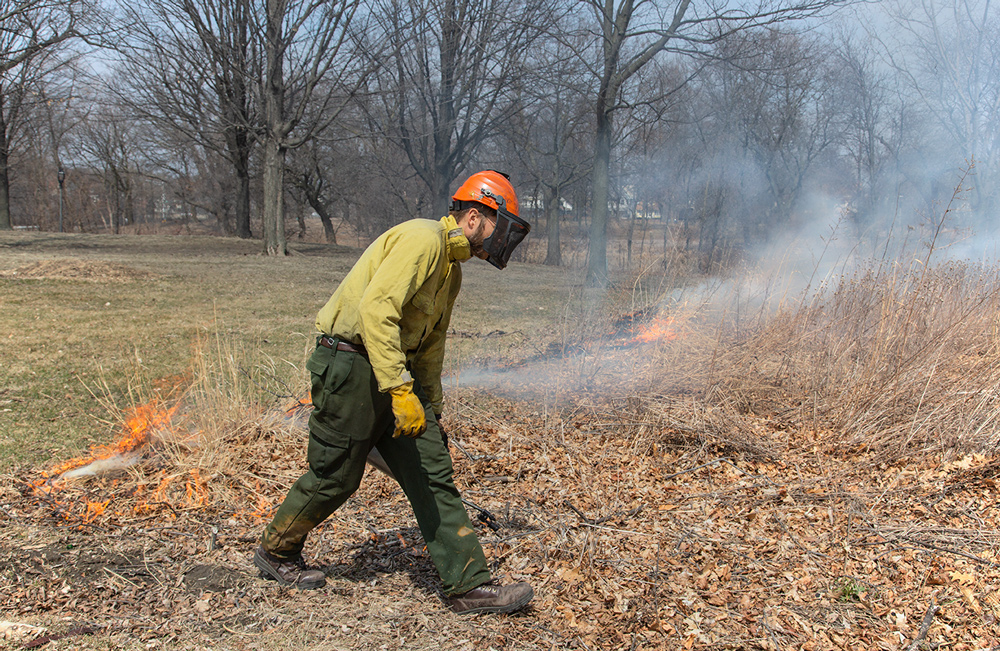
Jason Dare of Dare Ecosystem Management uses a drip torch to ignite the perimeter of a patch of prairie. The drip torch, an essential tool for a prescribed burn, literally drips fuel (usually a mixture of gasoline and diesel).

The Washington Park Bandshell, never in danger, provides a backdrop for one of the prescribed burn sites.

Kim Forbeck, Manager of Land Stewardship at the Urban Ecology Center helping to control the blaze with a rake.

The actions of the crew, igniting and tending to the fires, brought to mind the "firemen" in Ray Bradbury's novel, Fahrenheit 451. In contrast to that dystopian tale, however, these actions are totally benign.

One of the burn sites was a narrow strip of prairie grass along the edge of the lagoon. A bystander watches from a park bench.

The burn contributes to the Milwaukee County Parks Department's Shoreline Habitat Restoration Project, which is intended to establish a riparian buffer zone between the land and the water. The native plants in the buffer zone help prevent erosion, provide food and shelter for wildlife, and protect water quality in the lagoon by capturing runoff. The Urban Ecology Center can be seen in the background.

Michaela Molter, Land Steward at the Washington Park branch of the Urban Ecology Center, supervising the burn. 


-->

Saturday, May 2, 2015

Horicon Marsh: A poetic and photographic odyssey

-->
The marsh was burning. I’ve known for some time about changing forest management practices. I knew that controlled burning is now widely accepted as a method to control invasive species as well as to prevent uncontrolled, destructive wildfires. But it hadn’t occurred to me that a wetland would burn.


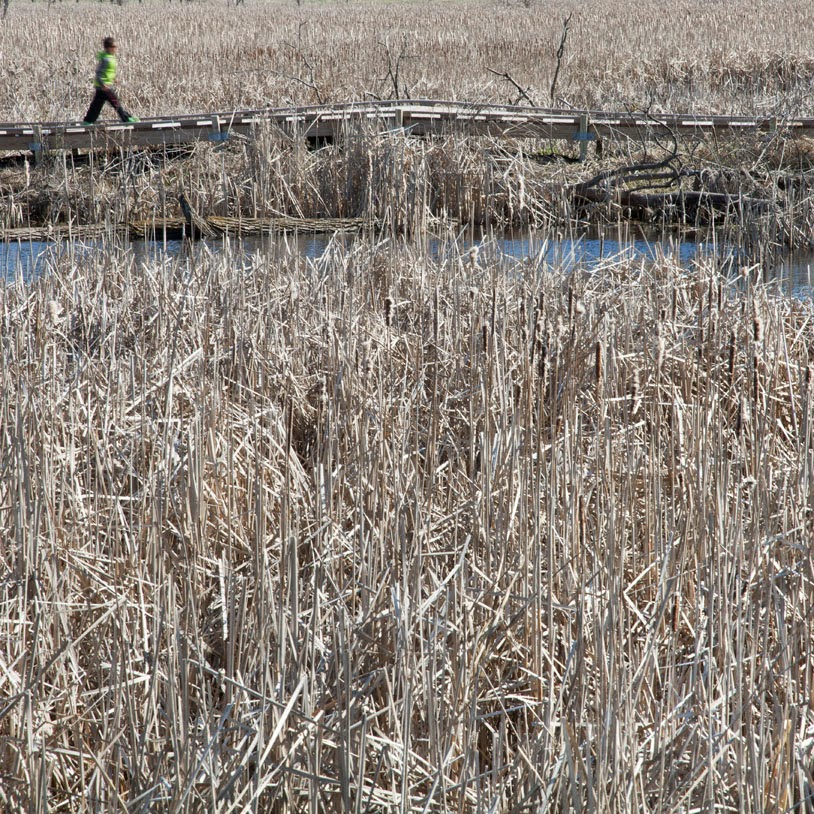
I was in Horicon Marsh National Wildlife Refuge with my friend Charlie. We happened upon a crew in the midst of a controlled burn authorized by the U.S. Fish and Wildlife Service. Traveling around the marsh we noted many areas that had been visibly burned, some quite recently, others during the past year. Evidence of burning became one of my photographic themes during our odyssey.


Charlie is a poet. We share similar values, including a reverence for nature, and we like to get away together now and then to soak up some of it. We usually choose a place within a couple of hours drive that is near a park or natural area. Horicon Marsh, the largest freshwater cattail marsh in the U.S. and less than an hour from Milwaukee, easily fits the bill. 


We dawdled for two days, walking trails in several parts of the marsh. As will become clear when you read Charlie’s poetic contribution below, I did more walking than he did. We stopped at both the federal and state visitor’s centers. Yes, there are two contiguous sanctuaries, the State Wildlife Area as well as the National Wildlife Refuge. Not that you can tell by looking at the topography (although we humans couldn’t leave well enough alone—a dike roughly coincides with the boundary.)


By the second day we had circumnavigated the entire marsh, both state-owned and federal. We even discovered Nitschke Mounds County Park filled with dozens of ancient, but un-photogenic, Indian mounds (above). Unlike the wildlife refuges, which were popular, we had the mounds to ourselves—and the thousand-year-old spirits of Late Woodland Culture effigy mound builders.


People often visit Horicon to see the birds and we certainly saw plenty, although migration was far from peak. We saw mostly the ubiquitous Canada geese and a variety of ducks. I also tallied a flock of Sandhill Cranes (above), a couple flocks of swans, a deuce each of prairie chickens and wild turkeys, bluebirds and some kind of swift. Plus numerous unidentifiable (by me) other birds.


And 16 turtles. You won’t see many birds in the photos. Gotta admit I’ve never been patient enough to be a wildlife photographer. Turtles are sitting ducks, so to speak, so I caught a few of them. Mostly I focused on my customary and oppositional themes: revealing the enchantment of nature near my urban haunts and finding traces of humanity’s presence in natural landscapes. The burns were an enthralling bonus.


Charlie wrote the following poem. I took photos. More selections below.

ON A HILLSIDE OVERLOOKING HORICON MARSH
WHILE MY FRIEND EDDEE WANDERS OFF
DOWN THE TRAIL TO TAKE PICTURES

Goose honk and bird chirp,
the blue-brown landscape
of marsh grass and water,
a few dead trees scratch the sky.
This is a place for birding,
but I’m here for loafing.
I’m good at it, lying here
with my head on a rock.
The afternoon sun, warm
on my face and jeans,
blue bird atop the blue bird house,
turkey vulture overhead.
Times like this I realize
if you stay still and wait long enough,
nature comes to you.

Charlie Rossiter, April, 2015


To see more photos go to my flickr album.

Friday, March 16, 2012

Riverside Park was burned on Wednesday!


I learned after the fact that the Urban Ecology Center (with help from the Milwaukee Fire Dept. and others) had conducted a controlled burn in parts of Riverside Park. I wish I could have been there to witness the event. As is explained on the UEC website, burning is important for long term sustainability of certain habitats and native species. (Before we humans interfered it happened naturally, of course.)


Although I missed the burn itself, I had to go check out the aftermath and take a few photos.


The burn is kept at ground level and even during natural burns established trees and hardy native shrubs seldom suffer for it.


Before long (especially with the early spring we're having this year) new shoots will sprout up amongst the ashes. Native species withstand the effects of burning better than exotics.

While I was there I met a nice young volunteer who explained why many of the trees in the park have blue bags hanging from them. These are sugar maple trees that the UEC taps for maple syrup, which they process themselves right at the center.

But if you want to see that you better head out there soon. They will be having a pancake breakfast on Saturday, March 24.

We're all invited. (Go to the UEC website for more info.)

While you're in Riverside Park to see the burn and the maples being tapped, make sure you wander on down along the Milwaukee River to see how other strategies are being used to control invasive species.


Large swaths of the flood plain have been covered in black plastic sheeting. No, it's not an elaborate environmental sculpture project, a la Christo. It's to control reed canary grass.

There's always something constructive going on around the Urban Ecology Center.