Monday, May 21, 2018

Hiking Hartland Marsh and the Ice Age Trail


The Bark River

Spring was still trying to catch up from our unseasonably cold April last week. But this day dawned brightly and suddenly turned unseasonably hot. Shedding jackets, a dozen or so of us gathered at the Cottonwood Wayside for a hike into Hartland Marsh led by Jeff Romagna, a volunteer with the Ice Age Trail Alliance.


Hartland Marsh Preserve is nestled between the Lake Country Industrial Park and the Gleason Commerce Center in Hartland. Its 180 acres is protected by the Waukesha County Land Conservancy in partnership with the Ice Age Trail Alliance and the Village of Hartland. The Bark River meanders through the middle of it, somewhere out where we couldn’t see it from the Wayside.

Our tour began on a mulched path, known as the John Muir Overlook, through a hardwood forest featuring ancient bur oaks. The trail narrowed, then led to a boardwalk across the marsh and over a small wooded island. 

Birds were plentiful, it being migration season. This is a rose-breasted grosbeak.

Another boardwalk looped through last year’s cattails and back to the forest. Here the trail was hemmed in with thickets of buckthorn. 

Most of the preserve has a far more open understory and the difference was striking. Jeff, our guide, introduced us to Paul Mozina, known as The Buckthorn Man, whose volunteer efforts have been largely responsible for removing this particularly obnoxious invasive species. Along with being more aesthetically pleasing to hike through, the cleared portions enable a more robust diversity of native species to flourish.


Across an open field we watched as a pair of sandhill cranes shepherded two chicks away from us towards a pond.

A side trail led us through a beautiful glade, over a hill and across the Bark River on a footbridge to another small island. Paul pointed out the many natural springs around the two hills that had led to its being a homestead, now vanished.

Four more sandhill cranes watched us warily from the marsh, their colors a nearly perfect match with the dead cattails. Can you spot all four?


According to the Ice Age Trail Alliance, wetland preserves like this are becoming more and more important as land is developed and urbanized. Wetlands serve critical ecological functions that help maintain environmental health as well as sustaining wildlife habitats.

Hickory sapling in bloom
By absorbing rainwater and nutrients, a marsh helps reduce flooding, prevents shoreline erosion along waterways, recharges groundwater, and enhances water quality.

Preserves like this one also provide opportunities for recreation, research and education, serving as both a laboratory and outdoor classroom for students and teachers.

The John Muir Overlook is a 1¼-mile loop linked (across Cottonwood Avenue) to the Hartland segment of the National Ice Age Scenic Trail. We hiked east along a portion of the trail until we reached the Aldo Leopold Overlook. The 45-foot tall glacial hill—which could be an esker or a moraine, according to Jeff—gave us views of the surrounding marsh. As we turned to go, a pair of brilliant white egrets sailed in to land on an open pond.

Tree huggers! It took three to reach around this enormous oak.


Sunday, May 20, 2018

Jane's Walking in the Milwaukee River Greenway


Vince Bushell and I would like to thank the ten hardy souls who showed up despite the rain and gloom to take a Jane's Walk as part of the month-long celebration of the life and legacy of Jane Jacobs. Vince is Project Manager for the River Revitalization Foundation and our walk began at their headquarters on the bend in the river between Humboldt and North. 


The blustery conditions did not keep the small group from paying rapt attention as several of us provided information about the history of the Milwaukee River and development of the Greenway, the wildlife, the Arboretum, Urban Ecology Center and other sights along the way. Vince and I were helped along by Virginia Small, who is one of the Jane's Walk organizers, and Dennis Grzezinski, a board member of the Urban Ecology Center.


Our walk took us up the East Bank Trail to Riverside Park, where we discovered this spectacular display of wild bluebells. Then we crossed the Locust Street Bridge to Gordon Park and returned via the Beer Line Trail. By the time we finished the sun had finally peeked out, though it was a good thing everyone came prepared for the rain.

We had 32 registrations and it's clear from the flurry of emails and text messages I got this morning that the conditions kept most away. Understandable. Virginia, Vince and I discussed the possibility of scheduling another walk for those who couldn't make it. Stay tuned for that.


Sunday, May 13, 2018

Photo essay: A spring bouquet for Mother's Day!

Happy Mother's Day to my mother (in remembrance), to the mother of my children, to the mother of my grandchildren, and all the other mothers out there. After a disappointing April that included a blizzard, May finally has given us spring flowers. Here is a bouquet of wildflowers (except for those at Boerner Botanical Gardens) to brighten up your Mother's Day.

Crown imperial (fritillaria) nestled among bluebells at Boerner Botanical Gardens, Hales Corners.
Hepatica
Hepatica, Genesee Oak Opening and Fen State Natural Area, Genesee.
Marsh marigold patch, Greenfield Park, West Allis Forsythia and South Ravine Bridge, Lake Park, Milwaukee
Skunk cabbage, Zinn Preserve, Town of Erin, Washington Co. Hawthorn budding, Zinn Preserve, Town of Erin, Washington Co. White trout lilies, Niagara Escarpment, Town of Leroy, Dodge Co. Trout lily patch, Niagara Escarpment, Town of Leroy, Dodge Co. Yellow trout lilies, Sanctuary Woods, Milwaukee County Grounds, Wauwatosa White trilliums, Jacobus Park, Wauwatosa Tulips, Boerner Botanical Gardens, Hales Corners. Redbud, Boerner Botanical Gardens, Hales Corners Bloodroot, Retzer Nature Center, Waukesha Co.
Flowering fruit tree, Underwood Parkwy, Milwaukee County Grounds, Wauwatosa

Tuesday, May 1, 2018

Jane’s Walk — The Milwaukee River Greenway: our premier urban wilderness


Picture yourself in a canoe, floating silently on a wide river in a valley flanked by tall wooded bluffs. You pass the occasional fisherman. Through the trees a lone jogger runs by on a riverside trail. A great blue heron starts up at your passing, rises on thermals, circles and soars away upstream. An idyllic vision.

View south from Locust Street
Now imagine being just minutes away from the towers of downtown. Welcome to the Milwaukee River Greenway, which, at over 840 acres, is larger than Central Park in New York. How many cities can you name where you might have an experience like this? One that approximates wilderness in the heart of a densely populated urban area.

I have been writing about Milwaukee’s “urban wilderness” for many years and I have numerous favorite places to go when I want to rejuvenate a spirit that longs for nature. But the Milwaukee River Greenway is among the jewels in the crown of an exemplary park system. It is our premier urban wilderness.

Rotary Centennial Arboretum
When I was invited to lead a walk for Jane’s Walk Milwaukee I immediately thought of sharing my love of this place. And so, I invite you to come experience the heart of the Milwaukee River Greenway, one of the greatest urban natural areas in the country.

If, like me, you are new to Jane’s Walk, I encourage you to check out the website and read up on Jane Jacobs, the author of The Death & Life of Great American Cities and the inspiration for this month-long citywide series of events.

I have recently embarked on a new project with Preserve Our Parks that will promote parks and encourage people to get out and explore them. We are calling it A Wealth of Nature to emphasize how fortunate we are to have an abundance of places to enjoy. I will introduce the group to the project and explain how you might use its features, which will include a new website that will help you find places to experience nature nearby.

For this tour I will be teaming up with Vince Bushell, who is Project Manager for the River Revitalization Foundation (RRF), Milwaukee's urban land trust. Vince knows a lot more than I do about the plants and animals we might see on our walk as well as the historic efforts by RRF and others to protect the Greenway.

Riverside Park
The details:

View north from North Avenue
Sunday, May 20 at 10 – 12 am.

The 2-mile tour will begin at the River Revitalization Foundation, 2134 N. Riverboat Rd., the former site of the North Ave. dam, and will end at the same location. There is street parking available.

From the Caesar's Park pedestrian bridge we will hike along the East Bank Trail north to Locust Street. This section of the tour is hard gravel and wheelchair accessible. After crossing the Locust Street Bridge we will walk back along the West Bank Trail, which is not accessible and may be muddy, depending on conditions. Points of interest include the Rotary Centennial Arboretum, Urban Ecology Center, Riverside Park and Gordon Park, with ruins from the period when it was a resort on the lake behind North Avenue dam. The views from Locust Street Bridge are a special highlight.

For more information and to register for the walk, go to our Facebook page. The tickets are free but there is a limit of 30 participants.


The ruins at Gordon Park

The walk is co-sponsored by Preserve Our Parks and River Revitalization Foundation.

View north from Locust Street
 To see more photos from the Milwaukee River Greenway go to my Flickr album.


Monday, April 30, 2018

Seeking wildflowers, finding…


Where is spring? I have been complaining about this elusive season ever since moving to Wisconsin (many years ago now.) But this year has been particularly egregious (see last week’s post of the blizzard!) On Saturday, a scheduled “Spring Wildflower Hike” at Havenwoods State Forest caught my eye and so, with minimal expectation, I went to see if the premise of the theme would be confirmed or not.

No, there were no flowers blooming, I was immediately informed when I arrived. The landscape was as sere and colorless as ever. Nevertheless, since I was there anyway I went for a walk and discovered that there were plenty of people out and about enjoying the park despite the delayed spring.

Nature can rejuvenate the spirit in any season. I have long believed that.

I didn’t wander aimlessly however. I was directed by park staff member Laura Spencer to where a group of Sierra Club members were working. They were digging up clumps of purple loosestrife, an invasive species. I learned that they were not digging them up in order to get rid of them but to take them back to the Nature Center and grow them. This came as a surprise until they explained further: The collected specimens would be grown in an enclosure so that beetles that are used to control the spread of the unwanted plants would reproduce and multiply.

Later the beetles will be released back into the wild in the areas that are infested with purple loosestrife where they will act as a natural biological control.


On my way home, I also stopped at McGovern Park, which is just across Silver Spring Drive from Havenwoods. Having been there in previous springs and delighted in a profusion of wildflowers I thought just maybe I would find a few early ones.


Most of the large woodlot there still looked quite barren, urban wilderness at its bleakest! I did see numerous shoots that I knew would bloom into lovely trout lily blossoms. But it would take another few days at least.

As at Havenwoods, however, the chilly temperature was not keeping everyone away.


Just when I was about ready to give up on wildflowers I found a few. I almost missed them. Spring beauties are tiny and these were not in the woodland where I expected them. They had sprouted up in a grassy spot next to the pond. Vindicated, I went home reassured that real spring would soon arrive. 

You can see last year's spectacle of trout lilies in McGovern Park in my column at Milwaukee Magazine on "Hidden Gems." 

-->

Sunday, April 29, 2018

Greenfield Park run for organ donation


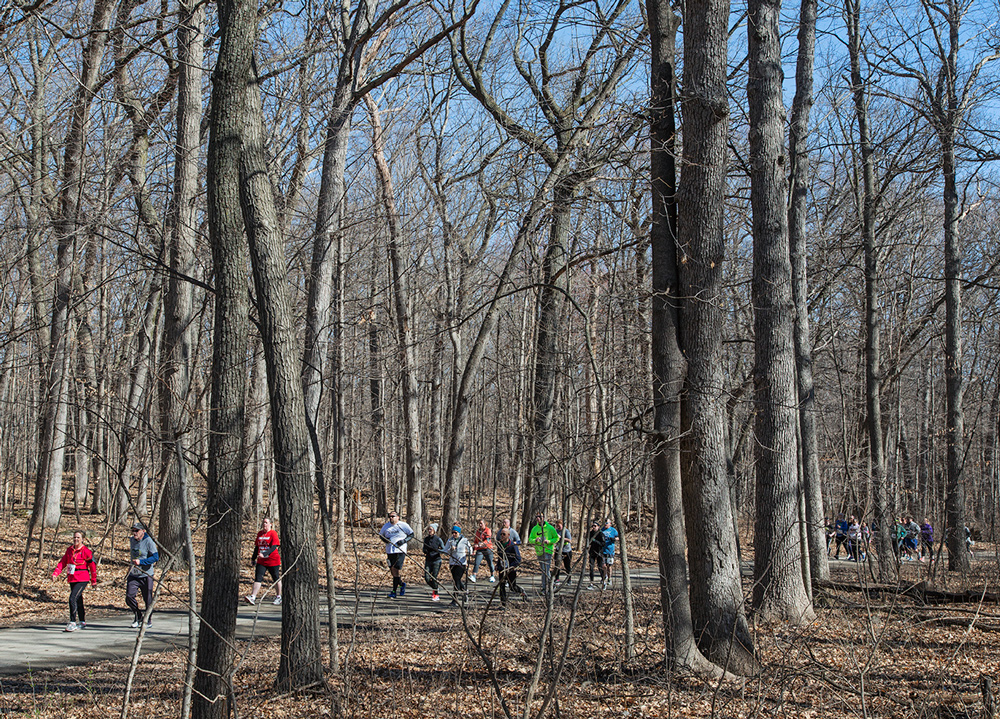
The temperature was still surprisingly chill for late April, but that didn't stop hundreds of people of all ages from turning out for the Cream City 5K, a run/walk to support organ donation. I caught a little of the action.


Finding Resilience in Nature: A Reflection on the Geography of Hope


In a small clearing on the bank of the river, under a stand of alders just beginning to bud, the people gather (right). They form a circle around a thin wisp of smoke rising from the center. Using only a traditional hand drill, several volunteers help breathe fire onto collected tinder. Native American leaders Caleen Sisk and Sky Road Webb offer a blessing, invoking earth, air, water, and fire, along with the surrounding trees that shelter us. The last cool tendrils of morning fog evaporate as the sun rises over the eastern ridgeline, bathing the congregation in warm light.
For me that moment illuminated the geography of hope.

The moment occurred on the second day of a conference entitled “Geography of Hope” (hosted by Black Mountain Circle and co-sponsored by the Center for Humans and Nature), which is held in Point Reyes Station, California. Though the conference was a long way from my home in Wisconsin, I had been intrigued and enticed by the theme: “Finding Resilience in Nature in Perilous Times.” Like so many of the other participants, I felt an urgent need to nurture resilience within, if not outright resistance to, our current cultural and political climate. And while the conference was as inspiring as I had hoped, what I didn’t anticipate was how much larger its message would prove to be.
It is easy and predictable, after all, for a lifelong nature lover to seek comfort in wondrous places. Spending a few days at beautiful Point Reyes National Seashore, which literally surrounded the conference site (top and below), may in itself have sufficed—especially for a Midwesterner hungry for an elusive spring. But, I felt there had to be more to the conference than lovely scenery, and there was.


This essay was published in City Creatures Blog by the Center for Humans and Nature.
Click here to continue reading.

To see a complete set of photos from Point Reyes and the Geography of Hope go to my Flickr album.