Showing posts with label arboretum. Show all posts

Wednesday, July 19, 2017

Riverside Park’s arboretum offers an enchanting array of wild herbs


Eager with anticipation, our group climbs to the hilltop and crowds into the small clearing around a circle of stones. Kyle Denton, our guide, plucks up the stalk of a large, broad-leafed plant near his feet. I recognize it immediately as the nemesis in my yard, ragweed. Each spring I spend an inordinate amount of time pulling sprouts in a futile effort to eradicate it. I am startled and amused that he chose this of all plants to begin with.


Denton tears off a leaf, crushes it with his fingers and holds it to his nose. He passes the stalk around so that everyone can do the same. Then he puts the leaf in his mouth and visibly mashes it with his teeth. Ragweed is both edible and medicinal, he tells us. Once cultivated as a crop by indigenous peoples, it is highly nutritious and an excellent source of protein. Sadly, he goes on, now it is known primarily as a leading cause of hay fever. Its chief medicinal use, he adds wryly, is to treat allergic reactions to…ragweed.


Kyle Denton calls himself an herbalist and forager, activities that may not suggest a contemporary urban lifestyle. Remarkably, however, the places he chooses to forage are in the City of Milwaukee. He shares his knowledge and love of plants in a variety of educational settings but his favorite classrooms, he told me in an email, are “the trails and wilds of this town.” I was already hooked when he then invited me to join one of his regular “herb walks.” 


This story was published at Milwaukee Magazine. Click here to continue reading.


Saturday, April 12, 2014

Update: How to grow an arboretum.

It's been a while since I've visited the Rotary Centennial Arboretum. Since Autumn to be precise. Well, spring is here--at last! And among other things that means people are out again at the Arboretum, adding new plants, mulching and doing all the other things needed to make the still largely empty land come alive.

How do you grow an arboretum? Well, if your arboretum is on land reclaimed from a brownfield of broken bricks, you look among the piles for newly staked seedlings. Here is what I found when I visited yesterday.

Joel, an Urban Ecology Center staffer.


Similar activity was taking place farther downstream along the Milwaukee River where the River Revitalization Foundation is beautifying its recently acquired property near North Avenue. I arrived shortly after burlap was laid down over the cleared and reseeded slope.

Tanya, an RRF staffer.


To view previous installments showing progress on the Arboretum:


Saturday, October 26, 2013

Autumn in the Arboretum

Sadly, I was out of town for the opening of the new Rotary Centennial Arboretum last month. I would have loved to attend. I finally managed to visit yesterday. Wonderful accomplishment! Just a few moody fall shots to share.

Signage acknowledging donors - gotta to that!
The hilltop with newly planted trees
Evidence of the earth-moving equipment required to design nature
An oak seedling: the future


Sunday, June 30, 2013

Planting the Rotary Centennial Arboretum

Last Thursday I got back over to the Rotary Centennial Arboretum, which is still in progress along the Milwaukee River. Due to open in September, a crew from the nearby Urban Ecology Center was busily planting plugs to jumpstart the new growth. I shot a few pictures of them in action before a storm drove them--and me--indoors. (To read more about the arboretum, read my previous post: "how to grow an arboretum.")


Thursday, May 9, 2013

How to grow an arboretum


The Milwaukee Rotary Centennial Arboretum, as it is officially named, will have a grand opening on September 28, 2013. But you can visit it anytime to check in on the progress. It is located along the Milwaukee River between Locust Street and North Avenue and includes Riverside Park. The easiest way to access it is to park at the Urban Ecology Center.

To read about the arboretum, go to the UEC website.

In its broadest meaning, an arboretum is an intentional woodland. Of course, any woodland in an urban setting like Milwaukee must be intentional in the sense that its existence depends on preventing development that would destroy it. Fortunately, the Milwaukee River Greenway includes a wonderful amount of wooded lands. But an arboretum like the Rotary Centennial Arboretum is even more intentional. A quick glance at some of these images illustrate that significant portions of it are currently quite barren of trees. So, how does one grow an arboretum in a city like Milwaukee?

With patience, donations, and a lot of work, much of it by volunteers. With spring finally settling in (knock on wood), I went to visit to see the progress for myself. Here is a little taste of what I saw.


To read about the arboretum, go to the UEC website.

Wednesday, June 8, 2011

River Revitalization Foundation takes a hike on National Trails Day


Last Saturday was National Trails Day, so designated by the American Hiking Society. The River Revitalization Foundation (RRF) invited the public to celebrate the day with a hike along the Milwaukee River. Although I had to wonder why a specially designated day was needed, being highly self-motivated when it comes to hiking, the Milwaukee River Greenway is one of my favorite places for it and I relished the idea of a hike guided by the knowledgeable staff of the RRF. 
false Solomon's seal
The worth of the designated event became apparent immediately as about 25 people assembled in Gordon Park. A few were seasoned hikers but most were not. Some confided that they’d never hiked along the Milwaukee River before.

We began with sight, across Locust St., of a modest house that belonged to Charles Whitnall, the mastermind of Milwaukee County’s magnificent park system. Vince Bushell, RRF’s Land Steward, provided some historical background about Gordon Park and the river below the bluff, which was invisible due to a screen of mature trees. When first developed, he said, the view was unobstructed. However, cuts to the parks budget have resulted in the elimination of tree trimming operations.

Anise blossoms
 We strolled down the recently developed, paved Beer Line Trail, so called because it follows the route of the former railroad line that once served Milwaukee’s breweries. Vince identified native flowers that were blooming in places that had been cleared of garlic mustard and other invasive species by RRF volunteers. 


Next to one of the two massive UWM dorms that bracket the river at North Ave. we found a troop of boy scouts working on another RRF project: re-routing a mountain bike trail to reduce erosion. Bikers love the riparian trails – and multi-use is the name of the game in this high-profile urban wilderness.


I was delighted to see the creative re-use of buckthorn as a fencing material in the new Wheelhouse Gateway Park at the south end of the Greenway.

By the time we crossed the bridge at Caesar’s Pool and turned back north up the East Bank Trail attrition had reduced our party to seven diehards. Which was too bad, I thought, because the east side trail is unpaved, which I prefer, and because we discovered a number of fascinating projects in the works.


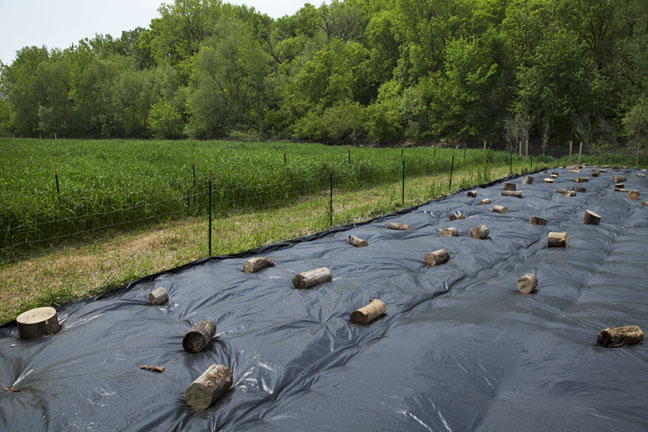
 There were square depressions at regular intervals in the tall grass made by slabs of plywood laid down to provide shelter for endangered Butler’s garter snakes. A soccer-field size area had been battened down with black plastic, in an experimental effort by the Urban Ecology Center to control invasive reed canary grass, which blankets much of the riverside.


The most exciting project has to be imagined from the devastation wrought upon one section of the bluff, which looks like a war zone. A new 40-acre arboretum is being created that will extend up and over the top of the bluff.  With an irony that is emblematic of the urban wilderness I love to write about, the first step in the development of the arboretum, apparently, is to clear-cut all the trees. The new, yet-to-be-planted trees will outlive me – and it fills my heart with joy to know that. 

arboretum under construction
We finished our loop in Riverside Park, which was originally designed in the 1890’s by Frederick Law Olmsted and rescued a hundred years later from blight and neglect by the Urban Ecology Center. Much as I admire Olmsted’s classic landscape designs and anticipate the beauty of the new arboretum, I must admit I was heartened to see this magnificent old black willow (below) lying where it had recently toppled. It is a fitting symbol of a new sensitivity to ecological processes and biodiversity. One of the signature differences between a wilderness and most urban parks is what happens to fallen trees. Park managers traditionally have made lumber and carted it away. But where trees are left to decompose they provide habitat for wildlife and their nutrients eventually return to the earth, repeating the cycle of regeneration. 


I enjoyed National Trails Day but I won’t be waiting for another official excuse to take my next hike in the urban wilderness. (You knew that!) I hope I see you out there on one of my hikes.

Click here to see more images from the National Trails Day hike and Milwaukee River Greenway.

Sunday, November 21, 2010

Visiting the University of Wisconsin Arboretum in Madison

Prairie Oaks

Like autumn itself, the leaves are mostly gone. The wide prairie is a rich tapestry of sienna and ochre, interwoven with strands of white, red, and black. Here and there coarse gray tree trunks rise out of it all as if to emphasize its prairie flatness. Deep in the tall grasses, red berries provide adornment. The day is surprisingly mild, not a presage of winter at all. This close to the solstice the sun rises only in a low arc, but still it shines brightly, casting a golden glow on the browns all around. I bask in its warmth, open my jacket.

Clearing the understory

I am alone on the prairie, although I have to force my imagination to exclude the incessant din of traffic along the beltline in order to feel it. Others have gone before me: there are plenty of fresh footprints and some dog prints on the wide path. In amongst them I spy the twin curves of deer hoofs and something with sharper claws than a dog; probably raccoon. The exercise is more than worth the effort to shut out the noise of “civilization” flitting past, barely visible through the leafless screen of trees ahead. Once again I am transported into the healing balm of urban wilderness.

Twisted

This instance brings me to remembrance of an old acquaintance with the UW Arboretum in Madison. I’ve been invited to give a reading to the Friends of the Arboretum, a most welcome opportunity. I arrive early, to prepare myself. I stay late to delay my return to that very same highway on my way home. Along the way I make some photographic offerings to share.

Wetland thicket

For more images from the Arboretum, go to my flickr page.

Tuesday, May 25, 2010

Should UWM be more like UW - Madison?

A meditation after visiting the University of Wisconsin – Madison Arboretum, one of my favorite urban wildernesses! And a reflection on the contrast I see with another university with aspirations to emulate Madison.

I first discovered the Arboretum as an undergraduate at the university (too many years ago!) and I go back whenever I get the chance. I had an opportunity to spend several hours there over the weekend. I’m including just a couple shots here, but you can see many more: just click the link below to go to my flickr site.

As I enjoyed walking through forest, wetland, and prairie sections of the arboretum – I believe I saw more of it in one day than ever before – I couldn’t help reflecting on UWM’s plan for the Milwaukee County Grounds. They are focused on developing a research campus on one of the few places in Milwaukee County that could be similar to the Arboretum. Wouldn’t it be refreshing if we could have a University of Wisconsin – Milwaukee Natural Area and Education Center instead of a research “park”? What if land stewardship and wildlife ecology were the focus at the County Grounds?

UWM’s long range goal is to be more like U.W. – Madison. I’m cool with that. As an alumnus of both institutions, I’d like to see them both thrive. UWM thinks the way to be like Madison is to increase its research capacity. I’d also like to see Milwaukee benefit from research the way Madison has. But have you been to Madison lately? The campus I attended so long ago is barely recognizable. Huge new buildings block familiar views and dwarf familiar structures. But Madison is doing it through what’s called “infill” in architectural lingo: using previously developed land rather than sacrificing parks or natural areas.

Although it goes against my core values to lose any potential parkland, being realistic I've consistently supported the compromise that was brokered following the "Save the County Grounds" debacle over ten years ago. Deferring to overwhelming public pressure, that compromise set aside most of the land as open green space, but allowed for some development as well. I've also supported UWM's bid to be the developer of choice because I believe UWM ought to be a good steward of this incomparable property. But is UWM committed to stewardship, or only research unrelated to the spectacular setting on which it wants to construct a campus? Let’s make Milwaukee more like Madison. What do you think: University of Wisconsin – Milwaukee Arboretum? Or maybe UWM Wildlife Sanctuary.

More pictures of the Madison Arboretum at flickr.
Pictures of the Milwaukee County Grounds at flickr.