Showing posts with label olmsted. Show all posts

Tuesday, August 23, 2011

Potholes degrade the Parkway experience


Broken pavement is a symptom of economic malaise and misplaced priorities. 


Over a century ago, Frederick Law Olmsted conceived of the parkway, intended to be a place in the city where its citizens could go for a ride or a walk and enjoy natural scenery. Charles Whitnall, founding father of the Milwaukee County parks, took Olmsted’s brilliant idea even further by designing parkways that parallel rivers and streams.

However, it’s hard to achieve the level of serenity envisioned by either man when a ride on the parkway requires constant vigilance in order to prevent a serious mishap due to potholes and crumbling pavement. This was brought forcefully home to me by contrast the other day.


I was out walking in the Milwaukee County Grounds the other day. I took the gravel path east around the detention basin from Hoyt Pool. When I reached what has been a wide gravel access road I was surprised to find a pristine expanse of newly laid asphalt stretching as far as I could see in both directions.


My first reaction was, who needs asphalt here where gravel would suffice? I am often dismayed when parkland is covered with concrete or asphalt. When I’d had a moment to reflect on the smooth surface further, though, I got angry instead.

Why has this dead end road that bears so little traffic been made so smooth while the heavily used Menomonee River Parkway continues to crumble? If you’ve driven on the parkway lately you know how bad it is. Potholes that can wreak havoc with a suspension system or cause a blowout seem to appear overnight.


In warm weather, overworked County crews eventually come by and throw a patch of asphalt in the worst of the holes. In winter the patches don’t stand a chance against the snowplows. Every year, in April the parkways look like they’ve been bombed. I’ve seen whole caravans of cars swerve into the opposite lane to avoid a wide swath of potholes.

If, like me, you enjoy riding a bicycle along the parkway, it’s even worse. There are some stretches where the severity of the conditions goes beyond the potential to cause expensive damage. It is downright dangerous to ride a bike on these roads.


Between Swan Boulevard and Congress Street, the Oak Leaf Trail coincides with the Menomonee River Parkway. The off-road section of the Oak Leaf Trail north of Congress is one of the loveliest places to ride a bike and I used to go there regularly. I don’t go as often now because I have to ride on the parkway to get there. It worsens year by year.

I made a call to the County Parks Department to ask about the situation. The County has a budget for road repairs and when a particular road reaches the top of the priority list it gets repaired. For now, believe it or not, there are worse roads on the list than this stretch of the Menomonee River Parkway. Compounding the problem for our particular stretch of parkway, apparently, are some turf battles between Milwaukee County and the City of Wauwatosa over who is responsible for repairs. 


The paving of the road into the County Grounds, although on County land, was part of MMSD’s detention basin construction project and as such was paid for out of that budget – a different pot of taxpayer money.

Personally, I don’t blame the County workers. It’s the budget. Who isn’t aware that the County budget is out of whack or that the parks are underfunded? The problems predate any current incumbent and have continued to escalate through administrations of different political persuasions.


It’s easy to pick on potholes. No one likes them. I don’t understand why there hasn’t been a louder public outcry over this before now. But frankly, we are all responsible. In the current anti-tax environment we are going to have to live with potholes a long while. What we need is the political spine to increase revenues. Otherwise our broken roads will never be repaired.

While we’re at it, let’s get our priorities straight. Take a look at the accompanying photos and tell me what’s wrong with the picture. Why are our taxes going to pave roads we don’t use instead of the ones we do? If this kind of thinking prevails we really will find ourselves at a dead end. 


Update:
The above first appeared in the Wauwatosa Patch on my WildWauwatosa column. I’ve since learned from my county supervisor, James Schmitt, that there is nothing in this year’s budget for repairs to the Menomonee River Parkway. “Maybe in 2012,” he said; “we’ll see.” Thanking me for bringing it to his attention, he went on to suggest that more complaints from constituents would help him argue in favor of moving up the timetable on road improvements.

So, what say? Let’s give him plenty of ammunition: send a message to your county supervisor and tell him or her that our parks and parkways deserve better care, more funding.  We all deserve better than a smooth road to nowhere.

 
Where are today's Olmsteds and Whitnalls, who have the vision to improve our quality of life, our psychic and spiritual well-being, with the serenity and beauty of urban nature?

Friday, July 15, 2011

Biography of Olmsted reviewed

A new biography of Frederick Law Olmsted by Justin Martin is called Genius of Place: The Life of Frederick Law Olmsted. Michael Lewis has written a thoughtful review of it on his blog.

Thursday, June 16, 2011

Wauwatosa’s innovation: Marketing parkways?


This is adapted from my recent column, Wild Wauwatosa. I wrote it in response to current events in the city where I live, but the issues and principles are hardly unique to this location.

What‘s in a name? First came Innovation Drive, in Wauwatosa’s Research Park. Then the University of Wisconsin—Milwaukee touted its planned engineering campus on the Milwaukee County Grounds as Innovation Park. The Crowne Plaza Hotel, on Innovation Dr., even adopted the moniker for its restaurant. Now officials have decided to brand the entire city of Wauwatosa as “Innovation Parkway,” based on the observation that it is interlaced with Olmsted-inspired Milwaukee County parkways.

View west across the Innovation Park site, one of the most spectacular locations in Wauwatosa.

The brand is being rolled out with the companion slogan “great opportunities at a great location.” The intent is to encourage economic development by promoting the city’s central location in the Milwaukee region and its accessibility with an emphasis on the proximity of the parkways.

I’m in favor of economic development. Of course. Especially in the current economic climate, who would question the need to attract business and create jobs? I’m also – no surprise here – in favor of parks, parkways, and open green space. What’s in a name? I call this blog Urban Wilderness in order to promote the idea that regular contact with nature is essential for a healthy life.

View southeast from UWM’s planned Innovation Park site showing Medical Complex towers.
The Milwaukee County Parks and parkway system provide beauty, serenity, and recreational opportunities within the urban region, making Wauwatosa and Milwaukee County especially attractive places to live. I hope that it is this inherent value of parkways that the architects of Wauwatosa’s new identity had in mind and that all new development will respect the integrity of those lands.

A short stroll along the Oak Leaf Trail on a pleasant evening is enough to convince anyone that people all over the county love the parkways. Wauwatosa officials and their newly created Community Development Authority should not be surprised if many of their constituents view this campaign with a measure of skepticism. Real estate developments notoriously are named after natural features that have been diminished or destroyed. The term “park” itself long has been coopted, its meaning subverted in oxymoronic combinations like Industrial Park and Business Park. How farfetched is the fear that “Innovation Parkway” will likewise disregard the meaning of parkway, or that public parkland will be lost to commercial development? Examples of this are as near and recent as Aurora’s Hospice Care Center on Honey Creek Parkway and the “Research Park,” which sits on land that really did look like a park not so long ago. Cookie cutter suburban subdivisions all over the country sport names like “Rolling Meadows,” “Tall Pines,” and the particularly egregious subcategory of “The Preserve at…[fill in the blank.]”


Wauwatosa’s new identity and marketing campaign won’t necessarily have this destructive effect on the parkways, nor should it. But if economic development is allowed to trump land preservation and the public’s enjoyment of nature then the danger is as real here as it is elsewhere. The citizens of Wauwatosa should be particularly concerned that the Community Development Authority is empowered to negotiate privately – without public input – even when development plans involve public land and taxpayers’ funds. 

A scenic natural area along Underwood Parkway.
The consultants who recommended the new brand to city officials wisely identified the parkways as among Wauwatosa’s most valued assets. The Mayor wants to use the new marketing strategy to “make a buzz around Wauwatosa.” A truly innovative idea would be to promote Wauwatosa and Milwaukee as cities where people can enjoy nature and places that protect natural areas. Let’s make a buzz about the indisputable importance of the parkways and the nearness of nature to the quality of life in our community. Economic development and the public interest both would benefit from this approach.

A view of High Pointe Office Center from Underwood Parkway.
Economic development is essential. Wauwatosa and Milwaukee have plenty of places that need revitalization. Development should be sensitive to the public’s enjoyment of the parks and parkways; it should occur in locations that will never compromise their value. This includes consideration of the views from the parks and not just the attraction of the views into the parks. The recently created overlay-zoning district for the Milwaukee River Greenway should serve as a model for development in ecologically sensitive areas. Milwaukee County really is blessed with an abundance of nature – that’s something worth creating a buzz around.

Wednesday, June 8, 2011

River Revitalization Foundation takes a hike on National Trails Day


Last Saturday was National Trails Day, so designated by the American Hiking Society. The River Revitalization Foundation (RRF) invited the public to celebrate the day with a hike along the Milwaukee River. Although I had to wonder why a specially designated day was needed, being highly self-motivated when it comes to hiking, the Milwaukee River Greenway is one of my favorite places for it and I relished the idea of a hike guided by the knowledgeable staff of the RRF. 
false Solomon's seal
The worth of the designated event became apparent immediately as about 25 people assembled in Gordon Park. A few were seasoned hikers but most were not. Some confided that they’d never hiked along the Milwaukee River before.

We began with sight, across Locust St., of a modest house that belonged to Charles Whitnall, the mastermind of Milwaukee County’s magnificent park system. Vince Bushell, RRF’s Land Steward, provided some historical background about Gordon Park and the river below the bluff, which was invisible due to a screen of mature trees. When first developed, he said, the view was unobstructed. However, cuts to the parks budget have resulted in the elimination of tree trimming operations.

Anise blossoms
 We strolled down the recently developed, paved Beer Line Trail, so called because it follows the route of the former railroad line that once served Milwaukee’s breweries. Vince identified native flowers that were blooming in places that had been cleared of garlic mustard and other invasive species by RRF volunteers. 


Next to one of the two massive UWM dorms that bracket the river at North Ave. we found a troop of boy scouts working on another RRF project: re-routing a mountain bike trail to reduce erosion. Bikers love the riparian trails – and multi-use is the name of the game in this high-profile urban wilderness.


I was delighted to see the creative re-use of buckthorn as a fencing material in the new Wheelhouse Gateway Park at the south end of the Greenway.

By the time we crossed the bridge at Caesar’s Pool and turned back north up the East Bank Trail attrition had reduced our party to seven diehards. Which was too bad, I thought, because the east side trail is unpaved, which I prefer, and because we discovered a number of fascinating projects in the works.


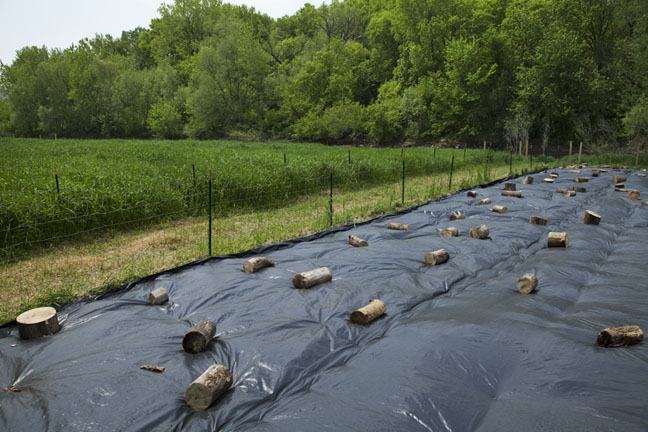
 There were square depressions at regular intervals in the tall grass made by slabs of plywood laid down to provide shelter for endangered Butler’s garter snakes. A soccer-field size area had been battened down with black plastic, in an experimental effort by the Urban Ecology Center to control invasive reed canary grass, which blankets much of the riverside.


The most exciting project has to be imagined from the devastation wrought upon one section of the bluff, which looks like a war zone. A new 40-acre arboretum is being created that will extend up and over the top of the bluff.  With an irony that is emblematic of the urban wilderness I love to write about, the first step in the development of the arboretum, apparently, is to clear-cut all the trees. The new, yet-to-be-planted trees will outlive me – and it fills my heart with joy to know that. 

arboretum under construction
We finished our loop in Riverside Park, which was originally designed in the 1890’s by Frederick Law Olmsted and rescued a hundred years later from blight and neglect by the Urban Ecology Center. Much as I admire Olmsted’s classic landscape designs and anticipate the beauty of the new arboretum, I must admit I was heartened to see this magnificent old black willow (below) lying where it had recently toppled. It is a fitting symbol of a new sensitivity to ecological processes and biodiversity. One of the signature differences between a wilderness and most urban parks is what happens to fallen trees. Park managers traditionally have made lumber and carted it away. But where trees are left to decompose they provide habitat for wildlife and their nutrients eventually return to the earth, repeating the cycle of regeneration. 


I enjoyed National Trails Day but I won’t be waiting for another official excuse to take my next hike in the urban wilderness. (You knew that!) I hope I see you out there on one of my hikes.

Click here to see more images from the National Trails Day hike and Milwaukee River Greenway.