Showing posts with label cities. Show all posts

Monday, September 21, 2015

Could Milwaukee be a “green” destination?


Milwaukee has earned the right to join the ranks of Earth-friendly cities

North Point Park
Shrieking in my ear, the alarm wrenched me from sleep. 3:00 a.m. I often wake up to see the sunrise but this was unprecedented. The big surprise, though, when I made it to North Point Park at 3:30 was the cheerfully chattering crowd already assembled.

After a brief orientation, 30 of us set off in the sultry night air to begin a 6-mile hike along Milwaukee’s lakefront. I was on my first Brew City Safari, an enterprise founded by Christian Matson-Alvirez. As we walked I asked him about his motivation and purpose.  

“I love Milwaukee,” he began, explaining that he enjoys exploring the city and sharing his inclination with like-minded people. Then he waxed eloquent about peace and tranquility. “It’s serene,” he says, “and you don’t have to leave the city to have this experience.”

His elegantly simple words and the passion in his eyes resonated profoundly. I felt as though he were reading my own thoughts.

We walked along the Oak Leaf Trail, through a tunnel of darkness lit only by a flashlight and a communal idea: Milwaukee is marvelous; let’s go for a hike and enjoy it!

Here was fresh evidence of an under-appreciated truth I’ve long felt needs wider telling. For all its challenges—some real, some a matter of perception—Milwaukee is a beautiful city with natural assets comparable to any and human assets that stand above most. In many ways Milwaukee is a farsighted ecological city and a model of sustainable urban living. Why don’t we believe this of ourselves and make more of it?

View towards downtown from Milwaukee River Greenway
Amid unrelenting reports of global climate change and environmental destruction it would be more than a good public relations strategy to elevate Milwaukee’s status as a progressive, environmentally conscious city. I believe Milwaukee can serve as a beacon of hope.

Cheryl Nenn, Milwaukee Riverkeeper
From the moment it was founded on the shore of Lake Michigan, geography and the environment have played a huge role in Milwaukee’s history. “Milwaukee is here because of its harbor and its three major rivers that run like arteries to the north, south and west,” says Cheryl Nenn, who serves as Milwaukee’s official Riverkeeper.

At first the rivers were for commerce and industry. However, their value as an amenity that improves the quality of life for its citizens was recognized far earlier than in most cities. In the early 20th century, visionary leaders like Charles Whitnall endowed Milwaukee with a park system that to this day is described in superlatives. Among its many qualities the most ingenious was an emphasis on preserving parkland along the rivers.

Menomonee River Parkway
Consequently, Milwaukee’s many river parkways form an “emerald necklace,” a term credited to the preeminent landscape architect, Frederick Law Olmsted. While Olmsted himself designed three of Milwaukee’s parks—Lake, Riverside and Washington—his principle of linear and linked parks and parkways is his most important legacy. The concept of interconnected natural landscapes later became fundamental to contemporary ecology and conservation.  

The irreplaceable natural features of what is now known as an Earth-friendly, “green” or Eco-city have been in place here in Milwaukee for over a century. Today, however, acreage of open green space is not enough for a city to be so designated.

I recently visited Portland, OR, which figures prominently in most lists of Earth-friendly cities. I came away with three primary impressions. First, the allure is real and the commitment to better the environment is evident; most visible in their mass transit system and dedicated, well-used bicycle lanes. Milwaukee is comparable in size but public transit is probably our highest hurdle when it comes to sustainability.  

Second, Portland has its share of problems. I saw people who appeared to be homeless hunkered down in several inner city pocket parks. I was cautioned against going into certain sections of the city, especially at night. Portland’s poverty rate is somewhat lower but Milwaukee’s median income is higher.

Most importantly, my visit to Portland convinced me anew that Milwaukee has the potential to compete in this arena. Our most intractable challenges are social. Poverty and racial segregation can never be dismissed. But mostly what Portland has over Milwaukee is a belief in itself as an Earth-friendly city. That belief—which attracts visitors like me and also helps attract and retain a like-minded population—is neither insignificant nor easy to replicate.

Lake Michigan shoreline at Doctor’s Park & Schlitz Audubon Nature Center
But we could be in their shoes. Grassroots groups like Brew City Safari, along with far more established programs, prove that we are doing the right things. Although often still considered a rust-belt city, Milwaukee has made great strides.

There are many progressive initiatives and good-news stories that suggest Milwaukee is more Earth-friendly than rust-belt. Here are five of those stories, some of which have attracted national attention.

Revitalization of the Menomonee Valley

Thirty years ago, the Menomonee Valley epitomized degraded rust-belt deindustrialization. Today, thanks to the collaborative efforts of government and private-sector leadership, the valley is a nationally recognized model of integrated economic and environmental revitalization. Guided by sustainable policies and practices, new industries are moving back in amongst beautifully restored parkland and some of the most popular entertainment venues in Wisconsin.

Three Bridges Park, Menomonee Valley
Milwaukee also is poised to replicate its successful strategies in two other blighted areas: the Harbor District and the 30th Street Corridor.

Urban Ecology Center

When the Urban Ecology Center, an innovative grassroots model of urban environmental education, opened there in 1991, Riverside Park was shunned by neighbors. Its Olmsted-designed features were all but obliterated by decay.

Since that time the Urban Ecology Center has opened three branches, collectively serving more than 92,000 visitors with year-round programming. Naturalists and environmental educators who want to emulate its example travel to Milwaukee from around the country. 
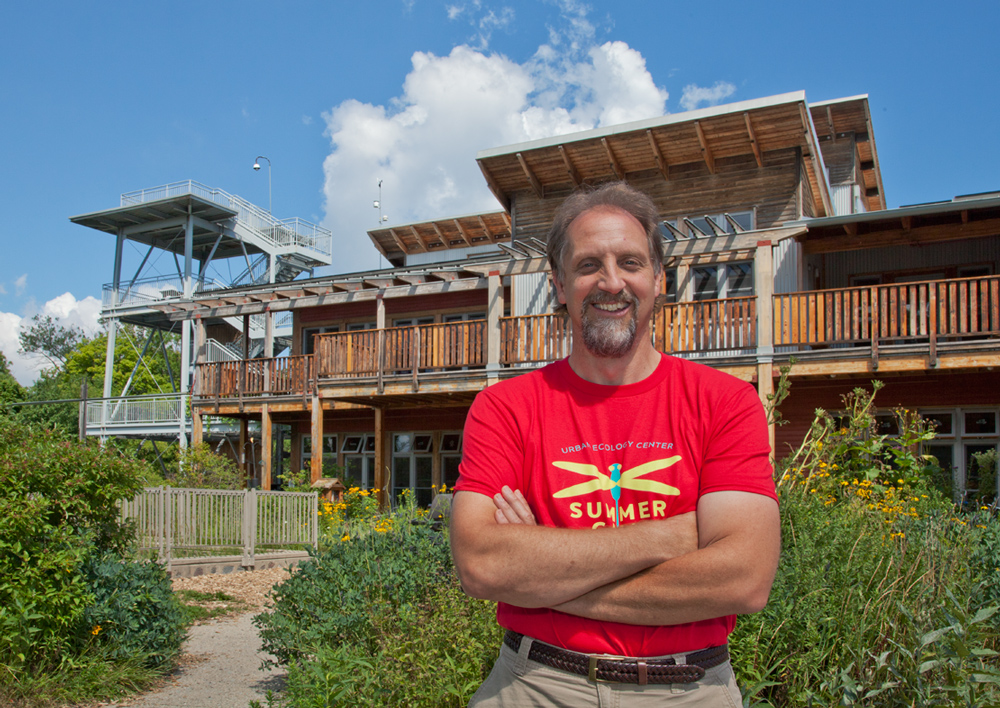

Ken Leinbach, founder and Executive Director of the Urban Ecology Center (above), in front of the Riverside Park Branch. “The fact that Milwaukee has two iconic enterprises—the Urban Ecology Center and Growing Power—that grew from the ground up shows the entrepreneurial spirit that exists in the city,” says Leinbach.

Riverside Park not only has been transformed into a lovely and safe outdoor learning laboratory, but has expanded. The 40-acre Rotary Centennial Arboretum opened in 2013 on reclaimed post-industrial land.

Urban Agriculture

Alice’s Garden, located in Johnson’s Park
Community gardening is not new, but today’s “foodie,” organic and locavore movements have made urban agriculture trendy. Milwaukee’s Victory Garden Initiative is an updated version of a World War I wartime necessity, while Alice’s Garden, with its emphasis on youth empowerment, cultural development and sustainable practices, takes the traditional community garden to a higher level.

Hydroponics lab at Growing Power
Milwaukee has actually been ahead of the curve on urban agriculture since 1993 when Will Allen established Growing Power. In addition to producing high-quality, fresh and affordable food for inner city neighborhoods, Growing Power has become a national leader in urban agriculture through its educational and technical assistance programs.

Will Allen with three young apprentice farmers
Allen was honored with a MacArthur Foundation “Genius Award” in 2008. “I’ve been in almost every city in America and lots of cities outside the country,” he told me. “I feel that Milwaukee is the urban agricultural capitol not only of the country but of the world, because of all of the good things that are going on and all the organizations that participate in urban agriculture and sustainable living.”

River restoration and preservation

Milwaukee’s rivers continue to be defining features. After a century and a half of abuse—when they were dammed, lined with concrete and reduced to open sewers—the last forty years have seen a complete reversal. Water quality has markedly improved thanks to grassroots efforts of watchdog groups like Milwaukee Riverkeeper and mammoth infrastructure projects managed by the Milwaukee Metropolitan Sewerage District (MMSD).

A widespread appreciation for the natural qualities of rivers has replaced the conventional utilitarian mindset. This shift is best symbolized by Milwaukee’s Downtown Riverwalk, which literally reorients businesses and visitors toward the water.

Milwaukee River Greenway
The removal of the North Avenue dam in 1997 created an opportunity to develop the Milwaukee River Greenway and Overlay District. The Greenway unifies a diverse mix of public parks and private natural areas and has become an exemplary place to experience urban nature. The hard-fought Overlay District protects eight miles of river, more than 840 acres of riparian habitat, and the “viewshed” that enables visitors to have a virtual wilderness experience within minutes of Downtown.

Kinnickinnic River channel
Nothing kills a river as thoroughly as confining it in a concrete channel. In the 1990s, the MMSD systematically began removing ill-conceived and outdated flood management channels to restore waterways to more natural conditions. Major portions of Lincoln Creek, a tributary of the Milwaukee River, and the Menomonee River already have been rehabilitated. A multi-year project of the MMSD that began in 2012 is tackling the Kinnickinnic River channel. What has been a dangerous drainage ditch will be restored with a naturalized streambed, meandering watercourse and native vegetation. 

Restored section of Kinnickinnic River
The MMSD, in partnership with the Conservation Fund, also has quietly purchased over 3,000 acres of open land in the three watersheds. This “Greenseams” program is intended to prevent future flooding. Significantly, it also preserves land for wildlife and recreation.

Water City

Remember Milwaukee’s marketing slogan, “A great place on a great lake?” Today a far more ambitious and worthwhile initiative promotes Milwaukee as a “water hub” for freshwater research, expertise and technology.

Global Water Center & Reed St. Yards in Menomonee Valley
The Water Council, formed in 2007 by business leaders, educators and scientists, touts a formidable record of achievements and resources intended to put Milwaukee on the world map. In 2013 the Global Water Center opened as an incubator for emerging water-related businesses. Milwaukee is one of only 13 cities in the world that have been designated by the UN as a Global Compact City for the quality of its efforts.

Milwaukee Water Commons' water celebration at Bradford Beach
A more grassroots, community-oriented effort also has begun to promote Milwaukee as a “Water City.” The Milwaukee Water Commons holds town hall meetings, partners with diverse community organizations to promote sustainability, and hosts celebrations highlighting the importance of water as essential to all life.

McKinley Beach and a view of downtown Milwaukee at sunrise
The sun rose over Lake Michigan when our stalwart band of hikers reached Milwaukee’s popular beaches. I turned to see the city bathed in the warm glow of dawning light, reflecting on how this one small action fits into the larger picture.

Kevin Shafer at the site of a restored section of the Kinnickinnic River
Kevin Shafer, the executive director of MMSD who has overseen major regional infrastructure projects, put it into this perspective:  “It’s not just the government—it’s everyone. It gets down to that individual person being more aware of what’s going on, what they can do to foster this effort, for all of us to become more sustainable.”

Sunrise over Lake Michigan
Much is happening on both levels, from infrastructure improvements and land reclamation to simple hikes along the lakefront. We walk because we love Milwaukee and it is beautiful. Milwaukee can be the good-news story of urban development and sustainability. What we need now is to believe it.


To see more photographs of many of the Milwaukee area parks and natural areas go to Flickr.

An edited version of this story first appeared in my Milwaukee Magazine column online on Sept. 16, 2015. 


Sunday, November 4, 2012

The High Line: Auguries of Innocence

I approached the High Line along West 30th Street, currently its northern terminus. Unknowingly, what I came to first was the old, unrestored elevated railway. Rusted, topped with crumbling concrete, and defaced with graffiti, it rose above construction barricades and cyclone fencing. This wide end of the rail yard spur completely covered the intersection of 30th Street and 10th Avenue, like a crude, industrial porte-cochère for the entrance to the park beyond. When the light turned green, a blur of taxis, trucks, and busses zoomed through.


Passing underneath, I emerged from its shadows into the open air. I thought of Frank Lloyd Wright, who characteristically designed low-ceilinged foyers to increase the drama of entering his more spacious interior. Ahead I could see, though barely, the thin line of green vegetation rising from the greenish-black painted steel structure I recognized as the High Line itself. To my right, atop the rust-stained gray concrete of the old rail line a scraggly fringe of autumn brown grasses and weeds fluttered gently.

The sky above 30th Street narrowed, wedged between the two sections of the line, the old and the new. The street felt considerably narrower still, however, due to the construction fencing along both sides. In defiance of the Great Recession Chelsea is experiencing a construction boom and it’s indisputably due to the success and popularity of the High Line.

As I approached the sleek, shiny steel staircase that would lead me upwards, I found myself suddenly amongst a small throng of people all converging on the same point. No matter. I was thrilled to be there. We ascended patiently, like passengers embarking on an airplane or patrons at an amusement park queuing for a ride. When I reached the level of the park, 30 feet above the street, an elevator door opened next to me and disgorged more “passengers.”

None of this prelude prepared me for the carnival atmosphere I encountered as I stepped into the constant river of people making their way along the narrow pathway atop the High Line. I eased into its flow, carried along on a current of humanity. At first a few spindly trees clung to the edges, rising a bit higher than the human river. These soon gave way to clumps of waist-high ornamental grasses intermixed with yellow and blue flowers. Marvelous as it all seemed, my first impression was less like a walk in a park than one along the boardwalk at Coney Island on a hot summer day.

It was October 2012. The High Line, that unique and influential park, had already been open for three years. Not only was it not new, it had become a sensation, a rock star of urban parks. It had been likened to a flying carpet, to “a suspended green valley in Manhattan’s Alps,” and to Alice’s Wonderland. Cities all over the country, including Milwaukee, were trying to figure out how to emulate its success.

However, on that warm Indian summer afternoon, I was blissfully ignorant of most of this. I had read a brief news report about the High Line when it opened in 2009 and immediately found myself enchanted by the very concept of it. But there had never been a good opportunity to go to it, living in the Midwest as I do.

When the opportunity finally did present itself, I did nothing to prepare for the experience. My mother had died and I was going to NY for the memorial service. (Once again I have her to thank – see my previous post). I tacked on four days to spend in Chelsea and to walk the High Line.

I had done no further reading about it. I didn’t go online and look at the High Line website. I saw none of the now famous pictures that Joel Sternfeld and others had taken of the High Line’s picturesque wildness. I didn’t avoid these things out of some principled belief in the purity of unmediated experience. I didn’t deliberately avoid doing what most people now do out of cultural habit and expectation. That it just never occurred to me to do these things seems in retrospect to have been providential.

I characteristically eschew guided experiences. When I travel I avoid tour groups. I rarely choose to pick up audio guides at museums. Like Ralph Waldo Emerson I want an experience that is my own, not one shaped by prior knowledge. This is merely my natural inclination, though, rather than a philosophical conclusion about the importance of unmediated experiences.

And so I came to be on the High Line with fresh eyes, unprejudiced with anyone else’s expectations – exaltations or disappointments. I came to face the paradox.

There were crowds, yes. But there was no unruliness to them. It was curiously peaceful. The more I walked amongst them, the farther behind I left my impression of Coney Island tumult, of being passengers on an amusement park ride. In its place came the feeling of participating in a pilgrimage, amongst strangers who were nevertheless companions on the road to some sacred shrine.


What were we seeking? There was a semblance of nature, neither a formal garden nor anything like a wilderness. The city surrounded us, but at a distinct remove. The High Line was unquestionably real and yet ambiguous, abstract. We were collectively engaged in imagining… something! Something each of the thousands of visitors brought within themselves, to engage with the world as they found it in this place, like the grain of sand in Blake’s famous line. And to feel the passion of what follows:

To see a world in a grain of sand
And a heaven in a wild flower,
Hold infinity in the palm of your hand,
And eternity in an hour.

I did spend four days in Chelsea and walked the High Line at least once on each of them. The longer I was there the more telling became the parallels with Blake’s epic poem, Auguries of Innocence, most of which is far less well known than that first stanza and which concludes with this:

God appears, and God is light,
To those poor souls who dwell in night;
But does a human form display
To those who dwell in realms of day.

To be continued.

This is the second of a series from the High Line. To read my first, click here.

Saturday, March 31, 2012

Houston, Texas: Waking to a new world.


I awake in the dark, momentarily disoriented. The room smells inexplicably clean and there is a mechanical hum coming from an unknown source. Remembering that I’d arrived at the hotel in Houston the day before, I rise and go to the window. Darkness. Being unfamiliar with the Texas climate, I wonder if it should be dark at 7:30 a.m.

Suddenly rain spatters the thick, black glass of the inoperable window. I hear only a soft, almost distant percussion, as if far more than a pane of glass separates me from the world outside and whatever storms there are. The air-conditioning clicks on again, seemingly louder.

I dress, grab my umbrella and go in search of breakfast. The elevator delivers me to the cheerfully lit, wood-paneled lobby twelve floors down. As I descend an escalator towards the basement I briefly glimpse furious gray gusts of rain through the plate glass windows. No one is visible outside.

There are people underground. A long queue stretches away from a tiny coffee shop next to the escalator. Others hurry by on their way, presumably, to a workplace. An expansive but low-ceilinged food court is softly lit in cool shades of white. Fast food vendors, most of which are closed, surround it, white steel grills drawn down over glass counters.

Exiting the nearly empty food court, I head into the West Dallas Tunnel.

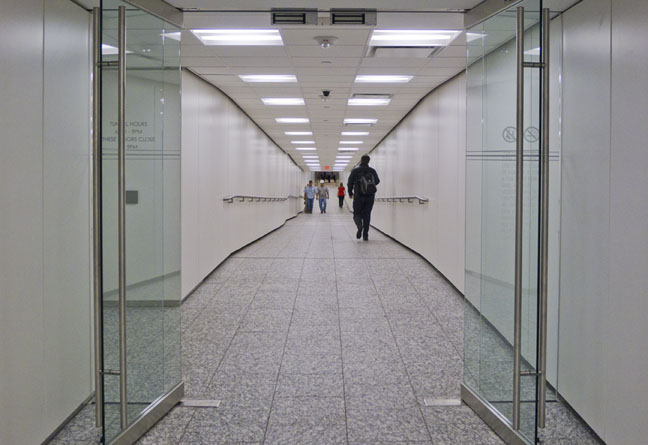
Houston’s subterranean tunnel system extends approximately seven miles in a labyrinthine network of pedestrian passageways, ramps, shops and food courts. It has little relationship to the street grid above and bears absolutely no resemblance to the natural world. A hurricane might be crashing through the city and, unless there was a power outage, no one down here would even notice.

That seems to be the point. It’s raining hard outside but everyone I pass is as dry as I am, dressed in power suits without outerwear or raingear. My unopened umbrella dangles from my arm.

In Houston, though, people are driven underground more often by the heat. Even in the brutal Houston summer, the climate-controlled tunnels allow them to remain comfortably suited and sweatered on their way between air-conditioned cars and air-conditioned offices. To what end, I wonder, does the march of civilization lead?

The West Dallas tunnel becomes the South Louisiana tunnel. The names vaguely correspond with street locations on the surface of the earth but nothing is straight or direct for more than the equivalent of a block down here.

Underfoot beige tile gives way to pale granite. The walls narrow into a sterile white corridor. I am reminded of a movie by George Lucas – THX 1138 – that is set in an underground city in some dystopian future. But this is not the future. It is all too present. Echoing the movie’s title character, my instinct is to escape.

I pass a block-long mural of the surface of the moon. I’m certain it is meant to be uplifting, but the irony is stunning. Who designs these places and then decides that the airless and barren lunar landscape is what we should see as we walk through them?
Just when I begin to despair of finding anything green or growing, I come upon a diminutive plastic jungle tucked in a corner, bracketed with brushed steel and ceramic tile. Green but not growing, it is scarcely more soothing than the moonscape. Is this meant to nurture our need for a connection with nature? Instead it puts me in mind of natural history museum dioramas that depict extinct species.

Every few hundred yards I stop to check the map posted on the wall or propped on a floor stanchion. If it didn’t say “you are here” in different places each time I would have no idea how far I’d gone or in which direction. North, south, east, west are equally meaningless. Distances are exaggerated by twists and turns.

I pass through the Tunnel Loop and wander down the East McKinney Tunnel before I discover that I’ve overshot my destination. I should have turned at the connector leading to the Lamar Tunnel, which runs parallel to the McKinney. The determined crowd surges around me. I am lost in a sky-less maze of polished steel fittings and white surfaces washed with invisible light sources. Urban wilderness is taking on new meaning.

King Minos of ancient Crete is supposed to have commissioned the world’s most famous labyrinth, which was guarded by the bull-headed Minotaur. Maybe that is an unfounded myth. In any case, all that remains of the powerful king and the Cretan civilization are the ruins of his palace at Knossos. Feeling not at all like Theseus, who penetrated the labyrinth and killed the monster, my hesitation and disorientation give me a moment to reflect on this modern-day labyrinth.

This is not a diatribe against cities. I believe in cities. Today we must turn Thoreau’s famous dictum on its head: In cities is the preservation of the world. I mentally genuflect to Thoreau and ask absolution for this heretical pronouncement. But the fact of the matter is, the preservation of wilderness now depends on making cities both livable and an attractive alternative to sprawl. That means bringing nature back into cities from which it has been abolished. Sustainable cities, like humans, need open space in which to breathe.

Neither is this an indictment of Houston, which may or may not deserve indictment. I have not explored it sufficiently to pass judgment. But how are we to survive if our cities lead us to mole-like lives in caverns and tunnels, unable to see the sun or smell the changing seasons?

Backtracking, I come finally to a two-story rotunda that is open to a street-level lobby above. I take the escalator, stepping briskly to speed my ascent. A soft glow of daylight gradually mingles with the unearthly shine of tunnel illumination.

I push open the heavy glass door and step out onto Main Street hoping to see trees or a planter with flowers in it. This view across the street is not reassuring.

The environments we create for our cities more and more have come to define the world we live in. A world in which nature is reduced to a twisted topiary in a concrete urn is not the world I want to wake up in tomorrow.

This is the first installment of a trilogy from Houston’s urban wilderness. To read the next, click on Buffalo Bayou, Part 1. If you want a taste of the cultural side of Houston, go to my Arts Without Borders blog.