I approached the High Line along West 30th
Street, currently its northern terminus. Unknowingly, what I came to first was
the old, unrestored elevated railway. Rusted, topped with crumbling concrete,
and defaced with graffiti, it rose above construction barricades and cyclone
fencing. This wide end of the rail yard spur completely covered the
intersection of 30th Street and 10th Avenue, like a
crude, industrial porte-cochère for the entrance to the park
beyond. When the light turned green, a blur of taxis, trucks, and busses zoomed
through.

Passing underneath, I emerged from its shadows into the open
air. I thought of Frank Lloyd Wright, who characteristically designed
low-ceilinged foyers to increase the drama of entering his more spacious
interior. Ahead I could see, though barely, the thin line of green vegetation
rising from the greenish-black painted steel structure I recognized as the High
Line itself. To my right, atop the rust-stained gray concrete of the old rail
line a scraggly fringe of autumn brown grasses and weeds fluttered gently.

The sky above 30th Street narrowed, wedged
between the two sections of the line, the old and the new. The street felt
considerably narrower still, however, due to the construction fencing along
both sides. In defiance of the Great Recession Chelsea is experiencing a
construction boom and it’s indisputably due to the success and popularity of
the High Line.
As I approached the sleek, shiny steel staircase that would
lead me upwards, I found myself suddenly amongst a small throng of people all
converging on the same point. No matter. I was thrilled to be there. We
ascended patiently, like passengers embarking on an airplane or patrons at an
amusement park queuing for a ride. When I reached the level of the park, 30
feet above the street, an elevator door opened next to me and disgorged more
“passengers.”

None of this prelude prepared me for the carnival atmosphere
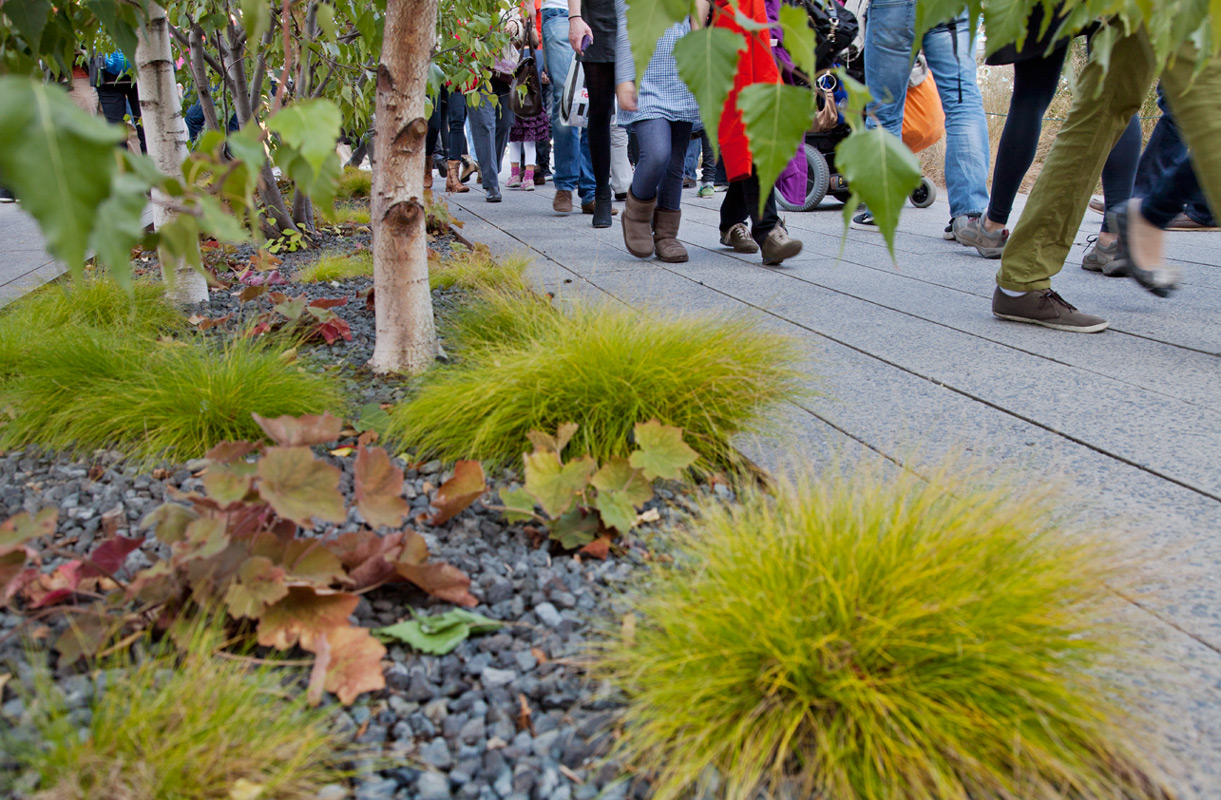
I encountered as I stepped into the constant river of people making their way
along the narrow pathway atop the High Line. I eased into its flow, carried
along on a current of humanity. At first a few spindly trees clung to the edges,
rising a bit higher than the human river. These soon gave way to clumps of
waist-high ornamental grasses intermixed with yellow and blue flowers.
Marvelous as it all seemed, my first impression was less like a walk in a park
than one along the boardwalk at Coney Island on a hot summer day.
It was October 2012. The High Line, that unique and influential
park, had already been open for three years. Not only was it not new, it had
become a sensation, a rock star of urban parks. It had been likened to a flying
carpet, to “a suspended green valley in Manhattan’s Alps,” and to Alice’s
Wonderland. Cities all over the country, including Milwaukee, were trying to
figure out how to emulate its success.
However, on that warm Indian summer afternoon, I was
blissfully ignorant of most of this. I had read a brief news report about the
High Line when it opened in 2009 and immediately found myself enchanted by the
very concept of it. But there had never been a good opportunity to go to it,
living in the Midwest as I do.
When the opportunity finally did present itself, I did
nothing to prepare for the experience. My mother had died and I was going to NY
for the memorial service. (Once again I have her to thank – see my previous
post). I tacked on four days to spend in Chelsea and to walk the High Line.

I had done no further reading about it. I didn’t go online
and look at the High Line website. I saw none of the now famous pictures that
Joel Sternfeld and others had taken of the High Line’s picturesque wildness. I
didn’t avoid these things out of some principled belief in the purity of
unmediated experience. I didn’t deliberately avoid doing what most people now
do out of cultural habit and expectation. That it just never occurred to me to
do these things seems in retrospect to have been providential.
I characteristically eschew guided experiences. When I travel
I avoid tour groups. I rarely choose to pick up audio guides at museums. Like Ralph
Waldo Emerson I want an experience that is my own, not one shaped by prior
knowledge. This is merely my natural inclination, though, rather than a
philosophical conclusion about the importance of unmediated experiences.
And so I came to be on the High Line with fresh eyes,
unprejudiced with anyone else’s expectations – exaltations or disappointments.
I came to face the paradox.
There were crowds, yes. But there was no unruliness to them.
It was curiously peaceful. The more I walked amongst them, the farther behind I
left my impression of Coney Island tumult, of being passengers on an amusement
park ride. In its place came the feeling of participating in a pilgrimage, amongst
strangers who were nevertheless companions on the road to some sacred shrine.

What were we seeking? There was a semblance of nature, neither
a formal garden nor anything like a wilderness. The city surrounded us, but at
a distinct remove. The High Line was unquestionably real and yet ambiguous,
abstract. We were collectively engaged in imagining… something! Something each
of the thousands of visitors brought within themselves, to engage with the world
as they found it in this place, like the grain of sand in Blake’s famous line. And
to feel the passion of what follows:
To see a world in a grain of sand
And a heaven in a wild flower,
Hold infinity in the palm of your hand,
And eternity in an hour.
Hold infinity in the palm of your hand,
And eternity in an hour.
I did spend four days in Chelsea and
walked the High Line at least once on each of them. The longer I was there the
more telling became the parallels with Blake’s epic poem, Auguries of Innocence, most of which is far less well known than that first stanza and
which concludes with this:
God appears, and God is light,
To those poor souls who dwell in night;
But does a human form display
To those who dwell in realms of day.
To those poor souls who dwell in night;
But does a human form display
To those who dwell in realms of day.
To be continued.
This is the second of a series from the
High Line. To read my first, click here.