Showing posts with label poetry. Show all posts

Thursday, August 11, 2016

Milwaukee Water Commons holds annual We Are Water celebration at lakefront


There was music, poetry, puppetry, art and invocations of the spirit on Bradford Beach last Sunday evening. It was the third in what has become an annual event called "We Are Water" organized by the Milwaukee Water Commons. Billed as a "celebration of Milwaukee's waters," the event has become a mini-arts festival as well as a meditation on the importance of water to Milwaukee and all life on earth.


Jahmes Finlayson and Dena Aronson got things going with some lively drumming...


...as well as a ritual libation: reflections on water and life while pouring Lake Michigan water onto the sand.


True Skool entertained the crowd with a rap about water.


Three young artists with Still Waters Collective gave an impassioned spoken word performance.


Off to the side of the beach members of Exfabula set up a roving interview station and recorded water stories told to them by volunteers from the audience.


Margaret Noodin, faculty member at UWM, gave everyone a lesson in Ojibwe...


...as member of the Overpass Light Brigade, with help from the audience, spelled out Ojibwe words for water and water-related terms.


Puppeteers got into the act with LED-illuminated figures of a heron and several accurately depicted species of fish native to Wisconsin waters.


The event culminated in an audience-participation creation of a peace sign with lighted cups of water, directed by artist-in-residence Melanie Ariens.

This is the short version of the story. To see many more photos of the event go to my Flickr album.

Saturday, May 2, 2015

Horicon Marsh: A poetic and photographic odyssey

-->
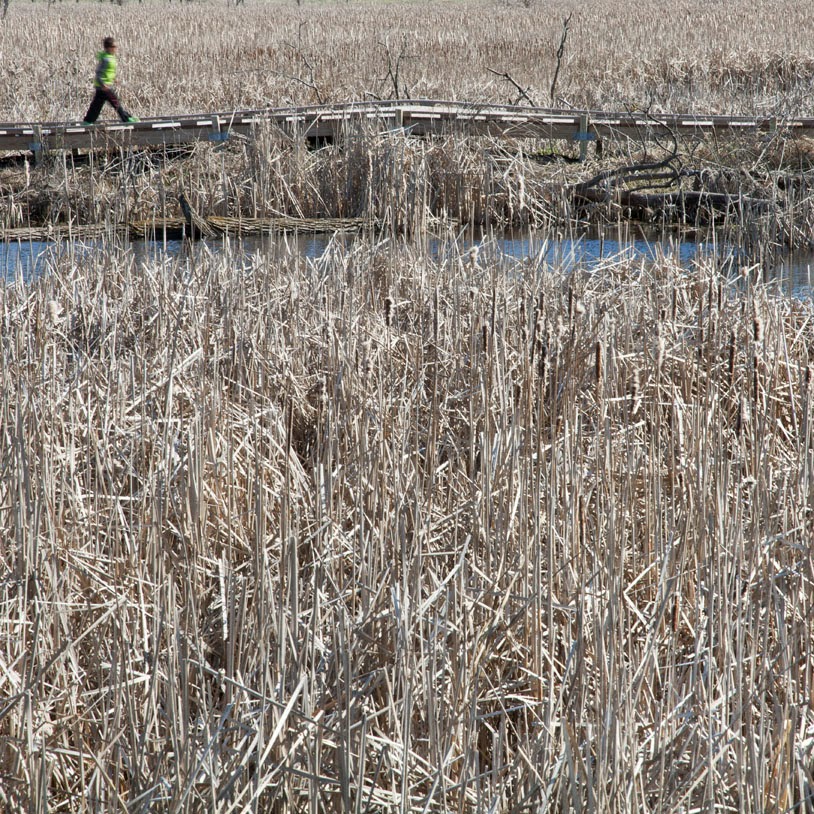
The marsh was burning. I’ve known for some time about changing forest management practices. I knew that controlled burning is now widely accepted as a method to control invasive species as well as to prevent uncontrolled, destructive wildfires. But it hadn’t occurred to me that a wetland would burn.


I was in Horicon Marsh National Wildlife Refuge with my friend Charlie. We happened upon a crew in the midst of a controlled burn authorized by the U.S. Fish and Wildlife Service. Traveling around the marsh we noted many areas that had been visibly burned, some quite recently, others during the past year. Evidence of burning became one of my photographic themes during our odyssey.


Charlie is a poet. We share similar values, including a reverence for nature, and we like to get away together now and then to soak up some of it. We usually choose a place within a couple of hours drive that is near a park or natural area. Horicon Marsh, the largest freshwater cattail marsh in the U.S. and less than an hour from Milwaukee, easily fits the bill. 


We dawdled for two days, walking trails in several parts of the marsh. As will become clear when you read Charlie’s poetic contribution below, I did more walking than he did. We stopped at both the federal and state visitor’s centers. Yes, there are two contiguous sanctuaries, the State Wildlife Area as well as the National Wildlife Refuge. Not that you can tell by looking at the topography (although we humans couldn’t leave well enough alone—a dike roughly coincides with the boundary.)


By the second day we had circumnavigated the entire marsh, both state-owned and federal. We even discovered Nitschke Mounds County Park filled with dozens of ancient, but un-photogenic, Indian mounds (above). Unlike the wildlife refuges, which were popular, we had the mounds to ourselves—and the thousand-year-old spirits of Late Woodland Culture effigy mound builders.


People often visit Horicon to see the birds and we certainly saw plenty, although migration was far from peak. We saw mostly the ubiquitous Canada geese and a variety of ducks. I also tallied a flock of Sandhill Cranes (above), a couple flocks of swans, a deuce each of prairie chickens and wild turkeys, bluebirds and some kind of swift. Plus numerous unidentifiable (by me) other birds.


And 16 turtles. You won’t see many birds in the photos. Gotta admit I’ve never been patient enough to be a wildlife photographer. Turtles are sitting ducks, so to speak, so I caught a few of them. Mostly I focused on my customary and oppositional themes: revealing the enchantment of nature near my urban haunts and finding traces of humanity’s presence in natural landscapes. The burns were an enthralling bonus.


Charlie wrote the following poem. I took photos. More selections below.

ON A HILLSIDE OVERLOOKING HORICON MARSH
WHILE MY FRIEND EDDEE WANDERS OFF
DOWN THE TRAIL TO TAKE PICTURES

Goose honk and bird chirp,
the blue-brown landscape
of marsh grass and water,
a few dead trees scratch the sky.
This is a place for birding,
but I’m here for loafing.
I’m good at it, lying here
with my head on a rock.
The afternoon sun, warm
on my face and jeans,
blue bird atop the blue bird house,
turkey vulture overhead.
Times like this I realize
if you stay still and wait long enough,
nature comes to you.

Charlie Rossiter, April, 2015


To see more photos go to my flickr album.

Sunday, October 6, 2013

The White Place


For the past week I have been staying, teaching photography, and relaxing at one of my favorite places: Ghost Ranch in Abiquiu, NM. Ghost Ranch is a retreat/education/conference center owned by the Presbyterian Church but is most famous as the place where Georgia O'Keeffe lived and painted many of her striking New Mexican work. One of her subjects was this unusually pale sandstone slot canyon in Abiquiu. The gray stone can look white in the bright New Mexican sun, hence the name. The site is owned by Dar al Islam, a mosque and Islamic Education Center.


I've been in the mood to write haiku here in New Mexico, a land of contrasts and, for me, introspection. Here is the one I wrote for the White Place:


the White Place
a monk in saffron robes
raises an ipad


I am teaching a workshop in digital photography at Ghost Ranch and I took my class to the White Place for a photo shoot. As our group gathered back at the parking area after a couple hours of shooting, I saw this monk walk slowly up to the mound with the “Plaza Blanca” sign on it overlooking the site. As I watched he slowly drew an ipad out of his robes and began to raise it with both hands. Knowing the capabilities of an ipad it was obvious that he was about to shoot a photograph. However, it reminded me of a priest raising a host, or a supplicant seeking absolution, or simple praise; something sacred and holy, as befits both the symbolism of his robes and the grandeur of the site. 


The well-known form of Haiku originated in Japan and is a very short, traditionally three-line, poem. In current practice the form is flexible. The essential quality of haiku is usually a small epiphany based on the observation of two contrasting images. I was inspired by the juxtaposition of the monk’s traditional garb with the latest technology—even if upon second thought, it ought to be considered perfectly normal in today’s polyglot society. 

I had put my camera in my bag when I saw the monk raise the ipad. I would have liked to catch a shot of him raising it. Alas, that was not to be. I did introduce myself and ask if I could make a photo of him, a request to which he acceded with humility. He said his name but it was so multi-syllabic and foreign to my ears that mind unfortunately would not grasp onto it.


Monday, June 17, 2013

Desert Monastery knows how to do seclusion

-->
“The world is too much with us…,” the poet said.

If, as Wordsworth says, we “lay waste our powers” by “getting and spending” then one solution is to remove the temptation by retreating from society.

The impulse to escape the travails of the world, to disconnect the TV, avoid the news (if not “getting and spending”) is easy to understand. It is one reason I came to Ghost Ranch. But for me it is temporary, an interlude of rest and recuperation. Monastics make it a way of life.

By their nature and purpose monasteries are meant to be retreats from the world. In many cases the idea of “retreat” is to remove oneself physically from contact with the larger society. This can happen just about anywhere—behind walls.

I drove a long way down a desert canyon to visit the Monastery of Christ in the Desert. For those not faint of heart it is a popular side excursion while staying at Ghost Ranch. This place has got seclusion nailed (unless you count folks like me who are allowed to wander in from the world!)

The dead end dirt road is 13 miles long. While thirteen miles doesn’t sound far in our car culture, I averaged about 13 miles per hour (not counting stops to take pictures.) That should make it easy to calculate how long it took to get there!

I might have gone a little faster in a 4x4 pickup but my little rental Kia Rio was not too steady on the narrow, dusty and washboarded road. The little round pebbles didn’t improve traction any, either!

Much of the road also is only one lane wide, carved from the red clay cliffs along the Chama River, with no barrier on the riverside edge. There were occasional turnouts to allow opposing traffic to pass, but I discovered that guys in SUVs seldom wait at a turnout. Yes, there was traffic that had to pass. 12 miles of the road is forest service access to recreation points along the river. Several times I had to squeeze by huge SUVs with kayaks or rafts lashed on top. On one particularly harrowing occasion our rear view mirrors nearly touched. And I was on the river side of the road!

Once I passed the last boat launch at mile 12, it was just me and the monastery ahead.

There is some proverb, I think, about the silence of the desert. (I’ve been blessed with the sounds of the desert; that old truism, if it exists, must refer to the absence of human voices and the clamor of culture.) If there is anything more silent than the desert it is a remote canyon in the desert.

Furthermore, the monks at this monastery have taken vows of silence. Even their own human voices are absent from their secluded existence. I didn’t meet any of them. The person at the gift shop (there is a gift shop, of course!) will talk to you (and sell you Christian paraphernalia; I resisted spending and getting any of it.)

Seclusion is accompanied by self-sufficiency here. Solar technology allows the monastery to retreat from the grid as well as society.

It was truly a peaceful place. The interior is dark and enclosed, like a cave or a kiva. The silence felt like a presence rather than an absence. Some, perhaps the reclusive monks, might name that presence. I was content to feel it for a brief interlude.

When I stepped back outside it was the canyon itself that 
moved me, now that my attention wasn’t on the perilous 
drive to reach it. “Late and soon,” it is nature that I 
name and claim. 
 
Here is Wordsworth’s short poem in its entirety:
 
The world is too much with us; late and soon,           
Getting and spending, we lay waste our powers:
 Little we see in Nature that is ours;
We have given our hearts away, a sordid boon!           
The Sea that bares her bosom to the moon;           
The winds that will be howling at all hours,           
And are up-gathered now like sleeping flowers;           
For this, for everything, we are out of tune;           
It moves us not.—Great God! I'd rather be           
A Pagan suckled in a creed outworn;
So might I, standing on this pleasant lea,           
Have glimpses that would make me less forlorn;           
Have sight of Proteus rising from the sea;           
Or hear old Triton blow his wreathed horn.

Friday, December 21, 2012

Happy New “Cycle”

-->

Well, this morning dawned like any other, which came as no surprise to me. The apocalyptic predictions fizzled like so many previous ones have.

I did hear from one person who woke up this morning to the sound of unusual silence and a power outage. That proved to be the result of yesterday’s storm, however and not attributable to ancient – or modern – superstitions.

If you are still blissfully ignorant of the purported “end of the world” that some had predicted would happen yesterday, based on the Mayan Calendar, then good for you for living above or beyond the media chatter! Yesterday was considered to be the end of the 5125-year-long cycle that the ancient Mayan peoples used in what’s called the long count calendar. Presumably, then, the new cycle begins today.

Happy New Cycle!

May the next 5125 years be better than the last. At least by then whoever is around will know how this global warming business turned out.

I was delighted to open my New York Times last Sunday to find that their editors had turned to poetry to commemorate the event (or non-event).

Here’s one short poem from the collection they published that I found particularly trenchant:

AT FIRST I THOUGHT

The blue jay
Was the last leaf
To fall
When it rocked
From side to side And slowly tumbled
To land on the snow
Weightless
As a piece of sky
Broken off
The cold blue place
Where winter keeps
The number zero.
— TOM HENNEN

Of course today is also the winter solstice. So, if the whole Mayan calendar thing is meaningless, we still have that traditional reason to celebrate a new beginning today. I for one always welcome the return of the sun, gradual though it is. And what a beautiful day it turned out to be! Though the cold was punishing it was quite lovely while I could stand it. I went out to the County Grounds to look around at the new fallen snow and I make this offering to both the new Cycle and the solstice.


I will close with another poetic meditation, this one by Mary Oliver:

In the Storm

Some black ducks
were shrugged up
on the shore.
It was snowing

hard, from the east,
and the sea
was in disorder.
Then some sanderlings,

five inches long
with beaks like wire,
flew in,
snowflakes on their backs,

and settled
in a row
behind the ducks --
whose backs were also

covered with snow --
so close
they were all but touching,
they were all but under

the roof of the duck's tails,
so the wind, pretty much,
blew over them.
They stayed that way, motionless,

for maybe an hour,
then the sanderlings,
each a handful of feathers,
shifted, and were blown away

out over the water
which was still raging.
But, somehow,
they came back

and again the ducks,
like a feathered hedge,
let them
crouch there, and live.

If someone you didn't know
told you this,
as I am telling you this,
would you believe it?

Belief isn't always easy.
But this much I have learned --
if not enough else --
to live with my eyes open.

I know what everyone wants
is a miracle.
This wasn't a miracle.
Unless, of course, kindness --

as now and again
some rare person has suggested --
is a miracle.
As surely it is.

~ Mary Oliver ~