A rare, up-close look at an elusive urban critter.
An edited version of this story was first posted at Milwaukee Magazine on February 9, 2016.
A small, gray face peered inquisitively out of the nest at
me with eyes large enough to qualify for an animated feature film. Cute. But I
was in no position to appreciate it. I was a dozen or more feet in the air, on
a ladder. My fancy DSLR camera hung uselessly from my neck. I couldn’t lean
back far enough to focus on the little creature. As I fumbled in my coat pocket
for my iPhone another of the furry occupants suddenly appeared, this one poised
to flee through the nest’s circular opening.
That’s when things got really interesting!
Wil-O-Way Woods, where this was happening, is a 45-acre remnant
hardwood forest in Wauwatosa. It is surrounded by what is commonly known as the
Milwaukee County Grounds and managed by the Wisconsin Department of Natural
Resources. The DNR is partnering with a private non-profit organization to
create what will be called a
Forest Exploration Center. These unusual little flying
squirrels are just one of the reasons this rare urban forest is worth
exploring.
We had parked our cars in the Wil-O-Way Underwood parking
lot. Through the leafless trees it was easy to spot the closest nest box. We
entered the woods on a well-packed trail then quickly forged a new path through
the snow to reach the tree with the box. Our squadron of five was comprised
mostly of wildlife enthusiasts. Gary Casper, the biologist in charge of
monitoring the squirrels, led our group.
Casper scampered up the ladder and opened the front of the
box. He announced what he found inside: a few acorn fragments and debris that
indicated the box had been used. No nest had been built in it and it was
otherwise vacant. One of the volunteers dutifully recorded Casper’s findings
and we moved on through the forest.
We crossed a ski trail and fresh snowshoe tracks. In many
places holes had been scrabbled in the snow by animals looking for sustenance
or nesting materials. Scat the size and color of roasted coffee beans confirmed
the unsurprising presence of deer. Even small urban forests like this one have
a variety of users, human and non-human. Managing such a forest can involve
juggling diverse interests and constituencies. With its many interconnected
segments administered by different agencies, the County Grounds presents
particularly complex management issues.

For example, when I asked who it was that hired him, Casper
replied, “It’s complicated.” Casper himself works for the
UWM Field Station.
The flying squirrel project, which includes surveying and monitoring a variety
of other species as well, is part of a wildlife assessment for the Milwaukee
Estuary Area of Concern. It is administered through the Great Lakes Office of
the DNR—which, in a quirk of bureaucratic irony, is separate from the DNR office
that oversees Wil-O-Way—and funded by the federal Environmental Protection
Agency.
 |
| Area along Swan Blvd. that recently was cleared;
brush piles will also be removed. |
We trudged between trunks of oak, hickory, maple and ash, some
too large to reach around. Flying squirrels require a mature forest to survive,
which speaks well of the quality of this isolated urban woodland. But many of
the other species that grace Wil-O-Way Woods travel freely between the various
parcels making up the County Grounds. Unfortunately, according to Casper, this
parcel is small enough to suffer from “edge effect,” meaning predators will
penetrate the woods from adjacent areas.
Wil-O-Way Woods is contiguous with the MMSD’s 90-acre flood
control basins. Swan Boulevard is all that separates the DNR parcel from the
55-acre County Grounds Park, administered by Milwaukee County Parks Dept., and
69-acre Innovation Park, the new multi-use property being developed by the UWM
Real Estate Foundation.
-->
Area along Swan Blvd. that recently was cleared;
native trees are to be planted.
While Innovation Park eventually will be mostly built out,
it also includes 11 acres of protected wildlife habitat popularized as the
Monarch Trail. Innovation Park’s accelerator building was where I had met Gary
Casper that very morning. We were there for a meeting prompted by a forestry
management decision to clear a broad swath of brush and timber along Swan
Boulevard. The discussion veered from clear-cutting to integrated management of
the County Grounds puzzle.
Up the ladder again, Casper tells us that there are telltale
signs of rodent activity on
top of the
second box. Again there is no nest, only scraps of food and bits of scat on the
inside. Our recorder jots notes and we proceed onward.
At the third box we hit pay dirt. Disturbing the nest as
little as possible, Casper counted five squirrels curled up in a furry ball.
Chewed leaf litter and shredded wood made up the bulk of the nesting materials
but something that looked like blue yarn was threaded throughout the mix.
Buoyed by our discovery, we wove through the trees, moving
from box to box and repeating the procedure. Though nearly all bore signs of
activity, most were vacant. Casper explained that the squirrels typically
congregate in winter to benefit from their combined body heat. Come spring they
usually spread out and raise their young in separate nests.
In addition to flying squirrels, the UWM study includes
bats, dragonflies, various birds, and the animal Casper told me excites him
most: a rare species of terrestrial crayfish that depends on scarce ephemeral
wetlands. The purpose of the three-year study is to survey and monitor the
target species; rank each one’s status as impaired or stable populations; and
to recommend restoration projects that would improve habitats where they would
be most effective.
 |
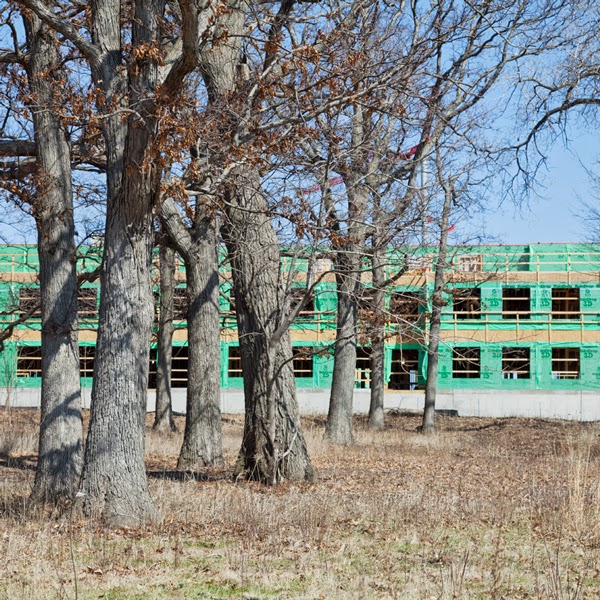
Tree clearing took place on DNR propoerty, across
Swan Blvd. from Innovation Park
where the Echelon Apartments are under
construction. |
|
An integrated, collaborative management plan on the County
Grounds could greatly enhance efforts by all parties to ameliorate existing
impairments and restore healthy habitats. Neil O’Reilly, an instructor in UWM’s
Conservation and Environmental Studies Program, provided a cogent example: a
forester concerned with sustainable timber management might choose to keep or
cull a very different selection of trees than a wildlife specialist would.
Birds, bats, flying squirrels and many other animals often inhabit very
particular niches in the fabric of the forest. That these naturally wary
animals are easily missed by the untrained eye is made abundantly clear by our
foray through the woods.

At box number nine (out of ten) we were again rewarded with
an inhabited nest. This time things became far more exciting when the
squirrels, which are nocturnal, were startled awake and began to move about. It
may have been my fault. Casper had agreed to let me climb the ladder and try to
get photographs. I was fumbling with my iPhone, trying to get it to focus on
the squirrel heading for the exit hole.
I have to admit I should have anticipated what it did next.
They’re called flying squirrels for a reason, after all! But I’d never seen one
before. I wasn’t ready when, instead of scurrying up the tree trunk like any
other squirrel, it leaped straight out. Spreading wide its fore and hind legs,
the membrane of skin connecting them stretched taut and it floated about ten
feet to a nearby tree trunk. Those watching on the ground gasped with
exclamations of delight.
Trying not to lose my balance on the ladder, I managed to
catch a glimpse of about half the enchanting flight. I didn’t even feel the
tiny claws poking through the denim of my jeans until someone called out,
“There’s one on your leg!” In the commotion surrounding the first squirrel’s
flight a second one had slipped out the front of the open nest box and onto my
clothes. I quickly closed the box.
I felt little prickles descending my leg. Then it was gone;
I didn’t see where. “They’re very tame,” Casper said with a grin as I stepped
off the ladder.
The wildlife assessment is in its third and final year.
Casper told me that while this species is fairly common statewide, the
Wil-O-Way flying squirrels would be classified as an isolated population. This
kind of mature upland hardwood forest is very uncommon in an urban setting. He
concludes that preserving the Wil-O-Way habitat “may be a locally significant
conservation priority.”
 |
| One of the squirrels primary predators |
I have tramped through Wil-O-Way Woods countless times and
over the years I’ve been lucky enough to spot many kinds of wildlife. Deer, of
course, but also coyotes, ground hogs, skunks, snakes, hawks, owls and
innumerable smaller birds. Squirrels too—they’re so ever-present I scarcely
notice them. But I will be eternally grateful to Gary Casper for this marvelous
gift: enabling me to see flying squirrels. Due to their nocturnal behavior I’d
never have known they were here.
Now I won’t be able to walk through these woods again
without remembering the phantom prickling of my skin and feeling the unseen
presence of flying squirrels.
 |
A healthy forest would be thinned of invasive
species;
but deadfall would be left to provide wildlife habitat.
|
To see more of my photos from the Milwaukee County Grounds, go to my
Flickr album.