Showing posts with label urban parks. Show all posts

Sunday, December 30, 2012

Marks and remarks from the Urban Wilderness

As I went out this morning light snow drifted slowly out of a clear blue sky. It was beautiful and mysterious, perhaps a portent on the cusp of a new year. Though if I believed in omens I might choose instead the coyote I spotted in the Menomonee Valley a few days ago. Instead of being sunny, a deep overcast was spitting sleet in spurts. The coyote's fur was sodden and dripping as it loped across the pavement in front of my car. It splashed in the icy roadside ditch, slipped through a chain link fence and on into the narrow field between the vast stadium parking lot and the railroad. The bent grasses amongst which it paused looked as bedraggled as it did. Above, I could see a steady stream of cars speeding by on the freeway. The coyote looked around briefly, then turned and slipped out of sight.

Some indigenous peoples of North America revere the coyote as the Creator. More commonly known as a Trickster, though, coyote may appear the fool or the clever impersonator. As I watched this lone, scrubby coyote disappear into perfect camouflage of its wintry surroundings, one thing is unambiguous - here is the wild incarnate. And, against what odds I can only guess, it lives in the heart of Milwaukee. The coyote may not in itself be the creator of the wild, but wherever it goes it does far more than impersonate what is wild. Coyote embodies the wild. To my way of thinking, that it can do this in the city is a good omen indeed.

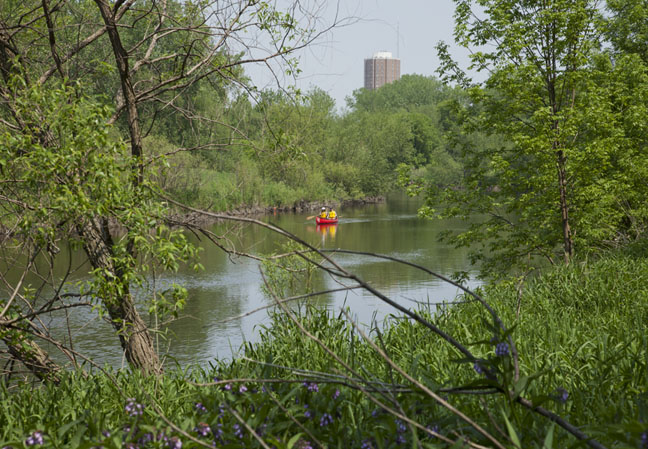
In addition to my glimpse of the coyote, I caught many a photograph this year, as you may have come to expect if you are a regular to my blog. Three that I shot just yesterday near the Milwaukee River in Gordon Park accompany this post.


2012 was a year for the record books. Much of the reason was bad news. But as December draws to a close, I am mindful of a more hopeful report I heard this week that claimed this was a watershed year for at least one important reason. Due to several extreme climatic events, including Superstorm Sandy and the worst drought conditions since the Dust Bowl, the general public and the media finally caught up with scientists regarding the real and inarguable effects of global warming.

Here at Urban Wilderness I like to recall high points of the passing year, as do many of us. I feel fortunate to have been able to explore both near and far, to revisit familiar places and to discover new ones. There were a number of surprises along the way, which I recorded in posts throughout the year. Listed below, with brief annotations, is what I consider my best of 2012.

The most significant event of the year was the most personal, the loss of my mother at 87. In August I wrote about her influence on me and my love of nature: In memoriam

Other than that, my favorite moments, in chronological order:

The year began softly, in a January blizzard. My meditation on the day is called A snowy silence

In February I covered one of my most regular beats, the Milwaukee County Grounds with Ronald McDonald House plans expansion. Although the specific request by Ronald McDonald House was settled by the County Board of Supervisors in July (see my update), questions remain about the ultimate fate of one final corner of unprotected land.

Also in February, Historic Milwaukee held a forum called "Remarkable Milwaukee." I weighed in with What's remarkable about Milwaukee?

An illuminating trip to Houston, Texas inspired a trilogy of posts. The first installment is called Waking to a new world. (Links to subsequent installments follow each.)

In March I explored a new (to me) park in the Milwaukee County system : A warm gray day in Grobschmidt Park.

In April I was invited by the Great Waters Group of the Sierra Club to give a keynote address for their annual Earth Day celebration. Here is what I told them: Reflections on Earth Day

A new trail in the Cambridge Woods portion of the Milwaukee River Greenway generated controversy in May: Urban wilderness and accessibility

In June I visited the Chicago Wilderness along the Des Plaines River: The scent of summer

And a trip to Phoenix resulted in a two-part post: It's a desert out there! (A link to part 2 follows this post.)

In July I finally made a long-awaited pilgrimage to visit Aldo Leopold's shack on the Wisconsin River north of Madison: A visit to Sand County

There was wonderful news to report in September: A new branch of the Urban Ecology Center opens in the Menomonee Valley

In October, another two-part post, this time from New York City: The High Line: Good and Bad. (A link to part 2 follows this post.)

In November a short excursion led to a surprising discovery - Starved Rock State Park - two hours southwest of Chicago: Off Season

This was also the year when I finally got around to putting the finishing touches on a book too long in the works: The Milwaukee County Grounds: Island of Hope

Happy New Year from the Urban Wilderness!


Saturday, October 20, 2012

The High Line: Good and Bad

-->
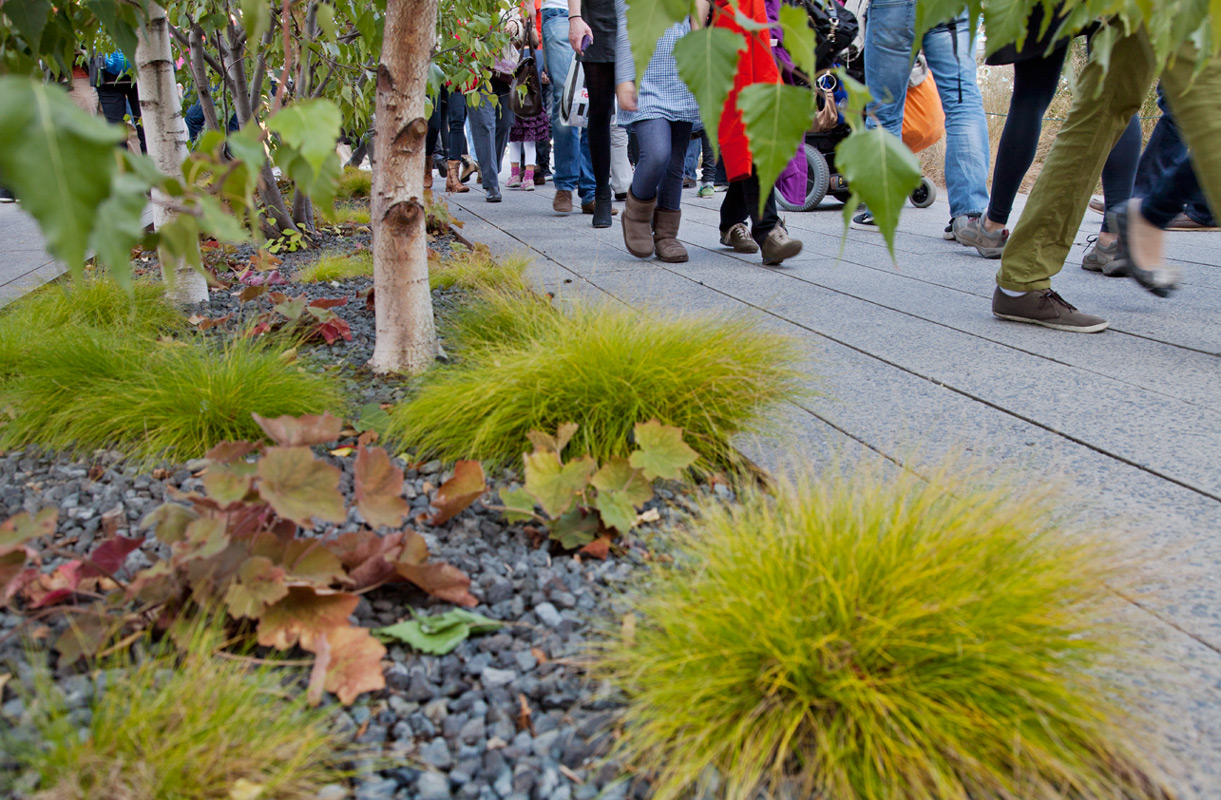
It was a glorious fall day, warm with buttery sunlight, as I made my way slowly along the narrow, tree-lined pathway. I was moving slowly for multiple reasons. First, I was enjoying the sunshine as well as my first experience of the High Line. Second, I frequently paused to inspect intriguing details of the park, which include wildflowers and public art, as well as marvelous panoramic views of mid-town Manhattan. Third, I was in a crush of like-minded revelers, an enormous, snaking parade of humanity out to visit one of New York’s newest, most innovative parks.


And fourth, of course, I was stopping periodically to take pictures. Like just about everyone around me. Spirits were high and the mood festive. A polyglot cacophony of human voices surrounded me, ebbing and swirling as people passed in both directions.


Amidst the many languages and inflected exclamations as I was, I might have passed by without noticing the one installation of public art that had no physical presence. But when I stopped to frame a photograph atop the steel grated “flyover” section of the park I heard a calm, measured voice speaking slowly and deliberately. It was oddly out of sync with the clamor. When I started to pay closer attention I heard the names of animals.

“Cheetah, …goose, …elephant, …hen, …lion, …mongoose,” intoned an invisible voice. The narrator paused and pronounced, “Bad animals: …spider, …bat, …shark, …head lice, …cockroaches….” The speaker must have been hidden under the walkway. Upon nearing it an expression of curiosity would appear on people’s faces and they would slow to figure it out, as I did.

I waited for it to cycle to the beginning: “Good animals: …penguin, …turtle, …swan, …house cat….”

A distinctive circular sign on the railing informed us that it was one of the many public art projects along the High Line, a sound installation by Uri Aran called Untitled (Good and Bad). I wondered how Aran decided which animals were to be considered good or bad. In my own opinion, a couple of the “bad” ones—bats and sharks—have gotten bad reputations for various reasons, but prove beneficial upon objective observation. And at least a couple of the “good” animals—geese and raccoons, for example—often are considered pests.

Then there’s the ambiguity of “goodness” itself. Listed among the “good” animals, the qualities of a rhinoceros look very different to a safari hunter, a naturalist, and a poacher intent on cashing in on the horn.

On another level, every kind of animal has its appropriate niche in the interconnected web of life—even head lice, I guess! The artist, according to the description on the High Line website, is trying to “spark dialogue about the arbitrary nature of classification in language.” It certainly spurred an internal dialogue for me, one that continued beyond classifications and even linguistics. 

The context of the piece, situated as it is at the center of the High Line, led to a larger question in my mind: Can nature be considered “good” and “bad?” Or, more fundamentally, what is nature? The High Line is one of the most unnatural places ever to have been conceived as parkland. Yet one of the amazing things about it, I think, is that it was inspired by nature; by what was perceived by some as wilderness taking over an abandoned elevated railroad.

Are there “good” and “bad” parks? The masses voting with their feet have clearly proclaimed the High Line “good.” I concur. By contrast, some parks, considered unsafe, are shunned by the general public. However, those parks are more likely to be refuges for wildlife. This also seems like a good thing to me. Good animals? Bad animals?

During the past week I spent four days walking and photographing the High Line. Time well spent, I believe. The park is a remarkable accomplishment. But, although it was inspired by the kind of urban wilderness to which I am usually attracted, it can no longer be called one. The website says that the landscape design is “reminiscent of the quiet contemplative nature of the self-seeded landscape and wild plantings that once grew on the unused High Line.” Emphasis mine.

What role should an urban park have in bringing the experience of nature to the citizens of any city? Followers of Urban Wilderness know that I am fully committed to urban parks that enable connections with nature. There has to be room for a variety of experiences and a spectrum of natural features, from formal gardens to outright unmanaged “wildernesses.” New York happens to be large enough to accommodate both. The High Line is a hybrid, exquisitely designed and carefully controlled.

Public art is a significant feature of the High Line’s program, but I submit that the High Line itself is a work of art that will always transcend the installations on and around it. The High Line elevates questions about the intermingled roles of art and nature to a unique level. Pun intended.

This is the first of what I expect will be at least a few meditations on my experiences this week on the High Line. And a lot more pictures. I hope you’ll stay tuned. (Episode 2: Auguries of Innocence.)


Monday, July 23, 2012

Milwaukee County Grounds: Island of Hope


Imagine parkland large enough to lose yourself in; a park with diverse topography, plants and animals; imagine a variety of public and private interests who collaborate on park stewardship. Now imagine that this park is in the middle of the most densely populated region in Wisconsin. Welcome to the Milwaukee County Grounds. 

My newest book, called The Milwaukee County Grounds: Island of Hope, explores the grounds and highlights ongoing issues in an effort to preserve and enhance this remarkable place. The book features a Foreword by Nancy Aten, award-winning principle of Landscapes of Place, LLC., as well as my photographs. It celebrates the land in all of its diversity and provides a vision for its future. 

The Milwaukee County Grounds: Island of Hope is meant to inspire appreciation for the importance of the grounds and to raise awareness about issues of preservation, ecological integrity, and biodiversity. Intact, this natural corridor will be an amenity and irreplaceable asset for nearby businesses, the adjacent Regional Medical Complex, and whole community. The County Grounds is a place of natural beauty that facilitates emotional, physical, and spiritual health and well-being. 

During the late twentieth century city and suburban residents alike became increasingly disconnected from the natural world. However, since the turn of the century there has been a resurgence of interest in urban parks and natural areas. Residents and city planners all over the country have turned vacant land and blighted brownfields into vibrant parklands.

Cities vie for the titles of livability and sustainability. The County Grounds is finally being recognized as this kind of irreplaceable asset. It is a uniquely accessible landscape endowed with remarkable biodiversity as well as the marvelous annual migration of butterflies.

Tune in to Lake Effect on WUWM 89.7 on Wednesday, July 25 at 10:00 a.m. I gave Susan Bence a tour of the County Grounds recently and she interviewed me while we walked around. Update: if you missed the broadcast, you can download the podcast and listen to the interview by clicking here.

The timing of the Lake Effect interview is intended to promote more than the book. There is a public forum also on July 25 at 6:30 p.m. at the Wauwatosa Civic Center. The topic is whether or not the historic Eschweiler buildings on the County Grounds should be preserved or torn down. I hope you’ll join me there. For more information about the forum go to Wauwatosa Patch

The Milwaukee County Grounds: Island of Hope can be previewed in its entirety – or purchased – at blurb.com. A selection of the photos from the book may be viewed on my website.


Sunday, June 3, 2012

Urban wilderness gets a nod in Journal Sentinel

A Milwaukee Journal Sentinel story posted yesterday by outdoors editor Paul Smith includes the following sentence, referring to the Urban Ecology Center's Teen Adventure Challenge program, "The 10th annual event was held in Milwaukee's urban wilderness, including Riverside Park and trails along the Milwaukee River."

photo by Paul Smith
It will come as no surprise, given the title of my blog, that I love the casual use of the term "urban wilderness." It wasn't so long ago that this didn't happen. In fact, when I titled my book about the Menomonee River watershed with that term I thought I was coining it. I'd never heard it before. That was 1999, not so long ago.

When I first googled the term, I forget when, but most likely around 2005 or 2006, only a single mention was found. (Someone had beaten me to it by titling a book about the New York City park system "Urban Wilderness" in 1986.)

Today google alerts me whenever the term is used on the internet. This happens almost weekly. I've been keeping a list of the most notable references and they've come from cities large and small all over the country - and Canada too. The conversation has shifted. People in cities everywhere have learned to value nearby nature, including many civic leaders.

Milwaukee's urban wilderness - it's 10,000 acres of natural areas - is bigger than most. It baffles me that community boosters don't promote this, one of Milwaukee's most significant and valuable assets. I believe we could rival Portland, OR for being a "green city" if we decided to make it a priority. Why not? Where are the civic leaders who will stand up for Milwaukee's prominence as a city with an abundance of nature?


Thursday, December 29, 2011

2011: A year in the Urban Wilderness


Following the time-honored year-end tradition, I offer my personal selections of the best of the Urban Wilderness from the past year. These are the stories of my explorations from month to month. Some are from far-away places, but among my favorites are many from right here in the Milwaukee area, as usual! We have much to be grateful for.


February – Reconsidering Aldo Leopold, from the Southern Unit of the Kettle Moraine State Park.


September – Wonderland: Urban parks stimulate more than the imagination, from the Menomonee River.


November – Ecopsychology among the kettles and moraines, near Eagle, WI.


December – Milwaukee’s “Thin Places,” a meditation on the parkway system.

The stories include images, as you have come to expect, and I hope you enjoy them all. It is hard to choose one best, but if I had to today I would pick this one from the KK River. It symbolizes the challenges that exist and the hope that I have for urban wilderness, wherever it is found.
 

 Thank you for following the Urban Wilderness – I hope to see you out there in 2012. Have a Happy New Year!

Saturday, December 3, 2011

Urban Wilderness: Staten Island, NY


The photographs throughout this post are from Staten Island’s Greenbelt system of parks and trails. Some of them illustrate passages directly from my story, but others are meant as a complementary photo essay.


Having a few hours before I needed to return my rental car at Newark Airport, I thought I might explore a bit of the Meadowlands, which are nearby. However, the spaghetti of freeways on the map was more than a little intimidating. Trying to navigate them in the car seemed a fool’s errand. I opted for Staten Island.

Although I grew up in New York and have visited “the city” many times since I moved to Wisconsin, I’d never been to Staten Island before. Someone said, “Why go there? It’s just another suburb.” In fact, on a map it looks much more like part of New Jersey than New York.

Why go there? I’d read about Fresh Kills, once the world’s largest landfill. An ambitious project now underway means to transform it into parkland. Its 2,200 acres make it three times larger than Central Park. It sounded like an appropriate urban wilderness adventure to me.

After the twelve-lane expanse of New Jersey Turnpike, the drive across the tunnel-like Goethals Bridge was a white-knuckle adventure in itself. A large steel paneled truck rattled along mere inches away from my side mirror. As we sloped down out of the cattle trough onto Staten Island, the road widened again. Wetlands stretched off on both sides, seasonally sear and brown, but a welcome contrast to the seemingly endless port terminals, refineries, industries, and highways of New Jersey.

Fresh Kills was easy to find. The West Side Expressway slices it like thanksgiving turkey. Barren mounds rise on either side like skinned breasts laid on a platter; man-made mountains that dwarf the houses, hotels, businesses, shopping centers, and power plants around its edges.

Cypress knees
As parkland it seemed completely unsatisfying; a pregnant wasteland that leaves me wondering how a landfill can be called “former,” as if the noxious contents will ever disappear. Maybe it will be more convincing in thirty years, when the “state-of-the-art ecological restoration techniques” have had a chance to mature.

Cypress and goose pond at Willowbrook Park
I circled it, looking fruitlessly for a way in. I didn’t need the numerous “no trespassing” signs to convince me to find a more inviting place for my urban adventure.

Fortunately, Staten Island offers many other opportunities to scratch my itch for exploration.

I chanced upon Willowbrook Park, despite narrow street access and low visibility signage. I found there a lovely pond surrounded by a paved path full of people strolling amid aggressive geese; cypress trees and a slew of their attendant knees along the water’s edge; and a park office with a map of The Greenbelt. Score! That led me to a larger, more alluring natural area.

I parked at the Greenbelt Nature Center, ignored the irony of the bench on its small lawn that bore a plaque reading “THE ADVENTURE BEGINS HERE!” (Am I supposed to sit?), and plunged gratefully into the forest. A more compelling sign on the nature trail proclaimed that this area will remain “forever wild.” I set out hopefully in search of its promise.

The trail, which was wide and clear enough to follow without assistance, was emblazoned with rectangular swatches of colorful paint. Apparently that wasn’t enough for someone; everywhere I went there also were vibrant pink and orange ribbons dangling from branches overhead. As I progressed along several trails with differently hued markers, I came to places where some over-achieving trail manager (or adolescent volunteer?) had spray-painted the ground itself, along with an occasional rock, wooden bench, and even dead leaves. No getting lost in this urban forest!

Photomontage of trail markings

Spray paint aside, the forest was indeed pretty wild. Leafless trees poked up from heaps of logs and downed branches that were shrouded in vines, brambles, and creepers, like thick cobwebs, making the place appear disheveled, faded with neglect, like Miss Havisham’s dining room in Great Expectations.

The trail dropped into hollows, some too muddy to cross, requiring me to backtrack and choose an alternate route – red or yellow this time? It wound around stagnant pools, like dark, cloudy crystal balls, mirroring the broken sky. In one a giant timber dipped into the still water, as if a gargantuan witch had long ago abandoned labors over a murky cauldron.

An unmarked (but easy to follow!) spur trail led to “ruins,” as identified on the trail map. My expectations of discovering a romantically decaying colonial mansion were dashed, though, by what proved to be the remains of a small corner made of rough stone with a set of concrete steps leading up to…a snarl of small trees. A ring of blackened charcoal, along with beer cans in a cave-like basement window well, indicated regular and irreverent visitation.
 
However, despite all the manifestations of humanity, my hike was quite solitary and peaceful. By the time I returned to my rental car I had spent long enough in the wilds of Staten Island to quiet my restless spirit and to brave a return trip over the Goethals Bridge and the short stretch of turnpike to the airport.

Ribbons hanging from branches to mark the trail.
The Meadowlands, as well as a rehabilitated Fresh Kills, remain on my bucket list for future explorations.

Tuesday, October 11, 2011

Love Parks Week

In England a non-profit called GreenSpace, founded in 2006, has created an annual event called Love Parks Week. According to their website, the event "is now established as a major event that is celebrated in parks across the country."

Let's do it here! Milwaukee has one of the premier park systems in the US. Why not celebrate it more? 

Canoeing the Milwaukee Urban Water Trail, Milwaukee River Greenway
This is also from the Love Parks Week website:
Did you know?

  • 91% of people believe that public parks and open spaces improve their quality of life.

  • Over 33 million people in England choose to use their green spaces, with around a tenth of the population visiting daily, and over half of us do so weekly.

  • Air quality, air temperature, water and flood management, are all kept within manageable limits because of parks and green spaces.

  • The more often a person visits urban open green spaces, the less often he or she will report stress-related illnesses.

  • A brisk walk every day in your local park, can reduce the risk of heart attacks, strokes and diabetes by 50%, fracture of the femur by 30%, colon cancer by 30%, breast cancer by 30% and Alzheimer's by 25%.

  • Local authorities are not legally required to provide, invest in or maintain public parks and green spaces.


  • I don't know the comparable stats for the US but I'd bet they are similar. 

    I love the parks. I know a lot of other people who do. Milwaukee should get out in front of this one, don't you think?

    Thursday, September 29, 2011

    Exploring an Urban Forest


    A new forestry center could add to the critical mass that has the potential to make the Milwaukee County Grounds one of Southeastern Wisconsin’s premier parklands.


    High overhead branches toss wildly about, auguring another storm. The forest is still damp from yesterday’s deluge and dark from thickly overcast skies. But despite the moaning and twisting in the canopy, down here at ground level it is calm. The foliage rustles softly all around. The forest feels protective. 


    I make my way through a particularly dense patch of undergrowth, most of which is invasive buckthorn. I understand the need for management.


    Farther along the trail the forest opens up, clear of most undergrowth. Last year’s leaves carpet the earth. A few bright yellow and red maple leaves, which turn early, accent the brown and contrast with the still intensely green woodland. 


    I reach the now dry depression that in spring was one of the few remaining vernal ponds, a vital habitat for many species. I understand the need for preservation.


    Trails interlace the forest, winding among the giant hardwoods and brushy thickets. People come here to calm their minds, uplift their spirits, experience the mystery of nature. I step off the trail into wilder woodland and come upon a clearing where someone – some group by the size of it – has built a makeshift shelter. My mental tally of youthful shelters, tree houses, and forts now numbers four. I am reminded of my own childhood. How many more hideouts are hidden in the recesses of our local forest?


    I understand the need for nearby nature that stimulates the imagination of people young and old.
    Theodore Roosevelt, president and tireless advocate for nature, said, “A people without children would face a hopeless future; a country without trees is almost as helpless.” A new forestry education center, planned for this woodland on the Milwaukee County Grounds, would bring together children and trees. What a great concept!

    The Forest Exploration Center’s plans for facilities and programming are ambitious. Eventually, a 60,000 sq. ft. indoor structure will be the heart of an educational complex that may include outdoor classrooms, a canopy walk/tower, and a working sawmill. 


    The “science-based” programming will emphasize cultural and economic aspects of forest management, according to board member Tom Gaertner, who owns a tree farm in Door County.


    I welcome sustainable forest management. Clearing the buckthorn and other invasive species, thinning the box elders and other weedy trees would not only improve the aesthetic experience of the woodland, but also would increase biodiversity. At the same time, the perennial explorer in me hopes that enough of its wildness remains that the alluring mystery isn’t lost.


    As a long-time educator – and advocate for urban wilderness – the idea of bringing school groups as well as the general public into contact with our remarkable forest is very appealing. I never tire of applauding the Urban Ecology Center, which has created a nationally recognized model for environmental education and stewardship. The new center’s board rightly identifies the need for educational opportunities that connect children with nature. They would be well advised to develop a cooperative relationship with the Urban Ecology Center.


    Cooperation also should be the watchword amongst the several entities with similar interests that fortuitously share the County Grounds. With effective and visionary planning and collaboration the new Forest Exploration Center, along with the new County Park, the Monarch Trail at Innovation Park, and MMSD’s flood detention basins together can fulfill the enormous potential to make the Milwaukee County Grounds unparalleled urban parkland.

    After all, it’s important not to lose sight of the forest for the trees!


    A hundred years after Teddy Roosevelt, another president, George Bush, said this:
    “Trees can reduce the heat of a summer's day, quiet a highway's noise, feed the hungry, provide shelter from the wind and warmth in the winter. …Forests are the sanctuaries not only of wildlife, but also of the human spirit. And every tree is a compact between generations.”
    Click here for an aerial view of the forest and surroundings. 


    Click here for an aerial view of the forest and surroundings.
     

    Thursday, September 22, 2011

    Wonderland: urban parks stimulate more than the imagination


    “If I had a world of my own, everything would be nonsense. Nothing would be what it is because everything would be what it isn't. And contrary-wise; what it is it wouldn't be, and what it wouldn't be, it would. You see?”   –Alice in Wonderland

    Believing in an urban wilderness makes about as much sense to most people as the wonderland Alice discovers when she throws caution to the wind and follows the white rabbit down the rabbit hole. However, I am a great believer in that paradoxical experience. We in Milwaukee County are fortunate. The county’s Parkway system provides many marvelous examples of urban wilderness, something that is what it isn’t.


    Many stretches of the Menomonee River Parkway near where I live are heavily wooded and lovely to walk through. There is one place, though, that I find almost magical. Every time I go there I feel as though I’ve fallen into something like Alice’s rabbit hole, where what you wouldn’t expect to see, you see.

    I leave my car at the end of the parkway drive. The paved off-road Oak Leaf Trail bike path runs north from there, but I am averse to pavement. I head due west, across a short bit of lawn, onto a well-trodden path that leads into what appears to be solid forest. Hardly a secret, dog-walkers and mountain bikers use this entrance to follow the trail, which cuts immediately south along the riverbank where the riparian woodland provides shade. 


    But I go straight through what is actually a narrow screen of trees at this point. Here is my rabbit hole. I emerge into dazzling sunlight and waist-high grass. Before I can even focus my eyes on it (let along my camera!) a great blue heron lifts off from the nearby limb of a long-dead tree and disappears across the river. The whisper of its large, lanky form skating over the forest canopy kindles my imagination, evokes something primeval. I behold a natural wonderland that envelops my senses.

    For perhaps a dozen feet other curious explorers have trampled the grass. But clearly most of them have been stymied, for the trail ends abruptly at the steeply eroded riverbank. A much fainter path leads off into the marsh northwards. I often come prepared with boots, knowing that I may need them to go farther. Today the near drought conditions enable me to proceed in street shoes.


    The marsh glows in the late afternoon sun. There is no other person about. It seems impossible. I am in the most densely populated metropolitan area in Wisconsin and my solitude is immense, the wildness is palpable. The scree of a hawk punctuates the feeling. 


    The wilderness deepens further as I cross the marsh and enter a woodland swamp. Giant black willows lie broken on the forest floor in various states of decomposition. Moss, fungi, and the new sprouts of resurgent willow rise from the decaying mass.

    A trio of deer startle at my approach, then bound off in alarm at my intrusion into what is obviously their domain. From the edge of a pond two more herons arise, like wraiths, in silence. My spirit calms. The daily tensions of civilization disappear like deer in the dusky forest, like herons in the sultry blue sky. 


    That I don’t find conversational caterpillars or animated playing cards doesn’t make this place less wondrous to me.


    Alice says, “If I had a world of my own, everything would be nonsense.” Well, I have a world of my own – we all do. Sense or nonsense, our world never will be more or less than what we imagine it to be. Cities can be the repositories of wilderness, providing opportunities for salvific engagement with nature, wildlife, and open space.

    “Alice laughed. ‘There's no use trying,’ she said: ‘one can't believe impossible things.’
    ‘I daresay you haven't had much practice,’ said the Queen. ‘When I was your age, I always did it for half-an-hour a day. Why, sometimes I've believed as many as six impossible things before breakfast.’”   –Through the Looking Glass