Showing posts with label new york. Show all posts

Thursday, January 28, 2016

Making the best of the New York blizzard

-->

It was a complete fluke, of course. You can’t plan for the weather when you book your flight months in advance. But there I was, in New York City during a near-record blizzard. Snow was falling at a rate of 3 inches per hour. Eventually it would accumulate to 26’’ at the official monitoring site in Central Park, one-tenth of an inch short of breaking the all-time record.

Meanwhile, the best thing to do was to get out and enjoy it. The subways were running. I hopped on the A train uptown from Chelsea to 72nd St. and joined what proved to be throngs heading into the park to enjoy the season’s first major snowfall.


I ditched most of the crowds by diving into a 36-acre section of the park called “The Ramble,” which designer Frederick Law Olmsted called a “wild garden.” Wild enough in a blizzard, I’d say.


I saw birds galore; mostly grackles, cardinals and chickadees. Some were massed in places that must have had something to eat buried in the snow. If I stood still for more than a moment I would be surprised to find myself surrounded by flocks looking for a handout. Thanks to a local photographer with a far longer lens than mine, who pointed the way, I spotted one large hawk.

Here is my photo essay of the New York blizzard in Central Park.


-->


Tuesday, August 27, 2013

Things I've seen: Postcards from New York City

I've been here three full days so far. I'm here to do some serious photographing in Central Park and on the High Line. I'll get around to posting some of those, but they'll take time. These are some random things I've seen in my wanderings around town. I hope you find them as intriguing as I did. The captions are necessarily brief. They are in roughly chronological order, but that's mostly irrelevant. The selections are heavy on food and architecture, two preoccupations of mine.

View of Manhattan skyline from the Amtrak train on the way in through Brooklyn.

Live crabs! They were wiggling around in there. Chinatown.

Also in Chinatown I found a luscious fruit that I've only had in Nicaragua before. There it's called pitahaya. Here it's called dragon fruit. It's just as tasty by either name!

Still in Chinatown. These are rambutan; very hairy on the outside but sweet inside.

Four crabs (seems to be a theme) hold up Cleopatra's Needle in Central Park.

The clean lines of FL Wright's Guggenheim balcony contrast with the neighborhood - as he intended.

UBS Plaza on Avenue of the Americas.

Rockefeller Center.


The Maritime 1968 Bulding in Chelsea.


St. Patrick's Cathedral.

 
Trees grow atop this steeple.

Chelsea Fish Market.

Ditto. If you can read the sign you will note these lobsters cost $20.95 per pound. I bought the same size lobsters in Gloucester, MA a few days ago for $3.99 a pound. No kidding. (I bet they're cheaper in Chinatown, too.)

No need for an appointment at this tatoo parlor.


Saturday, October 20, 2012

The High Line: Good and Bad

-->
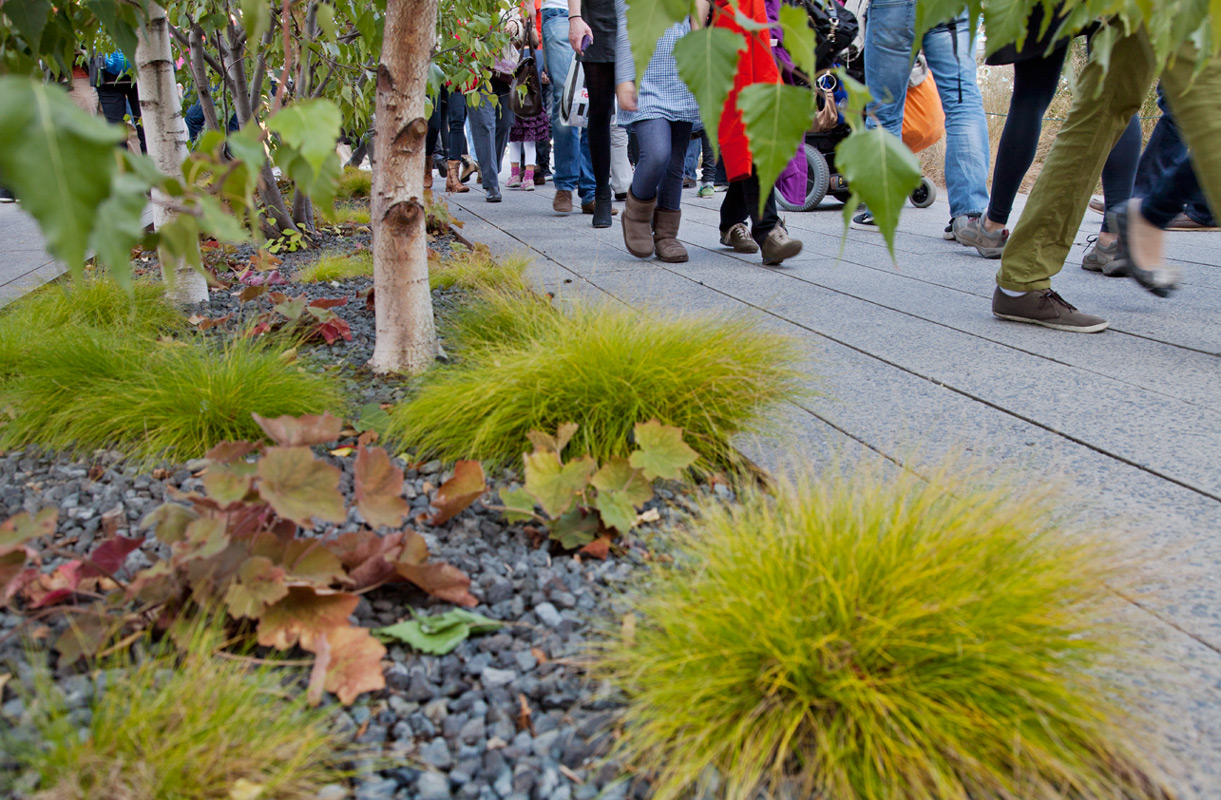
It was a glorious fall day, warm with buttery sunlight, as I made my way slowly along the narrow, tree-lined pathway. I was moving slowly for multiple reasons. First, I was enjoying the sunshine as well as my first experience of the High Line. Second, I frequently paused to inspect intriguing details of the park, which include wildflowers and public art, as well as marvelous panoramic views of mid-town Manhattan. Third, I was in a crush of like-minded revelers, an enormous, snaking parade of humanity out to visit one of New York’s newest, most innovative parks.


And fourth, of course, I was stopping periodically to take pictures. Like just about everyone around me. Spirits were high and the mood festive. A polyglot cacophony of human voices surrounded me, ebbing and swirling as people passed in both directions.


Amidst the many languages and inflected exclamations as I was, I might have passed by without noticing the one installation of public art that had no physical presence. But when I stopped to frame a photograph atop the steel grated “flyover” section of the park I heard a calm, measured voice speaking slowly and deliberately. It was oddly out of sync with the clamor. When I started to pay closer attention I heard the names of animals.

“Cheetah, …goose, …elephant, …hen, …lion, …mongoose,” intoned an invisible voice. The narrator paused and pronounced, “Bad animals: …spider, …bat, …shark, …head lice, …cockroaches….” The speaker must have been hidden under the walkway. Upon nearing it an expression of curiosity would appear on people’s faces and they would slow to figure it out, as I did.

I waited for it to cycle to the beginning: “Good animals: …penguin, …turtle, …swan, …house cat….”

A distinctive circular sign on the railing informed us that it was one of the many public art projects along the High Line, a sound installation by Uri Aran called Untitled (Good and Bad). I wondered how Aran decided which animals were to be considered good or bad. In my own opinion, a couple of the “bad” ones—bats and sharks—have gotten bad reputations for various reasons, but prove beneficial upon objective observation. And at least a couple of the “good” animals—geese and raccoons, for example—often are considered pests.

Then there’s the ambiguity of “goodness” itself. Listed among the “good” animals, the qualities of a rhinoceros look very different to a safari hunter, a naturalist, and a poacher intent on cashing in on the horn.

On another level, every kind of animal has its appropriate niche in the interconnected web of life—even head lice, I guess! The artist, according to the description on the High Line website, is trying to “spark dialogue about the arbitrary nature of classification in language.” It certainly spurred an internal dialogue for me, one that continued beyond classifications and even linguistics. 

The context of the piece, situated as it is at the center of the High Line, led to a larger question in my mind: Can nature be considered “good” and “bad?” Or, more fundamentally, what is nature? The High Line is one of the most unnatural places ever to have been conceived as parkland. Yet one of the amazing things about it, I think, is that it was inspired by nature; by what was perceived by some as wilderness taking over an abandoned elevated railroad.

Are there “good” and “bad” parks? The masses voting with their feet have clearly proclaimed the High Line “good.” I concur. By contrast, some parks, considered unsafe, are shunned by the general public. However, those parks are more likely to be refuges for wildlife. This also seems like a good thing to me. Good animals? Bad animals?

During the past week I spent four days walking and photographing the High Line. Time well spent, I believe. The park is a remarkable accomplishment. But, although it was inspired by the kind of urban wilderness to which I am usually attracted, it can no longer be called one. The website says that the landscape design is “reminiscent of the quiet contemplative nature of the self-seeded landscape and wild plantings that once grew on the unused High Line.” Emphasis mine.

What role should an urban park have in bringing the experience of nature to the citizens of any city? Followers of Urban Wilderness know that I am fully committed to urban parks that enable connections with nature. There has to be room for a variety of experiences and a spectrum of natural features, from formal gardens to outright unmanaged “wildernesses.” New York happens to be large enough to accommodate both. The High Line is a hybrid, exquisitely designed and carefully controlled.

Public art is a significant feature of the High Line’s program, but I submit that the High Line itself is a work of art that will always transcend the installations on and around it. The High Line elevates questions about the intermingled roles of art and nature to a unique level. Pun intended.

This is the first of what I expect will be at least a few meditations on my experiences this week on the High Line. And a lot more pictures. I hope you’ll stay tuned. (Episode 2: Auguries of Innocence.)


Saturday, December 3, 2011

Urban Wilderness: Staten Island, NY


The photographs throughout this post are from Staten Island’s Greenbelt system of parks and trails. Some of them illustrate passages directly from my story, but others are meant as a complementary photo essay.


Having a few hours before I needed to return my rental car at Newark Airport, I thought I might explore a bit of the Meadowlands, which are nearby. However, the spaghetti of freeways on the map was more than a little intimidating. Trying to navigate them in the car seemed a fool’s errand. I opted for Staten Island.

Although I grew up in New York and have visited “the city” many times since I moved to Wisconsin, I’d never been to Staten Island before. Someone said, “Why go there? It’s just another suburb.” In fact, on a map it looks much more like part of New Jersey than New York.

Why go there? I’d read about Fresh Kills, once the world’s largest landfill. An ambitious project now underway means to transform it into parkland. Its 2,200 acres make it three times larger than Central Park. It sounded like an appropriate urban wilderness adventure to me.

After the twelve-lane expanse of New Jersey Turnpike, the drive across the tunnel-like Goethals Bridge was a white-knuckle adventure in itself. A large steel paneled truck rattled along mere inches away from my side mirror. As we sloped down out of the cattle trough onto Staten Island, the road widened again. Wetlands stretched off on both sides, seasonally sear and brown, but a welcome contrast to the seemingly endless port terminals, refineries, industries, and highways of New Jersey.

Fresh Kills was easy to find. The West Side Expressway slices it like thanksgiving turkey. Barren mounds rise on either side like skinned breasts laid on a platter; man-made mountains that dwarf the houses, hotels, businesses, shopping centers, and power plants around its edges.

Cypress knees
As parkland it seemed completely unsatisfying; a pregnant wasteland that leaves me wondering how a landfill can be called “former,” as if the noxious contents will ever disappear. Maybe it will be more convincing in thirty years, when the “state-of-the-art ecological restoration techniques” have had a chance to mature.

Cypress and goose pond at Willowbrook Park
I circled it, looking fruitlessly for a way in. I didn’t need the numerous “no trespassing” signs to convince me to find a more inviting place for my urban adventure.

Fortunately, Staten Island offers many other opportunities to scratch my itch for exploration.

I chanced upon Willowbrook Park, despite narrow street access and low visibility signage. I found there a lovely pond surrounded by a paved path full of people strolling amid aggressive geese; cypress trees and a slew of their attendant knees along the water’s edge; and a park office with a map of The Greenbelt. Score! That led me to a larger, more alluring natural area.

I parked at the Greenbelt Nature Center, ignored the irony of the bench on its small lawn that bore a plaque reading “THE ADVENTURE BEGINS HERE!” (Am I supposed to sit?), and plunged gratefully into the forest. A more compelling sign on the nature trail proclaimed that this area will remain “forever wild.” I set out hopefully in search of its promise.

The trail, which was wide and clear enough to follow without assistance, was emblazoned with rectangular swatches of colorful paint. Apparently that wasn’t enough for someone; everywhere I went there also were vibrant pink and orange ribbons dangling from branches overhead. As I progressed along several trails with differently hued markers, I came to places where some over-achieving trail manager (or adolescent volunteer?) had spray-painted the ground itself, along with an occasional rock, wooden bench, and even dead leaves. No getting lost in this urban forest!

Photomontage of trail markings

Spray paint aside, the forest was indeed pretty wild. Leafless trees poked up from heaps of logs and downed branches that were shrouded in vines, brambles, and creepers, like thick cobwebs, making the place appear disheveled, faded with neglect, like Miss Havisham’s dining room in Great Expectations.

The trail dropped into hollows, some too muddy to cross, requiring me to backtrack and choose an alternate route – red or yellow this time? It wound around stagnant pools, like dark, cloudy crystal balls, mirroring the broken sky. In one a giant timber dipped into the still water, as if a gargantuan witch had long ago abandoned labors over a murky cauldron.

An unmarked (but easy to follow!) spur trail led to “ruins,” as identified on the trail map. My expectations of discovering a romantically decaying colonial mansion were dashed, though, by what proved to be the remains of a small corner made of rough stone with a set of concrete steps leading up to…a snarl of small trees. A ring of blackened charcoal, along with beer cans in a cave-like basement window well, indicated regular and irreverent visitation.
 
However, despite all the manifestations of humanity, my hike was quite solitary and peaceful. By the time I returned to my rental car I had spent long enough in the wilds of Staten Island to quiet my restless spirit and to brave a return trip over the Goethals Bridge and the short stretch of turnpike to the airport.

Ribbons hanging from branches to mark the trail.
The Meadowlands, as well as a rehabilitated Fresh Kills, remain on my bucket list for future explorations.