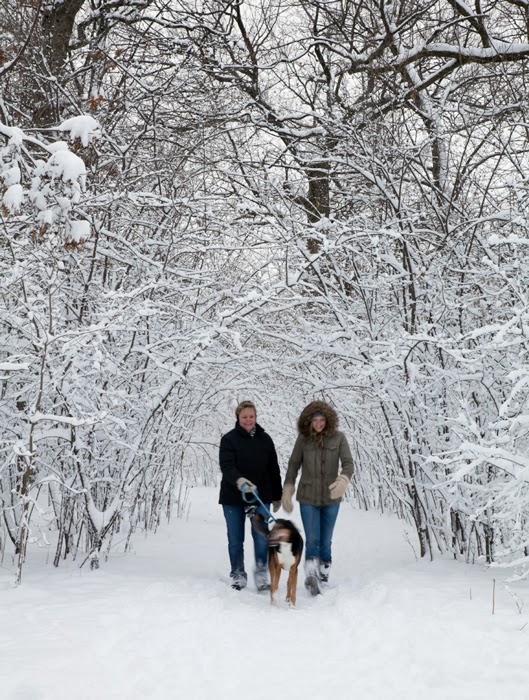
Monday, January 13, 2014

Open House for Menomonee Valley Artist Residency


You're invited!

Zimmerman Architectural Studios has cordially offered to open their building so that you can meet their new resident artist on gallery night. I am grateful to them and I'd like to invite you to come visit with me.

OPEN HOUSE

Menomonee Valley Artist Residency
Zimmerman Architectural Studios
2122 W. Mount Vernon St.

Friday, January 17
5:00 - 8:00 p.m.

There is a retrospective of my work on display.
If you have never been to the historic gas building that Zimmerman remodeled for their offices, it's worth a visit in itself!

Refreshments will be served.


Zimmerman is easy to see but hard to find. It is the large brick structure behind the tall octagonal tower near 25th Street between St. Paul and Canal Streets. Access is from 25th Street.


Wednesday, January 8, 2014

Why have an Artist in Residence in the Menomonee Valley?

I read a news article recently about a guy named Jesse Welter who has started a tourist business in Detroit. He guides clients through abandoned buildings because, apparently, there is a great demand to see the devastation and decay of a once great city. (Welter works surreptitiously because what he’s doing is both illegal and risky.) Detroit also has become a mecca for photographers attracted to the opportunities it provides for producing images of ruin and social upheaval. There is a book by two French photographers called, “The Ruins of Detroit.”

Using ruins as an artistic motif has historical roots tracing back at least to the Italian Renaissance, of course, when ancient civilizations were unearthed and used as a springboard for modern transformations of a medieval society. But what is being done in Detroit has been dubbed “ruin porn” by residents who see it as exploiting the decay without offering any solutions to the problems facing their community.

When I first began photographing the Menomonee Valley about 15 years ago, Milwaukee was often compared to Detroit and many thought our city to be on the verge of slipping into a similar abyss. The Menomonee Valley, the geographical center of the city, was also the epicenter of urban decay. We had ruins, too, particularly at the west end of the Valley where the Milwaukee Road once was the city’s largest employer. For a while, until they became unstable and had to be torn down, the chimneys that were the last vestiges of those ruins acquired value as monuments.

Chimneys, 2009

Although Milwaukee still has work to do, we have not suffered Detroit’s fate. The story of Milwaukee diverged from that of Detroit and one of the most important chapters in that story is the one about the Menomonee Valley. Ever since white settlers drove out the indigenous inhabitants, the history of the Valley has been one of repeated transformations.

The verdant wild rice marsh became the locus of urban expansion as the surrounding bluffs were torn down to fill it in. The Valley became Milwaukee’s industrial core—“machine shop to the world.” By the late Twentieth Century industry had moved on. The Valley had been abandoned, blighted with pollution, and hollowed out, much like Detroit.

The Valley is now seeing its fourth major period of transformation. This new transformation has been led, in no small measure, by Menomonee Valley Partners (MVP), a non-profit organization created for the purpose. While the revitalization of Milwaukee is part of a global trend of urbanization, the story of the Menomonee Valley diverges, again, in important ways. As in most cities, jobs and economic development are appropriately a primary concern. But from its inception MVP has had a larger vision.  

What first attracted me to the Valley weren’t the ruins. It was the resurgent wildness that had grown up around them. Neglect, contamination and blight had driven out the people and, ironically, made the valley once again attractive to wildlife. In contrast to the first transformation of the Valley, which filled the marshes, channeled the river and drove out wildlife, the new vision for redevelopment has included restoration of the river and natural areas along with business development.
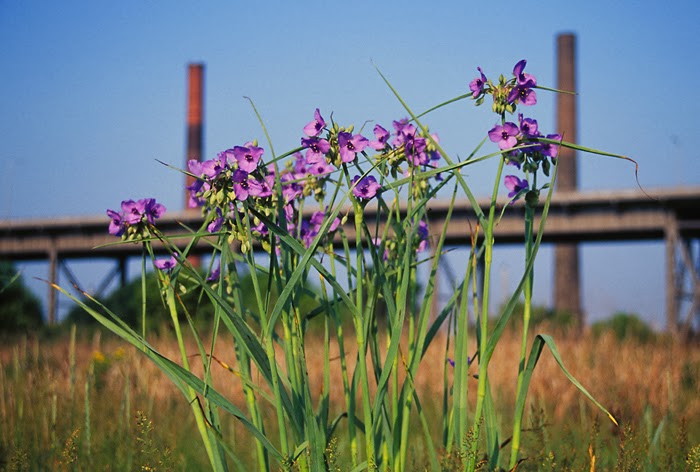
Spiderwort, ca. 2001
Instead of destroying natural habitats in the name of progress, there is a new understanding that a sustainable future involves the integration of the natural environment with human activity. The vision for the Valley layers on a third component to economic development and ecological rehabilitation: cultural revitalization. After all, what distinguish great cities from merely dense population centers are their cultural assets. They are places made vibrant by their histories, their recreational opportunities and by the arts.

If Detroit is to be saved it won’t be because Jesse Welter saw in it a business opportunity. It won’t be due to a flock of photographers who descend on the city for a day or a week and leave with images, however poignant and metaphorical. It will be the result of community efforts, including the many artists who have taken up residence there and whose work is about transformation and hope rather than decay and despair.

The latest chapter in the on-going story of the Menomonee Valley is one of transformation and hope. It is a story worth telling. Stay tuned.

Monday, January 6, 2014

Considering Thoreau in Milwaukee’s Menomonee Valley

The news for the past few days has been dominated by dire predictions of breaking records for cold. Today’s Journal Sentinel calls the predicted temperatures “life-threatening.” I’m certainly not going to go out photographing until things improve a bit. It’s a good day to stay indoors, with a fire preferably, and to reflect on warmer times and places. A good day to reprise another of my stories from my book, Urban Wilderness: Exploring a Metropolitan Watershed

The watershed in the book is my own, the Menomonee River. One of its chapters is about the Menomonee Valley. The book is a series of experiential short stories, accompanied by photographs, about my exploration of the watershed. One of my favorite stories in the whole book is from the chapter on the Industrial Valley. The photograph that relates best to this story, which was featured on the title page, is also one of my favorites. Perhaps that's not a coincidence!


Faint-Hearted Crusader

At the bottom of the bluff, near the river's edge, it is possible to imagine being in a distant wilderness rather than in a narrow corridor between landfills and brownfields in the industrial core of a major city. It is especially invigorating to touch the wild spirit of the river that lies at its heart, feeling the vitality of it, tried but unbroken.
In warm weather, the wear on this trail indicates regular traffic. But snow cover makes clear how rarely used it is in winter. Two, maybe three, people and one dog have preceded me this week. The infrequency of human visitation likely explains the enormous number of ducks and geese taking advantage of this refuge between the stadium and the 27th Street viaduct. Away from the edge of the bluff, out of sight of the waterfowl below, their constant murmur can be heard like a softly chanted litany. When my form appears at the rim it is as if a shot had been fired. Pandemonium ensues and the entire congregation rises. Within a minute, they are gone. All is silent but for the trickling of the current and the low rumble of a single truck high and far away on the viaduct.
In his essay Walking, Thoreau claims to "speak a word for Nature, for absolute Freedom and Wildness." I wish to speak for relative freedom and wildness. They are virtues that can coexist within society and culture while providing a contrast made poignant by the intimacy of their juxtaposition. Thoreau wants to "regard man as an inhabitant, or a part and parcel of nature, rather than a member of society," but it need not be an either-or proposition. Rather we must reconcile our social and natural selves as intertwining facets of a single whole. Indeed, until we can see them as one and the same, society ignores nature at its peril.
Thoreau chastises all who are "faint-hearted crusaders" unwilling to commit to true walking. This would require, he says, leaving family and friends, settling all one's affairs, and setting out without thought of returning. That is a journey Thoreau himself made only briefly and symbolically. I, too, am content to retrace my footprints in the snow, back to my parked car, my family, and the life I've made in a city graced by a measure of wildness.

From Urban Wilderness: Exploring a Metropolitan Watershed, 2008, Center for American Places at Columbia College Chicago.

To read additional excerpts, click here.

Thursday, January 2, 2014

The Menomonee Valley has an Artist in Residence!

Exciting news from the Menomonee Valley, which, as many followers of Urban Wilderness know, is one of my regular beats. I posted the following yesterday on Arts Without Borders (my other blog). But I think it will interest you folks who follow this blog, too.

Menomonee Valley Partners, in association with Zimmerman Architectural Studios, has established an Artist in Residency program that begins today. It is my honor to have been selected as their inaugural resident. Official announcements will be sent out shortly.

Menomonee Valley Partners has been a leader in Valley revitalization since 1998 and Zimmerman is one of the oldest and most successful architectural firms in Wisconsin. The residency program is intended to stimulate an exchange of ideas about the Valley, its history, its future, its place as a dynamic and vital part of the fabric of Milwaukee, a place where economic and community development is integrated with parks and natural areas. The exact nature of the work that I will be doing will develop over time as the year progresses.

Zimmerman Architectural Studios is hosting and I’ve begun to move into their beautifully renovated space on the north side of the Menomonee Valley. The Derse Company, another Valley business, has graciously donated a pair of display panels. These are installed in Zimmerman’s atrium and an introductory display of my prints is already in place.

Zimmerman is hosting an open house on January 17, in conjunction with gallery night. I hope you’ll stop in for a visit. Although it’s easily visible from I-94, their building can be a little hard to find. It’s located at 2122 W. Mount Vernon Avenue with access from 25th. Street. It’s just beyond the octagonal brick tower.


I am no stranger to the Valley since I’ve been photographing there since I began work on my book Urban Wilderness: Exploring a Metropolitan Watershed in 1999. However, I felt the urge to get out this morning right away. I also love the falling snow. And so here are two initial offerings from my first day as Artist in Residence in the Menomonee Valley. I invite you to follow my progress throughout the year on this blog or on my facebook page

Tuesday, December 31, 2013

Urban Wilderness: The year in review

-->
County Grounds tree cutting
The past year saw dispatches from Urban Wildernesses as far flung as London, England and the U. S. Southwest, along with coverage of a wide variety of stories much closer to home. Locally, 2013 was year of contrasts, of gains and losses in terms of urban wilderness. The year began with a bang; literally a crashing of trees and the whine of buzz saws at the Milwaukee County Grounds in Wauwatosa. My January post, Slaughter on the Milwaukee County Grounds: Innovation What?, struck a nerve and blasted all records, both prior and subsequent, for Urban Wilderness readership.
Other bad news included the proposed mine in the Bad River watershed of the Penokee Hills in northern Wisconsin, the precedent-setting decision by the WI Public Service Commission to allow power lines to be built in Milwaukee County’s Underwood Parkway, a decision by the WI DNR to expand hunting in the state, and a developer’s popular proposal to build a residential tower on Milwaukee’s lakefront in violation of Wisconsin’s Public Trust Doctrine. (The final outcomes of the mine and the lakefront development are still pending.)

3 Bridges Park opens
On the positive side of the ledger, Milwaukee created two fabulous new parks for its citizens to enjoy—3 Bridges Park in the Menomonee Valley and the Rotary Centennial Arboretum along the Milwaukee River.

I posted twice about 3 Bridges Park: 3 Bridges Park opens in Menomonee Valley and Photos of the opening.

Rotary Centennial Arboretum
And three times to share images of the arboretum as it developed during the year:

Also, people from all over the region continue to turn out in great numbers to help Milwaukee Riverkeeper clean up the rivers on Earth Day and the Menomonee River is finally going to be rid of the last remaining stretch of concrete channel.

Beyond all that it was another very good year for Urban Wilderness adventures. Here are a few of my favorite chronicles in chronological order:

January: An update on the tree-cutting episode at the Milwaukee County Grounds.

Starved Rock State Park, IL
In February I returned for a second look at Starved Rock State Park, not far from Chicago in Illinois: The Abstract Wild.

In March I returned to the Mke County Grounds for An Easter reflection.

Hampstead Heath, London
In May I reported on my April trip to London’s Hampstead Heath: Nature, Art and Artifice.

June found me in the Southwest where I posted from Abiquiu, NM—Desert monastery knows how to do seclusion—and southern Colorado—Colorful Colorado: a tale of tent caterpillars and pine beetles.

Millennium Reserve, Chicago, IL
In July I discovered Chicago’s Millennium Reserve, which at 140,000 acres will become the nation’s largest urban wilderness when its post-industrial landscape is fully rehabilitated: Chicago’s Millennium Reserve: A photo essay.

In August I finally made a long awaited pilgrimage to one of the most famous of all urban wildernesses: Postcards from Walden Pond.

North Park, Lincolnshire, IL
September found me off the beaten track—slightly—next to Interstate 94 outside Chicago: North Park, Lincolnshire, IL: We all live in awatershed.

In October I was fortunate enough to be able to return to New Mexico from where I filed this account of a visit to one of Georgia O’Keeffe’s favorite sources of inspiration: The White Place.

County Grounds
December was dark, as always, which led me to post twin stories about the winter solstice.

I closed the year in the place where it began, with a photo essay from the Milwaukee County Grounds, which has become a white place of a very different sort.

Happy New Year from the Urban Wilderness!

Sunday, December 29, 2013

Into white: A photographic circuit of the Milwaukee County Grounds

A recent snowfall drew me outside and, not wanting to drive in it, I went for a long walk in one of my favorite haunts, the County Grounds. I was amazed, not by the beauty of the landscape, which long experience has continually reaffirmed, but by how many people there were out there also enjoying it. More often than not, upon seeing me with my camera and tripod, I would hear the question repeated nearly verbatim: "Have you gotten any good pictures?" They are always well-intentioned but the implications seemed to be that it would be hard to miss and that I would be an incompetent fool not to have done so. I always smile and say something noncommittal like "I believe I might have."

One particularly enthusiastic fellow, after the inevitable question, added "There are some good ones over there," pointing up the hill where I was headed. As if photographs were simply out there like ripe apples waiting to be picked from the trees. And, indeed, I believe I did get a few good ones, at least good enough to share. Enjoy!

Approaching the east detention basin from Hoyt Park.

Revelers sledding on the steeply sloped berm of the east basin.

Two roads diverged in a wood and I..., I took the one without tire tracks making troughs in the deep snow.

Dog walkers on one of the popular trails through the woods behind Ronald McDonald House.

The endangered oak savanna.

The Grove. This copse is behind the We Energies power plant and was the inspiration for the winter solstice story I wrote for Urban Wilderness: Exploring a Metropolitan Watershed.

Port-a-potty. This is also behind the power plant, at the edge of a parking lot between the copse and the plant.

UWM's Accelerator building on the Innovation Park campus, enclosed but still under construction.

An icy tree in front of the ABB building, also under construction at Innovation Park. One of the many newly planted trees along Discovery Parkway.

The Eschweiler complex, visible through the steel pilings that are being driven along Watertown Plank Road to support the new interchange under construction there.

A view towards the We Energies power plant and the Milwaukee Regional Medical Complex from the recently re-landscaped County Grounds park.

Children's Hospital is just visible through the windrow of oaks along Swan Boulevard next to the east detention basin.

I hope I was able to pick a few good apples, though some were probably not what my fellow travelers that day had in mind. Thoreau said, "The perception of beauty is a moral test." This is ever true in the urban wilderness and all the more reason to keep the little of it we have left to us.

Saturday, December 21, 2013

Winter solstice ceremony on Milwaukee’s lakefront

-->
“We are all connected.” ~ John Clifford, Lakota Elder, Congregation of the Great Spirit
On this the winter solstice, the shortest day of the year, the sun never did rise.
Even the city, its towers enveloped in mist, seemed ephemeral.
We had come to Milwaukee’s lakefront to bear witness to the solstice, to honor the earth and its peoples, and to offer up special prayers for life-sustaining water. The ceremony was led by members of the Congregation of the Great Spirit, who engage in the ancient rituals four times a year, at the solstices and equinoxes. Out of respect for the sacred rites and offerings, I willingly complied with their request to refrain from photographing during the ceremony itself. (I shot all the accompanying photos either before or after the ceremony.)

We gathered under a great tree near the site of the old coast guard station, which had been used by the Indian community from 1971 to 1983. John Clifford, a Lakota Elder, began by explaining the importance of the site as well as the importance of the tree as a symbol of the unity of earth and sky.

Clifford lit an aromatic offering of tobacco and sage. We gathered at the tree. The first offering was to the “spider spirits,” black, white, gray, and gentle, which protect this sacred site. We then faced each of the cardinal directions in turn. Tiny bundles of tobacco were placed at the base of the tree. Prayers were spoken. The four cardinal directions are associated with colors, with the elements of earth, air, fire, and water. They also represent the four ages of humankind, new life, youth, adulthood, and the elders.
The solemnity of the ritual was maintained despite the intrusions of daily life: the sound of traffic on Lincoln Memorial Drive, dogs crunching through the frozen snow as they chased each other, joggers coming down off the pedestrian bridge/ramp. There was one brief perturbation of the mood when a colorful truck parked nearby with loudspeakers blaring “Jingle Bells” sung—barked that is—by dogs.
 
I discovered later that this was a business that offers sled dog rides in the park.

The emphasis was on water in in keeping with a Global Day of Prayer for Water organized by Milwaukee Riverkeeper and the Congregation of the Great Spirit. The most important message I heard during the ceremony was when Clifford invoked “all of my relatives.” By that he meant the earth and all people because, he said, “We are all connected.”

A free spirit? an omen? a kite caught in a tree. Everything is connected. I'm sure of it.

This is one of a pair of posts in honor of the Winter Solstice. The other is a reprise of my solstice story from Urban Wilderness: Exploring a Metropolitan Watershed.