Saturday, March 5, 2016

Nature in the New World: the 'American Vision' at Milwaukee Art Museum

An edited version of this review first appeared at Milwaukee Magazine on March 3, 2016.

Imagine wilderness that stretches out before you in every direction, apparently endlessly. Imagine a new nation, boldly wrenched from the tired conventions of its European origins—a nation of pioneers, adventurers and visionaries. What kind of art works would these circumstances inspire? The answer is currently on view at the Milwaukee Art Museum in the newly opened exhibit, Nature and the American Vision: The Hudson River School.

View from the Highlands of West Point, John Ferguson Weir, 1862
Yes! Go first to Nature and learn to paint landscape, and when you have learnt to imitate her, you may then study the pictures of great artists with benefit. Why should not the American landscape painter, in accordance with the principle of self-government, boldly originate a high and independent style, based on his native resources?” ~ Asher B. Durand

This quote, by one of the founders of the Hudson River School, is among many that greet viewers on the walls of the museum gallery. Make no mistake: Nature is not merely the subject of the artists of this period but also muse and often-deified raison d'être.

For the American Romantic artist of the early nineteenth century, Nature was abundant, exuberant and unfathomable. They not only painted it, they reveled in it. The artists of this time and place went to unprecedented lengths to document the landscape, becoming adventurers themselves as well as visionaries.

In some respects the ideals of the Romantics, which included writers and philosophers as well as artists, can seem quaint in contemporary circumstances. In 2016, a time of climate change, dwindling habitats and the extinction of species, when science and popular culture alike are as prone to question the nature of nature as to extoll its virtues, when it seems that no landscape remains unsullied, what shall we make of the artists of the Hudson River School? Are these paintings of a vanishing American landscape mere historical curiosity or do they still have something to say to us today?
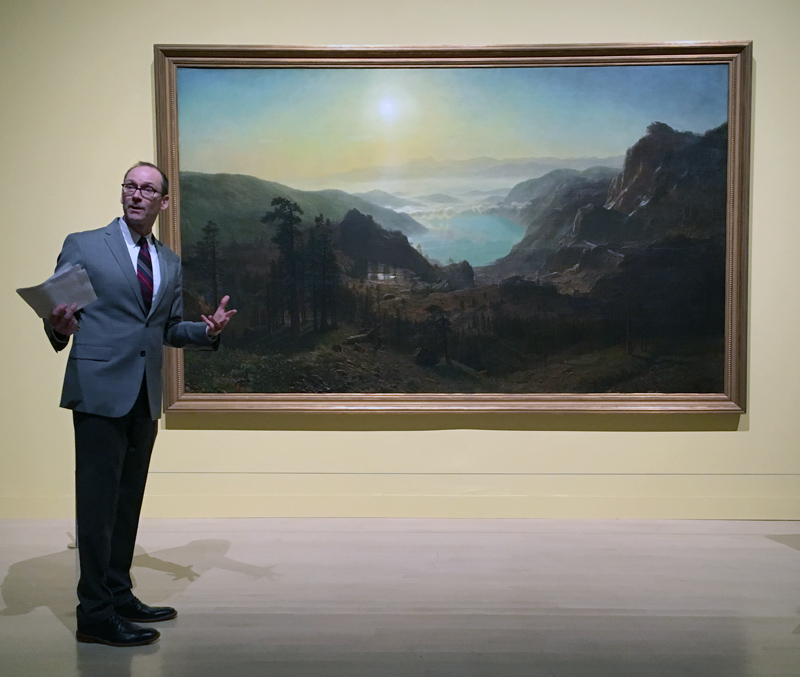
Milwaukee Art Museum curator Brandon Ruud
with Donner Lake from the Summit by Albert Bierstadt, 1873


The paintings of this period, from the 1820s through much of the century, are indisputably of historical importance. In the words of curator Brandon Ruud, who led a tour of the exhibit, this was the first homegrown artist movement in the still-young republic—no small achievement from artists who up to that time invariably and literally went to Europe for inspiration as well as training. But more than that, the artists helped create a national identity based on their vision. It was the subject itself—a wild landscape of seemingly boundless abundance that distinguished the New World from its European roots—that leant the movement its originality, along with a true-believer’s faith in its importance.

Study from Nature, Stratton Notch, Vermont, Asher B. Durand, 1853
The idea of “imitating” nature, encouraged by Durand, one of the founders of the movement, is anathema to many contemporary artists. And yet nature, in all its ambiguity and challenge, and even the notion of landscape, which bears its own cultural baggage, has acquired new potency today. We are all faced with exigencies of nature—now more often referred to as “the environment”—that civilization has long sought to control if not ignore.

It also should be noted that, despite Durand’s advice, painters didn’t so much imitate nature as use it as a platform from which to leap. Great liberties often were taken with the physical places in the landscape that inspired them. This is seldom evident when viewing the actual paintings, which, for all the imbued drama, are executed in a convincingly naturalistic style and with an eye to intimately rendered detail.

I recently picked up a volume of essays by Paul Shepard on this very topic. Shepard, a twentieth century philosopher and ecologist, did more than write extensively about the Hudson River School. He went to great lengths to demonstrate how different are the paintings from the very specific places they purportedly depict, making a series of photographs from the precise vantage points of particular paintings. The artists freely interposed imagined foreground elements on recognizable scenes and the topography itself is often exaggerated in terms of contour and scale.

Niagara Falls, Louisa Davis Minot, 1818
In an example from the exhibit, Louisa Davis Minot dramatized the pristine power of Niagara Falls in part by omitting the burgeoning commercial establishments that even then threatened to diminish the purity of the experience.

The artists did this because the landscape was more than a subject. It was a symbol that represented ideals embodied in the new republic—a land of irrepressible freedom and limitless opportunity. It was also a land of unimaginable natural wonders, which dazzled audiences who flocked to see the canvases.

Even today the relevance of the Hudson River School goes beyond historical importance. In a very real sense our lasting perception of nature and especially of wilderness was a creation of the Romantic idealists. Before that time the landscape was set decoration and wilderness a place to be feared and conquered. Emerson, Thoreau and Muir were among the first to recognize the interdependence of humans and the natural world (not counting indigenous cultures that never lost sight of it.) But it was the artists like Durand, Cole and Bierstadt who made of their ideas a palpable, visible reality. And while Modernism has come and gone, their vision of nature lingers in the popular imagination.

Durand inquired, with grand rhetoric characteristic of the period, “Why should not the American landscape painter, in accordance with the principle of self-government, boldly originate a high and independent style, based on his native resources?” He was echoing the temper of Ralph Waldo Emerson’s own exhortation in his transcendentalist masterpiece, Nature, to “enjoy an original relation to the universe.”

Both are saying that people—artists in Durand’s case—ought to get outdoors and experience nature for themselves, in all its visceral power and glory. This idea stood in revolutionary opposition to common practice wherein a “grand tour” of Europe and the work of Classical and neo-Classical predecessors dictated the tenor and style of painting.

Castle of Ostia Seen from the Pine Forest of Castel Fusano William Stanley Hazeltine, 1881


The exhibit wisely includes a section of paintings clearly derivative of European antecedents in order to drive home this point. The neo-Classical elements—Greek or Roman ruins in the landscape, for example—and contemplative moods contrast with the wilder character of more typical Hudson River School compositions.

By the end of the Romantic period, Impressionism and subsequent Modernist movements began to assert dominance within the artistic establishment. The world—and the increasingly exploited and despoiled landscape—had changed sufficiently that continued efforts by painters of the Romantic style might be criticized as wishful thinking. However, along with contemporaries like Thoreau and Muir, they expressed a real need to protect dwindling wild places that prefigured an embryonic conservation movement.

View of the Yosemite Valley, in California, Thomas Hill, 1865
It is in this impulse, to protect and save nature as well as to marvel at it, that the Hudson River School retains its cogency today. We are in a similar age, when the 50-year-old environmental movement has expanded and matured, when there is growing global realization that for too long the Modernist ideals of progress and technology have obscured our interdependency with the natural world.

The Consummation of Empire, from The Course of Empire, Thomas Cole, 1836
The exhibit reaches a crescendo in the final gallery, which is devoted entirely to the suite of five paintings by Thomas Cole entitled “The Course of Empire.” Although I’d seen them before, they lose none of their emotional or intellectual power with repeated viewing. The sequence depicts the rise and fall of a civilization supposed to be mythical, but clearly recognizable in its Classical architectural and stylistic detail. The scenes proceed from an untamed wilderness through imperialistic excess and on to destruction and desolation.

According to Ruud, the paintings (from the 1830s) were Cole’s deliberate attempt to warn and admonish the leaders of the new nation not to succumb to historical precedent, to protect the extraordinary landscape that made America exceptional. There was no lack of hubris in Andrew Jackson’s land of manifest destiny. The substance may have shifted but a similar tone can be heard today on the presidential campaign trail.

Destruction, from The Course of Empire, Thomas Cole, 1836
A visit to the Milwaukee Art Museum to see Nature and the American Vision: The Hudson River School may be just the antidote. I recommend it. It runs through May 8, 2016.

Monday, February 15, 2016

Flying Squirrels in the Milwaukee County Grounds


  A rare, up-close look at an elusive urban critter.

An edited version of this story was first posted at Milwaukee Magazine on February 9, 2016.


A small, gray face peered inquisitively out of the nest at me with eyes large enough to qualify for an animated feature film. Cute. But I was in no position to appreciate it. I was a dozen or more feet in the air, on a ladder. My fancy DSLR camera hung uselessly from my neck. I couldn’t lean back far enough to focus on the little creature. As I fumbled in my coat pocket for my iPhone another of the furry occupants suddenly appeared, this one poised to flee through the nest’s circular opening.

That’s when things got really interesting!

Wil-O-Way Woods, where this was happening, is a 45-acre remnant hardwood forest in Wauwatosa. It is surrounded by what is commonly known as the Milwaukee County Grounds and managed by the Wisconsin Department of Natural Resources. The DNR is partnering with a private non-profit organization to create what will be called a Forest Exploration Center. These unusual little flying squirrels are just one of the reasons this rare urban forest is worth exploring.

We had parked our cars in the Wil-O-Way Underwood parking lot. Through the leafless trees it was easy to spot the closest nest box. We entered the woods on a well-packed trail then quickly forged a new path through the snow to reach the tree with the box. Our squadron of five was comprised mostly of wildlife enthusiasts. Gary Casper, the biologist in charge of monitoring the squirrels, led our group.

Casper scampered up the ladder and opened the front of the box. He announced what he found inside: a few acorn fragments and debris that indicated the box had been used. No nest had been built in it and it was otherwise vacant. One of the volunteers dutifully recorded Casper’s findings and we moved on through the forest.

We crossed a ski trail and fresh snowshoe tracks. In many places holes had been scrabbled in the snow by animals looking for sustenance or nesting materials. Scat the size and color of roasted coffee beans confirmed the unsurprising presence of deer. Even small urban forests like this one have a variety of users, human and non-human. Managing such a forest can involve juggling diverse interests and constituencies. With its many interconnected segments administered by different agencies, the County Grounds presents particularly complex management issues.

For example, when I asked who it was that hired him, Casper replied, “It’s complicated.” Casper himself works for the UWM Field Station. The flying squirrel project, which includes surveying and monitoring a variety of other species as well, is part of a wildlife assessment for the Milwaukee Estuary Area of Concern. It is administered through the Great Lakes Office of the DNR—which, in a quirk of bureaucratic irony, is separate from the DNR office that oversees Wil-O-Way—and funded by the federal Environmental Protection Agency.


Area along Swan Blvd. that recently was cleared; brush piles will also be removed.


We trudged between trunks of oak, hickory, maple and ash, some too large to reach around. Flying squirrels require a mature forest to survive, which speaks well of the quality of this isolated urban woodland. But many of the other species that grace Wil-O-Way Woods travel freely between the various parcels making up the County Grounds. Unfortunately, according to Casper, this parcel is small enough to suffer from “edge effect,” meaning predators will penetrate the woods from adjacent areas.

Wil-O-Way Woods is contiguous with the MMSD’s 90-acre flood control basins. Swan Boulevard is all that separates the DNR parcel from the 55-acre County Grounds Park, administered by Milwaukee County Parks Dept., and 69-acre Innovation Park, the new multi-use property being developed by the UWM Real Estate Foundation.

--> Area along Swan Blvd. that recently was cleared; native trees are to be planted.

While Innovation Park eventually will be mostly built out, it also includes 11 acres of protected wildlife habitat popularized as the Monarch Trail. Innovation Park’s accelerator building was where I had met Gary Casper that very morning. We were there for a meeting prompted by a forestry management decision to clear a broad swath of brush and timber along Swan Boulevard. The discussion veered from clear-cutting to integrated management of the County Grounds puzzle.

Up the ladder again, Casper tells us that there are telltale signs of rodent activity on top of the second box. Again there is no nest, only scraps of food and bits of scat on the inside. Our recorder jots notes and we proceed onward.


At the third box we hit pay dirt. Disturbing the nest as little as possible, Casper counted five squirrels curled up in a furry ball. Chewed leaf litter and shredded wood made up the bulk of the nesting materials but something that looked like blue yarn was threaded throughout the mix.

Buoyed by our discovery, we wove through the trees, moving from box to box and repeating the procedure. Though nearly all bore signs of activity, most were vacant. Casper explained that the squirrels typically congregate in winter to benefit from their combined body heat. Come spring they usually spread out and raise their young in separate nests.

In addition to flying squirrels, the UWM study includes bats, dragonflies, various birds, and the animal Casper told me excites him most: a rare species of terrestrial crayfish that depends on scarce ephemeral wetlands. The purpose of the three-year study is to survey and monitor the target species; rank each one’s status as impaired or stable populations; and to recommend restoration projects that would improve habitats where they would be most effective.

Tree clearing took place on DNR propoerty, across Swan Blvd. from Innovation Park
where the Echelon Apartments are under construction.


An integrated, collaborative management plan on the County Grounds could greatly enhance efforts by all parties to ameliorate existing impairments and restore healthy habitats. Neil O’Reilly, an instructor in UWM’s Conservation and Environmental Studies Program, provided a cogent example: a forester concerned with sustainable timber management might choose to keep or cull a very different selection of trees than a wildlife specialist would. Birds, bats, flying squirrels and many other animals often inhabit very particular niches in the fabric of the forest. That these naturally wary animals are easily missed by the untrained eye is made abundantly clear by our foray through the woods.


At box number nine (out of ten) we were again rewarded with an inhabited nest. This time things became far more exciting when the squirrels, which are nocturnal, were startled awake and began to move about. It may have been my fault. Casper had agreed to let me climb the ladder and try to get photographs. I was fumbling with my iPhone, trying to get it to focus on the squirrel heading for the exit hole.

I have to admit I should have anticipated what it did next. They’re called flying squirrels for a reason, after all! But I’d never seen one before. I wasn’t ready when, instead of scurrying up the tree trunk like any other squirrel, it leaped straight out. Spreading wide its fore and hind legs, the membrane of skin connecting them stretched taut and it floated about ten feet to a nearby tree trunk. Those watching on the ground gasped with exclamations of delight.


Trying not to lose my balance on the ladder, I managed to catch a glimpse of about half the enchanting flight. I didn’t even feel the tiny claws poking through the denim of my jeans until someone called out, “There’s one on your leg!” In the commotion surrounding the first squirrel’s flight a second one had slipped out the front of the open nest box and onto my clothes. I quickly closed the box.

I felt little prickles descending my leg. Then it was gone; I didn’t see where. “They’re very tame,” Casper said with a grin as I stepped off the ladder.

The wildlife assessment is in its third and final year. Casper told me that while this species is fairly common statewide, the Wil-O-Way flying squirrels would be classified as an isolated population. This kind of mature upland hardwood forest is very uncommon in an urban setting. He concludes that preserving the Wil-O-Way habitat “may be a locally significant conservation priority.”

One of the squirrels primary predators
I have tramped through Wil-O-Way Woods countless times and over the years I’ve been lucky enough to spot many kinds of wildlife. Deer, of course, but also coyotes, ground hogs, skunks, snakes, hawks, owls and innumerable smaller birds. Squirrels too—they’re so ever-present I scarcely notice them. But I will be eternally grateful to Gary Casper for this marvelous gift: enabling me to see flying squirrels. Due to their nocturnal behavior I’d never have known they were here.

Now I won’t be able to walk through these woods again without remembering the phantom prickling of my skin and feeling the unseen presence of flying squirrels.

A healthy forest would be thinned of invasive species; 
but deadfall would be left to provide wildlife habitat.

To see more of my photos from the Milwaukee County Grounds, go to my Flickr album.


Thursday, January 28, 2016

Making the best of the New York blizzard

-->

It was a complete fluke, of course. You can’t plan for the weather when you book your flight months in advance. But there I was, in New York City during a near-record blizzard. Snow was falling at a rate of 3 inches per hour. Eventually it would accumulate to 26’’ at the official monitoring site in Central Park, one-tenth of an inch short of breaking the all-time record.

Meanwhile, the best thing to do was to get out and enjoy it. The subways were running. I hopped on the A train uptown from Chelsea to 72nd St. and joined what proved to be throngs heading into the park to enjoy the season’s first major snowfall.


I ditched most of the crowds by diving into a 36-acre section of the park called “The Ramble,” which designer Frederick Law Olmsted called a “wild garden.” Wild enough in a blizzard, I’d say.


I saw birds galore; mostly grackles, cardinals and chickadees. Some were massed in places that must have had something to eat buried in the snow. If I stood still for more than a moment I would be surprised to find myself surrounded by flocks looking for a handout. Thanks to a local photographer with a far longer lens than mine, who pointed the way, I spotted one large hawk.

Here is my photo essay of the New York blizzard in Central Park.


-->


An invitation to Milwaukee's Urban Wilderness


Peace like a river

The theme of Wauwatosa's 2016 "All-City Read" is the title of a novel, "Peace like a River," by Leif Enger.

As one of the many events being sponsored by the city for this theme, I've been asked to share my experiences in Milwaukee's Urban Wilderness. I will show images from Milwaukee's three rivers and copious parklands and illustrate why I believe we have a world-class, eco-friendly city and region.

I invite you to come spend some time with me as we explore Milwaukee's great outdoors.

You have two opportunities to catch my presentation:

February 4 @ 1:30 pm - 3:00 pm
 
Hart Park Senior Center (Muellner Building), 7300 Chestnut St., Wauwatosa


February 13 @ 2:00 pm - 3:30 pm
 
The Grand Hall at Hoyt Park Pool, 1800 N. Swan Boulevard, Wauwatosa


For more information about the 2016 All-City Read, click here
To learn more about me and my work, check out my website


Tuesday, January 12, 2016

Overpass Light Brigade lights up Lake Park Indian mound


Tonight in Lake Park votive lights were laid around the perimeter of an ancient Indian burial mound. A dozen poets were on hand to articulate our message. To the beat of native drumming we danced a ceremonial round dance that encircled the mound.

Thanks go to the Overpass Light Brigade for organizing the event and who say:

We stand on the coldest day of the winter against a Wisconsin Republican piece of legislation that would allow for the destruction of Native American mounds that stand in the path of development and extraction projects. We say people and culture over profit.

Mikwenim is an Ojibwa word for rememberance.

Wednesday, December 30, 2015

Urban Wilderness: The year in review

This year's stories from the urban wilderness came from near and far. Some were as close to home as the Menomonee River, which runs near my house, and some as far away as I've ever been: Australia and New Zealand. Some celebrate restoration successes and community efforts, while others reflect on controversial issues.

The first story of the year was a hold-over from 2014 when I was artist in residence in Milwaukee's Menomonee Valley. Ruby and the Tree: Growing with 3 Bridges Park is a lovely metaphor for what's going right in the Valley.

The Menomonee River itself bookends the year. Early on preparations began for the Last stretch of concrete to be removed from the Menomonee River, near Wisconsin Avenue where the river passes by Piggsville. I returned to the Menomonee in December, this time upstream in Hoyt Park where a series of sewer crossings that had been damming the river were being removed: Menomonee River restoration.

In February I left town to visit a favorite haunt not too far away in Illinois: Art, Artifice and Nature at Starved Rock State Park. A very popular park that receives four million visitors a year, the two primary attractions in winter are ice climbing and eagle watching.

In March controversy erupted over a beloved patch of trees on Milwaukee's East Side: Walker targets UWM's Downer Woods. Why?  

Also in March the Mandel Group began construction on their Echelon Apartments at Innovation Park on the County Grounds in Wauwatosa. I began a series of updates showing construction progress. By the end of the year it also became clear that the battle to preserve all four of the historic Eschweiler buildings was lost. Three updates:
Construction update on County Grounds.
The Milwaukee County Grounds: A visual meditation.
Eschweilers come down as Echelons rise.

Just east of Innovation Park, still on the County Grounds, still in March, a long-awaited upgrade to the power plant serving the Regional Medical Complex got underway: Between Park and Power Plant: 10 acres in Tosa.

Across the county, on the lakefront in Cudahy, more controversy played over the better part of the year. I visited Warnimont Park in April and posted this: Milwaukee County parkland threatened by gun club’s plan for shooting range. Good judgment prevailed. By the end of the year the gun club was asked to relocate somewhere outside of the park.


A short excursion in April took me to one of Wisconsin's premier wildlife refuges: Horicon Marsh: A poetic and photographic odyssey. I caught a controlled burn in progress, along with additional shots of burned-over areas. Fascinating! Who knew a marsh would burn?

I spent a lot of time along the Kinnickinnic River this year, thanks to the MMSD. I posted two photo essays about it:
Earth Day: A community cleans up the KK.
The Kinnickinnic River and community development: A makeover

In May and June I followed Greg Septon to five nesting sites around the Milwaukee area as he banded fledgling falcons. One of my favorite stories of the year: Milwaukee's peregrine falcons get a helping hand.

The biggest controversy of the year happened over Independence day weekend. The state legislature, trying to take advantage of the distraction, tried to insert new powers to the Milwaukee County executive regarding O'Donnell Park: O'Donnell power play generates legislative fireworks.

In August I took a hike, not usually a newsworthy event. But this one began at 3:30 a.m. and introduced me to Brew City Safaris, a very worthy effort to get people out for hikes in the city: An urban hike along Milwaukee's Lakefront.

Yet more controversy stirred in September as a group calling itself Citizens Acting for Rail Safety staged a Rally on river to protest oil trains. The trains carrying explosive crude oil pass through downtown Milwaukee, crossing the Menomonee River at the point where it meets the Milwaukee River.

Also in September I finally published a story that had been years stewing in my consciousness:
Could Milwaukee be a "green" destination? I believe Milwaukee deserves to be known as a eco-friendly city, on a par with Portland, OR. I consider this to be one of the most important stories I've ever published.

In October I traveled to Australia and New Zealand. Although I hope there will be more to come (from Australia), I managed to post three stories, all about New Zealand:
Dispatch from New Zealand: Muriwai Beach.
One Tree Hill, Auckland, NZ.
Rangitoto Island: The resilience of nature.

The year ended with a bang, almost literally. On a very stormy December morning I happened to drive along Lincoln Memorial Dr. where I discovered High seas on Milwaukee's lakefront. It became a very popular post.


 Happy New Year from the Urban Wilderness!