Showing posts with label kinnickinnic river. Show all posts

Thursday, May 21, 2015

The Kinnickinnic River and community development: A makeover


--> -->
A south-side community fills a void created by flooding

The truck that was to deliver the flowers was late but no one seemed to mind. Neighbors chatted amiably in Spanish. Staffers from the Sixteenth Street Community Health Centers had set up two tents for an annual spring plant sale. The tents and the people milling around them seemed very small in the broad, vacant city block between the Kinnickinnic River and the row of houses fronting W. Harrison Ave .


Propelled by several impatient children, a few people went across the vestigial dead-end street to the adjacent city block, also largely vacant. Raised beds for community gardens had been built and fenced in a small corner of the block. Volunteers showed the kids how to pull weeds and rake the soil in preparation for planting. Incrementally, the community is reclaiming empty land that stretches four long city blocks alongside the river. 


Not long ago all of those blocks were filled with houses. The reason for their removal is as concrete as the river that bisects the neighborhood. The Kinnickinnic River has literally been lined with concrete since the 1960s. It looks more like a drainage ditch than a river. This was no accident. At the time it was believed that channelization would solve the problem of flooding.


Today the channeled river seems more like a catastrophe than a solution. While the drastic measure did reduce flooding for a time, it also degraded water quality, destroyed all semblance of wildlife habitat within and along the waterway and increased the threat of drowning. Now, ironically, even the original intent of the channel is no longer effective. The past 50 years has seen the floodplain rise dramatically. If nothing were done to alleviate the new circumstances, a major storm could inundate as many as 350 homes in the neighborhood.


Which is why the houses have been purchased and, one by one, dismantled. The removal of the houses is just part of a major flood management initiative led by the Milwaukee Metropolitan Sewerage District. Sixteenth Street Community Health Centers and partners have been implementing quality of life improvements from a companion plan called the Kinnickinnic River Corridor Neighborhood Plan. The most dramatic and eagerly awaited changes—the removal of the concrete channel and rehabilitation of a naturalized river—will come later. The most trying task is currently underway: asking families to move and tearing down houses.


Over 60 homes have already come down. Hence the vacant land. Last week I was able to observe the workers as they dismantled another. Although more expensive than traditional demolition, the MMSD has opted for a process called deconstruction. Forgoing the bulldozer for manual labor, everything salvageable or recyclable is painstakingly removed from the house. Usable appliances and fixtures are set aside. Plaster walls are pummeled until they reveal the lathe and studs beneath, which become recycled wood.


House demolition usually generates a huge amount of indiscriminately crushed debris that is hauled off to landfills. The more laborious deconstruction process enables materials to be separated for recycling and reduces what ends up in a landfill.


The process began here years ago. Numerous neighborhood meetings were conducted to explain the project and build community support. Initially, there was concern and hesitation about the acquisition and removal of homes. However, now that the work has progressed as far as it has the mood has shifted. According to Iris Gonzalez at the Sixteenth Street Community Health Centers, many people have become not just supportive but excited about the project. There is even some impatience at the pace of the work.


As more houses come down and more land stands vacant, people have begun to imagine its eventual transformation. They anticipate the planned new parkland and an actual river running through the neighborhood. The project is supposed to be completed in 2022.


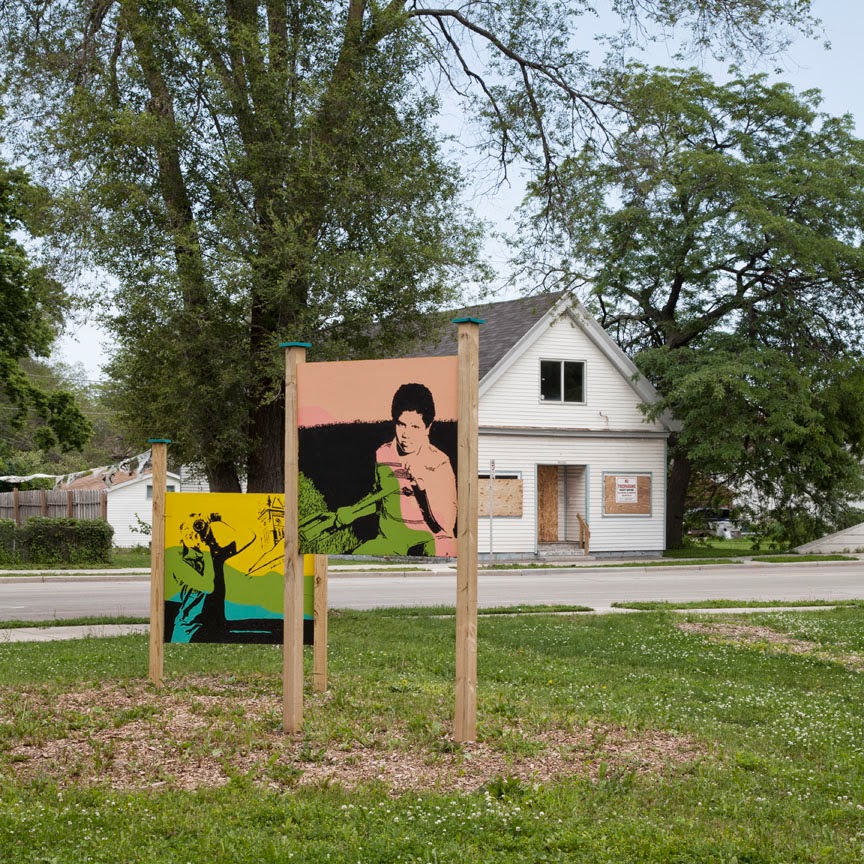
Meanwhile, the neighborhood has begun to fill the void. In addition to the community gardens some temporary public art has been erected on another corner of cleared land.

I wander back to the tents. The truck has arrived. A crowd gathers to help unload the plants and get them ready for sale. People are lined up to make their selections. The Sixteenth Street Community Health Centers staff is joined by young volunteers who help carry potted flowers back to cars and nearby homes. The annual event is called “Bloom and Groom.” It is subsidized by the collaborative efforts of Urban Anthropology and Sixteenth Street CHC along with grants from the Greater Milwaukee Foundation and the Neighborhood Improvement Development Corporation. The organizers hope that investing in flowers and improving the appearance of the neighborhood will be a visible demonstration of pride and commitment to the future.


The flowers are beautiful in the bright morning sun and the smiles on everyone’s faces, it seems to me, are a clear sign of that hope and pride.

To see more photos from the KK River and the neighborhood go to my flickr album.

If you missed my recent post about the Earth Day clean up of the KK River, click here.

Full disclosure: I am connected to the two lead organizations responsible for the KK River Flood Management Project and Neighborhood Plan. I am working with the MMSD to document the current phase of the KK River Project and until recently my daughter was employed by the Sixteenth Street Community Health Centers. But if you check out my flickr photos it will be clear that I've been interested in this work long before any of that!

Tuesday, April 21, 2015

Earth Day: A community cleans up the KK

-->
Which do you think is the more powerful metaphor?

A) While picking up trash along the concrete-lined Kinnickinnic River I found a framed print of exotic waterfowl discarded in riverside bushes.


B) Two hundred community members turned out last Saturday to pick up trash along a stretch of their river that has been little more than a drainage ditch for over 40 years.


The irony of the sentimental wildlife print discarded near the degraded river is good for a chuckle, but I choose B as the more important metaphor. The KK River Neighbors Association and the 16th St. Community Health Center turned people out in force to join in the annual Earth Day cleanup sponsored by Milwaukee Riverkeeper. The symbolism is clear: the community cares about its environment and is hopeful about the future of its maligned waterway.

The reason for that hope is as concrete as the river channel: The Milwaukee Metropolitan Sewerage District has begun a multi-year project to remove said concrete channel and restore a more natural flow to the Kinnickinnic River. Judging from the enthusiastic comments I heard repeatedly on Saturday, the community is thrilled at the prospect.


Acres of cleared land between Harrison Street (background) and the KK River (behind me) are evidence of progress on MMSD’s rehabilitation project. After houses in the flood-prone area are purchased and demolished the concrete channel will be removed and the river reconfigured within a landscaped park.

After two hours of picking up trash near the river and throughout the neighborhood on either side everyone gathered at another concrete symbol of the river’s revitalization. The concrete channel, which until recently extended east to the I-94 overpass, now ends just shy of the 6th St. Bridge. The first phase of the MMSD project was completed in 2011. In addition to removing the concrete channel a newly dedicated KK River Trail was created alongside the rehabilitated stream.


A huge crowd that included cleanup teams from several sites on the KK gathered along the 6th St segment of the KK River Trail for a “Trash Bash” organized by the event sponsors. Free pizza and burritos were available to all. There were family-friendly interactive displays related to water and the river. A team of scientists from UW—Madison were on hand to help folks learn more about their river.

The UW team provided hip waders for the public to borrow so that they could physically immerse themselves in the river. “Having kids and adults connect with the river in that way is huge,” said Iris Gonzalez, one of the organizers from the 16th St. Community Health Center. “Most of them were very hesitant to try but, after watching others (in some cases their own children), they were convinced. It is experiences like feeling the pressure of the water against your body, or the waders suck onto your legs when you step in and seeing fish and fish eggs up close that foment a spirit of stewardship.”


Local children spray water onto a watershed model that illustrates how water flows are affected by varying slopes, soils and vegetation conditions.

The success of the “Trash Bash” in bringing the community down to the river, to activate the new trail and to celebrate the transformation that is underway was a major achievement. Many in the neighborhood had not ventured there before, according to Gonzalez. However, she told me proudly, “I know they will be back!”

The event culminated in a spectacular demonstration of hydraulic flows and river dynamics. Peter Levi, the UW limnologist heading the team of scientists, poured red dye into the river just east of the 6th St. Bridge. At first the dye turned the water bright scarlet and then expanded to fill the width of the river. The dye gradually dissipated as it swirled downstream, around rocks and settled into pools. It was a crowd pleaser and a lovely end to the Earth Day river cleanup.


A brief series of photos from the day follows.


To see even more photos from this event go to my flickr album.

Full disclosure: I am substantially connected to many of the organizations responsible for the cleanup and KK River Project because the work they are doing is dear to my soul. As a former board member of Milwaukee Riverkeeper I have participated in most (if not all—I don’t quite recall) of their 20 annual river cleanups. I am working with the MMSD to document the current phase of the KK River Project. On top of that until recently my daughter, Chelsea, was employed by the 16th St. Community Health Center. And Chelsea brought my only (so far) granddaughter to help out with the cleanup. She’s only 3 years old, so she mostly played on the Cleveland Park playground and ate pizza at the Trash Bash. Hey, I said “full disclosure!” Oh, and Chelsea took my picture with this funny-looking fish.


More photos on flickr.

Thursday, July 25, 2013

Saving the last wetland in Milwaukee's estuary: the Grand Trunk

How important are a meager six acres of wetland surrounded by industrial and commercial developments just off the Kinnickinnic River near the port of Milwaukee? As the last remaining wetland in an estuary where wild rice marshes once covered the entire confluence of Milwaukee's three rivers and several miles into the Menomonee Valley, I believe they are important enough to save and protect. A couple years ago I wrote about this site, known as the Grand Trunk after the railroad company which ran its tracks nearby. I am reprising that story below.

This is topical, though, because there is an opportunity to make your voice heard on this issue at an upcoming public hearing. Here are the details:

Public Open House
re: Bay View Wetland restoration and sustainable development project.

Thursday August 1, 2013
4:30 to 6:30 pm
Presentation at 5:00 pm


Location:
Port of Milwaukee, 2323 S. Lincoln Memorial Drive
(alongside the CARFERRY ROAD northbound ramp to the Hoan Bridge.)

You can see an aerial view of the Grand Trunk site by clicking here.

The following story was originally posted in October, 2011.

Seiche: Symbolism and reality in an unlikely urban wilderness

In the midst of active rail lines and towering industrial buildings, I find the activity of beavers most mysterious. Discovering the little haven of nature in a place so completely altered by humans is itself unexpected. The presence of a beaver, an animal also driven to modify its environment, seems miraculous and symbolic.

Against long odds, a wetland remains within the historic estuary of the Milwaukee River.

Milwaukee’s estuary, with its vast wild rice marshes, once was one of the greatest treasures in the entire great lakes basin. First it drew myriad Indian tribes, who prospered from its abundance. Later it drew European settlers who, to make a long story short, cleared the wilderness, filled the wetlands, paved over the earth – and transformed it into “the machine shop of the world.”

Today the estuary is reduced to the confluence of the city’s three rivers, their banks lined with concrete and steel. But, accompanied by Megan O’Shea of the Wisconsin DNR, I set out to explore a tiny unnamed wetland in this unlikely setting.


Starting at Skipper Bud’s Marina on the Kinnickinnic River, we follow an uninviting ditch strewn with trash. There are plans to clean and rehabilitate it. In theory, aside from providing drainage the ditch should be hydrologically dynamic. Surprisingly, inland bodies of water as large as Lake Michigan can have something like a tide. It is called seiche. Storm fronts, high winds, and variations in air pressure can cause water levels to fluctuate from one side of the lake to the other, like water sloshing in a tub.

During a seiche event, high lake water can flow into the wetland bringing aquatic life with it as high tide does in a salt marsh.


It takes only a minute or two to reach the heart of the miniscule marsh from South Marina Drive. Atop a large berm we look down on a patch of cattails nearly overwhelmed by tall non-native reeds called Phragmites. Attractive but aggressively invasive, these will have to be eradicated.

We walk along a weed-choked dirt track to reach the far end of the mostly dry 6.5-acre site. A healthy wetland is more than a place that’s wet. Fortunately for this site, size is not a crucial factor. Three things are needed: the right soils, plants, and hydrology – or flow of water. Surrounding uplands add complexity and vitality to the ecosystem, which increases biodiversity.


Bushwhacking through tangled undergrowth, we are suddenly, marvelously immersed in nature. Even here, where surrounding industrial buildings, boxcars, or dry-docked boats are rarely out of sight, the variety of colorful plants in slightly faded autumn splendor is a revelation. We skirt an impenetrable stand of sandbar willows. Poplar leaves quiver in the breeze, by turns silvery and golden.

The wind dies as we enter a slough. All evidence of the surrounding city disappears. After a rainfall the wetland drains through here into the ditch. We see the telltale trees, gnawed and toppled. The teeth marks are gray with age and some of the neatly coned stumps have long since resprouted. Among the many incongruities of our diminutive wetland this evidence of beavers is the most compelling.


I imagine a beaver swimming down the Milwaukee River. First the intrepid creature has to leave its comfortable habitat, probably near the headwaters where the river is relatively wild and protected by Kettle Moraine State Park. Before long it reaches farmland where cow pastures occasionally denude the riverbanks. Then for most of its long journey it paddles past suburban homes perched on lawns to enjoy riverfront views.

Our big-toothed, flat-tailed protagonist would have to portage past – or slip over – at least a couple dams; avoid piers, boaters, fishermen. When at last it reaches downtown Milwaukee it is confronted by a canyon of condominiums and industries, with their bulwarks of concrete walls.

The beaver perseveres. It threads its way through the hardened confines of the constrained river; past barges, motorboats, bridges; until it reaches the narrow, polluted outlet of the only wetland left in the estuary. What instinct drives it to this apparently desperate end?


The question reverberates as we emerge from the copse to see a flat, vacant brownfield, dotted with mounds of asphalt and gravel. Even this harsh landscape sprouts new mosses, grasses, and trees. Nature is persistent. The brownfield would double the size of the preserve. Sadly, it isn’t included on the planning map.

Why should we care? Why restore such a meager wetland, so long neglected and circumscribed by blight? In a few hours time a bulldozer could erase the last wetland, flatten its gentle contours, prepare it for pavement. Centuries of progress have led us, like the beaver, to this desperate end.


This unlikely place is precisely where we need a refuge. Yes, we can replenish a habitat for the fish, birds, and other creatures that require it to thrive, but our own salvation is no less at stake, inextricably bound as it is to theirs. We humans are drawn to nature, to water and the soft edges of the land, as surely as the beaver.

We are at a moment, if not a turning of the tide then at least a high water mark – a seiche – when the effects of our own pressure on the earth are swamping outdated and unsustainable impulses. Like beavers, we have the power to shape our environment. We can push it around with bulldozers but we cannot conquer nature. How we shape it will determine if we thrive or perish.


It is time to become reacquainted with nature. There is no better place to begin than here in the ravaged estuary of the Milwaukee River. This seemingly insignificant wetland at the edge of civilization is what we have left to work with. We must not merely protect it; we must make the most of it.

Saturday, April 20, 2013

Milwaukee's rivers get cleaned up

It was a chilly but bright morning and Milwaukee area residents turned out in force to clean up the three rivers. The annual River Clean Up occurs on the Saturday closest to Earth Day. It is sponsored by Milwaukee Riverkeeper, the Urban Ecology Center, among other organizations. I toured three of the sites many sites where crews were out picking up trash and other debris. Here is a brief photo essay of the morning's activity, which included a stranger than usual find in one of the rivers.


First stop: Honey Creek in Wauwatosa.


Lindsay and Mel pause for a pose.

Barcalounger, anyone?


A group of girls from St. Joan Antida High School lend a hand.


Next stop, the Menomonee Valley. Here volunteers stroll along the Hank Aaron State Trail near Miller Park.


Picking up trash on the riverbank near the Hank Aaron State Trail's Valley Passage.


Jeff, a staff member of the Menomonee Valley Branch of the Urban Ecology Center, tries to wrestle a large piece of sheet metal from the river.


An Urban Ecology Center team picks invasive garlic mustard in conjunction with the river clean up.


My third stop was the Kinnickinnic River, where some heavy lifting was going on.

Seriously heavy lifting!

Luckily Poseidon lent a hand. (His real name is Tim.)


Wes wins the annual prize for finding the strangest item in the river. This leather valise was discovered to contain articles of clothing, a pistol, and bricks. The bricks, presumably, were in there to make sure the stash of incriminating evidence stayed at the bottom of the river. Little did the perpetrators of whatever this implies know that the riverkeepers would discover it!


Someone called 911 and within minutes officers Pelczynski and Campos responded. They cautiously inspected the bag.

And retrieved the gun.


Close inspection revealed it to be a BB gun. The story of its disposal in the river, in the bag with the clothing, remains a mystery.

To see additional photos, go to my flickr page.