Showing posts with label milwaukee riverkeeper. Show all posts

Sunday, October 9, 2016

Riverkeeper leads Brew City Safari tour of Milwaukee River Greenway

The sun shone brightly on Saturday afternoon as I joined a throng gathering at Caesar's Pool Park for a hike on the Milwaukee River. Sponsored by Brew City Safari, the tour was led by guest guide, Cheryl Nenn, Milwaukee's Riverkeeper. I played leap-frog with the group to the halfway point at the Locust Street bridge. At that point I lost the group due to my penchant for wandering off to shoot photos. But I forged on. It was a perfect day for a hike in one of my favorite places. Here's my photo essay:


Riverkeeper Nenn leads group across the river at Caesar's Pool, site of the former North Avenue dam.


Seedling in protective tube planted by River Revitalization Foundation volunteers to restore native species along the West Bank Trail.


We saw several spots where bank stabilization work was underway to mitigate damage done by a storm in 2010.


The group circled the "graffiti wall" that adorns the ruins of a former bathing resort, when this part of the Milwaukee River Greenway was a lake impounded by the North Avenue dam.


This mattress, embedded in the tall riparian grasses, is evidence that people other than graffiti taggers frequent the spot.


On the east side of the river I enter the Rotary Arboretum and Riverside Park.


A series of cairn-like sculptures by Nic Thompkins now graces the park.


Planting native vegetation is also being done along the East Bank Trail. Here it is organized by the Urban Ecology Center, which is located in Riverside Park.


Evidence of beavers -- well, at least one beaver anyway!


One of a series of murals on the piers of the North Avenue Bridge.


And back again to Caesar's Pool Park. The next Brew City Safari hike is this coming Saturday, Oct. 15 at Havenwoods State Park. Check it out on their website.


Thursday, October 11, 2012

Clean Water Act at 40


The early 70’s were a heady time for nature-lovers. The first Earth Day was in 1970. I remember that early energy of what became known as the “environmental movement.” We had marched for Civil Rights; we had protested the Vietnam War. Now we were going to save the earth. And do you know what? A lot of good came from that energy. The Clean Water Act is one of the highlights.

October 18 marks the 40th anniversary of the passage of the Clean Water Act. Last night at Discovery World, Milwaukee Riverkeeper hosted an anniversary party to celebrate the enormous positive impact that this legislation has had. As a former Milwaukee Riverkeeper board member I’ve been to many of their annual fall “River Bashes” and this was the most well attended one that I can recall.

Todd Ambs, director of the national River Network, was the guest speaker. His talk focused on both the progress that has been made since the 1972 passage of the act and on the many challenges that we still face. You can read his “40 thoughts for 40 years” on the River Network website. 

We are at a critical moment and the “environmental movement,” despite its indisputable success, has been vilified by a surprisingly large segment of an increasingly polarized populace. (In 1972 a bipartisan Congress overrode Nixon’s presidential veto to pass the Clean Water Act.) Ambs commented on the perceived negativity of the environmental movement, using the Civil Rights Movement as an example. He said that when Dr. Martin Luther King made his most famous speech in 1963 he didn’t call it “I have a complaint.” We in the environmental community often have been guilty of predicting gloom and doom. But it doesn’t take long to become either despondent or antagonistic in the face of unrelenting bad news. We can’t afford to emphasize problems without simultaneously celebrating successes. We must hold up our dreams for the earth instead of our complaints.

Ambs quoted Carl Sagan: “Anything else you're interested in is not going to happen if you can't breathe the air and drink the water. Don't sit this one out. Do something. You are by accident of fate alive at an absolutely critical moment in the history of our planet.”


One of the literal sparks that ignited the Earth Day movement and motivated Congress to pass the Clean Water Act was the burning of the Cuyahoga River in Cleveland, OH in 1969. In fact, it had caught fire many times over many preceding decades. As Ambs pointed out, rivers no longer catch fire in the U.S., thanks largely to the Clean Water Act. He didn’t go on to add that now, unfortunately, tap water has begun to catch fire instead due to groundwater contamination by the oil shale fracking industry. (If this is news, check out the sobering movie, Gasland.) There is still work to be done.


My dream is for my children and grandchildren -- and their compatriots in other parts of the world -- to have safe and secure drinking water, fishable and swimmable rivers and lakes, and an unabashed love of nature, even if they live in densely populated cities as so many must. 

Taking care of our planetary home also will benefit everyone's bottom line. Another Ambs quote, from former WI governor Gaylord Nelson, the founder of Earth Day: “The economy is a wholly owned subsidiary of the environment.”

For more information on the Clean Water Act and the 40th anniversary, go to the Office ofManagement and Budget website or to an article in the Huffington Post.

Happy birthday, Clean Water Act, and congratulations, Milwaukee Riverkeeper!


A recent outing of the Milwaukee Riverkeeper boat on the Milwaukee River, which is much cleaner today than it was in 1972.

Sunday, April 22, 2012

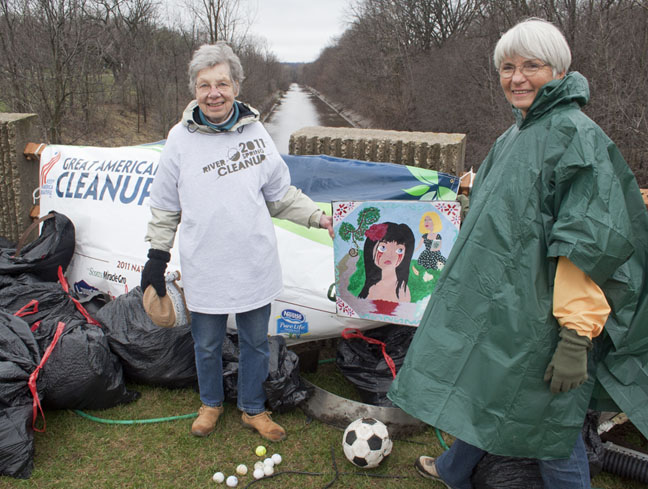
Annual Earth Day river clean up draws thousands

It was a glorious spring day, which always helps. Over 4,000 people came out to participate in the annual river clean up sponsored by Milwaukee Riverkeeper. Today's Milwaukee Journal Sentinel has the complete story but I got around to a few sites before I settled in at Krueger Park, along Underwood Creek, where I mostly pulled garlic mustard and baby buckthorns. Here are some images.


Large contingents fanned out along both sides of the Milwaukee River near North Avenue.


Volunteers working among the sandbar willows next to the rushing narrows just north of Caesar's Pool.


A plastic bag flutters like a defiant banner in the upper branches of a tree while volunteers collect an enormous volume of trash below.


It took a lot of heft to remove this old, rusted tailgate from a remote part of Krueger Park in Brookfield.


Furniture was the item of the day in Underwood Parkway, near 115th St.

Tuesday, April 19, 2011

Wild Wauwatosa comes to Wauwatosa Patch

Dear fans of the urban wilderness: I have a new beat - although it overlaps with my old beat. I've been invited to write a weekly column for the new online news venue called Wauwatosa Patch. My column is called Wild Wauwatosa and I will be covering much of the same thematic territory in the more limited physical territory of Wauwatosa.

Recently completed outflow structure for the MMSD detention basins
So, if there's something happening out on the County Grounds...

Mating geese considering a nesting place at the Burleigh Triangle?
Or if I simply run across some curious phenomenon of nature in this urban setting, you will probably hear about it at Wild Wauwatosa. My latest post is about last weekend's river cleanup, organized by Milwaukee Riverkeeper.

A painting found in Underwood Creek has ironic poignancy
I invite you to check out Wild Wauwatosa by clicking this link.


Saturday, March 19, 2011

Finding fish - alive - in the Menonomee River!


After reading on the Milwaukee Riverkeeper website about a die off of “thousands” of Gizzard Shad, a species of small fish, and the mobs of seagulls flocking to gobble them up, I headed down to the Menomonee Valley to check it out. I did see more than the usual number of gulls, but nothing to get excited about.


What I found more interesting were the live fish, fingerlings, that I discovered swarming around in the recently completed Emmber Lane River Access and Restoration Project. This is where a new pier has been installed, just off Emmber Lane, where it crosses the Menomonee River. I don’t know my fish species very well, so I could easily be wrong, but these little guys look a lot like the Sturgeon fingerlings I’ve helped Riveredge Nature Center restore to the Milwaukee River.


The barrier that was installed to keep this backwater clear of debris is not completely effective, as you can see from this shot. A bloated goose carcass floated amongst the more typical flotsam. However, it is much better than what I’ve seen in previous years. You can also see that the fingerlings are paying the debris no mind.


I took the opportunity to stroll along the stretch of Hank Aaron State Trail that runs west of Emmber Lane. The urban wilderness is stretched especially thin here. But when the sun came out it was quite brilliant. I scared off a flock of migrating ducks I couldn’t identify (white and black; possibly Common Goldeneye) before I could get close enough for a photo. I complained in a recent blog about the overwintering Canada geese and the lie they make of Aldo Leopold’s observation in A Sand County Almanac: “One swallow does not make a summer, but one skein of geese, cleaving the murk of a March thaw, is the spring.” Well, I’m happy to report that these are the kind of geese that prove its lingering truth. It is reassuring to know that they are too skittish to let me near, for it is that wildness in them that raises my spirits - as it did for Leopold.

Saturday, January 29, 2011

Wisconsin wetland protections at risk under new management

Scott Walker and the new Republican legislature want to make it easier for developers to pave paradise and put up more parking lots. As the River Rat says, we're going to be "open for business; closed for habitat."

See good stories at Milwaukee Riverkeeper and the River Alliance.

Wednesday, September 22, 2010

Green Rivers

Do you know what color your river is today?

I had read that the the sewers were being tested, but it still came as a shock when I happened upon the acid green waters in a neighborhood creek that carries run off into the Menomonee River. I imagine that anyone who didn’t know what was happening would be more than shocked. In fact, I’ve gotten emails from folks that were disturbed as well as curious. (I guess I’m ready-reference now for the rivers! I’m flattered. But, for anyone who doesn’t already know this, the person who really knows all about this stuff is our Milwaukee Riverkeeper, Cheryl Nenn.) The obnoxiously bright green is harmless dye deliberately introduced into drains by the City of Wauwatosa to detect what is called infiltration and inflow, which is supposed to help them track down where actual pollution is coming from. I hope it works!


To read a Milwaukee Journal Sentinel article about the testing and the flooding that precipitated it, go to "Tosa sewer test finds big leaks in home laterals."

For more information contact Milwaukee Riverkeeper.

Tuesday, June 8, 2010

Two environmental events to choose from tonight in Milwaukee

The Milwaukee River Work Group has been working (hence the name!) to pass proposed Milwaukee River Greenway Overlay District legislation, which will protect over 8 miles of river, floodplain, and riverfront habitat from the former North Avenue Dam to Silver Spring Road. Last week the Milwaukee Common Council passed important three measures. There will be an open house to show the public the plans from 5 to 7 p.m. June 8 at the University of Wisconsin-Milwaukee School of Architecture.

This is important stuff! One of the goals is to limit development to maintain natural views within the river corridor. This would restrict highrise structures near the river such as the one above. Check it out.

Read more at Milwaukee Riverkeeper.

And after you check that out you can stop by the Schlitz Audubon Nature Center. At 7 pm I will be giving a presentation for their series The Spiritual World of Nature. I will, of course, be sharing my experiences and pictures of the urban wilderness. (The Nature Center does charge an admission fee.)

For details go to Schlitz Audubon Nature Center.

Here is a shot from my book:


Sunday, May 16, 2010

Milwaukee Urban Water Trail makes NY Times Travel section

Hey, not only did today's New York Times feature Milwaukee's Urban Water Trail in their Travel section but they used one of my photos to illustrate it. Another plug for Milwaukee's urban wilderness! Thanks to Cheryl Nenn, Milwaukee Riverkeeper, for making the connection. Keep up the good work, Cheryl!

Check out Seven Rivers Less Paddled.

Wednesday, April 21, 2010

Milwaukee County Grounds: a proposal with no proponents

It was standing room only in the Common Council meeting room at Wauwatosa City Hall last night. On the agenda: a public hearing about whether or not to rezone two pieces of the Milwaukee County Grounds. Item one, if approved, would rezone 89-acres as a business district in order to permit UWM to move forward with its proposed Innovation Park and research campus. Item two would rezone 55 acres as a conservancy district for parkland.

Mayor Jill Didier explained that each item would be addressed as follows: Proponents speak first; then opponents, followed by general questions.
No one stood up to support the proposed rezoning of item one.

(A member of the Wauwatosa Preservation Society did stand up and speak in order to address the preservation of the Eschweiler Buildings, but she specifically qualified her remarks by saying she was not there to support the entire zoning proposal.)

Then a wide variety of citizens of all ages took turns at the microphone to oppose the rezoning and propose that the entire remaining land in the county grounds be zoned as conservancy. They spoke eloquently and passionately about the value of the land, the loss of green space in Wauwatosa, the importance of the Monarch and other wildlife habitats, and about their personal experiences on the county grounds. The mood in the room was overwhelmingly in favor of maintaining open green space and preserving wildlife.

When all the opponents were finished I rose to ask two rhetorical questions.

Why did no one come to support the proposal? It requires no leap of logic to conclude that the proponents were so confident of approval that they felt the Common Council needed no convincing.

If the land is rezoned, does that mean that the UWM proposal is also approved? That proposal, which was left alarmingly open ended, has generated continued controversy and debate. Nancy Welch, Director of Community Development, explained that the business district zoning would give Wauwatosa the most control over the development of the site. I urged the Common Council to assert its control by adopting specific and effective restrictions over what, where, and how much development occurs. The goal should be to keep within the spirit of the previously adopted Kubala-Washatko plan and the will of the community as expressed at this hearing.

Item two was more predictably one-sided. The entire audience stood in support of conservancy zoning for the parkland. Several spoke. Cheryl Nenn, Milwaukee Riverkeeper, urged that both parcels be zoned as conservancy. This elicited a rousing applause. Another speaker assured the Council that no one opposes UWM, only their choice of a location for their campus. A UWM faculty member reminded the Council that the Innovation Park proposal is highly controversial even within the UWM community.

No one spoke in opposition to this proposal.

“Call me a skeptic,” I said as I got up once more to ask a question. What kinds of development are allowed in a conservancy zone? There was a loud collective gasp as Ms. Welch explained that conservancy zoning allows for athletic facilities and educational or park-related structures. Mayor Didier quickly jumped in to assure the crowd that no stadiums were being proposed.
I requested that the obvious will of the people be enshrined in the greater protections provided by zoning the land as “no-build” in addition to conservancy. Further, the “no-build” restrictions should be added to those portions of the business district identified in the plan as wildlife habitat and green spaces, as well as the 17-acre DOT outlot set aside for freeway expansion.

Much was said about the value of this land and the Monarch habitat. It is not hyperbole to suggest that this is the most valuable land in Milwaukee County (someone added “in Wisconsin.”) It is also not hyperbole to underscore the irreplaceable importance of the Monarch habitat and the value it brings to our community. As I’ve said on the record many times: Let’s keep this treasure for future generations to enjoy.

For more on this hearing, go to WauwatosaNOW.

Sunday, April 18, 2010

Cleaning the Menomonee River in Solitude

Down in the “canyon” of the Menomonee all is still, quiet, and suddenly warm. The warmth is a combination of bright, almost liquid sunshine and the peaceful feeling that the stillness brings. I shouldn’t be surprised, with all my previous experiences in this very place. Nevertheless, I am surprised -- and charmed all over again.

The low, distant murmur of traffic doesn’t disturb the mood. The occasional jet overhead is but a brief interruption. Only one tiny detail mars my reverie. A plastic grocery bag, caught high in tree branches above the rim of the bluff, where a steady wind whips it fiercely, snaps like a flag. Unfortunately a fitting symbol, it reminds me of my purpose.


This time I haven’t come to the river for my normal dose of urban wilderness. Earth Day is upon us and I am here to clean the river. The annual River Clean Up, sponsored by Milwaukee Riverkeeper, Menomonee Valley Partners and others, has brought hundreds (perhaps more) to many parts of the watershed to help.

I’ve attended each of the last ten such clean ups, but this is the first time I’ve found myself alone with the river –and the trash! Sadly, there is plenty for me to collect, as per usual after the spring thaw has revealed the detritus left from wintry months and runoff.


But could there be a more fitting moment for me to inaugurate a new Urban Wilderness blog? Here I am, at peace once again with the river and helping to clean it at the same time.