Showing posts with label community. Show all posts

Sunday, September 11, 2016

Water communion


I am blessed. Last night, after a week of occasionally heavy downpours, I walked from my house to the Milwaukee County Grounds where I was treated to one of the more spectacular sunsets I have had the pleasure to witness. Brilliantly lit by the setting sun, a thunderhead moved off to the north, still visibly drenching the earth below it. The sun on the horizon in the west lit up the underside of the thunderstorm and created an intense perpendicular rainbow, like a scene from Close Encounters. (The image, shot with my iPhone, doesn't do it justice!)

Caught up in the spectacle, I didn't stop at the time to think further about the thunderstorm or the role that rain plays in the water cycle. But the theme of the service at church this morning brought that image into sharper focus, metaphorically speaking. I am a member of Unitarian Universalist Church West (UUCW) and it was our annual "Water Communion" service, which signals the start of the church year.

Smallmouth bass, Riveredge Nature Center, Mke River, 5/16
The Water Communion is a ritual that symbolizes not only the importance of water to all of life but also the spiritual community of the congregation. Congregants are encouraged to bring water to church that comes from a place we have visited over the summer or that represents a meaningful event that happened. During the ritual people pour their offering into a common bowl, mingling the waters.

The litany that accompanied the ritual included this: "We bring water water of sunrise and new beginnings..., water of harvest and sunset; the sweat of a job well done; the tears of endings..., water of quiet and peace...." We paused in meditation, to reflect on our water, its source and its meanings in our personal lives. As I reflected on this I was struck, not for the first time, by how much my life is blessed. I have been privileged with experiences relating to waters both near and far. 

Kayaking the Menomonee River, 5/16
Here I offer a selection of images and brief reflections. (The links embedded in the text will take you to previous blog posts.) I fulfilled a long-time goal in May of kayaking the Menomonee River. In the process I found it to be surprisingly wild even given my already high expectations. The smallmouth bass (above) was caught by naturalists at Riveredge Nature Center as part of World Fish Migration Day.


It's true that I saw many scenes involving Lake Michigan that were quite similar to this one. But in June I had the great fortune to spend the solstice in Finland. This sunset occurred at approx. 11:45 pm. over the Gulf of Finland. I was on a cruise-ship-size ferry on my way from Helsinki to...


St. Petersburg, Russia. The highlight of my two days there was the Hermitage, seen here from across the Neva River.

The UUCW house band played Joni Mitchell's The Circle Game for the Water Communion. I hadn't heard it in years:

And the seasons they go round and round
And the painted ponies go up and down
We're captive on the carousel of time
We can't return we can only look
Behind from where we came
And go round and round and round
In the circle game


"A community is a network of relationships and the places where those relationships interact."

Water and more specifically the Kinnickinnic River was the theme of my most important art exhibit of the year. Concrete River: Memorial and Promise on the Kinnickinnic, a collaboration with Melanie Ariens, opened at the Alfons Gallery in May and ran through July. Collaboration continued when the dance duo of Andrea and Daniel Burkholder, pictured here, performed a site-specific dance created especially to harmonize with the exhibit.


And while the Concrete River exhibit showcased the planned rehabilitation of the KK River, it was gratifying to see the last stretch of concrete channel finally disappear from the Menomonee River this summer (near the stadium, visible in the distance).


The limestone ledges and cliffs of the Niagara escarpment along Green Bay framed a week at The Clearing, a self-styled "Folk School" where I attended a writer's workshop in July. Along with few (well, more than a few) photos, I returned with a water-related haiku:

sitting on stone
scent of cedar
clear horizon


August was a busy month and water was a constant theme. On August 7 the Milwaukee Water Commons staged its annual We Are Water celebration on Bradford Beach.

"People want more community these days because contemporary life in mainstream America can be pretty discouraging. We're bombarded every day by messages that promote individualistic behavior--and the more disconnected we feel the more...we consume." To me these words from the Water Communion service extend beyond the human community to include all life.


Because we are an activist denomination, the Water Communion included a call to action. One of this summer's actions was the second annual "Convergence at the Confluence" rally to promote oil train safety. It took place at the confluence of the Menomonee and Milwaukee Rivers on August 14.

"In community we lend our strength and support to one another--in community we can do things we could never do alone!"


August 25 marked the centennial anniversary of the founding of the National Park Service. I marked the occasion by visiting the closest National Park to Milwaukee, Indiana Dunes National Lakeshore. There, along with some of those Lake Michigan horizons, I discovered a wealth of other habitats, including this wetland called the Great Marsh (although the discerning eye will note that it is in fact a swamp!) (It's the trees.)


September got off to a watery start when I decided to explore the Root River sections of the Oak Leaf Trail for the first time. Here you see it in high water, a condition that will be far more common when the Waukesha water diversion project is implemented and that community's wastewater will be dumped into the Root River.

Another quote from the Water Communion: "The water we have gathered comes from the world's far corners and our own kitchen sinks. It is as salty as tears, as cool as a deep spring, as turbulent as a rushing river, as calm as a deep blue lake."


My most recent water-related adventure was just yesterday, when I led a stalwart group of Sierra Club members on a guided hike along the Menomonee River. In the rain. I was concerned that no one would show up. It being the Sierra Club, however, they knew what to wear and we all enjoyed the wet. An Englishman named Alfred Wainwright is credited with a saying I am fond of recalling in these situations: "There is no such thing as bad weather, just unsuitable clothing."


One of the hymns we sang for the Water Communion included this line: "When our heart is in a holy place we are blessed with love and amazing grace." I saved what I consider my most amazing photo for last. It is an undoctored image of the sun rising out of Lake Michigan.

I am blessed. The best week of the summer was not my voyage to the foreign shores of Finland but, as I said, right here on our own Great Lake. I spent a very relaxing week staring at that horizon. I saw the sun rise each day. Each day it was different and new. It looked like this only once. My heart was in a holy place that day. (And my camera was on a tripod!)

But one last water story. My favorite.

Until she started school for the first time last week I took care of my granddaughter once a week, as I've done for the past 4 years. The best day of my week was when Lynncita came to play with me. On hot days in the summer we liked to walk to Hoyt Park Pool. Even in cold weather when all we have is the sink, she enjoys playing with water. This summer she invented a new game. I would fill the watering can with water from the hose and then she would pour the water into pails. Then she lifted the pails and dropped them to watch the water splash. There is nothing like a 4-year-old to make you feel young again!

One warm day she was doing her pail splashing thing over and over, continually asking me for more water. Then suddenly, with no warning or hint of her intentions, instead of dropping the lifted pail she turned it upside down over her head. I watched as she sputtered and wiped her eyes, wondering what would come after. She erupted with the most gleeful chortling laugh.

And then she did it again. And again...

I did not get a still photo of it. But you can see it on YouTube.

I promise it will make you smile.

I do feel blessed.


Thursday, May 21, 2015

The Kinnickinnic River and community development: A makeover


--> -->
A south-side community fills a void created by flooding

The truck that was to deliver the flowers was late but no one seemed to mind. Neighbors chatted amiably in Spanish. Staffers from the Sixteenth Street Community Health Centers had set up two tents for an annual spring plant sale. The tents and the people milling around them seemed very small in the broad, vacant city block between the Kinnickinnic River and the row of houses fronting W. Harrison Ave .


Propelled by several impatient children, a few people went across the vestigial dead-end street to the adjacent city block, also largely vacant. Raised beds for community gardens had been built and fenced in a small corner of the block. Volunteers showed the kids how to pull weeds and rake the soil in preparation for planting. Incrementally, the community is reclaiming empty land that stretches four long city blocks alongside the river. 


Not long ago all of those blocks were filled with houses. The reason for their removal is as concrete as the river that bisects the neighborhood. The Kinnickinnic River has literally been lined with concrete since the 1960s. It looks more like a drainage ditch than a river. This was no accident. At the time it was believed that channelization would solve the problem of flooding.


Today the channeled river seems more like a catastrophe than a solution. While the drastic measure did reduce flooding for a time, it also degraded water quality, destroyed all semblance of wildlife habitat within and along the waterway and increased the threat of drowning. Now, ironically, even the original intent of the channel is no longer effective. The past 50 years has seen the floodplain rise dramatically. If nothing were done to alleviate the new circumstances, a major storm could inundate as many as 350 homes in the neighborhood.


Which is why the houses have been purchased and, one by one, dismantled. The removal of the houses is just part of a major flood management initiative led by the Milwaukee Metropolitan Sewerage District. Sixteenth Street Community Health Centers and partners have been implementing quality of life improvements from a companion plan called the Kinnickinnic River Corridor Neighborhood Plan. The most dramatic and eagerly awaited changes—the removal of the concrete channel and rehabilitation of a naturalized river—will come later. The most trying task is currently underway: asking families to move and tearing down houses.


Over 60 homes have already come down. Hence the vacant land. Last week I was able to observe the workers as they dismantled another. Although more expensive than traditional demolition, the MMSD has opted for a process called deconstruction. Forgoing the bulldozer for manual labor, everything salvageable or recyclable is painstakingly removed from the house. Usable appliances and fixtures are set aside. Plaster walls are pummeled until they reveal the lathe and studs beneath, which become recycled wood.


House demolition usually generates a huge amount of indiscriminately crushed debris that is hauled off to landfills. The more laborious deconstruction process enables materials to be separated for recycling and reduces what ends up in a landfill.


The process began here years ago. Numerous neighborhood meetings were conducted to explain the project and build community support. Initially, there was concern and hesitation about the acquisition and removal of homes. However, now that the work has progressed as far as it has the mood has shifted. According to Iris Gonzalez at the Sixteenth Street Community Health Centers, many people have become not just supportive but excited about the project. There is even some impatience at the pace of the work.


As more houses come down and more land stands vacant, people have begun to imagine its eventual transformation. They anticipate the planned new parkland and an actual river running through the neighborhood. The project is supposed to be completed in 2022.


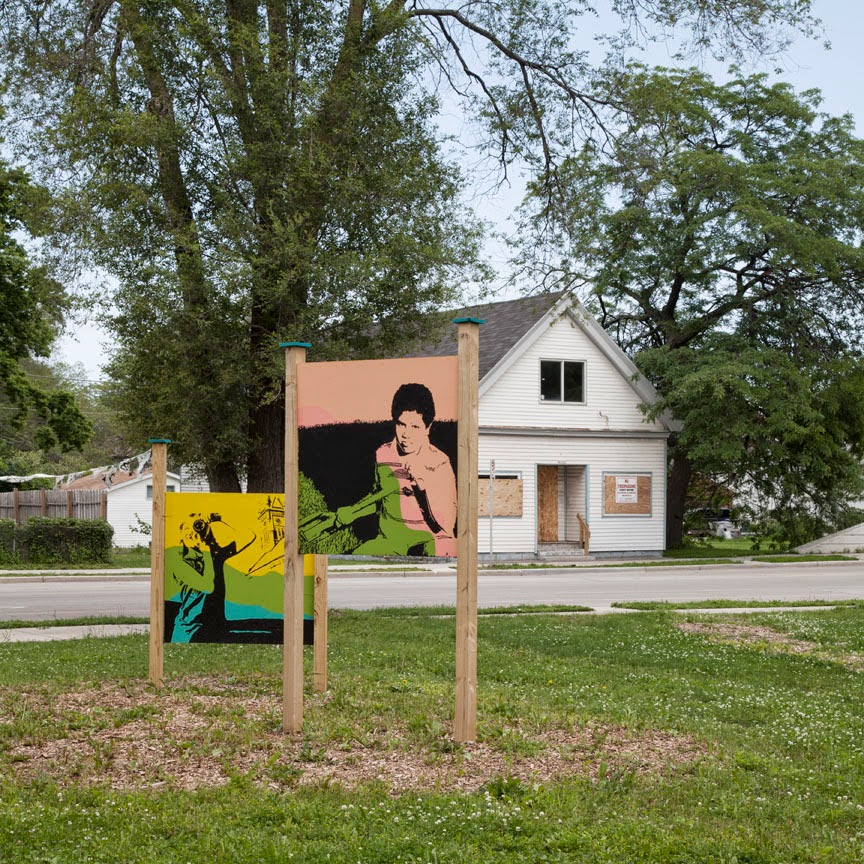
Meanwhile, the neighborhood has begun to fill the void. In addition to the community gardens some temporary public art has been erected on another corner of cleared land.


I wander back to the tents. The truck has arrived. A crowd gathers to help unload the plants and get them ready for sale. People are lined up to make their selections. The Sixteenth Street Community Health Centers staff is joined by young volunteers who help carry potted flowers back to cars and nearby homes. The annual event is called “Bloom and Groom.” It is subsidized by the collaborative efforts of Urban Anthropology and Sixteenth Street CHC along with grants from the Greater Milwaukee Foundation and the Neighborhood Improvement Development Corporation. The organizers hope that investing in flowers and improving the appearance of the neighborhood will be a visible demonstration of pride and commitment to the future.


The flowers are beautiful in the bright morning sun and the smiles on everyone’s faces, it seems to me, are a clear sign of that hope and pride.

To see more photos from the KK River and the neighborhood go to my flickr album.

If you missed my recent post about the Earth Day clean up of the KK River, click here.

Full disclosure: I am connected to the two lead organizations responsible for the KK River Flood Management Project and Neighborhood Plan. I am working with the MMSD to document the current phase of the KK River Project and until recently my daughter was employed by the Sixteenth Street Community Health Centers. But if you check out my flickr photos it will be clear that I've been interested in this work long before any of that!

Tuesday, April 21, 2015

Earth Day: A community cleans up the KK

-->
Which do you think is the more powerful metaphor?

A) While picking up trash along the concrete-lined Kinnickinnic River I found a framed print of exotic waterfowl discarded in riverside bushes.


B) Two hundred community members turned out last Saturday to pick up trash along a stretch of their river that has been little more than a drainage ditch for over 40 years.


The irony of the sentimental wildlife print discarded near the degraded river is good for a chuckle, but I choose B as the more important metaphor. The KK River Neighbors Association and the 16th St. Community Health Center turned people out in force to join in the annual Earth Day cleanup sponsored by Milwaukee Riverkeeper. The symbolism is clear: the community cares about its environment and is hopeful about the future of its maligned waterway.

The reason for that hope is as concrete as the river channel: The Milwaukee Metropolitan Sewerage District has begun a multi-year project to remove said concrete channel and restore a more natural flow to the Kinnickinnic River. Judging from the enthusiastic comments I heard repeatedly on Saturday, the community is thrilled at the prospect.


Acres of cleared land between Harrison Street (background) and the KK River (behind me) are evidence of progress on MMSD’s rehabilitation project. After houses in the flood-prone area are purchased and demolished the concrete channel will be removed and the river reconfigured within a landscaped park.

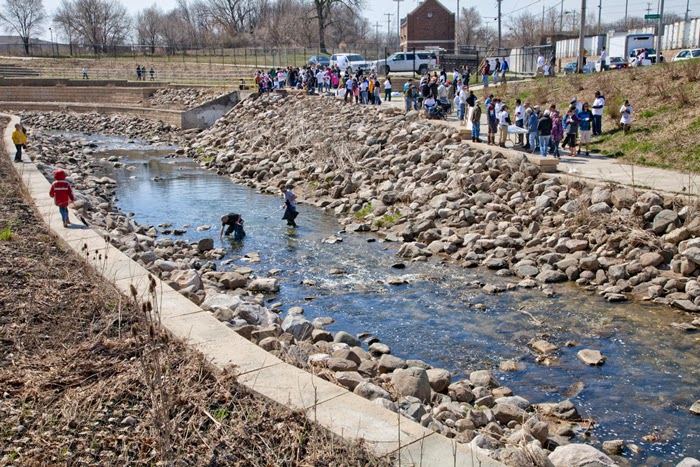
After two hours of picking up trash near the river and throughout the neighborhood on either side everyone gathered at another concrete symbol of the river’s revitalization. The concrete channel, which until recently extended east to the I-94 overpass, now ends just shy of the 6th St. Bridge. The first phase of the MMSD project was completed in 2011. In addition to removing the concrete channel a newly dedicated KK River Trail was created alongside the rehabilitated stream.


A huge crowd that included cleanup teams from several sites on the KK gathered along the 6th St segment of the KK River Trail for a “Trash Bash” organized by the event sponsors. Free pizza and burritos were available to all. There were family-friendly interactive displays related to water and the river. A team of scientists from UW—Madison were on hand to help folks learn more about their river.

The UW team provided hip waders for the public to borrow so that they could physically immerse themselves in the river. “Having kids and adults connect with the river in that way is huge,” said Iris Gonzalez, one of the organizers from the 16th St. Community Health Center. “Most of them were very hesitant to try but, after watching others (in some cases their own children), they were convinced. It is experiences like feeling the pressure of the water against your body, or the waders suck onto your legs when you step in and seeing fish and fish eggs up close that foment a spirit of stewardship.”


Local children spray water onto a watershed model that illustrates how water flows are affected by varying slopes, soils and vegetation conditions.

The success of the “Trash Bash” in bringing the community down to the river, to activate the new trail and to celebrate the transformation that is underway was a major achievement. Many in the neighborhood had not ventured there before, according to Gonzalez. However, she told me proudly, “I know they will be back!”

The event culminated in a spectacular demonstration of hydraulic flows and river dynamics. Peter Levi, the UW limnologist heading the team of scientists, poured red dye into the river just east of the 6th St. Bridge. At first the dye turned the water bright scarlet and then expanded to fill the width of the river. The dye gradually dissipated as it swirled downstream, around rocks and settled into pools. It was a crowd pleaser and a lovely end to the Earth Day river cleanup.


A brief series of photos from the day follows.


To see even more photos from this event go to my flickr album.

Full disclosure: I am substantially connected to many of the organizations responsible for the cleanup and KK River Project because the work they are doing is dear to my soul. As a former board member of Milwaukee Riverkeeper I have participated in most (if not all—I don’t quite recall) of their 20 annual river cleanups. I am working with the MMSD to document the current phase of the KK River Project. On top of that until recently my daughter, Chelsea, was employed by the 16th St. Community Health Center. And Chelsea brought my only (so far) granddaughter to help out with the cleanup. She’s only 3 years old, so she mostly played on the Cleveland Park playground and ate pizza at the Trash Bash. Hey, I said “full disclosure!” Oh, and Chelsea took my picture with this funny-looking fish.


More photos on flickr.

Tuesday, March 11, 2014

Construction Season: Reframing the Menomonee Valley.

It snowed again overnight. Just east of the 35th Street Viaduct in the Menomonee Valley there is a vacant lot below the curve in Canal Street. This morning the surface of the lot looked as if a sheet had been spread over it with military precision. Or perhaps not so much a sheet as another of those blank canvases that has made the Valley what it is today. Welcome to the new American landscape.

This canvas was primed and ready to paint.


By mid-day a team of caterpillar shovels and bulldozers had clanked their way back and forth across this canvas like so many gargantuan paintbrushes. The brilliant white snow now framed a dark rectangle of exposed earth, like a somberly hued Rothko abstraction. The plans for the site, however, like so much that is happening in the Valley, are far from abstract. They also exemplify the hopeful new attitude that, if it prevails against the winds of pessimism brought on by multiple contemporary crises, has the power to alter human destiny.

That’s a lot to ask of a small, local company that packages tea.

The rest of this story and additional photos are posted on my other blog: Arts Without Borders


Friday, May 6, 2011

MK-Eat, Art, and Urban Wilderness


MK-Eat is Milwaukee’s version of a community-building and arts-supporting fundraising effort that has been done successfully in other cities. The public is invited to a dinner/presentation event and in return for a $15 donation gets a meal and the chance to vote on an arts proposal.

The event is tomorrow evening, May 7, at The Riverwest Public House,
815 E Locust St. It runs from 6-9 pm.

The main event is a series of presentations by the artists who have submitted proposals for projects that will benefit the community.

There will be eight presenters, including myself. You can get a preview of the proposals on the MK-Eat website.  You can also sign up for the dinner and/or make a donation.

We who are presenting our proposals have been encouraged to self promote as well as to encourage any and all to come, if you have an inclination to do so. This is my invitation. I’d love to see all the supporters of my two blogs, Arts WithoutBorders and Urban Wilderness, join me for this event.

Yes, I’m grateful for the support I’ve gotten over the past year when I’ve been blogging on these two platforms. This MK-Eat event gives me a rare opportunity to cross over and share with both audiences why I do both.

I am a fine art photographer and although my work includes a variety of subjects the one that occupies most of my time and attention is what I’ve long called the Urban Wilderness Project. I have been using my artwork for many years, often in conjunction with environmental groups, to express my belief that urban and suburban dwellers will benefit from greater exposure to natural areas in our parklands. My proposal for MK-Eat combines my love of photography with my love of Milwaukee’s park system. You can read much more about the project on mywebsite – and see many photographs there, too.

Here is one recent example from the Urban Wilderness Project. I call it "Wraith." It is from Milwaukee's lakefront.