It was a glorious spring day, which always helps. Over 4,000 people came out to participate in the annual river clean up sponsored by Milwaukee Riverkeeper. Today's Milwaukee Journal Sentinel has the complete story but I got around to a few sites before I settled in at Krueger Park, along Underwood Creek, where I mostly pulled garlic mustard and baby buckthorns. Here are some images.
Large contingents fanned out along both sides of the Milwaukee River near North Avenue.
Volunteers working among the sandbar willows next to the rushing narrows just north of Caesar's Pool.
A plastic bag flutters like a defiant banner in the upper branches of a tree while volunteers collect an enormous volume of trash below.
It took a lot of heft to remove this old, rusted tailgate from a remote part of Krueger Park in Brookfield.
Furniture was the item of the day in Underwood Parkway, near 115th St.
Sunday, April 22, 2012
Friday, April 13, 2012
Buffalo Bayou, Houston Texas. Part 2.
This is the final installment of a trilogy from Houston's urban wilderness. To read them from the beginning, click here.
On my last day there, after nearly a week in windowless conference rooms, I finally had a chance to continue my adventures in Houston’s urban wilderness. The rain was long gone. It was Sunday, gloriously sunny and warm. Bursting with cabin fever, I was more than ready to head upstream to explore Buffalo Bayou further.
My adventure began with mixed messages. I descended through one of the canoe-shaped arches down a long stairway into the deeply sunken river corridor. Artist John Runnels, creator of the gateway structures, likens Buffalo Bayou to Houston’s “birth canal.” Runnels calls his 20-ft. stainless steel sculptures “Dream Boats” and they each bear a unique river-inspired poetic phrase, such as “Water is the most beautiful mirror of voices…sing the stream.”
I did hear voices. Whether they were echoing off the water or under the Sabine Street Bridge I couldn’t tell.
![]() |
| Swamped trail turns back hikers |
A narrow strip of worn asphalt led me a mere couple hundred yards before it was swallowed up in silt. The sandy trail devolved into mud and then a small backwater of the river itself lapped over it. A fat fish leaped with a resounding splash, as if for emphasis. Wilderness seemed to be reestablishing a beachhead in the genteel park. Although it turned me back, I considered it a welcome omen.
I crossed over the bridge.
The north river trail was a 10-ft. wide white swath of concrete so new there still were construction fences next to it and patches of dirt awaiting fresh sod alongside. Skateboarders converged on the adjacent Lee & Joe Jamail Skatepark. A steady stream of cyclists of all ages sped past me as I strolled down the gently sloping ramp towards the river.
The bike trail was as active as it had been vacant during my previous excursion. Clearly the riverside park is in high demand for the recreational opportunities it offers and park developers were eagerly, and extensively, providing infrastructure appropriate to meet it. I began to discern a pattern.
The park guide explains, “Buffalo Bayou slowly winds its way through the center of the fourth largest city in the United States. Over the past 170 years of Houston's development and continued growth, the natural habitats of Buffalo Bayou have been impacted by human development, invasive species introduction, and pollution.”
I am struck by the passive, understated phrase, “…have been impacted by human development….”
I sauntered along the concrete, flanked on both sides by lawns, searching for natural habitats.
![]() |
| Mistletoe |
In the trees overhead, great bunches of mistletoe hang ominously, like macabre ornaments. A.k.a. “witches broom,” the parasitic species was long considered a destructive pest. Now it is recognized as beneficial to biodiversity. Its purportedly amorous effect upon those who stand under it has an uncertain origin in early mystical Christianity. How often our image of the maleficent gets superimposed on the pious!
![]() |
| Painted turtles |
On a wooden bridge that crosses a tiny tributary, I leaned over the rail and looked down to see two Texas-sized painted turtles warily staring back up at me. They were secure enough. I was an anomaly. No one else paused to look.
![]() |
| Purple winecups in the grass |
Referring to the Buffalo Bayou Partnership’s Restoration Plan I am cheered. Programs “to rebuild native habitats” are in place that include, “erosion control, reforestation, habitat improvement, and species diversification.” The chicken or egg conundrum is how best to build popular appreciation for nature: Which comes first, attracting people to the outdoors or reestablishing healthy, sustainable habitats?
Once upon a time we all lived in nature. Nature – landscape, atmosphere, water, plants, animals – is the original and still necessary infrastructure for life on earth. Now that most of us live in cities, we must reintroduce ourselves to nature. If our parks are completely tame, reduced to a flash of green that we speed past on high-tech bicycles in our Lycra outfits, how will we come to value turtles that lurk under bridges? Or snakes in the tall grass? Surely there must be snakes! Surely there must be places for tall grass.
![]() |
| Primrose |
I had to walk a while before I could shake off the city and pay attention to birdsong instead of the sound of traffic. Eventually, the lawns shrank back a bit from the river. There were more copses and bushier banks, if not much tall grass. Some lacy pepperweed, clumps of primroses, lantana, and tiny pink oxalis blossoms began to appear. Ripe mulberries stained the lawn under overhanging branches. A whiff redolent of lilac and other less recognizable aromas wafted now and then from bushes and trees.
Since all of Texas is exotic to me I don’t know how much of what I was seeing was native or exotic except the invasive chinaberry trees. Fortunately, they are identified in the restoration plan.
![]() |
| Wild onion in bloom |
Crossing to the south bank, I find an appealingly boggy draw between the now roadside bike trail and a large dog park. Down in the muck a single, curiously shaped plant bore a single tiny white blossom. As I bent down to photograph it I made the novice’s mistake, immortalized in St. Exupéry’s The Little Prince, of thinking it rare and therefore special.
“I thought that I was rich,” laments the little prince when he comes to the rose garden, “with a flower that was unique in all the world; and all I had was a common rose.”
A short while later, back on the north side, the bike path veered off up a hill to parallel Memorial Drive. I stayed near the river and, in a corner spared by the lawn mower, was rewarded with an abundance of the same flowers, which I have since learned was wild onion. Contrary to the little prince, I felt richer knowing that there were multitudes of wildflowers where before the solitary one seemed so tenuous and fragile.
I didn’t notice the signs as I approached the Waugh Drive overpass but as soon as I was underneath I stopped short, mesmerized by a mysterious clicking or pinging. The sound was constant, almost mechanical, but with an arrhythmic, organic regularity. Echoing between bridge deck and ground, it seemed to emanate from the very air. Mystified, I asked a passerby what was making the sound. “Bats,” he said succinctly as he strode purposefully past.
![]() |
| Waugh Bridge Bat Colony |
Of course! The slightly pungent odor that I had barely noticed grew suddenly powerful. I looked down. The ground was covered in tiny granules of dark guano. I looked up. I couldn’t see a single bat, but it was clear enough where they were hiding. Tightly spaced concrete bridge support beams stretching the width of the roadway were separated by very narrow crevices. The bridge designers had inadvertently created an ideal bat sanctuary!
I did see the signs on my way out. The first said, “CAUTION: You May Wish to Stand Back During Bat Flight, to Avoid Droppings.” The second was in larger, bolder type. “CAUTION: Never Handle Grounded Bats.” Below those were the same two messages in Spanish.
This is where, marvelously, urban meets wilderness. Untamable, bats, like wolves, embody the wild. Often feared, bats usually have an attraction rating well below mistletoe and even snakes. But, far from being considered a nuisance, the Waugh Bridge Bat Colony, as it is known here in Buffalo Bayou, has become a popular local attraction. The nightly emergence of up to 300,000 bats is rightly considered a spectacle worthy of attention.
The Buffalo Bayou Partnership website highlights the paradoxical relationship we have with these wild creatures: “For an amazing, from the water, view of the bats' emergence, reserve your spot on our Bat Colony Pontoon Boat Tours!” How wonderful is that? I wished I had another day in Houston so that I could experience it myself.
![]() |
| Twin pedestrian/bike bridge and skyline |
If only more wildlife could survive under bridges in the shadows of skyscrapers!
Under yet another bridge I find a young mother with a beached kayak. Her daughter wandered aimlessly nearby. She told me that they had floated five miles downstream with the intention of paddling back upstream to return to their car. Then she pointed to her husband up next to Memorial Drive calling a taxi with his cell phone. The current had been too strong.
I enjoyed a sunny afternoon on Buffalo Bayou along with hundreds of other people and five turtles. As I again neared the tall skyscrapers downtown I did see a small black snake slither quickly through the not so tall grass. My journey ended as it had begun, up the steep stairs next to the Sabine Bridge and through Runnel’s dream boat. As I reached the top my emotions were not unlike those I’d felt coming out of the underground my first day in Houston. (See previous post.)
This time, however, it was nature I’d left behind: the long, serpentine green park and the river slithering between its steep banks, inexorably carving its way through the city. The Buffalo Bayou Park system is tame for an urban wilderness. I prefer wilder places where more of the earth’s original infrastructure remains – mulberry trees and mistletoe, turtles, wildflowers, yes, but also woodlands, wetlands, and uncut prairie grass; and less concrete or lawn. Nevertheless, it was a refreshing respite from the grid.Is it too much to hope that Houston’s “birth canal” can provide a rebirth of nature in our fourth largest city? Intentions are good. But we’ve been riding a swift current towards a future ever more determined by urban, manufactured infrastructures and technologies. How will we know when we’ve gone so far that we can’t paddle back upstream?
![]() |
| Mulberries reach out to the grid |
The voice of the fox from The Little Prince whispers in my ear, “You become responsible, forever, for what you have tamed.”
Click here to go back to “Buffalo Bayou, Part 1.”
Click here to go to “Waking to a New World,” the first installment from this Houston trilogy.
In closing I should repeat the disclaimer in my first installment: These stories are personal reflections inspired by my limited experience. I have not explored Houston – or even all of Buffalo Bayou – sufficiently to evaluate the overall environment. There are other parks and natural areas in the metro region. I hope to get back to explore more of them one day. For information about the park, go to Buffalo Bayou Partnership.
Labels:
buffalo bayou,
houston,
parks,
parks and recreation,
rivers,
urban nature
Monday, April 9, 2012
Buffalo Bayou, Houston Texas. Part 1.
I was in Houston for a conference; I didn’t choose the hotel. Therefore it came as a pleasant surprise to find it situated a mere block away from Buffalo Bayou, the city’s primary waterway. Houston was founded on its banks in 1836. According to a park guide, it also is one of the few regional rivers left that has not been lined in concrete. I had to go see.
The block between the river and the glass towers of downtown is occupied by Sam Houston Park. The park is a leafy enclave that contains historic wooden buildings and wide lawn landscaped to slope down to a picturesque pond. It is inhabited by a flock of unfamiliar-looking geese with extravagant coloration. Cypresses at the water’s edge have extended a series of their distinctive “knees” along the bank of the pond like a palisade.
My first view of Buffalo Bayou was inauspicious. The river is decked with a freeway. Concrete columns outnumber trees. In places the steeply sloped lawn is in fact replaced by even more steeply sloped concrete.
I walked eastward, downstream, heading deeper and deeper into the concrete jungle. I spent a leisurely and largely solitary afternoon strolling and shooting pictures. Although the sound of traffic on the Gulf Freeway overhead was as constant as the muddy river flowing below, the biking/jogging path that cuts through the concrete was mostly empty. Now and then a jogger flashed by. I saw a man walking two large dogs, a pair of equestrian cops plodding slowly along.
A lone kayaker in a homemade wooden craft briefly danced around the concrete columns rising from the swiftly flowing river. Then, like flotsam, he swept on downriver.
The park’s infrastructure is impressive, if your taste in parks runs to red brick buttresses, grand staircases, faux-Classical balustrades, and ivy-encrusted walls. Entrances into the park/river corridor are graced with sculptural gateways emblazoned with river-inspired poetry. Little expense, it seemed, had been spared once the already constricted bayou was deemed an amenity.
(As in so many cities, this epiphany was relatively recent. The Buffalo Bayou Partnership, a coalition of civic, environmental and business interests, was formed in 1984, not long after the social/environmental transformations during the decade that followed the first Earth Day in 1970.)
I don’t know how long ago the current “improvements” were completed, but erosion has taken its toll even where the hardscape is most intensive. Rivers, like adolescents, always find ways to defy our efforts to constrain them. My downstream foray ended when I came to a place where the concrete path disappeared under the muddy silt of recent flooding.
After brooding all afternoon the sky finally decided on a hard, straight downpour. I sat on a park bench in the shelter of the elevated freeway and watched the rain fall in sheets. It felt like sitting under an immense plantation house porch overlooking the river and its skyline backdrop.
I mused on the word “bayou,” which brings to my mind dark recesses in a thickly forested swamp and stagnant water. It was impossible to reconcile this image with the scene before my eyes.
Upstream, according to the park guide, the riparian corridor widens and there is more green on the map. I would need another day to explore.
Click here to read Buffalo Bayou, Part 2.
To read my first post from Houston, about the underground tunnel system, go to “Waking to a New World.”
Labels:
buffalo bayou,
houston,
parks,
parks and recreation,
rivers,
urban nature
Saturday, March 31, 2012
Houston, Texas: Waking to a new world.
I awake in the dark, momentarily disoriented. The room smells inexplicably clean and there is a mechanical hum coming from an unknown source. Remembering that I’d arrived at the hotel in Houston the day before, I rise and go to the window. Darkness. Being unfamiliar with the Texas climate, I wonder if it should be dark at 7:30 a.m.
Suddenly rain spatters the thick, black glass of the inoperable window. I hear only a soft, almost distant percussion, as if far more than a pane of glass separates me from the world outside and whatever storms there are. The air-conditioning clicks on again, seemingly louder.
I dress, grab my umbrella and go in search of breakfast. The elevator delivers me to the cheerfully lit, wood-paneled lobby twelve floors down. As I descend an escalator towards the basement I briefly glimpse furious gray gusts of rain through the plate glass windows. No one is visible outside.
There are people underground. A long queue stretches away from a tiny coffee shop next to the escalator. Others hurry by on their way, presumably, to a workplace. An expansive but low-ceilinged food court is softly lit in cool shades of white. Fast food vendors, most of which are closed, surround it, white steel grills drawn down over glass counters.
Exiting the nearly empty food court, I head into the West Dallas Tunnel.
Houston’s subterranean tunnel system extends approximately seven miles in a labyrinthine network of pedestrian passageways, ramps, shops and food courts. It has little relationship to the street grid above and bears absolutely no resemblance to the natural world. A hurricane might be crashing through the city and, unless there was a power outage, no one down here would even notice.
That seems to be the point. It’s raining hard outside but everyone I pass is as dry as I am, dressed in power suits without outerwear or raingear. My unopened umbrella dangles from my arm.
In Houston, though, people are driven underground more often by the heat. Even in the brutal Houston summer, the climate-controlled tunnels allow them to remain comfortably suited and sweatered on their way between air-conditioned cars and air-conditioned offices. To what end, I wonder, does the march of civilization lead?
The West Dallas tunnel becomes the South Louisiana tunnel. The names vaguely correspond with street locations on the surface of the earth but nothing is straight or direct for more than the equivalent of a block down here.
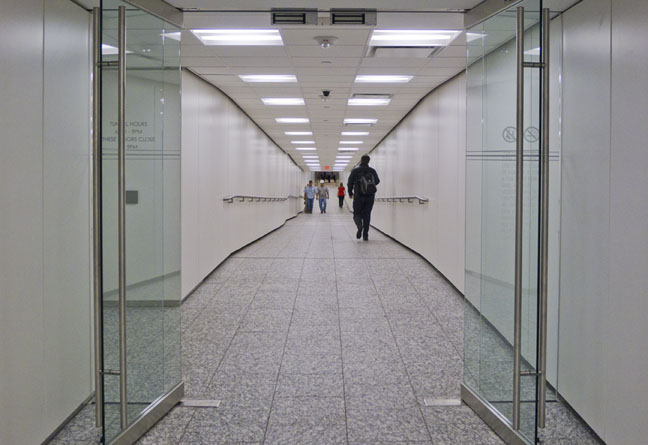
Underfoot beige tile gives way to pale granite. The walls narrow into a sterile white corridor. I am reminded of a movie by George Lucas – THX 1138 – that is set in an underground city in some dystopian future. But this is not the future. It is all too present. Echoing the movie’s title character, my instinct is to escape.
I pass a block-long mural of the surface of the moon. I’m certain it is meant to be uplifting, but the irony is stunning. Who designs these places and then decides that the airless and barren lunar landscape is what we should see as we walk through them?
Just when I begin to despair of finding anything green or growing, I come upon a diminutive plastic jungle tucked in a corner, bracketed with brushed steel and ceramic tile. Green but not growing, it is scarcely more soothing than the moonscape. Is this meant to nurture our need for a connection with nature? Instead it puts me in mind of natural history museum dioramas that depict extinct species.
Every few hundred yards I stop to check the map posted on the wall or propped on a floor stanchion. If it didn’t say “you are here” in different places each time I would have no idea how far I’d gone or in which direction. North, south, east, west are equally meaningless. Distances are exaggerated by twists and turns.
I pass through the Tunnel Loop and wander down the East McKinney Tunnel before I discover that I’ve overshot my destination. I should have turned at the connector leading to the Lamar Tunnel, which runs parallel to the McKinney. The determined crowd surges around me. I am lost in a sky-less maze of polished steel fittings and white surfaces washed with invisible light sources. Urban wilderness is taking on new meaning.
King Minos of ancient Crete is supposed to have commissioned the world’s most famous labyrinth, which was guarded by the bull-headed Minotaur. Maybe that is an unfounded myth. In any case, all that remains of the powerful king and the Cretan civilization are the ruins of his palace at Knossos. Feeling not at all like Theseus, who penetrated the labyrinth and killed the monster, my hesitation and disorientation give me a moment to reflect on this modern-day labyrinth.
This is not a diatribe against cities. I believe in cities. Today we must turn Thoreau’s famous dictum on its head: In cities is the preservation of the world. I mentally genuflect to Thoreau and ask absolution for this heretical pronouncement. But the fact of the matter is, the preservation of wilderness now depends on making cities both livable and an attractive alternative to sprawl. That means bringing nature back into cities from which it has been abolished. Sustainable cities, like humans, need open space in which to breathe.
Neither is this an indictment of Houston, which may or may not deserve indictment. I have not explored it sufficiently to pass judgment. But how are we to survive if our cities lead us to mole-like lives in caverns and tunnels, unable to see the sun or smell the changing seasons?
Backtracking, I come finally to a two-story rotunda that is open to a street-level lobby above. I take the escalator, stepping briskly to speed my ascent. A soft glow of daylight gradually mingles with the unearthly shine of tunnel illumination.
I push open the heavy glass door and step out onto Main Street hoping to see trees or a planter with flowers in it. This view across the street is not reassuring.
The environments we create for our cities more and more have come to define the world we live in. A world in which nature is reduced to a twisted topiary in a concrete urn is not the world I want to wake up in tomorrow.
This is the first installment of a trilogy from Houston’s urban wilderness. To read the next, click on Buffalo Bayou, Part 1. If you want a taste of the cultural side of Houston, go to my Arts Without Borders blog.
Labels:
cities,
civilization,
environment,
houston,
human nature,
labyrinth,
texas,
thoreau,
thx 1138,
tunnel,
underground
Friday, March 16, 2012
Riverside Park was burned on Wednesday!
I learned after the fact that the Urban Ecology Center (with help from the Milwaukee Fire Dept. and others) had conducted a controlled burn in parts of Riverside Park. I wish I could have been there to witness the event. As is explained on the UEC website, burning is important for long term sustainability of certain habitats and native species. (Before we humans interfered it happened naturally, of course.)
Although I missed the burn itself, I had to go check out the aftermath and take a few photos.
The burn is kept at ground level and even during natural burns established trees and hardy native shrubs seldom suffer for it.
Before long (especially with the early spring we're having this year) new shoots will sprout up amongst the ashes. Native species withstand the effects of burning better than exotics.
While I was there I met a nice young volunteer who explained why many of the trees in the park have blue bags hanging from them. These are sugar maple trees that the UEC taps for maple syrup, which they process themselves right at the center.But if you want to see that you better head out there soon. They will be having a pancake breakfast on Saturday, March 24.
We're all invited. (Go to the UEC website for more info.)
While you're in Riverside Park to see the burn and the maples being tapped, make sure you wander on down along the Milwaukee River to see how other strategies are being used to control invasive species.
Large swaths of the flood plain have been covered in black plastic sheeting. No, it's not an elaborate environmental sculpture project, a la Christo. It's to control reed canary grass.
There's always something constructive going on around the Urban Ecology Center.
Sunday, March 11, 2012
A warm gray day in Grobschmidt Park
Wednesday, March 7.
It is beyond unseasonably warm. Stepping outside elicits the peculiar feeling of dislocation that happens when I travel to some completely other – tropically warm – place during Wisconsin’s usually interminable winters. I love stepping off the plane and taking that first deep breath. Immediately I know I’m not home any more.
Today I feel it without going anywhere! Just outdoors.
![]() |
| Grobschmidt Park |
I can’t go back inside! I decide to explore a county park that is new to me. From the Parks Department map I pick Grobschmidt, a neat green rectangle just off College Ave. on the northern edge of Franklin.
I know I am getting close when subdivision signs begin to read “Homes on the Park,” “Parkwood Village” and “Parkwater Apartments.” The urge to name what we’ve built after the things we’ve destroyed seems irresistible. We set aside remnants so that residents of the ‘homes on the park’ can look out picture windows and imagine what they don’t even realize is lost.
A line from T. S. Eliot’s poem, The Waste Land, drifts up from my subconscious: “These fragments I have shored against my ruins.”
Grobschmidt has no lot. I pull up and park along S. 35th St., which provides public access.
The view from the road is of a fairly large lake populated with a boisterous crowd of floating waterfowl. The lake is surrounded by what seems like level land and a featureless gray tree line. But you can’t experience wilderness – or nature in general – from a road. And I’ve learned to suspect first impressions as shallow, despite their potential for lasting influence.
Besides, if anything it has gotten even warmer. I leave my jacket in the car.
![]() |
| trail through buckthorn |
The heavily overcast sky threatens rain but I am not deterred. A muddy trail parallels the lakeside. A clamor of ducks and geese punctuates the gray land, gray water, gray sky. Before long I veer off into the woods on an even muddier, narrower – and grayer – track. Soon it becomes a tunnel through a particularly dense thicket of buckthorn.
![]() |
| hawthorn |
The world is gray, wood and sky alike, but my mood is buoyant, elevated by the balmy temperature. I ponder the essence of grayness and relish its endless permutations. The hawthorn is dark, twisted and spiky. The loose bark of the mighty hickory is chalky with a hint of cyan. A brace of nearly white brambles dances before a rigid backdrop of charcoal trees.
A close observer of nature is never threatened with tedium. Even so, the occasional colorful spray of red osier dogwood is reason for exultation.
![]() |
| hickory |
The earth, so recently blanketed, is everywhere soggy from sudden snowmelt. Muddy deer tracks bearing fresh hoof prints crisscross the trail. They are so numerous I have to wonder why I don’t see a single deer. (A veritable herd of them sauntered across my patio just yesterday! I guess they’ve all decamped for Wauwatosa to see if my tulips have sprouted yet.)
In seventh grade I was made to read The Waste Land by a no doubt well-meaning and ambitious English teacher. Wasted on me then (pun intended), decades passed before I could return to it with appreciation. In its famous opening lines Eliot says, “April is the cruelest month, breeding / Lilacs out of the dead land, mixing / Memory and desire, stirring / Dull roots with spring rain.”
Eliot didn’t live in Wisconsin. If April is the cruelest month here it is because winter has not yet loosed its grip and the lilacs are waiting for the certainty of May. But I’ve long considered March to be the crueler month. Its mercurial moods dash confidence in the coming of spring. The land remains dead.
The “forgetful snow” is gone. The marsh is broken, matted with bent reeds. “The nymphs are departed.” And – normally in March – it is still too damn cold.
But not today, a miraculously mild day in Grobschmidt Park!
Warm wind passes through the gray trees, rattles dead leaves still clinging to trees. Barren branches clatter like dry bones. (As I write these words, a day later, it is indeed cold again. There is even a dusting of new snow. March!)
My first impression of barren flatness is long forgotten by the time I reach the far end of the park and glimpse a roof over the crest of a distant hilltop. I slip down into lowland forest, skirt open marsh, cross a dormant, still icy, sedge meadow, and head uphill again to upland forest. Brian Russart, the Milwaukee County Park system’s natural areas coordinator, considers Grobschmidt a microcosm, exemplary of habitat diversity. Even now, all hued in gray, I can see why.
My circuit of the park nearly complete, I reach a section that does look like a wasteland. A wide swath has been slashed. The few spindly trees that were spared emphasize the apparent devastation all around. One scraggly hawthorn holds up a tiny, dried out nest as if in supplication. Memory and desire, stirring.
“What are the roots that clutch, what branches growOut of this stony rubbish?”But, no, this is not The Waste Land. I am not alarmed. The county has a habitat improvement plan that includes a three-year cycle of mowing to maintain the prairie-like grassland. Hell, I’d like to see it burn! That would be even healthier for biodiversity.
I’d also like to see the Parks Department budget grow enough to control the buckthorn in the woodlands. Fragments, yes, but our parks must be shored up against our ruins.
Saturday, March 10, 2012
Celebrating Leopold Weekend in Riverside Park
The Urban Ecology Center, a most appropriate place to pay homage to Leopold.
A view of Gordon Park from Riverside Park.
The Milwaukee River and the urban wilderness through which it runs.
For more photos, check out my Milwaukee River Greenway set on flickr.
Subscribe to:
Posts (Atom)