
--> -->
A south-side community fills a void created by flooding
The truck that was to deliver the flowers was late but no
one seemed to mind. Neighbors chatted amiably in Spanish. Staffers from the Sixteenth Street Community Health Centers
had set up two tents for an annual spring plant sale. The tents and the people
milling around them seemed very small in the broad, vacant city block between
the Kinnickinnic River and the row of houses fronting W. Harrison Ave .

Propelled by several impatient children, a few people went
across the vestigial dead-end street to the adjacent city block, also largely
vacant. Raised beds for community gardens had been built and fenced in a small
corner of the block. Volunteers showed the kids how to pull weeds and rake the
soil in preparation for planting. Incrementally, the community is reclaiming
empty land that stretches four long city blocks alongside the river.

Not long ago all of those blocks were filled with houses. The
reason for their removal is as concrete as the river that bisects the
neighborhood. The Kinnickinnic River has literally been lined with concrete
since the 1960s. It looks more like a drainage ditch than a river. This was no
accident. At the time it was believed that channelization would solve the
problem of flooding.

Today the channeled river seems more like a catastrophe than
a solution. While the drastic measure did reduce flooding for a time, it also
degraded water quality, destroyed all semblance of wildlife habitat within and
along the waterway and increased the threat of drowning. Now, ironically, even
the original intent of the channel is no longer effective. The past 50 years
has seen the floodplain rise dramatically. If nothing were done to alleviate
the new circumstances, a major storm could inundate as many as 350 homes in the
neighborhood.

Which is why the houses have been purchased and, one by one,
dismantled. The removal of the houses is just part of a major flood management
initiative led by the Milwaukee Metropolitan Sewerage District. Sixteenth Street Community
Health Centers and partners have been implementing quality of life improvements
from a companion plan called the Kinnickinnic River Corridor Neighborhood Plan.
The most dramatic and eagerly awaited changes—the removal of the concrete
channel and rehabilitation of a naturalized river—will come later. The most
trying task is currently underway: asking families to move and tearing down
houses.

Over 60 homes have already come down. Hence the vacant land.
Last week I was able to observe the workers as they dismantled another.
Although more expensive than traditional demolition, the MMSD has opted for a
process called deconstruction. Forgoing the bulldozer for manual labor,
everything salvageable or recyclable is painstakingly removed from the house.
Usable appliances and fixtures are set aside. Plaster walls are pummeled until
they reveal the lathe and studs beneath, which become recycled wood.

House demolition usually generates a huge amount of
indiscriminately crushed debris that is hauled off to landfills. The more
laborious deconstruction process enables materials to be separated for
recycling and reduces what ends up in a landfill.

The process began here years ago. Numerous neighborhood
meetings were conducted to explain the project and build community support.
Initially, there was concern and hesitation about the acquisition and removal
of homes. However, now that the work has progressed as far as it has the mood
has shifted. According to Iris Gonzalez at the Sixteenth Street Community
Health Centers, many people have become not just supportive but excited about
the project. There is even some impatience at the pace of the work.

As more houses come down and more land stands vacant, people
have begun to imagine its eventual transformation. They anticipate the planned
new parkland and an actual river running through the neighborhood. The project
is supposed to be completed in 2022.

Meanwhile, the neighborhood has begun to fill the void. In
addition to the community gardens some temporary public art has been erected on
another corner of cleared land.
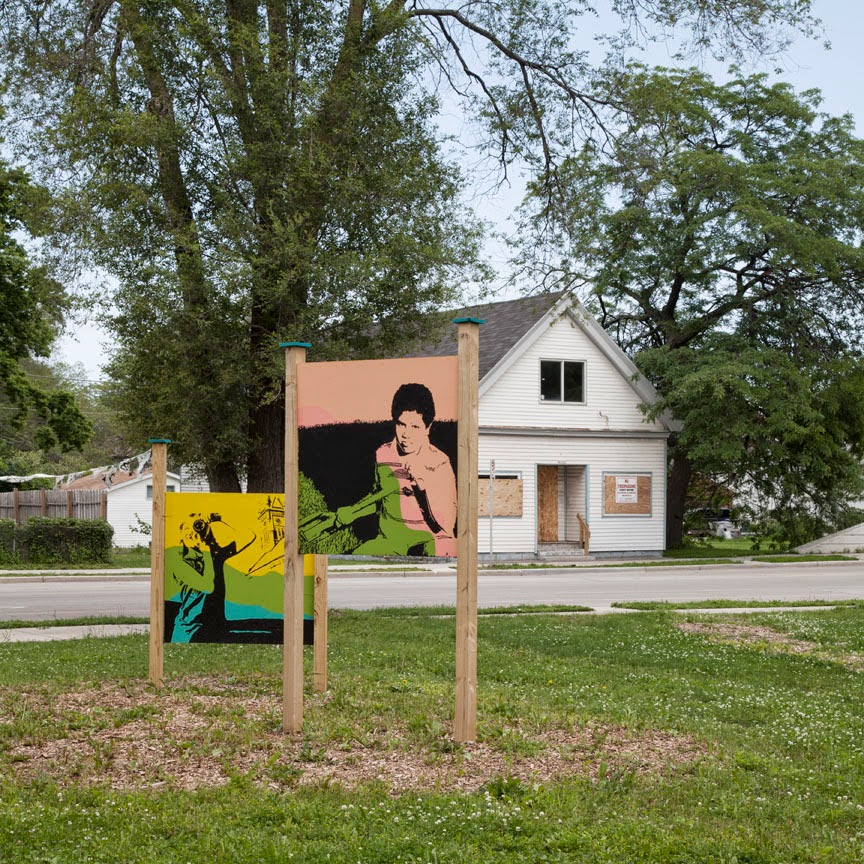
I wander back to the tents. The truck has arrived. A crowd
gathers to help unload the plants and get them ready for sale. People are lined
up to make their selections. The Sixteenth Street Community Health Centers
staff is joined by young volunteers who help carry potted flowers back to cars
and nearby homes. The annual event is called “Bloom and Groom.” It is
subsidized by the collaborative efforts of Urban Anthropology and Sixteenth
Street CHC along with grants from the Greater Milwaukee Foundation and the
Neighborhood Improvement Development Corporation. The organizers hope that
investing in flowers and improving the appearance of the neighborhood will be a
visible demonstration of pride and commitment to the future.

The flowers are beautiful in the bright morning sun and the
smiles on everyone’s faces, it seems to me, are a clear sign of that hope and
pride.
To see more photos from the KK River and the neighborhood go to my flickr album.
If you missed my recent post about the Earth Day clean up of the KK River, click here.
If you missed my recent post about the Earth Day clean up of the KK River, click here.
Full disclosure: I am connected to the two lead organizations responsible for the
KK River Flood Management Project and Neighborhood Plan. I am
working with the MMSD to document the current phase of the KK River Project and until recently my daughter was employed by the Sixteenth Street Community Health Centers. But if you check out my flickr photos it will be clear that I've been interested in this work long before any of that!


