Thursday, August 11, 2011

Kinnickinnic River: images and metaphors


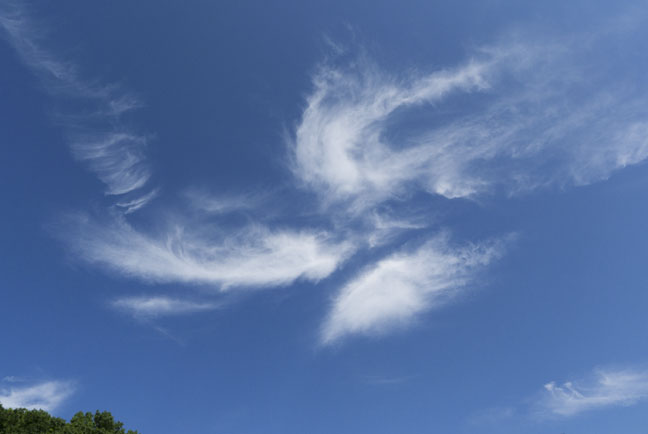
I watch for clouds. When I notice them tumbling overhead, I seek out open spaces where I can see the drama unfold. Today a brisk westerly wind whips them up. I’ve been eager for an excuse to revisit the troubled Kinnickinnic River. On my way there I crane my neck to see through the car windows. Cumulus, billowing and wrestling, converge on torn patches of blue sky.

By the time I reach the KK Parkway gray clouds have overcome the blue. It is completely overcast; gloomy.  Disappointed but unfazed, I head down the concrete slope into the KK channel, where gloomy seems an appropriate mood.


Last week I kayaked down the Milwaukee River. (Read my previous post.) The KK River repels as romantic nonsense any notion of setting a boat into it. This river repels even the notion of “river.” It appears more like an empty freeway with a watery median.

What kind of society paves its rivers?

To slightly alter one of my favorite lines from an old song by Paul Simon, “I’d rather be a river than a street….”  So, now and then, I step off the concrete “pavement” into the channel. The chorus concludes, “I’d rather sail away, like a Swan that’s here and gone….” But I am determined. I continue down the much-abused river.


Within fifteen minutes the clouds have dissipated. Shredded remnants are a theatrical backdrop for the river of concrete. The resurgent sun lightens my mood as well as the surroundings.

I rarely go out without my camera, which is probably my loss. Mostly I acquire a lot of pictures that fill up an enormous amount of space on my hard drives. What I risk losing is the freedom to experience my surroundings aimlessly, purely.

Thoreau wrote, “Our moments of inspiration are not lost though we have no particular poem to show for them; for those experiences have left an indelible impression….” (Substitute “photo” for “poem.”) The Kinnickinnic River, with its relentless concrete, leaves an indelible impression.

I am glad for my camera today. The abased river is rich with imagery and metaphor.


I come to a wall built during the Civilian Conservation Corps era. The meticulous craftsmanship of its construction is still evident despite the depredations of time and erosion. Vines dangle over it and in places trees burst through the carefully laid stones, as if mocking our puny efforts to control natural forces, raging rivers, erosion. Even a walk along a concrete river can provide a lesson in humility. Who are we to wall in a river?


Adding insult to injury, the steel ramparts of a railroad bridge are defiled with layers of graffiti. One particular tag is compellingly ironic: boldly, the word JOKE vanquishes previous tags, for now. The question goes begging: on who is the joke? Trailing vines swing in the breeze, emphasizing how inert the JOKE really is.


A variegated shaft of sunlight slashes across the warring layers of graffiti underneath the bridge. There is no victor here. But! Farther on….

Grass ruptures concrete. The leaves of emergent bushes burst through, spill out like an organic solvent for human arrogance. Trees rise from the paved river. An ovation of clouds rises to applaud the transfiguration.


The Kinnickinnic, identified as one of the “most endangered” rivers in the country, is nothing to celebrate. The penetration of concrete by blades of grass, while marvelous, does not constitute redemption. And yet…!

I arrived in gloom; but the clouds have lifted and so have my spirits. There is hope. The ruptured concrete may be a symbol of a new awareness. Not far downstream machinery is poised to remove the concrete channel from a section of the KK and reconfigure a more natural river. The concrete channel is not ordained. Let us be like the humble grass.

We can be a society that unpaves its rivers. But it is in ourselves that change must happen.

I leave the concrete river, satisfied that I have managed to arrest the flow of time and the river with a few photographs, but challenged by Thoreau once again:

“It is something to be able to paint a particular picture, or to carve a statue, and so to make a few objects beautiful, but it is more glorious to carve and paint the very atmosphere and medium through which we look, which morally we can do. To affect the quality of the day, that is the highest of arts. We are tasked to make our lives, even in their details, worthy of the contemplation of our most elevated and critical hour.”


Monday, August 1, 2011

Meditations on the Milwaukee River Greenway


Twelve kayaks put in below the dam in Kletsch Park in Glendale. The rain-swollen river pours over the dam like water from a tipped bucket that never empties.  Our progress is swift. Without lifting a paddle we can drift and daydream. Welcome to my daydream.

Richard Louv suggests that technology and nature are not incompatible, but “the more high-tech our lives become, the more nature we need to achieve a natural balance.” I’ve left my cell phone behind, but not my camera. To each their own technologies. Balance, too, is up to each of us.

There are few places on earth with an abundance of fresh water. The danger of abundance is a tendency to take the resource for granted; perhaps to fail to protect it. Milwaukee, part of the Great Lakes watershed, is particularly fortunate. Drifting, my mind fills with the grace of abundance.

It is Friday, a workday; lawn chairs poised to enjoy river views sit empty and silent.  The day, warm and bright, reminds me of a line from Leonard Cohen’s song, Suzanne: “the sun shone down like honey…”


Canada geese preen themselves on stones near the shore. I slide slowly towards one who nonchalantly continues its regimen of grooming until I am so near I could wack it with my paddle. (Indeed, this species is often considered a pest and others might have been tempted to do so.)


We round a sharp bend to where the river parallels the forbidding barrier along I-43. The tranquility of our idyll is disturbed by the sound of unseen traffic. A famous line comes to mind from Frost’s poem, Mending Wall: “Something there is that doesn't love a wall, that wants it down…”


Serenity returns when the river veers into Lincoln Park. The river divides into two channels around an island. Our guide, Jeanne, cautions us to keep to the right, which only serves to whet my curiosity: what would I find if I go to the left? Had I been alone, I might have tried it, but, conditioned as I am by my years of teaching, I dutifully follow the group.


Purple loosestrife grows rampant on the muddy floodplain exposed when the Estabrook Dam was opened a couple years back. Ironic, perhaps: an invasive species floods in where an invasive dam once held back the water. Something there is that doesn't love a dam, that wants it down…


We drift with the current, under a synchronicity of clouds.


I am stupefied, unable to conjure a clever caption. Robert Michael Pyle asks, “What happens to a species that loses touch with its habitat?”


On the freeway a river of cars, nearly as incessant as water, speeds over the Milwaukee River.

We portage around the dam, the proposed removal of which has generated so much heated debate. Frost’s poem returns to haunt me: neither walls nor dams make good neighbors.

We also portage around the falls in Estabrook Park. Four teenage boys in the flood-swollen river use the dangerous cataract as a waterslide. The cell phone comes in handy. We drift on. We can only hope that the police will arrive before tragedy befalls the foolish. 

Buddhism teaches us to be mindful. Mindfulness is not disengagement but its opposite. It is thoughtlessness that allows us to fritter away the earth’s abundance – or to sit idly by and see it frittered away, doing nothing to prevent it.


Below the Capitol Drive bridge we enter my favorite stretch of the Greenway. In the kayak, in the middle of the channel, the last remaining tower slowly disappears behind the tree line. With it goes the feeling of being in the city. My imagination is set completely at ease. 

The elusive feeling of wildness resolves itself and I welcome it. 


Still adrift, still moving buoyantly forward, I raise my eyes skyward, filled with enchantment.


I have long been inspired by Thoreau’s famous words, “In wildness is the preservation of the world.” I don’t believe it diminishes Thoreau to agree with Mike Houck, director of the Urban Greenspaces Institute in Portland, OR, who updates that for the twenty-first century: “In livable cities is the preservation of the wild.”


After three hours, twelve kayaks pull up on the bank at Riverside Park, below the Urban Ecology Center, which organized our excursion into the urban wilderness.


In a new book called Urban Green, Peter Harnik says “…parks are on the public’s agenda” and “…cities are vying with one another for ‘the best park system’ and the ‘livability crown’….” He mentions New York, Philadelphia, Washington, Seattle, and even Detroit as examples. Why not Milwaukee? Where are Milwaukee’s cheerleaders when it comes to promoting the virtues of our gold medal park system?

Tuesday, July 26, 2011

Scientists study evolution in New York City


“Evolution is one of life’s constants. New species emerge; old ones become extinct. Environmental changes have often steered evolution in new directions. And modern cities like New York have brought particularly swift changes to the environment.”

And so, according to this fascinating article in the New York Times, scientists have begun studying evolution in some of the most unlikely of places, including the medians that divide traffic lanes on busy streets.

Like studying evolution anywhere, the work isn’t always easy. However, the complications in an urban setting tend to be somewhat different than in, say, the Amazon rainforests: “We get police called on us a lot,” said Dr. Munshi-South, an assistant professor at Baruch College. “Sometimes with guns drawn.”

Some of the equipment they use gets mistaken for drug paraphernalia, too.

“…Urban evolution is attracting more research these days, because cities are fast-growing, and the urban environment is quickly taking over large areas of the Earth’s surface.”

The issue of invasive species is another constant in evolutionary studies. This article offers an unusual perspective: “As the invaders adapted to New York, they put extra pressure on native species, competing with them for space and food. In the Brooklyn Botanic Garden, for instance, American bittersweet vines are dwindling away, outcompeted by Oriental bittersweet. At the same time, the two species are interbreeding, producing hybrids. “It’s a double-whammy,” said James D. Lewis, a plant ecologist at Fordham University.”

Check it out: Evolution Right Under Our Noses.


Saturday, July 23, 2011

Underwood Creek: good, bad, and ugly?


Underwood Creek has long been a troubled waterway. Much of it was channelized in the 1960’s, as is most dramatically evident in this view west from 115th Street in Wauwatosa. Now Waukesha  wants to dump its (treated) wastewater into Underwood Creek – from whence it would flow into the Menomonee River.


If you’ve been following this issue you know that the diversion of Lake Michigan water over the boundary of the Great Lakes watershed has been highly controversial. Although the Wisconsin DNR recently approved the application process, allowing it to move forward, the decision still must be ratified by the governors of all states (and provinces) that border on the Great Lakes, in accord with the Great Lakes Compact.

I urge everyone to attend one of three public hearings that have been scheduled for southeastern Wisconsin to give the DNR a chance to provide an overview of this process.

One of the public hearings is at 5:30 on Wednesday, July 27, at Hart Park in Wauwatosa.

The other two are in Pewaukee (July 26) and Sturtevant (July 28). For much more information about the issue and all three public hearings, go to Milwaukee Riverkeeper.


As part of the Milwaukee Metropolitan Sewerage District’s flood management project, a lot of time, effort, and money have gone into removing a section of the concrete channel from Underwood Creek. The benefits of this are far more than aesthetic. This photo shows part of that work in progress in 2010. What will happen to all of this when the extra wastewater from Waukesha in thrown into the mix? I hope the public hearing will shed some light on that and many other questions.
Other things are happening along Underwood Creek. On the plus side, I recently biked underneath Bluemound Road on the Oak Leaf Trail for the first time – a huge improvement, as anyone who frequents this popular bike path can attest. As this photo shows, there is still some work to be done before the new path is completely connected on either side of Bluemound. 
On the unfortunate and ironic side, a section of Underwood Parkway, near Watertown Plank Road, is being repaved. I’m all for new pavement. This parkway has been getting progressively worse for many years. But why are they putting in curbs?
Progressive streetscaping uses swales instead of curbs. Swales are gently sloping ditches that allow stormwater to soak into the ground instead of running along the curb and into a sewer pipe. They are a perfect solution for a roadway like the parkway. How much taxpayer money has gone into flood management on both sides of this parkway, along Underwood Creek and in the County Grounds? But now we’re putting in new curbs and sewers to carry off stormwater instead of inexpensive swales?

Monday, July 18, 2011

Chicago wilderness sustains an abundance of life – human included!


I’ve never been able to get so close to a great blue heron before – not without startling it into rapid retreat. I had been strolling along the bank of the Chicago River in the shade of the dense hardwood forest canopy. I came to a clearing where the slant of the evening light shone like a spotlight on the opposite bank. My attention was drawn by the dramatically splayed skeletal roots of a long dead stump and the symmetry of its mirrored image on the water.


I made my way incautiously towards the point on the bank opposite it to frame a good shot of the stump. I set up my tripod and looked through the viewfinder. Only then did I notice the heron perched on a log off to the side, motionless and perfectly camouflaged against the exposed earth and tangle of roots on the deeply eroded bank.
 

I was stunned. Not by the heron’s presence; I see them frequently along urban rivers. The surprise was that it remained there, so still and poised, focused on its quarry below the surface, after I wandered carelessly into its field of view. An ancient bird, the great blue heron has adapted well to habitats altered by human development. However, unlike some other species, it has not grown accustomed to humans themselves and nearly always flies at the slightest intrusion. 


Perhaps its lack of fear was a result of immaturity. The slate gray of a full-grown heron was still mottled with shades of brown and white, indicating this bird’s relative youth. I waited patiently for it to fly off and provide a picturesque moment. It didn’t. Finally, I waved. It looked up at me and then back at the water. Nearing exasperation, I threw a stick. The rippling water fractured its slender reflection but the bird remained imperturbable. Two men jogging on the bank above yelled back and forth to one another. As their colorful outfits flashed by there was no reaction from the heron.

Finally, for no apparent reason, it slid gracefully off its log and sailed away – just after I’d given up and lifted my camera from the tripod, missing the shot. 


Later, as I rounded a bend and beheld the idyllic scene ahead another heron, larger and grayer, disappeared with more characteristic alacrity, proving the rule that had made my first encounter so surprising.

 
I saw many deer. There are always deer. The whitetail is common enough to be a nuisance. Two does shepherded two tiny dappled fawns as they foraged across the river. Elsewhere, two young bucks with velvet antlers allowed me to get even closer than the heron, without an intervening river. But the self-assured poise of the deer was not surprising; they had little to fear from me and clearly knew it.

I was alone with the animals for quite a while.  But when I came to rail line turned recreational trail that bridged the river I found a refreshingly diverse, steady stream of people using it. I noted two joggers, a cyclist, two young mothers pushing strollers, a dog walker, several solitary amblers, and a trio of shirtless Hispanic teens in thigh-hugging baggy pants and exposed boxers. All were enjoying a tiny green space wedged between Chicago’s urban grid and a curve of the Edens Expressway.


I crossed the old railroad span – staying well away from the edge without any railing! Through the trees ahead I spied a field full of soccer players. I was reminded of Richard Louv’s book, “The Nature Principle,” in which he insists not only that everyone needs the tonic of wildness to maintain wholeness and mental health but also that we who already love the parks need to understand the cultural and preferential differences of others who use parklands and the various needs that they satisfy.


On the other hand, there must be limits to tolerance, including abuse of the natural resources themselves. I wasn’t bothered by the graffiti, since some unwritten but welcome code confined it to the concrete of the bridge abutments. 


At the start of my little excursion I had passed the incongruously placed grate that provides access for one of Chicago’s extensive system of stormwater tunnels. Randomly interspersed around the same meadow were small patches of grass that appeared to have been burned. Returning through the meadow by a different route on my way back to my car the mystery was solved when I came across the sulfurous remains of someone’s impressive arsenal of fireworks.


It is easy to decry the destruction caused by unsupervised explosions. The stormwater tunnel, which stores raw sewage during storms for later treatment, represents ecological impacts of human development on a scale that are much harder to fathom. The urban wilderness, always a place rife with paradox, reveals challenges while it provides opportunities.

"I am glad I shall never be young without wild country to be young in. Of what avail are forty freedoms without a blank spot on the map?" These lines of Aldo Leopold’s are often quoted. I’ve quoted them before myself. Sadly, more and more young people grow up far from the truly wild areas to which Leopold was referring. On the brighter side, more and more people, young and old, like the ones I was seeing here, are realizing the virtues of what Louv calls “nearby nature” and are making efforts to experience the freedoms it provides without leaving the city they live in.


I did a Google map search to find this park, which is called LaBagh Woods, before I came down from Milwaukee. I do that whenever I plan to travel and expect to have a little free time for exploring. When set to “map” mode the green areas on a Google map look remarkably like “blank spots on the map.” Clicking on “satellite” mode reveals the lush textures of woodland canopies that, for so many of us who live in cities, can and must be a substitute for Leopold’s vision.
 

Friday, July 15, 2011

Biography of Olmsted reviewed

A new biography of Frederick Law Olmsted by Justin Martin is called Genius of Place: The Life of Frederick Law Olmsted. Michael Lewis has written a thoughtful review of it on his blog.

Thursday, July 14, 2011

Barb Agnew gets recognition in Wisconsin Trails blog

Barb Agnew is probably familiar to regular readers of Urban Wilderness, but in case you don't know who she is, she is the Barb in Barb and Dick's Wildflowers, a lovely flower shop on the western fringe of Wauwatosa. She is also the founder of the Friends of the Monarch Trail and indefatigable defender of the Milwaukee County Grounds, which is where the Trail is located.

She is the subject of a nice, and well-deserved, write up on the Wisconsin Trails blog. It comes with a few nice slides of her and her beloved butterflies.